Proportion / Ratio / Rate - PSAT Math
Card 1 of 574
To ship a package, the postal service charges  for the first 150 grams and
  for each additional 50 grams or part thereof. What is one possible weight in grams for a package that costs
  to ship?
To ship a package, the postal service charges
Tap to reveal answer
The weight will be 150 grams + (1.15 – 0.55)/0.05 * 50g.
You need to subtract first 150 grams cost from the total cost and divide by the price per unit to determine how many units. Next, multiply units by weight per unit and add to the original first 150 grams.
150 + 600 = 750 grams
This is the maximum weight that can be sent at that price; the minimum weight that could be charged this price would be 701 grams. Hence a package weighing 750 grams will be charged $1.15.
The weight will be 150 grams + (1.15 – 0.55)/0.05 * 50g.
You need to subtract first 150 grams cost from the total cost and divide by the price per unit to determine how many units. Next, multiply units by weight per unit and add to the original first 150 grams.
150 + 600 = 750 grams
This is the maximum weight that can be sent at that price; the minimum weight that could be charged this price would be 701 grams. Hence a package weighing 750 grams will be charged $1.15.
← Didn't Know|Knew It →
The price of 10 yards of fabric is c cents, and each yard makes q quilts. In terms of _q_and c, what is the cost, in cents, of the fabric required to make 1 quilt?
The price of 10 yards of fabric is c cents, and each yard makes q quilts. In terms of _q_and c, what is the cost, in cents, of the fabric required to make 1 quilt?
Tap to reveal answer
We create a conversion ratio that causes yards to cancel out, leaving only cents in the numerator and quilts in the denominator. This ratio is ((c cent )/(10 yard))((1 yard)/(q quilt))=(c )/(10q ) cent⁄quilt . Since the ratio has cents in the numerator and quilts in the denominator, it represents the price in cents per quilt.
We create a conversion ratio that causes yards to cancel out, leaving only cents in the numerator and quilts in the denominator. This ratio is ((c cent )/(10 yard))((1 yard)/(q quilt))=(c )/(10q ) cent⁄quilt . Since the ratio has cents in the numerator and quilts in the denominator, it represents the price in cents per quilt.
← Didn't Know|Knew It →
Susan is doing a bake sale for her sorority. One third of the money she made is from blueberry cupcakes, which cost 50 cents each. A quarter of her sales is from cinnamon cream pies, which cost $1 each. And the rest are from her chocolate brownies, which cost 25 cents each. She made a total of $60 at the end of her bake sale, how many brownies did she sell?
Susan is doing a bake sale for her sorority. One third of the money she made is from blueberry cupcakes, which cost 50 cents each. A quarter of her sales is from cinnamon cream pies, which cost $1 each. And the rest are from her chocolate brownies, which cost 25 cents each. She made a total of $60 at the end of her bake sale, how many brownies did she sell?
Tap to reveal answer
1/3 of sales from cupcakes = $20, ¼ of sales from cream pies = $15 and the rest are from brownies = $60-$20-$15 = $25. Since each brownie costs 25 cents, Susan will have sold 100 of them.
1/3 of sales from cupcakes = $20, ¼ of sales from cream pies = $15 and the rest are from brownies = $60-$20-$15 = $25. Since each brownie costs 25 cents, Susan will have sold 100 of them.
← Didn't Know|Knew It →
In 7 years Bill will be twice Amy’s age. Amy was 1.5 times Molly’s age 2 years ago. If Bill is 29 how old is Molly?
In 7 years Bill will be twice Amy’s age. Amy was 1.5 times Molly’s age 2 years ago. If Bill is 29 how old is Molly?
Tap to reveal answer
Consider
(Bill + 7) = 2 x (Amy + 7)
(Amy – 2) = 1.5 x (Molly – 2)
Solve for Molly using the two equations by finding Amy’s age in terms of Molly’s age.
Amy = 2 + 1.5 Molly – 3 = 1.5 x Molly – 1
Substitute this into the first equation:
(Bill + 7) = 2 x (Amy + 7) = 2 x (1.5 x Molly – 1 + 7) = 2 x (1.5 x Molly + 6) = 3 x Molly + 12
Solve for Molly:
Bill + 7 – 12 = 3 x Molly
Molly = (Bill – 5) ¸ 3
Substitute Bill = 29
Molly = (Bill – 5) ¸ 3 = 8
Consider
(Bill + 7) = 2 x (Amy + 7)
(Amy – 2) = 1.5 x (Molly – 2)
Solve for Molly using the two equations by finding Amy’s age in terms of Molly’s age.
Amy = 2 + 1.5 Molly – 3 = 1.5 x Molly – 1
Substitute this into the first equation:
(Bill + 7) = 2 x (Amy + 7) = 2 x (1.5 x Molly – 1 + 7) = 2 x (1.5 x Molly + 6) = 3 x Molly + 12
Solve for Molly:
Bill + 7 – 12 = 3 x Molly
Molly = (Bill – 5) ¸ 3
Substitute Bill = 29
Molly = (Bill – 5) ¸ 3 = 8
← Didn't Know|Knew It →
When Christina opens a bag of white and milk chocolate pieces, 20% of the chocolate pieces are white. After Christina eats 10 milk chocolate pieces, the ratio of brown chocolate to white chocolate is 2 to 3. How many pieces of chocolate are left in the bag?
When Christina opens a bag of white and milk chocolate pieces, 20% of the chocolate pieces are white. After Christina eats 10 milk chocolate pieces, the ratio of brown chocolate to white chocolate is 2 to 3. How many pieces of chocolate are left in the bag?
Tap to reveal answer
Let original white chocolate pieces = W and original milk chocolate pieces = M. So the total number of pieces in the original bag is M + W.
From the first sentence: (M + W) x 0.2 = W or
0.2 M = 0.8 W or \[M = 4W\]
Once Christina has eaten 10 milk chocolate pieces, there are W pieces of white chocolate, (M – 10) pieces of milk chocolate and (M + W – 10) pieces total. According to the second sentence:
W ¸ (M – 10) = 3 ¸ 2
Or 2W = 3M - 30
Insert the equation in brackets: 2W = 3\[4W\] + 30 = 12W – 30
10W = 30 or W = 3 and M = 12
We want “How many pieces of chocolate are left in the bag” or (M – W – 10).
So (M +W – 10) = 3 + 12 – 10 = 5
Let original white chocolate pieces = W and original milk chocolate pieces = M. So the total number of pieces in the original bag is M + W.
From the first sentence: (M + W) x 0.2 = W or
0.2 M = 0.8 W or \[M = 4W\]
Once Christina has eaten 10 milk chocolate pieces, there are W pieces of white chocolate, (M – 10) pieces of milk chocolate and (M + W – 10) pieces total. According to the second sentence:
W ¸ (M – 10) = 3 ¸ 2
Or 2W = 3M - 30
Insert the equation in brackets: 2W = 3\[4W\] + 30 = 12W – 30
10W = 30 or W = 3 and M = 12
We want “How many pieces of chocolate are left in the bag” or (M – W – 10).
So (M +W – 10) = 3 + 12 – 10 = 5
← Didn't Know|Knew It →
You are buying a new car. The car gets 33 miles per gallon in the city and 39 miles per gallon on the highway. You plan on driving 30,000 miles over three years and 10,000 of that will be city driving. If gas costs $3.50 per gallon, how much will you pay in gas over the three year period (round to the nearest cent)?
You are buying a new car. The car gets 33 miles per gallon in the city and 39 miles per gallon on the highway. You plan on driving 30,000 miles over three years and 10,000 of that will be city driving. If gas costs $3.50 per gallon, how much will you pay in gas over the three year period (round to the nearest cent)?
Tap to reveal answer
Cost = ( Miles driven / Miles per gallon) * 3.50
Total Mileage = City Miles + Highway Miles
30,000 = 10,000 + Highway Miles
Highway Miles = 20,000
Cost City = ( 10,000 miles / 33 miles per gallon ) * 3.50
Cost City = 303.03 * $3.50 = $1060.60
Cost Highway = ( 20,000 miles / 39 miles per gallon ) * 3.50
Cost Highway = 512.82 * $3.50 = $1794.87
Total Cost = Cost City + Cost Highway = $1060.60 + $1794.87 = $2855.47
Cost = ( Miles driven / Miles per gallon) * 3.50
Total Mileage = City Miles + Highway Miles
30,000 = 10,000 + Highway Miles
Highway Miles = 20,000
Cost City = ( 10,000 miles / 33 miles per gallon ) * 3.50
Cost City = 303.03 * $3.50 = $1060.60
Cost Highway = ( 20,000 miles / 39 miles per gallon ) * 3.50
Cost Highway = 512.82 * $3.50 = $1794.87
Total Cost = Cost City + Cost Highway = $1060.60 + $1794.87 = $2855.47
← Didn't Know|Knew It →
A class room of 8th graders is 1/3 boys. Of all the students 4/5 of them are aged 14 while the others are aged 13. If there are 20 girls in the class, approximately how many boys are age 13?
A class room of 8th graders is 1/3 boys. Of all the students 4/5 of them are aged 14 while the others are aged 13. If there are 20 girls in the class, approximately how many boys are age 13?
Tap to reveal answer
If 20 students are girls, this is 2/3 of the class, giving 30 students total with 10 of them being boys. 4/5 of the boys will be 14, leaving 1/5 of the boys age 13. 1/5 of 10 is 2.
If 20 students are girls, this is 2/3 of the class, giving 30 students total with 10 of them being boys. 4/5 of the boys will be 14, leaving 1/5 of the boys age 13. 1/5 of 10 is 2.
← Didn't Know|Knew It →
x and y are integers such that x > 0 and y > 0 .
12x + 3y = 176,500.
Quantity A: The maximum possible value of x
Quantity B: The maximum possible value of y
x and y are integers such that x > 0 and y > 0 .
12x + 3y = 176,500.
Quantity A: The maximum possible value of x
Quantity B: The maximum possible value of y
Tap to reveal answer
Note that it is not necessary to find the solution to this problem. Thus, find an expression for x and an expression for y at their maximums and compare.
First, observe from the equation that x gets smaller as y gets bigger and y gets smaller as y gets bigger. This can be found by making the equation in the form (y = mx + b) and finding that m is negative. Thus there is a negative correlation between x and y.
Therefore at its maximum, x is such that y = 0. In other words,
x = 176,500 / 12
y is maximum when x = 0. In other words,
y = 176,500 / 3
Note that 176,500 / 3 > 176,500 / 12 because the denominator is smaller.
Note that it is not necessary to find the solution to this problem. Thus, find an expression for x and an expression for y at their maximums and compare.
First, observe from the equation that x gets smaller as y gets bigger and y gets smaller as y gets bigger. This can be found by making the equation in the form (y = mx + b) and finding that m is negative. Thus there is a negative correlation between x and y.
Therefore at its maximum, x is such that y = 0. In other words,
x = 176,500 / 12
y is maximum when x = 0. In other words,
y = 176,500 / 3
Note that 176,500 / 3 > 176,500 / 12 because the denominator is smaller.
← Didn't Know|Knew It →
If 1015 meters = 1 petameter and 1018 meters = 1 exameter, how many petameters are equal to 1 exameter?
If 1015 meters = 1 petameter and 1018 meters = 1 exameter, how many petameters are equal to 1 exameter?
Tap to reveal answer
The problem gives us two conversion ratios, which are (1018 meters/ 1 exameter) and (1 petameter/ 1015 meters).
We convert 1 exameter into petameters by multiplying 1 exameter by the conversion ratios so that all units other than petameters cancel out: 1 exameter * (1018 meters/ 1 exameter) * (1 petameter/ 1015 meters). Therefore one exameter is 1018/1015 petameters. Finally, when dividing terms with common bases, we subtract the exponents, so our result is 1018/1015 = 103 = 1000.
The problem gives us two conversion ratios, which are (1018 meters/ 1 exameter) and (1 petameter/ 1015 meters).
We convert 1 exameter into petameters by multiplying 1 exameter by the conversion ratios so that all units other than petameters cancel out: 1 exameter * (1018 meters/ 1 exameter) * (1 petameter/ 1015 meters). Therefore one exameter is 1018/1015 petameters. Finally, when dividing terms with common bases, we subtract the exponents, so our result is 1018/1015 = 103 = 1000.
← Didn't Know|Knew It →
If Shaquille O'Neal is 7 feet tall and casts a shadow 5 feet long. At the same time of day, how long would the shadow be from a 49-foot tall house?
If Shaquille O'Neal is 7 feet tall and casts a shadow 5 feet long. At the same time of day, how long would the shadow be from a 49-foot tall house?
Tap to reveal answer
The question is about similar triangles. The height of the two objects would correspond with each other and the shadows would correspond with each other. As with many geometry problems, it is helpful if you draw a diagram. Set up a proportion for each so the height of Shaquille O'Neal to the height of the house then his shadow to the shadow of the house.
7/49 = 5/x
Solve for x by cross-multiplying:
5 * 49 = 7x
x = 35
The question is about similar triangles. The height of the two objects would correspond with each other and the shadows would correspond with each other. As with many geometry problems, it is helpful if you draw a diagram. Set up a proportion for each so the height of Shaquille O'Neal to the height of the house then his shadow to the shadow of the house.
7/49 = 5/x
Solve for x by cross-multiplying:
5 * 49 = 7x
x = 35
← Didn't Know|Knew It →
John is 35 years old, 5 years older than his brother Bob and 20 years younger than his father Jack. How old was Jack when Bob was born?
John is 35 years old, 5 years older than his brother Bob and 20 years younger than his father Jack. How old was Jack when Bob was born?
Tap to reveal answer
If John is 35, that means currently Jack is 55 and Bob is 30. 55 – 30 = 25 years old when Bob was born.
If John is 35, that means currently Jack is 55 and Bob is 30. 55 – 30 = 25 years old when Bob was born.
← Didn't Know|Knew It →
In a mixture of flour and sugar, the ratio of flour to sugar is 5 to 1. How many kilograms of flour will there be in 12 kilograms of this mixture?
In a mixture of flour and sugar, the ratio of flour to sugar is 5 to 1. How many kilograms of flour will there be in 12 kilograms of this mixture?
Tap to reveal answer
The question says that the mixture has 5 units of flour for every 1 unit of sugar, which adds up to a total of 5 + 1 = 6 units of the mixture; therefore in 6 kilograms of the mixture, 1 kilogram will be sugar.
To find how much sugar will be in 12 kilograms of the mixture, we multiply the amount of sugar in 6 kilograms of the mixture by 2, giving us 1 kilogram of sugar * 2 = 2 kilograms of sugar.
The question says that the mixture has 5 units of flour for every 1 unit of sugar, which adds up to a total of 5 + 1 = 6 units of the mixture; therefore in 6 kilograms of the mixture, 1 kilogram will be sugar.
To find how much sugar will be in 12 kilograms of the mixture, we multiply the amount of sugar in 6 kilograms of the mixture by 2, giving us 1 kilogram of sugar * 2 = 2 kilograms of sugar.
← Didn't Know|Knew It →
A survey of studio offices in a city with 14,000 employees reveals that there are, on average, 12.5 employees per office. If there have been a cumulative total of 3,400 printers sold to the offices of the city, what is the best estimate of the average number of printers per office?
A survey of studio offices in a city with 14,000 employees reveals that there are, on average, 12.5 employees per office. If there have been a cumulative total of 3,400 printers sold to the offices of the city, what is the best estimate of the average number of printers per office?
Tap to reveal answer
The best estimate would be to simply divide the number of printers by the number of offices. However, they only gave us the average number of employees per office, thus to find the number of offices we divide:
14,000 (people)/12.5 (per office) = 14,000/12.5 = 1,120 offices
We already know the number of printers available total, thus again divide
3,400 (printers)/1,120 (offices) = 3.04, or 3.0 printers per office as the best estimate.
The best estimate would be to simply divide the number of printers by the number of offices. However, they only gave us the average number of employees per office, thus to find the number of offices we divide:
14,000 (people)/12.5 (per office) = 14,000/12.5 = 1,120 offices
We already know the number of printers available total, thus again divide
3,400 (printers)/1,120 (offices) = 3.04, or 3.0 printers per office as the best estimate.
← Didn't Know|Knew It →
A factory makes six widgets in a batch that takes 24 minutes to complete. How long does it take to make 57 widgets?
A factory makes six widgets in a batch that takes 24 minutes to complete. How long does it take to make 57 widgets?
Tap to reveal answer
We have here a basic ratio:
6/24 = 57/x
Solving for x, we get: 6x = 24 * 57; 6x = 1368; x = 228
Now, we must be very careful here, however. Is 228 an even multiple of 24? 228/24 = 9.5. That means that we would have to do 9.5 batches. The question indicates that these are batched in groups of 6; therefore, we have to run 10 batches to get our amount. That would be 240 minutes or 4 hours.
We have here a basic ratio:
6/24 = 57/x
Solving for x, we get: 6x = 24 * 57; 6x = 1368; x = 228
Now, we must be very careful here, however. Is 228 an even multiple of 24? 228/24 = 9.5. That means that we would have to do 9.5 batches. The question indicates that these are batched in groups of 6; therefore, we have to run 10 batches to get our amount. That would be 240 minutes or 4 hours.
← Didn't Know|Knew It →
Kendall can run 26 miles in 4 hours and 20 minutes. At this rate how long would it take him to run 100 miles?
Kendall can run 26 miles in 4 hours and 20 minutes. At this rate how long would it take him to run 100 miles?
Tap to reveal answer
Set up a proportion and conver 4 hours and 20 minutes into just minutes for now,
so 26/260 = 100/X
Solve for X = 1000 minutes
1000/60 = 16 hours and 40 minutes
Set up a proportion and conver 4 hours and 20 minutes into just minutes for now,
so 26/260 = 100/X
Solve for X = 1000 minutes
1000/60 = 16 hours and 40 minutes
← Didn't Know|Knew It →
Out of 85 students in a certain class, 42 own a laptop and 54 own an mp3 player. If 5 students don't own either, what fraction of the students own both a laptop and an mp3 player?
Out of 85 students in a certain class, 42 own a laptop and 54 own an mp3 player. If 5 students don't own either, what fraction of the students own both a laptop and an mp3 player?
Tap to reveal answer
Once you subtract the 5 students that don't own either, there are 80 students left.
There's 96 total students when you add the number that own an mp3 and the number that own a laptop, meaning 16 own both.
Recall that the fraction will be number of students who have both laptop and mp3 divided by the total students in the class.

Once you subtract the 5 students that don't own either, there are 80 students left.
There's 96 total students when you add the number that own an mp3 and the number that own a laptop, meaning 16 own both.
Recall that the fraction will be number of students who have both laptop and mp3 divided by the total students in the class.
← Didn't Know|Knew It →
A recipe calls for a ratio of  for wheat, barley, and flour. If we have 12 pounds of barley, how much wheat do we need to use all of it?
A recipe calls for a ratio of
Tap to reveal answer
We can set up a ratio of  and then solve for
  .
.
We can set up a ratio of
← Didn't Know|Knew It →
Six is to thirteen-and-a-half as seventeen is to what?
Six is to thirteen-and-a-half as seventeen is to what?
Tap to reveal answer
Let us express this as an algebraic expression:
$\frac{6}{13.5}$=\frac{17}{x}$
We can cross multiply:
6x=13.5times 17
6x=229.5
x=\frac{229.5}{6}$=38.25
Let us express this as an algebraic expression:
$\frac{6}{13.5}$=\frac{17}{x}$
We can cross multiply:
6x=13.5times 17
6x=229.5
x=\frac{229.5}{6}$=38.25
← Didn't Know|Knew It →
A TV show lasts 30 minutes, what fraction of the show is left after 12 minutes have passed?
A TV show lasts 30 minutes, what fraction of the show is left after 12 minutes have passed?
Tap to reveal answer
After watching 12 minutes of the show 18 remain. 18 is 60% of the total 30 minutes. As a fraction it can be expressed as 3/5.
After watching 12 minutes of the show 18 remain. 18 is 60% of the total 30 minutes. As a fraction it can be expressed as 3/5.
← Didn't Know|Knew It →
A bag contains red, orange, and yellow marbles only. The marbles occur in a ratio of 5 red marbles: 4 orange marbles: 1 yellow marble. If one-third of the red marbles, one-half of the orange marbles, and one-fourth of the yellow marbles are removed, then what fraction of the remaining marbles in the bag is red?
A bag contains red, orange, and yellow marbles only. The marbles occur in a ratio of 5 red marbles: 4 orange marbles: 1 yellow marble. If one-third of the red marbles, one-half of the orange marbles, and one-fourth of the yellow marbles are removed, then what fraction of the remaining marbles in the bag is red?
Tap to reveal answer
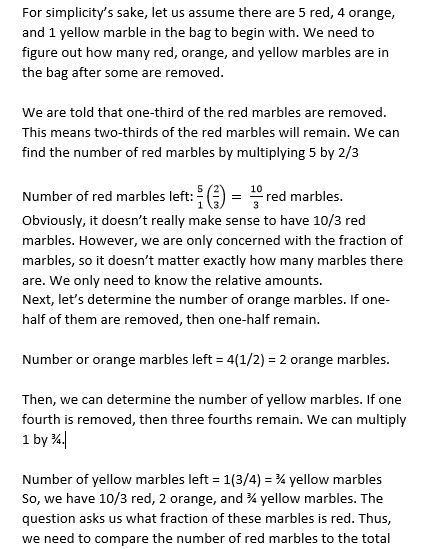
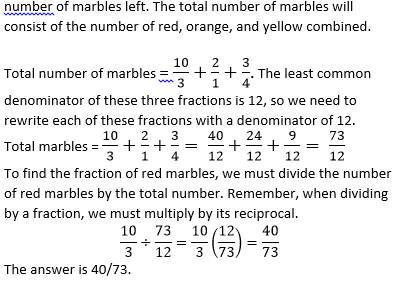
← Didn't Know|Knew It →