Operations with Fractions - PSAT Math
Card 1 of 231
Simplify:

Simplify:
Tap to reveal answer
Division is the same as multiplying by the reciprocal. Thus, a/b ÷ c/d = a/b x d/c = ad/bc
Division is the same as multiplying by the reciprocal. Thus, a/b ÷ c/d = a/b x d/c = ad/bc
← Didn't Know|Knew It →
If p is a positive integer, and 4 is the remainder when p-8 is divided by 5, which of the following could be the value of p?
If p is a positive integer, and 4 is the remainder when p-8 is divided by 5, which of the following could be the value of p?
Tap to reveal answer
Remember that if x has a remainder of 4 when divided by 5, xminus 4 must be divisible by 5. We are therefore looking for a number p such that p - 8 - 4 is divisible by 5. The only answer choice that fits this description is 17.
Remember that if x has a remainder of 4 when divided by 5, xminus 4 must be divisible by 5. We are therefore looking for a number p such that p - 8 - 4 is divisible by 5. The only answer choice that fits this description is 17.
← Didn't Know|Knew It →
If x=\frac{2}{3}$ and y= frac {3}{4}, then what is the value of frac {x}{y}?
If x=\frac{2}{3}$ and y= frac {3}{4}, then what is the value of frac {x}{y}?
Tap to reveal answer
Dividing by a number (in this case frac {3}{4}) is equivalent to multiplying by its reciprocal (in this case frac {4}{3}). Therefore:
frac {2}{3}div $\frac{3}{4}$ = $\frac{2}{3}$times $\frac{4}{3}$ = $\frac{8}{9}$
Dividing by a number (in this case frac {3}{4}) is equivalent to multiplying by its reciprocal (in this case frac {4}{3}). Therefore:
frac {2}{3}div $\frac{3}{4}$ = $\frac{2}{3}$times $\frac{4}{3}$ = $\frac{8}{9}$
← Didn't Know|Knew It →
Evaluate the following:
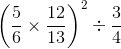
Evaluate the following:
Tap to reveal answer
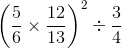
First we will evaluate the terms in the parentheses:
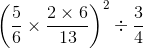
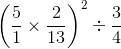

Next, we will square the first fraction:

$\frac{100}{169}$div $\frac{3}{4}$
We can evaluate the division as such:
$\frac{100}{169}$times$\frac{4}{3}$=\frac{400}{507}$
First we will evaluate the terms in the parentheses:
Next, we will square the first fraction:
$\frac{100}{169}$div $\frac{3}{4}$
We can evaluate the division as such:
$\frac{100}{169}$times$\frac{4}{3}$=\frac{400}{507}$
← Didn't Know|Knew It →
Simplify: 
Simplify:
Tap to reveal answer
Start by rewriting this fraction as a division problem:

When dividing fractions, you multiply by the reciprocal of the second fraction, so you can rewrite your problem like this:

Multiply across the numerators and then across the denominators to get  . The x's cancel, and you can reduce the fraction to be
  .
.
Start by rewriting this fraction as a division problem:
When dividing fractions, you multiply by the reciprocal of the second fraction, so you can rewrite your problem like this:
Multiply across the numerators and then across the denominators to get
← Didn't Know|Knew It →
Define an operation  as follows:
For all real numbers  ,
,
 .
.
Evaluate  .
.
Define an operation
For all real numbers
Evaluate
Tap to reveal answer


← Didn't Know|Knew It →
Define an operation  as follows:
For all real numbers  ,
,
 .
.
Evaluate  .
.
Define an operation
For all real numbers
Evaluate
Tap to reveal answer
 ,
,
or, equivalently,


or, equivalently,
← Didn't Know|Knew It →
Define an operation  as follows:
For all real numbers  ,
,
 .
.
Evaluate  .
.
Define an operation
For all real numbers
Evaluate
Tap to reveal answer


← Didn't Know|Knew It →
Define an operation  as follows:
For all real numbers  ,
,
 .
.
Evaluate  .
.
Define an operation
For all real numbers
Evaluate
Tap to reveal answer
 , or, equivalently,


← Didn't Know|Knew It →
Define an operation  as follows:
For all real numbers  ,
,
 .
.
Evaluate  .
.
Define an operation
For all real numbers
Evaluate
Tap to reveal answer
 ,
,
or, equivalently,


From here we need to find a common denominator.


or, equivalently,
From here we need to find a common denominator.
← Didn't Know|Knew It →
Define an operation  as follows:
For all real numbers  ,
,
 .
.
Evaluate  .
.
Define an operation
For all real numbers
Evaluate
Tap to reveal answer

or, equivalently,


or, equivalently,
← Didn't Know|Knew It →
Simplify:

Simplify:
Tap to reveal answer
Begin by simplifying any additions that need to be done:

becomes

Now, remember that the numerator  can be rewritten
  :
:

Now, when you divide fractions, you multiply the numerator by the reciprocal of the denominator:

Cancel the  s and you get:
Begin by simplifying any additions that need to be done:
becomes
Now, remember that the numerator
Now, when you divide fractions, you multiply the numerator by the reciprocal of the denominator:
Cancel the
← Didn't Know|Knew It →
Jesse has a large movie collection containing X movies. 1/3 of his movies are action movies, 3/5 of the remainder are comedies, and the rest are historical movies. How many historical movies does Jesse own?
Jesse has a large movie collection containing X movies. 1/3 of his movies are action movies, 3/5 of the remainder are comedies, and the rest are historical movies. How many historical movies does Jesse own?
Tap to reveal answer
1/3 of the movies are action movies. 3/5 of 2/3 of the movies are comedies, or (3/5)*(2/3), or 6/15. Combining the comedies and the action movies (1/3 or 5/15), we get 11/15 of the movies being either action or comedy. Thus, 4/15 of the movies remain and all of them have to be historical.
1/3 of the movies are action movies. 3/5 of 2/3 of the movies are comedies, or (3/5)*(2/3), or 6/15. Combining the comedies and the action movies (1/3 or 5/15), we get 11/15 of the movies being either action or comedy. Thus, 4/15 of the movies remain and all of them have to be historical.
← Didn't Know|Knew It →
If x = 1/3 and y = 1/2, find the value of 2_x_ + 3_y_.
If x = 1/3 and y = 1/2, find the value of 2_x_ + 3_y_.
Tap to reveal answer
Substitute the values of x and y into the given expression:
2(1/3) + 3(1/2)
= 2/3 + 3/2
= 4/6 + 9/6
= 13/6
Substitute the values of x and y into the given expression:
2(1/3) + 3(1/2)
= 2/3 + 3/2
= 4/6 + 9/6
= 13/6
← Didn't Know|Knew It →
Tap to reveal answer
← Didn't Know|Knew It →
Solve $\frac{3}{7}$+\frac{5}{8}$-$\frac{1}{2}$.
Solve $\frac{3}{7}$+\frac{5}{8}$-$\frac{1}{2}$.
Tap to reveal answer
Finding the common denominator yields $\frac{24}{56}$+\frac{35}{56}$-$\frac{28}{56}$. We can then evaluate leaving $\frac{31}{56}$.
Finding the common denominator yields $\frac{24}{56}$+\frac{35}{56}$-$\frac{28}{56}$. We can then evaluate leaving $\frac{31}{56}$.
← Didn't Know|Knew It →
What is the solution, reduced to its simplest form, for x = $\frac{7}{9}$+\frac{3}{5}$+\frac{2}{15}$+\frac{7}{45}$} ?
What is the solution, reduced to its simplest form, for x = $\frac{7}{9}$+\frac{3}{5}$+\frac{2}{15}$+\frac{7}{45}$} ?
Tap to reveal answer
x=\frac{7}{9}$+\frac{3}{5}$+\frac{2}{15}$+\frac{7}{45}$=\frac{35}{45}$+\frac{27}{45}$+\frac{6}{45}$+\frac{7}{45}$=\frac{75}{45}$=\frac{5}{3}$
x=\frac{7}{9}$+\frac{3}{5}$+\frac{2}{15}$+\frac{7}{45}$=\frac{35}{45}$+\frac{27}{45}$+\frac{6}{45}$+\frac{7}{45}$=\frac{75}{45}$=\frac{5}{3}$
← Didn't Know|Knew It →
What is the sum of  and
and  ?
?
What is the sum of
Tap to reveal answer
We can begin by eliminating the obviously wrong answers. We know that the sum of the two fractions will be more than 1, so the answer choices  and
and  are out. Now, let's add the two fractions:
Begin by converting  to
to  .
.
Now find the common denominator of  and
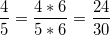
and  . The least common multiple of 5 and 6 is 30, so 30 is the common denominator. Now alter both fractions so that they use the common denominator:
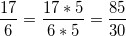
Now we can easily add the two fractions together:
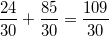
The answer is  .
.
We can begin by eliminating the obviously wrong answers. We know that the sum of the two fractions will be more than 1, so the answer choices
Begin by converting
Now find the common denominator of
Now we can easily add the two fractions together:
The answer is
← Didn't Know|Knew It →
Subtract and simplify the fractions:

Subtract and simplify the fractions:
Tap to reveal answer
First we need to give them common denominators. Remember, whatever you do to the denominator you must do to the numerator:


From here, we do algebraic operations to subtract and simplify.


First we need to give them common denominators. Remember, whatever you do to the denominator you must do to the numerator:
From here, we do algebraic operations to subtract and simplify.
← Didn't Know|Knew It →
Define an operation  as follows:
For all real  ,
,

Evaluate 
Define an operation
For all real
Evaluate
Tap to reveal answer


← Didn't Know|Knew It →