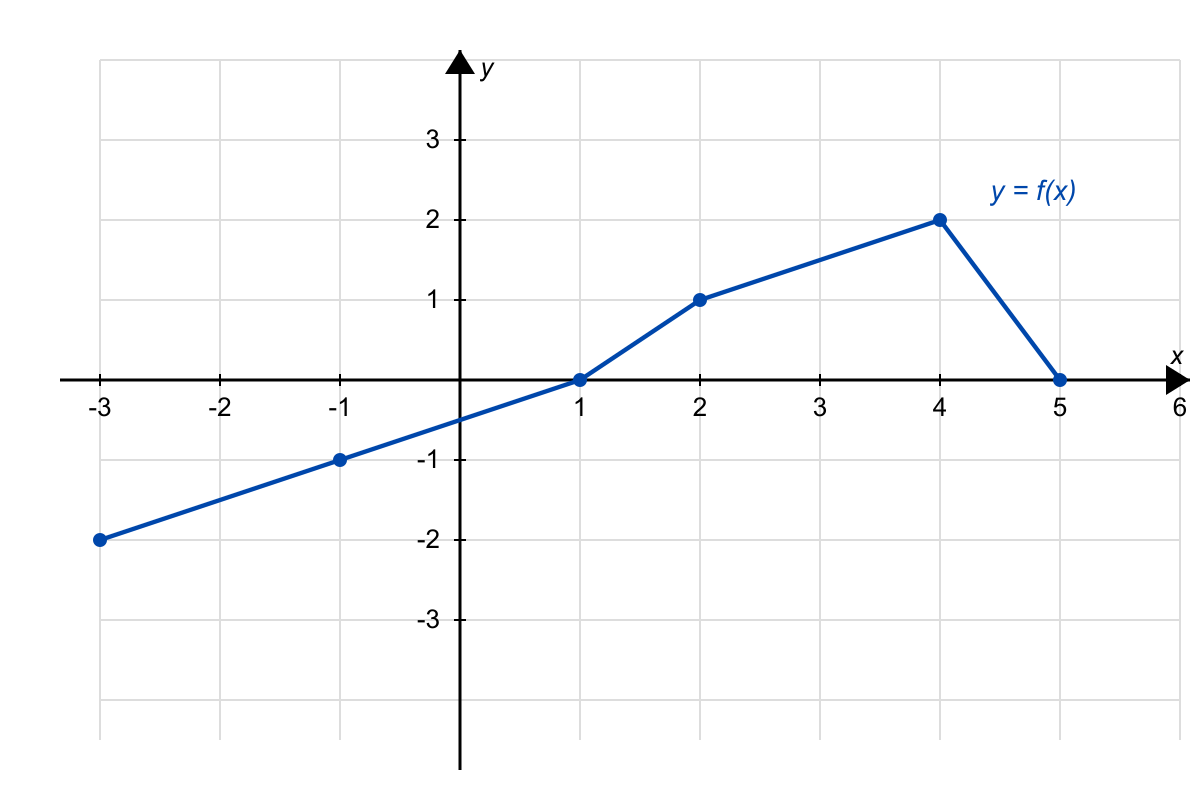
Graphing Functions - PSAT Math
Card 1 of 30
What is the axis of symmetry of $y=a(x-h)^2+k$?
Tap to reveal answer
The vertical line $x=h$. Parabolas are symmetric about the vertical line through the vertex.
← Didn't Know|Knew It →
Identify the vertex of $y=(x-4)^2-7$.
Tap to reveal answer
$(4,-7)$. In vertex form $y=a(x-h)^2+k$, vertex is $(h,k)$.
← Didn't Know|Knew It →
What are the $x$-intercepts of $y=(x-1)(x+4)$?
Tap to reveal answer
$(-4,0)$ and $(1,0)$. Set $y=0$ and solve: $(x-1)(x+4)=0$ gives $x=1$ or $x=-4$.
← Didn't Know|Knew It →
What is the domain of $f(x)=\sqrt{x-5}$?
Tap to reveal answer
$x\ge 5$. Square roots require non-negative inputs: $x-5\ge 0$.
← Didn't Know|Knew It →
What is the $y$-intercept of the line $y=-2x+7$?
Tap to reveal answer
$(0,7)$. Substitute $x=0$: $y=-2(0)+7=7$.
← Didn't Know|Knew It →
What is the location of the vertex of $y=(x-3)^2-5$?
Tap to reveal answer
$(3,-5)$. In vertex form $(x-h)^2+k$, the vertex is at $(h,k)$.
← Didn't Know|Knew It →
Identify the end behavior of $y=x^2$ as $x\to\pm\infty$.
Tap to reveal answer
$y\to\infty$ as $x\to\infty$ and as $x\to-\infty$. The parabola opens upward, so both ends go to infinity.
← Didn't Know|Knew It →
What is the vertex form of a quadratic and what point does it reveal immediately?
Tap to reveal answer
$y=a(x-h)^2+k$; vertex $(h,k)$. The parabola's turning point is at $(h,k)$.
← Didn't Know|Knew It →
What is the range of a function in a graphing context?
Tap to reveal answer
All possible output values $y=f(x)$. The vertical extent of the graph.
← Didn't Know|Knew It →
What is the domain of a function in a graphing context?
Tap to reveal answer
All $x$-values for which $f(x)$ is defined. The horizontal extent of the graph.
← Didn't Know|Knew It →
What are the $x$-intercepts of $y=f(x)$ in terms of an equation you solve?
Tap to reveal answer
Solutions to $f(x)=0$ (points $(x,0)$). Where the graph crosses the $x$-axis, so $y=0$.
← Didn't Know|Knew It →
What is the definition of the graph of a function $y=f(x)$ in the coordinate plane?
Tap to reveal answer
The set of all points $(x,f(x))$ for allowed $x$. Each input $x$ maps to exactly one output point $(x,f(x))$.
← Didn't Know|Knew It →
What is the slope-intercept form of a linear function and what does each parameter represent?
Tap to reveal answer
$y=mx+b$; slope $m$, $y$-intercept $b$. Linear graphs have constant slope $m$ and cross $y$-axis at $(0,b)$.
← Didn't Know|Knew It →
What is the effect on the graph of $y=f(ax)$ when $a>1$?
Tap to reveal answer
Horizontal compression by factor $a$. Multiplying inputs by $a>1$ compresses horizontally.
← Didn't Know|Knew It →
What is the effect on the graph of $y=af(x)$ when $a>1$?
Tap to reveal answer
Vertical stretch by factor $a$. Multiplying outputs by $a>1$ stretches vertically.
← Didn't Know|Knew It →
What is the $y$-intercept of $y=f(x)$ in terms of function notation (when it exists)?
Tap to reveal answer
The point $(0,f(0))$. Found by substituting $x=0$ into the function.
← Didn't Know|Knew It →
What is the vertical line test used to determine when a graph represents $y$ as a function of $x$?
Tap to reveal answer
No vertical line intersects the graph more than once. Functions have only one $y$-value per $x$-value.
← Didn't Know|Knew It →
What is the effect on the graph of $y=f(-x)$?
Tap to reveal answer
Reflection across the $y$-axis. Negating inputs flips the graph over the $y$-axis.
← Didn't Know|Knew It →
What is the effect on the graph of $y=-f(x)$?
Tap to reveal answer
Reflection across the $x$-axis. Negating outputs flips the graph over the $x$-axis.
← Didn't Know|Knew It →
What is the effect on the graph of $y=f(x-k)$ for a constant $k$?
Tap to reveal answer
Horizontal shift right $k$ units. Subtracting $k$ from inputs shifts right $k$ units.
← Didn't Know|Knew It →
What is the effect on the graph of $y=f(x)+k$ for a constant $k$?
Tap to reveal answer
Vertical shift up $k$ units. Adding $k$ to outputs moves the graph up $k$ units.
← Didn't Know|Knew It →
What is the effect on the graph of replacing $f(x)$ with $a f(x)$ for $a>1$?
Tap to reveal answer
Vertical stretch by factor $a$. Multiplying outputs by $a>1$ stretches graph away from $x$-axis.
← Didn't Know|Knew It →
Find the slope of the line passing through $(2,5)$ and $(6,1)$.
Tap to reveal answer
$m=-1$. Using slope formula: $rac{1-5}{6-2}=rac{-4}{4}=-1$.
← Didn't Know|Knew It →
What is the equation of a line with slope $m$ and $y$-intercept $b$?
Tap to reveal answer
$y=mx+b$. Standard form where $m$ is slope and $b$ is $y$-intercept.
← Didn't Know|Knew It →
Find the $x$-intercept of $y=2x-8$ as a point on the coordinate plane.
Tap to reveal answer
$(4,0)$. Set $y=0$: $0=2x-8$, so $x=4$.
← Didn't Know|Knew It →
What are the $x$-intercepts of $y=f(x)$ in terms of an equation involving $f$?
Tap to reveal answer
Solutions to $f(x)=0$, written as points $(x,0)$. These are where the graph crosses the $x$-axis.
← Didn't Know|Knew It →
What is the $y$-intercept of $y=f(x)$ in terms of $f$?
Tap to reveal answer
The point $(0, f(0))$. Occurs where the graph crosses the $y$-axis, when $x=0$.
← Didn't Know|Knew It →
What is the vertical line test for deciding whether a graph represents a function?
Tap to reveal answer
A graph is a function if every vertical line hits it at most once. Functions have only one $y$-value per $x$-value.
← Didn't Know|Knew It →
What is the effect on the graph of replacing $f(x)$ with $f(-x)$?
Tap to reveal answer
Reflect across the $y$-axis. Negating inputs reverses the graph horizontally.
← Didn't Know|Knew It →
What is the effect on the graph of replacing $f(x)$ with $f(bx)$ for $b>1$?
Tap to reveal answer
Horizontal compression by factor $b$. Multiplying inputs by $b>1$ squeezes graph toward $y$-axis.
← Didn't Know|Knew It →