Fractions - PSAT Math
Card 1 of 1526
Simplify:

Simplify:
Tap to reveal answer
Division is the same as multiplying by the reciprocal. Thus, a/b ÷ c/d = a/b x d/c = ad/bc
Division is the same as multiplying by the reciprocal. Thus, a/b ÷ c/d = a/b x d/c = ad/bc
← Didn't Know|Knew It →
If p is a positive integer, and 4 is the remainder when p-8 is divided by 5, which of the following could be the value of p?
If p is a positive integer, and 4 is the remainder when p-8 is divided by 5, which of the following could be the value of p?
Tap to reveal answer
Remember that if x has a remainder of 4 when divided by 5, xminus 4 must be divisible by 5. We are therefore looking for a number p such that p - 8 - 4 is divisible by 5. The only answer choice that fits this description is 17.
Remember that if x has a remainder of 4 when divided by 5, xminus 4 must be divisible by 5. We are therefore looking for a number p such that p - 8 - 4 is divisible by 5. The only answer choice that fits this description is 17.
← Didn't Know|Knew It →
If x=\frac{2}{3}$ and y= frac {3}{4}, then what is the value of frac {x}{y}?
If x=\frac{2}{3}$ and y= frac {3}{4}, then what is the value of frac {x}{y}?
Tap to reveal answer
Dividing by a number (in this case frac {3}{4}) is equivalent to multiplying by its reciprocal (in this case frac {4}{3}). Therefore:
frac {2}{3}div $\frac{3}{4}$ = $\frac{2}{3}$times $\frac{4}{3}$ = $\frac{8}{9}$
Dividing by a number (in this case frac {3}{4}) is equivalent to multiplying by its reciprocal (in this case frac {4}{3}). Therefore:
frac {2}{3}div $\frac{3}{4}$ = $\frac{2}{3}$times $\frac{4}{3}$ = $\frac{8}{9}$
← Didn't Know|Knew It →
Evaluate the following:
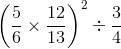
Evaluate the following:
Tap to reveal answer
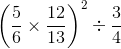
First we will evaluate the terms in the parentheses:
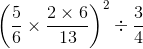
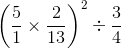

Next, we will square the first fraction:

$\frac{100}{169}$div $\frac{3}{4}$
We can evaluate the division as such:
$\frac{100}{169}$times$\frac{4}{3}$=\frac{400}{507}$
First we will evaluate the terms in the parentheses:
Next, we will square the first fraction:
$\frac{100}{169}$div $\frac{3}{4}$
We can evaluate the division as such:
$\frac{100}{169}$times$\frac{4}{3}$=\frac{400}{507}$
← Didn't Know|Knew It →
Simplify: 
Simplify:
Tap to reveal answer
Start by rewriting this fraction as a division problem:

When dividing fractions, you multiply by the reciprocal of the second fraction, so you can rewrite your problem like this:

Multiply across the numerators and then across the denominators to get  . The x's cancel, and you can reduce the fraction to be
  .
.
Start by rewriting this fraction as a division problem:
When dividing fractions, you multiply by the reciprocal of the second fraction, so you can rewrite your problem like this:
Multiply across the numerators and then across the denominators to get
← Didn't Know|Knew It →
Define an operation  as follows:
For all real numbers  ,
,
 .
.
Evaluate  .
.
Define an operation
For all real numbers
Evaluate
Tap to reveal answer


← Didn't Know|Knew It →
Define an operation  as follows:
For all real numbers  ,
,
 .
.
Evaluate  .
.
Define an operation
For all real numbers
Evaluate
Tap to reveal answer
 ,
,
or, equivalently,


or, equivalently,
← Didn't Know|Knew It →
Define an operation  as follows:
For all real numbers  ,
,
 .
.
Evaluate  .
.
Define an operation
For all real numbers
Evaluate
Tap to reveal answer


← Didn't Know|Knew It →
Define an operation  as follows:
For all real numbers  ,
,
 .
.
Evaluate  .
.
Define an operation
For all real numbers
Evaluate
Tap to reveal answer
 , or, equivalently,


← Didn't Know|Knew It →
Define an operation  as follows:
For all real numbers  ,
,
 .
.
Evaluate  .
.
Define an operation
For all real numbers
Evaluate
Tap to reveal answer
 ,
,
or, equivalently,


From here we need to find a common denominator.


or, equivalently,
From here we need to find a common denominator.
← Didn't Know|Knew It →
Define an operation  as follows:
For all real numbers  ,
,
 .
.
Evaluate  .
.
Define an operation
For all real numbers
Evaluate
Tap to reveal answer

or, equivalently,


or, equivalently,
← Didn't Know|Knew It →
Simplify:

Simplify:
Tap to reveal answer
Begin by simplifying any additions that need to be done:

becomes

Now, remember that the numerator  can be rewritten
  :
:

Now, when you divide fractions, you multiply the numerator by the reciprocal of the denominator:

Cancel the  s and you get:
Begin by simplifying any additions that need to be done:
becomes
Now, remember that the numerator
Now, when you divide fractions, you multiply the numerator by the reciprocal of the denominator:
Cancel the
← Didn't Know|Knew It →
Write 7.5% as a fraction.
Write 7.5% as a fraction.
Tap to reveal answer
First convert the percentage to a decimal:
7.5% = .075
Then turn this into a fraction:
.075 = 75/1000
Simplify by dividing the numerator and denominator by 25:
75/1000 = 3/40
First convert the percentage to a decimal:
7.5% = .075
Then turn this into a fraction:
.075 = 75/1000
Simplify by dividing the numerator and denominator by 25:
75/1000 = 3/40
← Didn't Know|Knew It →
Write as a fraction: 22%
Write as a fraction: 22%
Tap to reveal answer
22% = 22/100
Divide everything by 2:
22/100 = 11/50
11 is a prime number, so this is as reduced as this fraction can get.
22% = 22/100
Divide everything by 2:
22/100 = 11/50
11 is a prime number, so this is as reduced as this fraction can get.
← Didn't Know|Knew It →
25% of 64 is equal to 5% of what number?
25% of 64 is equal to 5% of what number?
Tap to reveal answer
25% of 64 is 16 (you can find this with a calculator by 0.25 * 64). Divide 16 by 0.05 (or 1/20) to get the value of the number 16 is 5% of. (Or mental math of 16 * 20)
25% of 64 is 16 (you can find this with a calculator by 0.25 * 64). Divide 16 by 0.05 (or 1/20) to get the value of the number 16 is 5% of. (Or mental math of 16 * 20)
← Didn't Know|Knew It →
When y is decreased by ten percent, the result is equal to fifteen percent of x. Assuming both x and y are nonzero, what is the ratio of x to y?
When y is decreased by ten percent, the result is equal to fifteen percent of x. Assuming both x and y are nonzero, what is the ratio of x to y?
Tap to reveal answer
The problem states that decreasing y by ten percent gives us the same thing as taking fifteen percent of x. We need to find an expression for decreasing y by ten percent, and an expression for fifteen percent of x, and then set these two things equal.
If we were to decrease y by ten percent, we would be left with ninety percent of y (because the percentages must add to one hundred percent). We could write ninety percent of y as 0.90_y_ = (90/100)y = (9/10)y. Remember, when converting from a percent to a decimal, we need to move the decimal two places to the left.
Similarly, we can write 15% of x as 0.15_x_ = (15/100)x = (3/20)x.
Now, we set these two expressions equal to one another.
(9/10)y = (3/20)x
Multiply both sides by 20 to eliminate fractions.
18_y_ = 3_x_
The question asks us to find the ratio of x to y, which is equal to x/y. Thus, we must rearrange the equation above until we have x/y by itself on one side.
18_y_ = 3_x_
Divide both sides by 3.
6_y_ = x
Divide both sides by y.
6 = x/y
Thus, the ratio of x to y is 6.
The answer is 6.
The problem states that decreasing y by ten percent gives us the same thing as taking fifteen percent of x. We need to find an expression for decreasing y by ten percent, and an expression for fifteen percent of x, and then set these two things equal.
If we were to decrease y by ten percent, we would be left with ninety percent of y (because the percentages must add to one hundred percent). We could write ninety percent of y as 0.90_y_ = (90/100)y = (9/10)y. Remember, when converting from a percent to a decimal, we need to move the decimal two places to the left.
Similarly, we can write 15% of x as 0.15_x_ = (15/100)x = (3/20)x.
Now, we set these two expressions equal to one another.
(9/10)y = (3/20)x
Multiply both sides by 20 to eliminate fractions.
18_y_ = 3_x_
The question asks us to find the ratio of x to y, which is equal to x/y. Thus, we must rearrange the equation above until we have x/y by itself on one side.
18_y_ = 3_x_
Divide both sides by 3.
6_y_ = x
Divide both sides by y.
6 = x/y
Thus, the ratio of x to y is 6.
The answer is 6.
← Didn't Know|Knew It →
Convert 62% into simplified fraction form.
Convert 62% into simplified fraction form.
Tap to reveal answer
To convert a percent into a fraction, simply divide by 100 and reduce. In our case, 62 and 100 have the common factor of 2, so solving and simplification are as follows:

To convert a percent into a fraction, simply divide by 100 and reduce. In our case, 62 and 100 have the common factor of 2, so solving and simplification are as follows:
← Didn't Know|Knew It →
If Mr. Jones’ math class has 8 boys and two-thirds of the class are girls, how many total students are in the class?
If Mr. Jones’ math class has 8 boys and two-thirds of the class are girls, how many total students are in the class?
Tap to reveal answer
If two-thirds of the class are girls, then one-third must be boys. Set up an equation comparing the number of boys to how much they represent in the entire class:
8 = (1/3) x, where x is the number in the entire class.
When we solve for x in the equation we get x = 24.
If two-thirds of the class are girls, then one-third must be boys. Set up an equation comparing the number of boys to how much they represent in the entire class:
8 = (1/3) x, where x is the number in the entire class.
When we solve for x in the equation we get x = 24.
← Didn't Know|Knew It →
Mr. Owens spent $7.50 for a dinner buffet. The amount he paid accounted for 3/4 of the money in his wallet. How much money is left in his wallet for other expenses?
Mr. Owens spent $7.50 for a dinner buffet. The amount he paid accounted for 3/4 of the money in his wallet. How much money is left in his wallet for other expenses?
Tap to reveal answer
If $7.50 is 3/4 of the total, 7.50/3 gives us what 1/4 of his total money would be. This equals $2.50, the remaining unspent quarter.
If $7.50 is 3/4 of the total, 7.50/3 gives us what 1/4 of his total money would be. This equals $2.50, the remaining unspent quarter.
← Didn't Know|Knew It →
A certain ball that is dropped will bounce back to 3/5 of the height it was initially dropped from. If after the 2nd bounce the ball reaches 39.96 ft, what was the initial height the ball was dropped from?
A certain ball that is dropped will bounce back to 3/5 of the height it was initially dropped from. If after the 2nd bounce the ball reaches 39.96 ft, what was the initial height the ball was dropped from?
Tap to reveal answer
We know the height of the initial bounce, so work backwards to find the initial height. 39.96/0.6 = 66.6 = height of ball after first bounce
66.6/0.6 = 111 ft
We know the height of the initial bounce, so work backwards to find the initial height. 39.96/0.6 = 66.6 = height of ball after first bounce
66.6/0.6 = 111 ft
← Didn't Know|Knew It →