Exponential Ratios and Rational Numbers - PSAT Math
Card 1 of 133
Tap to reveal answer
← Didn't Know|Knew It →

Tap to reveal answer
From the equation in the problem statement

Now squaring both sides we get
 this is a quadratic equation which equals

and the factors of this equation are

This gives us  .
.
However, if we plug these solutions back into the original equation,  does not create an equality. Therefore,
  is an extraneous solution.
From the equation in the problem statement
Now squaring both sides we get
and the factors of this equation are
This gives us
However, if we plug these solutions back into the original equation,
← Didn't Know|Knew It →
Rationalize the denominator:

Rationalize the denominator:
Tap to reveal answer
The conjugate of  is
is  .
.
Now multiply both the numerator and the denominator by 
and you get:
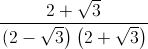

Hence we get
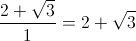
The conjugate of
Now multiply both the numerator and the denominator by
and you get:
Hence we get
← Didn't Know|Knew It →
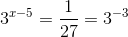
Solve for  :
:

Solve for
Tap to reveal answer


← Didn't Know|Knew It →
Solve for  .
.

Solve for
Tap to reveal answer


← Didn't Know|Knew It →
If,

What does 
If,
What does
Tap to reveal answer
If  ,
,
then  .
.
If
then
← Didn't Know|Knew It →
For some positive integer  , if
, if  , what is the value of
  ?
?
For some positive integer
Tap to reveal answer
If  , then
  must equal 3 (Note that
  cannot be -3 because you need it to be positive.
Now, plug  into the new equation
  :
:


If
Now, plug
← Didn't Know|Knew It →
If  and
and  are positive integers and
  , then what is the value of
  ?
?
If
Tap to reveal answer
43 = 64
Alternatively written, this is 4(4)(4) = 64 or 43 = 641.
Thus, m = 3 and n = 1.
m/n = 3/1 = 3.
43 = 64
Alternatively written, this is 4(4)(4) = 64 or 43 = 641.
Thus, m = 3 and n = 1.
m/n = 3/1 = 3.
← Didn't Know|Knew It →
Write the following logarithm in expanded form:

Write the following logarithm in expanded form:
Tap to reveal answer

← Didn't Know|Knew It →
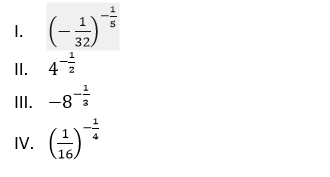
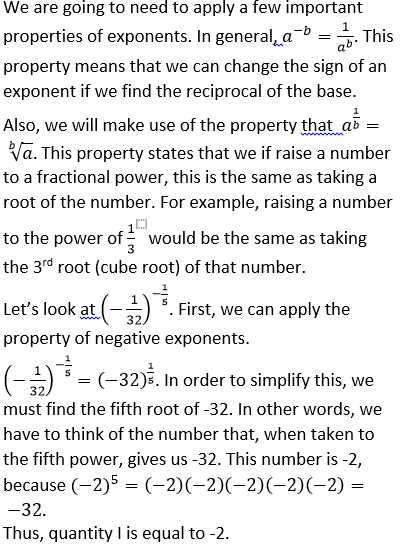
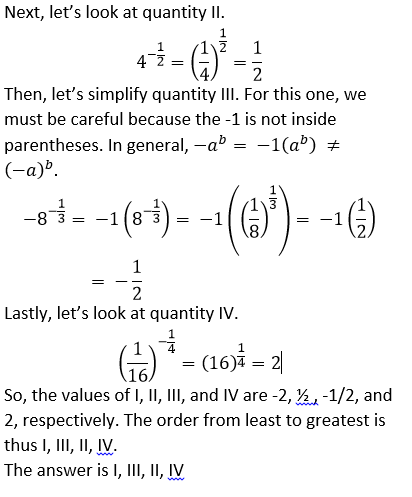
Which of the following lists the above quantities from least to greatest?
Which of the following lists the above quantities from least to greatest?
Tap to reveal answer
← Didn't Know|Knew It →
If a piece of pie is cut into 3 sections, and each of those pieces is further cut into three sections, then those pieces are cut into three sections, how many (tiny) pieces of pie are there?
If a piece of pie is cut into 3 sections, and each of those pieces is further cut into three sections, then those pieces are cut into three sections, how many (tiny) pieces of pie are there?
Tap to reveal answer
The answer is 33 = 27
The answer is 33 = 27
← Didn't Know|Knew It →
Solve for  .
.
$2^{x}$= 64
Solve for
$2^{x}$= 64
Tap to reveal answer
Since $2^{x}$= $2^{6}$
Hence 
Since $2^{x}$= $2^{6}$
Hence
← Didn't Know|Knew It →
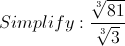
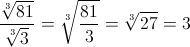
Simplify:

Simplify:
Tap to reveal answer

← Didn't Know|Knew It →
Solve for  :
:

Solve for
Tap to reveal answer
From the equation one can see that

Hence  must be equal to 25.
From the equation one can see that
Hence
← Didn't Know|Knew It →
Evaluate:

Evaluate:
Tap to reveal answer


← Didn't Know|Knew It →
Solve for  .
.

Solve for
Tap to reveal answer

← Didn't Know|Knew It →
Solve for  .
.

Solve for
Tap to reveal answer


← Didn't Know|Knew It →
Solve for  .
.

Solve for
Tap to reveal answer
Use the rules of logarithms to combine terms.

Hence, 


By fatoring we get 
Hence  .
.
However, you cannot take the logarithm of a negative number. Thus, the only value for  is
is  .
.
Use the rules of logarithms to combine terms.
Hence,
By fatoring we get
Hence
However, you cannot take the logarithm of a negative number. Thus, the only value for
← Didn't Know|Knew It →

and

Find 
and
Find
Tap to reveal answer

Hence the correct answer is  .
.
Hence the correct answer is
← Didn't Know|Knew It →
Tap to reveal answer
← Didn't Know|Knew It →