Trigonometric Identities
Help Questions
Pre-Calculus › Trigonometric Identities
Find 


Explanation
Using the sum formula for sine,

where,


yeilds:


Evaluate


Explanation


We can use the sum identity to evaluate this sine:

From the unit circle, we can determine these measures:

Evaluate
Explanation
We can use the sum identity to evaluate this sine:
From the unit circle, we can determine these measures:
Find the value of 


Explanation
To solve 
Write the formula for these identities.

To solve for 


Substitute the special angles in the formula.

Evaluate both conditions.




Solve for 
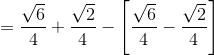
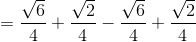


Find the value of
Explanation
To solve
Write the formula for these identities.
To solve for
Substitute the special angles in the formula.
Evaluate both conditions.
Solve for
Find the value of
Explanation
To solve
Write the formula for these identities.
To solve for
Substitute the special angles in the formula.
Evaluate both conditions.
Solve for
Evaluate
Explanation
We can use the sum identity to evaluate this sine:
From the unit circle, we can determine these measures:
Find
Explanation
Using the sum formula for sine,
where,
yeilds:
Find
Explanation
Using the sum formula for sine,
where,
yeilds:
In the problem below, 

Find


Explanation
Since 


So 
Since 


So 
Using the sine sum formula, we see:
