Graphs of Polynomial Functions
Help Questions
Pre-Calculus › Graphs of Polynomial Functions
Give the 

Round to the nearest tenth, if applicable.


The graph has no 
Explanation
The 


The 

Write the equation for the polynomial in the graph:
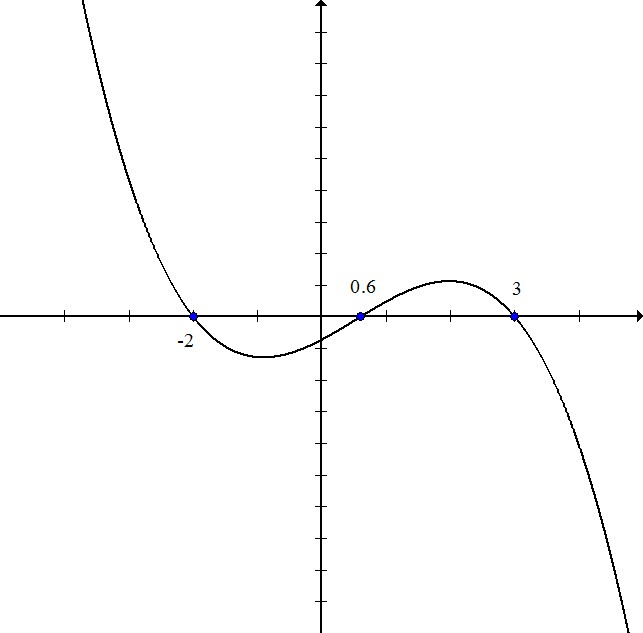





Explanation
The zeros of the polynomial are 
The first factor is 


The second and third factors are 

Multiply:



Because the graph goes down-up-down instead of the standard up-down-up, the graph is negative, so change all of the signs:

Give the
Round to the nearest tenth, if applicable.
The graph has no
Explanation
The
The
Write the equation for the polynomial in the graph:
Explanation
The zeros of the polynomial are
The first factor is
The second and third factors are
Multiply:
Because the graph goes down-up-down instead of the standard up-down-up, the graph is negative, so change all of the signs:
Graph the function and identify the roots.


Explanation
This question tests one's ability to graph a polynomial function.
For the purpose of Common Core Standards, "graph polynomial functions, identifying zeros when suitable factorizations are available, and showing end behavior" falls within the Cluster C of "Analyze Functions Using Different Representations" concept (CCSS.MATH.CONTENT.HSF-IF.C.7).
Knowing the standard and the concept for which it relates to, we can now do the step-by-step process to solve the problem in question.
Step 1: Use algebraic technique to factor the function.
Recognize that the binomial is a perfect square for which the following formula can be used

since

thus the simplified, factored form is,

Step 2: Identify the roots of the function.
To find the roots of a function set its factored form equal to zero and solve for the possible x values.


Step 3: Create a table of 

The values in the table are found by substituting in the x values into the function as follows.

Step 4: Plot the points on a coordinate grid and connect them with a smooth curve.
Graph the function and identify the roots.
Explanation
This question tests one's ability to graph a polynomial function.
For the purpose of Common Core Standards, "graph polynomial functions, identifying zeros when suitable factorizations are available, and showing end behavior" falls within the Cluster C of "Analyze Functions Using Different Representations" concept (CCSS.MATH.CONTENT.HSF-IF.C.7).
Knowing the standard and the concept for which it relates to, we can now do the step-by-step process to solve the problem in question.
Step 1: Use algebraic technique to factor the function.
Recognize that the binomial is a perfect square for which the following formula can be used
since
thus the simplified, factored form is,
Step 2: Identify the roots of the function.
To find the roots of a function set its factored form equal to zero and solve for the possible x values.
Step 3: Create a table of
The values in the table are found by substituting in the x values into the function as follows.
Step 4: Plot the points on a coordinate grid and connect them with a smooth curve.
Graph the function and identify its roots.


Explanation
This question tests one's ability to graph a polynomial function.
For the purpose of Common Core Standards, "graph polynomial functions, identifying zeros when suitable factorizations are available, and showing end behavior" falls within the Cluster C of "Analyze Functions Using Different Representations" concept (CCSS.MATH.CONTENT.HSF-IF.C.7).
Knowing the standard and the concept for which it relates to, we can now do the step-by-step process to solve the problem in question.
Step 1: Use algebraic technique to factor the function.
Recognize that the binomial is a perfect square for which the following formula can be used

since

thus the simplified, factored form is,

Step 2: Identify the roots of the function.
To find the roots of a function set its factored form equal to zero and solve for the possible x values.


Step 3: Create a table of

The values in the table are found by substituting in the x values into the function as follows.

Step 4: Plot the points on a coordinate grid and connect them with a smooth curve.
Graph the function and identify its roots.
Explanation
This question tests one's ability to graph a polynomial function.
For the purpose of Common Core Standards, "graph polynomial functions, identifying zeros when suitable factorizations are available, and showing end behavior" falls within the Cluster C of "Analyze Functions Using Different Representations" concept (CCSS.MATH.CONTENT.HSF-IF.C.7).
Knowing the standard and the concept for which it relates to, we can now do the step-by-step process to solve the problem in question.
Step 1: Use algebraic technique to factor the function.
Recognize that the binomial is a perfect square for which the following formula can be used
since
thus the simplified, factored form is,
Step 2: Identify the roots of the function.
To find the roots of a function set its factored form equal to zero and solve for the possible x values.
Step 3: Create a table of
The values in the table are found by substituting in the x values into the function as follows.
Step 4: Plot the points on a coordinate grid and connect them with a smooth curve.
Graph the function and identify its roots.


Explanation
This question tests one's ability to graph a polynomial function.
For the purpose of Common Core Standards, "graph polynomial functions, identifying zeros when suitable factorizations are available, and showing end behavior" falls within the Cluster C of "Analyze Functions Using Different Representations" concept (CCSS.MATH.CONTENT.HSF-IF.C.7).
Knowing the standard and the concept for which it relates to, we can now do the step-by-step process to solve the problem in question.
Step 1: Use algebraic technique to factor the function.
Recognize that the binomial is a perfect square for which the following formula can be used
since

thus the simplified, factored form is,

Step 2: Identify the roots of the function.
To find the roots of a function set its factored form equal to zero and solve for the possible x values.


Step 3: Create a table of

The values in the table are found by substituting in the x values into the function as follows.

Step 4: Plot the points on a coordinate grid and connect them with a smooth curve.
Graph the function and identify its roots.
Explanation
This question tests one's ability to graph a polynomial function.
For the purpose of Common Core Standards, "graph polynomial functions, identifying zeros when suitable factorizations are available, and showing end behavior" falls within the Cluster C of "Analyze Functions Using Different Representations" concept (CCSS.MATH.CONTENT.HSF-IF.C.7).
Knowing the standard and the concept for which it relates to, we can now do the step-by-step process to solve the problem in question.
Step 1: Use algebraic technique to factor the function.
Recognize that the binomial is a perfect square for which the following formula can be used
since
thus the simplified, factored form is,
Step 2: Identify the roots of the function.
To find the roots of a function set its factored form equal to zero and solve for the possible x values.
Step 3: Create a table of
The values in the table are found by substituting in the x values into the function as follows.
Step 4: Plot the points on a coordinate grid and connect them with a smooth curve.