Descartes' Rule, Intermediate Value Theorem, Sum and Product of Zeros
Help Questions
Pre-Calculus › Descartes' Rule, Intermediate Value Theorem, Sum and Product of Zeros
Please choose the best answer from the following choices.
Find the sum and product of the zeros of the following polynomial:









Explanation
Factoring the polynomial will give you 

The zeros of these binomials will be 

If you add these together (sum) you get 

Given 


Explanation
To determine zeros of 

Set each of the factorized components equal to zero and solve for 


The sum of the roots:

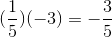
The product of the roots:
Please choose the best answer from the following choices.
Find the sum and product of the zeros of the following polynomial:
Explanation
Factoring the polynomial will give you
The zeros of these binomials will be
If you add these together (sum) you get
Given
Explanation
To determine zeros of
Set each of the factorized components equal to zero and solve for
The sum of the roots:
The product of the roots:
Please choose the best answer from the following choices.
Find the sum and product of the zeros of the following polynomial:



Explanation
To find the zeros you have to factor the polynomial.
This is easily factorable and you will get 

Next, set both of these equal to zero. 

Isolate the x's and you will get 

The sum will be 

Please choose the best answer from the following choices.
Find the sum and product of the zeros of the following polynomial:
Explanation
To find the zeros you have to factor the polynomial.
This is easily factorable and you will get
Next, set both of these equal to zero.
Isolate the x's and you will get
The sum will be
Determine the possible number of Positive and Negative Real Zeros of the polynomial using Descartes' Rule of Signs

Positive zeroes:

Negative zeroes:

Positive zeroes:

Negative zeroes:

Positive zeroes:

Negative zeroes:

Positive zeroes:

Negative zeroes:

Explanation
In order to determine the positive number of real zeroes, we must count the number of sign changes in the coefficients of the terms of the polynomial. The number of real zeroes can then be any positive difference of that number and a positive multiple of two.
For the function
there are four sign changes. As such, the number of positive real zeroes can be

In order to determine the positive number of real zeroes, we must count the number of sign changes in the coefficients of the terms of the polynomial after substituting for 
After substituting 

and there is one sign change.
As such, there can only be one negative root.
Determine the possible number of Positive and Negative Real Zeros of the polynomial using Descartes' Rule of Signs
Positive zeroes:
Negative zeroes:
Positive zeroes:
Negative zeroes:
Positive zeroes:
Negative zeroes:
Positive zeroes:
Negative zeroes:
Explanation
In order to determine the positive number of real zeroes, we must count the number of sign changes in the coefficients of the terms of the polynomial. The number of real zeroes can then be any positive difference of that number and a positive multiple of two.
For the function
there are four sign changes. As such, the number of positive real zeroes can be
In order to determine the positive number of real zeroes, we must count the number of sign changes in the coefficients of the terms of the polynomial after substituting for
After substituting
and there is one sign change.
As such, there can only be one negative root.