Polar Equations of Conic Sections
Help Questions
Pre-Calculus › Polar Equations of Conic Sections
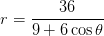
Given the polar equation, identify the conic section.
Ellipse
Parabola
Hyperbola
Explanation
Recall that the polar equations of conic sections can come in the following forms:
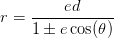
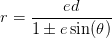

To determine what conic section the polar graph depicts, look only at the conic section's eccentricity.


First, put the given polar equation into one of the forms seen above by dividing everything by 
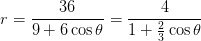
Now, for the given conic section, 
Given the polar equation, identify the conic section.
Ellipse
Parabola
Hyperbola
Explanation
Recall that the polar equations of conic sections can come in the following forms:
To determine what conic section the polar graph depicts, look only at the conic section's eccentricity.
First, put the given polar equation into one of the forms seen above by dividing everything by
Now, for the given conic section,
Given the polar equation, determine the conic section:
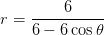
Parabola
Hyperbola
Ellipse
Explanation
Recall that the polar equations of conic sections can come in the following forms:
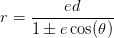
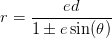

To determine what conic section the polar graph depicts, look only at the conic section's eccentricity.


First, put the given polar equation into one of the forms seen above by dividing everything by 

Now, for the given conic section, 
Given the polar equation, determine the conic section:
Parabola
Hyperbola
Ellipse
Explanation
Recall that the polar equations of conic sections can come in the following forms:
To determine what conic section the polar graph depicts, look only at the conic section's eccentricity.
First, put the given polar equation into one of the forms seen above by dividing everything by
Now, for the given conic section,
Write the equation for 


Explanation
This is the equation for a parabola, so the eccentricity is 1. It opens up, so the focus is above the directrix.
This means that our equation will be in the form

where a is the distance from the focus to the vertex.
In this case, we have 

Because the vertex is 

The equation is

Write the equation for
Explanation
This is the equation for a parabola, so the eccentricity is 1. It opens up, so the focus is above the directrix.
This means that our equation will be in the form
where a is the distance from the focus to the vertex.
In this case, we have
Because the vertex is
The equation is
Write the equation for the hyperbola 


Explanation
The directrix is to the left of the focus at the origin, and the major axis is horizontal, so our equation is going to take the form


First we need to solve for c so we can find the eccentricity. For a hyperbola, we use the relationship 


In this case, 


To find the eccentricity: 


Plugging in e and p:

To simplify we can multiply top and bottom by 3:

Write the equation for the hyperbola
Explanation
The directrix is to the left of the focus at the origin, and the major axis is horizontal, so our equation is going to take the form
First we need to solve for c so we can find the eccentricity. For a hyperbola, we use the relationship
In this case,
To find the eccentricity:
Plugging in e and p:
To simplify we can multiply top and bottom by 3:
Write the equation for 


Explanation
This is the equation for a down-opening parabola. The vertex is at 


Because the focus is at the origin, and the parabola opens down, the polar form of the equation is 
This equation is

Write the equation for
Explanation
This is the equation for a down-opening parabola. The vertex is at
Because the focus is at the origin, and the parabola opens down, the polar form of the equation is
This equation is