Parabolas
Help Questions
Pre-Calculus › Parabolas
Describe the orientation of a parabola with the following equation:

Facing down
Facing up
Facing to the left
Facing to the right
None of the other options
Explanation
The coefficient of the squared term tells us whether the parabola faces up or down. Parabolas in general, as in the parent function, are in the shape of a U. In the equation given, the coefficient of the squared term is 

Describe the orientation of a parabola with the following equation:
Facing down
Facing up
Facing to the left
Facing to the right
None of the other options
Explanation
The coefficient of the squared term tells us whether the parabola faces up or down. Parabolas in general, as in the parent function, are in the shape of a U. In the equation given, the coefficient of the squared term is
Find the axis of symmetry and the vertex of the parabola given by the following equation:

Vertex at

Axis of symmetry at

Vertex at

Axis of symmetry at

Vertex at

Axis of symmetry at

Vertex at

Axis of symmetry at

Explanation
Find the axis of symmetry and the vertex of the parabola given by the following equation:

To find the axis of symmetry of a parabola in standard form, 

So...

This means that we have an axis of symmetry at 

So, we are halfway there, now we need the coordinates of our vertex. We already know the x-coordinate, which is 7. To find the y-coordinate, simply plug 7 into the parabola's formula and solve!

This makes our vertex the point

Which of the following could be the graph of f(x)?

Explanation
Which of the following could be the graph of f(x)?

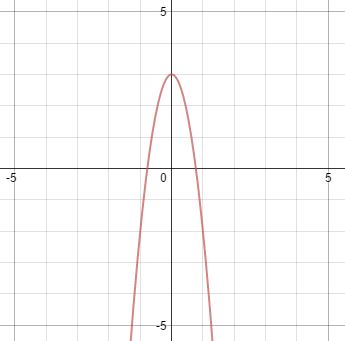
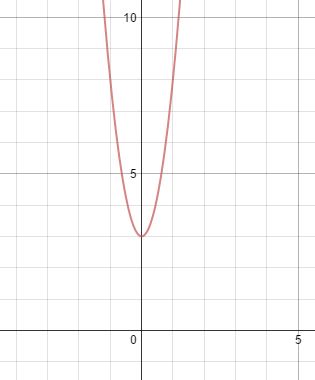
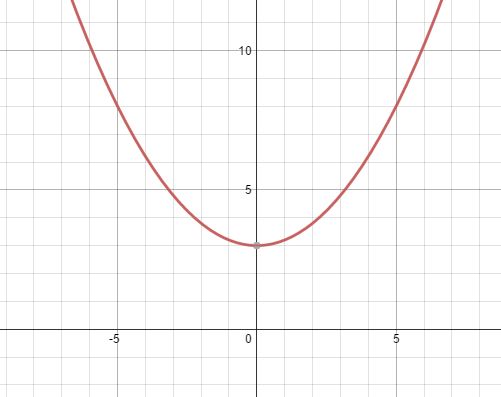
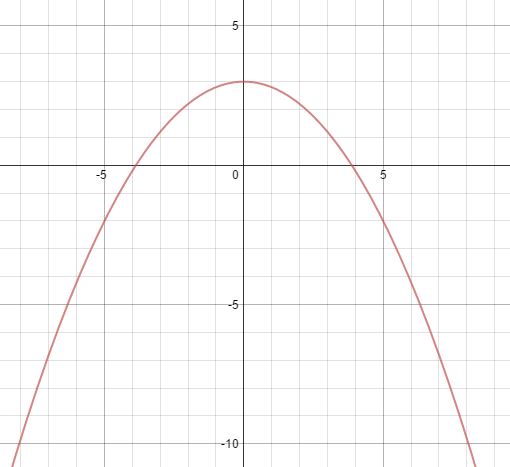
Begin by realizing this must be a downward facing parabola with its vertex at (0,3)
We know this because of the negative sign in front of the 5, and by the constant term of 3 on the end.
This narrows our options down to 2. One is much narrower than the other, although it may seem counterintuitive, the narrower one is what we need. This is because for every increase in x, we get a corresponding increase of times 5 in y. This translates to a graph that will get to higher values of y faster than a basic parabola. So, we need the graph below. to further confirm, try to find f(1)

So, the point (1,-2) must be on the graph, which means we must have:
Find the axis of symmetry and the vertex of the parabola given by the following equation:
Vertex at
Axis of symmetry at
Vertex at
Axis of symmetry at
Vertex at
Axis of symmetry at
Vertex at
Axis of symmetry at
Explanation
Find the axis of symmetry and the vertex of the parabola given by the following equation:
To find the axis of symmetry of a parabola in standard form,
So...
This means that we have an axis of symmetry at
So, we are halfway there, now we need the coordinates of our vertex. We already know the x-coordinate, which is 7. To find the y-coordinate, simply plug 7 into the parabola's formula and solve!
This makes our vertex the point
Which of the following could be the graph of f(x)?
Explanation
Which of the following could be the graph of f(x)?
Begin by realizing this must be a downward facing parabola with its vertex at (0,3)
We know this because of the negative sign in front of the 5, and by the constant term of 3 on the end.
This narrows our options down to 2. One is much narrower than the other, although it may seem counterintuitive, the narrower one is what we need. This is because for every increase in x, we get a corresponding increase of times 5 in y. This translates to a graph that will get to higher values of y faster than a basic parabola. So, we need the graph below. to further confirm, try to find f(1)
So, the point (1,-2) must be on the graph, which means we must have:
Describe the orientation of the parabola below:
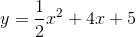
Facing up
Facing down
Facing left
Facing right
None of the other options
Explanation
The coefficient of the squared term tells us whether the parabola faces up or down. Parabolas in general, as in the parent function, are in the shape of a U. In the equation given, the coefficient of the squared term is 

Describe the orientation of the parabola below:
Facing up
Facing down
Facing left
Facing right
None of the other options
Explanation
The coefficient of the squared term tells us whether the parabola faces up or down. Parabolas in general, as in the parent function, are in the shape of a U. In the equation given, the coefficient of the squared term is
Which is the equation for a parabola that opens down?





Explanation
The answer is 
Which is the equation for a parabola that opens down?
Explanation
The answer is