Use Logarithms To Solve Exponential Equations and Inequalities - Pre-Calculus
Card 1 of 40
Solving an exponential equation.
Solve for  ,
,
 .
.
Solving an exponential equation.
Solve for
Tap to reveal answer
We recall the property:




Now,  .
.
Thus
 .
.
We recall the property:
Now,
Thus
← Didn't Know|Knew It →
Solving an exponential equation.
Solve

Solving an exponential equation.
Solve
Tap to reveal answer
Use  (which is just
  , by convention) to solve.



 .
.
Use
← Didn't Know|Knew It →
Solve
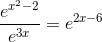 .
.
Solve
Tap to reveal answer
After using the division rule to simplify the left hand side you can take the natural log of both sides.
If you then combine like terms you get a quadratic equation which factors to,
 .
.
Setting each binomial equal to zero and solving for  we get the solution to be
  .
.
After using the division rule to simplify the left hand side you can take the natural log of both sides.
If you then combine like terms you get a quadratic equation which factors to,
Setting each binomial equal to zero and solving for
← Didn't Know|Knew It →
Solve the equation for  using the rules of logarithms.

Solve the equation for
Tap to reveal answer
Expanding the logarithms into sums of logarithms will cancel out the first two x terms, resulting in the equation:

Combining the first and second terms, then subtracting the new term over will allow you to isolate the variable term.
Divide both sides of the equation by 2, then exponentiate with 3.
Evaluating this term numerically will give the correct answer.

Expanding the logarithms into sums of logarithms will cancel out the first two x terms, resulting in the equation:
Combining the first and second terms, then subtracting the new term over will allow you to isolate the variable term.
Divide both sides of the equation by 2, then exponentiate with 3.
Evaluating this term numerically will give the correct answer.
← Didn't Know|Knew It →
Solve the following equation:

Solve the following equation:
Tap to reveal answer
To solve this equation, recall the following property:
 Can be rewritten as


Evaluate with your calculator to get

To solve this equation, recall the following property:
Evaluate with your calculator to get
← Didn't Know|Knew It →
Solve for x: 
Solve for x:

Tap to reveal answer

← Didn't Know|Knew It →
Solve for x in the following equation: 
Solve for x in the following equation:

Tap to reveal answer

← Didn't Know|Knew It →
Solve for x using the rules of logarithms: 
Solve for x using the rules of logarithms:

Tap to reveal answer

← Didn't Know|Knew It →
Solve for x: 
Solve for x:

Tap to reveal answer

← Didn't Know|Knew It →
Simplify the log expression: 
Simplify the log expression:

Tap to reveal answer
The logarithmic expression is as simplified as can be.
The logarithmic expression is as simplified as can be.
← Didn't Know|Knew It →
Solve for x:
Solve for x:
Tap to reveal answer
← Didn't Know|Knew It →
Simplify the log expression:
Simplify the log expression:
Tap to reveal answer
The logarithmic expression is as simplified as can be.
The logarithmic expression is as simplified as can be.
← Didn't Know|Knew It →
Solving an exponential equation.
Solve for ,
.
Solving an exponential equation.
Solve for
Tap to reveal answer
We recall the property:
Now, .
Thus
.
We recall the property:
Now,
Thus
← Didn't Know|Knew It →
Solving an exponential equation.
Solve
Solving an exponential equation.
Solve
Tap to reveal answer
Use (which is just , by convention) to solve.
.
Use
← Didn't Know|Knew It →
Solve
.
Solve
Tap to reveal answer
After using the division rule to simplify the left hand side you can take the natural log of both sides.
If you then combine like terms you get a quadratic equation which factors to,
.
Setting each binomial equal to zero and solving for we get the solution to be .
After using the division rule to simplify the left hand side you can take the natural log of both sides.
If you then combine like terms you get a quadratic equation which factors to,
Setting each binomial equal to zero and solving for
← Didn't Know|Knew It →
Solve the equation for using the rules of logarithms.
Solve the equation for
Tap to reveal answer
Expanding the logarithms into sums of logarithms will cancel out the first two x terms, resulting in the equation:
Combining the first and second terms, then subtracting the new term over will allow you to isolate the variable term.
Divide both sides of the equation by 2, then exponentiate with 3.
Evaluating this term numerically will give the correct answer.
Expanding the logarithms into sums of logarithms will cancel out the first two x terms, resulting in the equation:
Combining the first and second terms, then subtracting the new term over will allow you to isolate the variable term.
Divide both sides of the equation by 2, then exponentiate with 3.
Evaluating this term numerically will give the correct answer.
← Didn't Know|Knew It →
Solve the following equation:
Solve the following equation:
Tap to reveal answer
To solve this equation, recall the following property:
Can be rewritten as
Evaluate with your calculator to get
To solve this equation, recall the following property:
Evaluate with your calculator to get
← Didn't Know|Knew It →
Solve for x:
Solve for x:
Tap to reveal answer
← Didn't Know|Knew It →
Solve for x in the following equation:
Solve for x in the following equation:
Tap to reveal answer
← Didn't Know|Knew It →
Solve for x using the rules of logarithms:
Solve for x using the rules of logarithms:
Tap to reveal answer
← Didn't Know|Knew It →