Solve Trigonometric Equations and Inequalities in Quadratic Form - Pre-Calculus
Card 1 of 24
Solve for  in the equation
  on the interval
  .
.
Solve for
Tap to reveal answer
If you substitute  you obtain a recognizable quadratic equation which can be solved for
  ,
,
 .
.
Then we can plug  back into our equation and use the unit circle to find that
 .
.
If you substitute
Then we can plug
← Didn't Know|Knew It →
If  exists in the domain from
  , solve the following:
If
Tap to reveal answer
Factorize  .
.

Set both terms equal to zero and solve.



This value is not within the  domain.



This is the only correct value in the  domain.
Factorize
Set both terms equal to zero and solve.
This value is not within the
This is the only correct value in the
← Didn't Know|Knew It →
Given that theta exists from  , solve:
Given that theta exists from
Tap to reveal answer
In order to solve  appropriately, do not divide
  on both sides. The effect will eliminate one of the roots of this trig function.
Substract  from both sides.

Factor the left side of the equation.

Set each term equal to zero, and solve for theta with the restriction  .
.





The correct answer is:
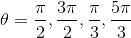
In order to solve
Substract
Factor the left side of the equation.
Set each term equal to zero, and solve for theta with the restriction
The correct answer is:
← Didn't Know|Knew It →
Solve  for
for 
Solve
Tap to reveal answer
By subtracting  from both sides of the original equation, we get
  . We know that the square of a trigonometric identity cannot be negative, regardless of the input, so there can be no solution.
By subtracting
← Didn't Know|Knew It →
Solve  when
when 
Solve
Tap to reveal answer
Given that, for any input,  , we know that
 , and so the equation
  can have no solutions.
Given that, for any input,
← Didn't Know|Knew It →
Solve  when
when 
Solve
Tap to reveal answer
By adding one to both sides of the original equation, we get  , and by taking the square root of both sides of this, we get
  From there, we get that, on the given interval, the only solutions are
  and
and  .
.
By adding one to both sides of the original equation, we get
← Didn't Know|Knew It →
Solve for in the equation on the interval .
Solve for
Tap to reveal answer
If you substitute you obtain a recognizable quadratic equation which can be solved for ,
.
Then we can plug back into our equation and use the unit circle to find that
.
If you substitute
Then we can plug
← Didn't Know|Knew It →
If exists in the domain from , solve the following:
If
Tap to reveal answer
Factorize .
Set both terms equal to zero and solve.
This value is not within the domain.
This is the only correct value in the domain.
Factorize
Set both terms equal to zero and solve.
This value is not within the
This is the only correct value in the
← Didn't Know|Knew It →
Given that theta exists from , solve:
Given that theta exists from
Tap to reveal answer
In order to solve appropriately, do not divide on both sides. The effect will eliminate one of the roots of this trig function.
Substract from both sides.
Factor the left side of the equation.
Set each term equal to zero, and solve for theta with the restriction .
The correct answer is:
In order to solve
Substract
Factor the left side of the equation.
Set each term equal to zero, and solve for theta with the restriction
The correct answer is:
← Didn't Know|Knew It →
Solve for
Solve
Tap to reveal answer
By subtracting from both sides of the original equation, we get . We know that the square of a trigonometric identity cannot be negative, regardless of the input, so there can be no solution.
By subtracting
← Didn't Know|Knew It →
Solve when
Solve
Tap to reveal answer
Given that, for any input, , we know that, and so the equation can have no solutions.
Given that, for any input,
← Didn't Know|Knew It →
Solve when
Solve
Tap to reveal answer
By adding one to both sides of the original equation, we get , and by taking the square root of both sides of this, we get From there, we get that, on the given interval, the only solutions are and .
By adding one to both sides of the original equation, we get
← Didn't Know|Knew It →
Solve for in the equation on the interval .
Solve for
Tap to reveal answer
If you substitute you obtain a recognizable quadratic equation which can be solved for ,
.
Then we can plug back into our equation and use the unit circle to find that
.
If you substitute
Then we can plug
← Didn't Know|Knew It →
If exists in the domain from , solve the following:
If
Tap to reveal answer
Factorize .
Set both terms equal to zero and solve.
This value is not within the domain.
This is the only correct value in the domain.
Factorize
Set both terms equal to zero and solve.
This value is not within the
This is the only correct value in the
← Didn't Know|Knew It →
Given that theta exists from , solve:
Given that theta exists from
Tap to reveal answer
In order to solve appropriately, do not divide on both sides. The effect will eliminate one of the roots of this trig function.
Substract from both sides.
Factor the left side of the equation.
Set each term equal to zero, and solve for theta with the restriction .
The correct answer is:
In order to solve
Substract
Factor the left side of the equation.
Set each term equal to zero, and solve for theta with the restriction
The correct answer is:
← Didn't Know|Knew It →
Solve for
Solve
Tap to reveal answer
By subtracting from both sides of the original equation, we get . We know that the square of a trigonometric identity cannot be negative, regardless of the input, so there can be no solution.
By subtracting
← Didn't Know|Knew It →
Solve when
Solve
Tap to reveal answer
Given that, for any input, , we know that, and so the equation can have no solutions.
Given that, for any input,
← Didn't Know|Knew It →
Solve when
Solve
Tap to reveal answer
By adding one to both sides of the original equation, we get , and by taking the square root of both sides of this, we get From there, we get that, on the given interval, the only solutions are and .
By adding one to both sides of the original equation, we get
← Didn't Know|Knew It →
Solve for in the equation on the interval .
Solve for
Tap to reveal answer
If you substitute you obtain a recognizable quadratic equation which can be solved for ,
.
Then we can plug back into our equation and use the unit circle to find that
.
If you substitute
Then we can plug
← Didn't Know|Knew It →
If exists in the domain from , solve the following:
If
Tap to reveal answer
Factorize .
Set both terms equal to zero and solve.
This value is not within the domain.
This is the only correct value in the domain.
Factorize
Set both terms equal to zero and solve.
This value is not within the
This is the only correct value in the
← Didn't Know|Knew It →