Solve Trigonometric Equations and Inequalities - Pre-Calculus
Card 1 of 88
In the problem below,  and
and  .
.
Find
 .
.
In the problem below,
Find
Tap to reveal answer
Since  and
and  is in quadrant I, we can say that
  and
and  and therefore:
 .
.
So  .
.
Since  and
and  is in quadrant I, we can say that
  and
and  and therefore:
 .
.
So  .
.
Using the sine sum formula, we see:

Since
So
Since
So
Using the sine sum formula, we see:
← Didn't Know|Knew It →
Find  using the sum identity.
Find
Tap to reveal answer
Using the sum formula for sine,

where,
 ,
, 
yeilds:


 .
.
Using the sum formula for sine,
where,
yeilds:
← Didn't Know|Knew It →
Calculate  .
.
Calculate
Tap to reveal answer
Notice that  is equivalent to
  . With this conversion, the sum formula can be applied using,

where
 ,
,  .
.
Therefore the result is as follows:


 .
.
Notice that
where
Therefore the result is as follows:
← Didn't Know|Knew It →
Evaluate the exact value of:

Evaluate the exact value of:
Tap to reveal answer
In order to solve  , two special angles will need to be used to solve for the exact values.
The angles chosen are  and
and  degrees, since:

Write the formula for the cosine additive identity.

Substitute the known variables.

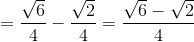

In order to solve
The angles chosen are
Write the formula for the cosine additive identity.
Substitute the known variables.
← Didn't Know|Knew It →
In the problem below, 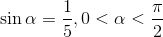 and
and 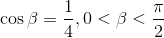 .
.
Find
 .
.
In the problem below,
Find
Tap to reveal answer
Since  and
and  is in quadrant I, we can say that
  and
and  and therefore:
 .
.
So  .
.
Since  and
and  is in quadrant I, we can say that
  and
and  and therefore:
 . So
. So  .
.
Using the cosine sum formula, we then see:
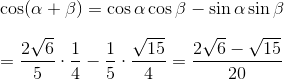 .
.
Since
So
Since
Using the cosine sum formula, we then see:
← Didn't Know|Knew It →
In the problem below, 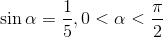 and
and 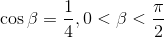 .
.
Find
 .
.
In the problem below,
Find
Tap to reveal answer
Since  and
and  is in quadrant I, we can say that
  and
and  and therefore:
 .
.
So  .
.
Since  and
and  is in quadrant I, we can say that
  and
and  and therefore:
 .
.
So  .
.
Using the cosine difference formula, we see:
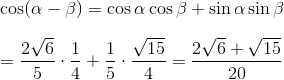
Since
So
Since
So
Using the cosine difference formula, we see:
← Didn't Know|Knew It →
In the problem below,  and
and  .
.
Find
 .
.
In the problem below,
Find
Tap to reveal answer
Since  and
and  is in quadrant I, we can say that
  and
and  and therefore:
 .
.
So  .
.
Since  and
and  is in quadrant I, we can say that
  and
and  and therefore:
 .
.
So  .
.
Using the sine difference formula, we see:

Since
So
Since
So
Using the sine difference formula, we see:
← Didn't Know|Knew It →
In the problem below, 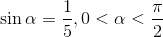 and
and 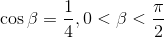 .
.
Find
 .
.
In the problem below,
Find
Tap to reveal answer
Since  and
and  is in quadrant I, we can say that
  and
and  and therefore:
 .
.
So
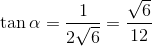 .
.
Since  and
and  is in quadrant I, we can say that
  and
and  and therefore:
 .
.
So  .
.
Using the tangent sum formula, we see:
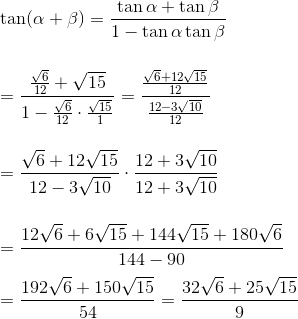
Since
So
Since
So
Using the tangent sum formula, we see:
← Didn't Know|Knew It →
In the problem below, 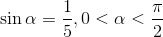 and
and 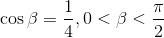 .
.
Find
 .
.
In the problem below,
Find
Tap to reveal answer
Since  and
and  is in quadrant I, we can say that
  and
and  and therefore:
 .
.
So 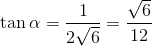 .
.
Since  and
and  is in quadrant I, we can say that
  and
and  and therefore:
 .
.
So  .
.
Using the tangent sum formula, we see:
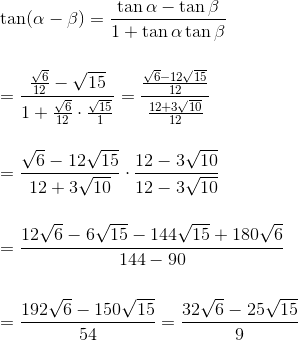
Since
So
Since
So
Using the tangent sum formula, we see:
← Didn't Know|Knew It →
Find the value of  .
.
Find the value of
Tap to reveal answer
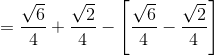
To solve  , we will need to use both the sum and difference identities for cosine.
Write the formula for these identities.

To solve for  and
and  , find two special angles whose difference and sum equals to the angle 15 and 75, respectively. The two special angles are 45 and 30.


Substitute the special angles in the formula.

Evaluate both conditions.




Solve for  .
.
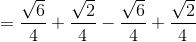


To solve
Write the formula for these identities.
To solve for
Substitute the special angles in the formula.
Evaluate both conditions.
Solve for
← Didn't Know|Knew It →
Given that  and
and  , find
  .
.
Given that
Tap to reveal answer
Jump straight to the tangent sum formula:

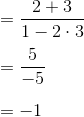
From here plug in the given values and simplify.
Jump straight to the tangent sum formula:
From here plug in the given values and simplify.
← Didn't Know|Knew It →
Find the exact value for: 
Find the exact value for:
Tap to reveal answer
In order to solve this question, it is necessary to know the sine difference identity.

The values of  and
and must be a special angle, and their difference must be 15 degrees.
A possibility of their values that match the criteria are:


Substitute the values into the formula and solve.


Evaluate  .
.

In order to solve this question, it is necessary to know the sine difference identity.
The values of
A possibility of their values that match the criteria are:
Substitute the values into the formula and solve.
Evaluate
← Didn't Know|Knew It →
Find the exact value of: 
Find the exact value of:
Tap to reveal answer
In order to find the exact value of  , the sum identity of sine must be used. Write the formula.

The only possibilites of  and
and  are 45 and 60 degrees interchangably. Substitute these values into the equation and evaluate.


In order to find the exact value of
The only possibilites of
← Didn't Know|Knew It →
Which of the following expressions best represents  ?
?
Which of the following expressions best represents
Tap to reveal answer
Write the identity for  .
.
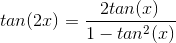
Set the value of the angle equal to  .
.


Substitute the value of  into the identity.

Write the identity for
Set the value of the angle equal to
Substitute the value of
← Didn't Know|Knew It →
Evaluate
 .
.
Evaluate
Tap to reveal answer
 is equivalent to
  or more simplified
  .
.
We can use the sum identity to evaluate this sine:

From the unit circle, we can determine these measures:

We can use the sum identity to evaluate this sine:
From the unit circle, we can determine these measures:
← Didn't Know|Knew It →
Evaluate
 .
.
Evaluate
Tap to reveal answer
The angle  or
or  .
.
Using the first one:

We can find these values in the unit circle:

The angle
Using the first one:
We can find these values in the unit circle:
← Didn't Know|Knew It →
Find using the sum identity.
Find
Tap to reveal answer
Using the sum formula for sine,
where,
,
yeilds:
.
Using the sum formula for sine,
where,
yeilds:
← Didn't Know|Knew It →
Calculate .
Calculate
Tap to reveal answer
Notice that is equivalent to . With this conversion, the sum formula can be applied using,
where
, .
Therefore the result is as follows:
.
Notice that
where
Therefore the result is as follows:
← Didn't Know|Knew It →
Evaluate the exact value of:
Evaluate the exact value of:
Tap to reveal answer
In order to solve , two special angles will need to be used to solve for the exact values.
The angles chosen are and degrees, since:
Write the formula for the cosine additive identity.
Substitute the known variables.
In order to solve
The angles chosen are
Write the formula for the cosine additive identity.
Substitute the known variables.
← Didn't Know|Knew It →
In the problem below, and .
Find
.
In the problem below,
Find
Tap to reveal answer
Since and is in quadrant I, we can say that and and therefore:
.
So .
Since and is in quadrant I, we can say that and and therefore:
. So .
Using the cosine sum formula, we then see:
.
Since
So
Since
Using the cosine sum formula, we then see:
← Didn't Know|Knew It →