Fundamental Theorem of Algebra - Pre-Calculus
Card 1 of 96
What are the roots of

including complex roots, if they exist?
What are the roots of
including complex roots, if they exist?
Tap to reveal answer
One of the roots is  because if we plug in 1, we get 0. We can factor the polynomial as

So now we solve the roots of  .
.

The root will not be real.
The roots of this polynomial are  .
.
So, the roots are 
One of the roots is
So now we solve the roots of
The root will not be real.
The roots of this polynomial are
So, the roots are
← Didn't Know|Knew It →
The polynomial  has a real zero at 1.5. Find the other two zeros.
The polynomial
Tap to reveal answer
If this polynomial has a real zero at 1.5, that means that the polynomial has a factor that when set equal to zero has a solution of  . We can figure out what this is this way:
 multiply both sides by 2
 is the factor
Now that we have one factor, we can divide to find the other two solutions:
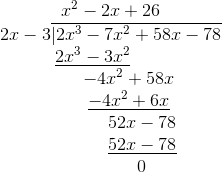
To finish solving, we can use the quadratic formula with the resulting quadratic,  :
:

If this polynomial has a real zero at 1.5, that means that the polynomial has a factor that when set equal to zero has a solution of
Now that we have one factor, we can divide to find the other two solutions:
To finish solving, we can use the quadratic formula with the resulting quadratic,
← Didn't Know|Knew It →
The polynomial  intersects the x-axis at point
  . Find the other two solutions.
The polynomial 
Tap to reveal answer
Since we know that one of the zeros of this polynomial is 3, we know that one of the factors is  . To find the other two zeros, we can divide the original polynomial by
  , either with long division or with synthetic division:
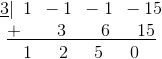
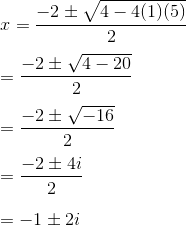
This gives us the second factor of  . We can get our solutions by using the quadratic formula:
Since we know that one of the zeros of this polynomial is 3, we know that one of the factors is
This gives us the second factor of
← Didn't Know|Knew It →
If the real zero of the polynomial  is 3, what are the complex zeros?
If the real zero of the polynomial
Tap to reveal answer
We know that the real zero of this polynomial is 3, so one of the factors must be  . To find the other factors, we can divide the original polynomial by
  , either by long division or synthetic division:
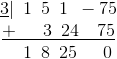
This gives us a second factor of  which we can solve using the quadratic formula:

We know that the real zero of this polynomial is 3, so one of the factors must be
This gives us a second factor of
← Didn't Know|Knew It →
Find all the real and complex zeroes of the following equation: 
Find all the real and complex zeroes of the following equation:

Tap to reveal answer
First, factorize the equation using grouping of common terms:

Next, setting each expression in parenthesis equal to zero yields the answers.


First, factorize the equation using grouping of common terms:

Next, setting each expression in parenthesis equal to zero yields the answers.


← Didn't Know|Knew It →
Find all the zeroes of the following equation and their multiplicity: 
Find all the zeroes of the following equation and their multiplicity:

Tap to reveal answer
First, pull out the common t and then factorize using quadratic factoring rules:

This equation has solutions at two values: when  and when
 Therefore, But since the degree on the former equation is one and the degree on the latter equation is two, the multiplicities are 1 and 2 respectively.
First, pull out the common t and then factorize using quadratic factoring rules:
This equation has solutions at two values: when 

← Didn't Know|Knew It →
Find a fourth degree polynomial whose zeroes are -2, 5, and 
Find a fourth degree polynomial whose zeroes are -2, 5, and

Tap to reveal answer
This one is a bit of a journey. The expressions for the first two zeroes are easily calculated,  and
and  respectively. The last expression must be broken up into two equations:
 which are then set equal to zero to yield the expressions
  and
and 
Finally, we multiply together all of the parenthesized expressions, which multiplies out to 
This one is a bit of a journey. The expressions for the first two zeroes are easily calculated, 


Finally, we multiply together all of the parenthesized expressions, which multiplies out to

← Didn't Know|Knew It →
The third degree polynomial expression  has a real zero at
  . Find all of the complex zeroes.
The third degree polynomial expression 

Tap to reveal answer
First, factor the expression by grouping:

To find the complex zeroes, set the term  equal to zero:

First, factor the expression by grouping:

To find the complex zeroes, set the term 

← Didn't Know|Knew It →
Find all the real and complex zeros of the following equation: 
Find all the real and complex zeros of the following equation:
Tap to reveal answer
First, factorize the equation using grouping of common terms:

Next, setting each expression in parentheses equal to zero yields the answers.

First, factorize the equation using grouping of common terms:
Next, setting each expression in parentheses equal to zero yields the answers.
← Didn't Know|Knew It →
Find all the zeroes of the following equation and their multiplicity: 
Find all the zeroes of the following equation and their multiplicity:
Tap to reveal answer
First, pull out the common t and then factorize using quadratic factoring rules: 
This equation has a solution as two values: when  , and when
  . Therefore, But since the degree on the former equation is one and the degree on the latter equation is two, the multiplicities are 1 and 2 respectively.
First, pull out the common t and then factorize using quadratic factoring rules:
This equation has a solution as two values: when 
← Didn't Know|Knew It →
Find a fourth-degree polynomial whose zeroes are  , and
, and 
Find a fourth-degree polynomial whose zeroes are 

Tap to reveal answer
This one is a bit of a journey. The expressions for the first two zeroes are easily calculated,  and
and  respectively. The last expression must be broken up into two equations:
  which are then set equal to zero to yield the expressions
 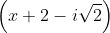 and
and 
Finally, we multiply together all of the parenthesized expressions, which multiplies out to 
This one is a bit of a journey. The expressions for the first two zeroes are easily calculated, 


Finally, we multiply together all of the parenthesized expressions, which multiplies out to
← Didn't Know|Knew It →
The third-degree polynomial expression  has a real zero at
  . Find all of the complex zeroes.
The third-degree polynomial expression 

Tap to reveal answer
First, factor the expression by grouping: 
To find the complex zeroes, set the term  equal to zero:
First, factor the expression by grouping:
To find the complex zeroes, set the term 
← Didn't Know|Knew It →
A polyomial with leading term  has 5 and 7 as roots; 7 is a double root. What is this polynomial?
A polyomial with leading term
Tap to reveal answer
Since 5 is a single root and 7 is a double root, and the degree of the polynomial is 3, the polynomial is  . To put this in expanded form:






Since 5 is a single root and 7 is a double root, and the degree of the polynomial is 3, the polynomial is
← Didn't Know|Knew It →
Express the polynomial 
as a product of linear factors.
Express the polynomial
as a product of linear factors.
Tap to reveal answer
We begin by attempting to find any rational roots using the Rational Root Theorem, which states that the possible rational roots are the positive or negative versions of the possible fractional combinations formed by placing a factor of the constant term in the numerator and a factor of the leading coefficient in the denominator.
That was a lot of wordage in one sentence, so let's break that down. We begin with our polynomial.

The constant term is the term without a variable (just a plain number). In our case the constant is 60. What are the possible factors of 60?

The leading coefficient is the number in front of the largest power of the variable. When the terms are listed in descending order (highest to lowest power), the leading coefficient is always the first number. In our case the leading coefficient is hard to spot. Since there is no number in front of  , the coefficient is 1 by default.
This is nice because the only factor of 1 is well ... 1.
We then create all the possible fractions with a factor of the constant in the numerator and a factor of the leading coefficient in the denominator. This actually isn't as bad as it could be since our only possible denominator is 1. Any fraction with a denominator of 1 is just the numerator. Therfore, our possible "fractions" are simply

However, we must consider the positive or negative versions of these, so our final list of possible rational roots is

Unfortunately, this is where the process (at least without the assitance of a graphing calculator) becomes less fun. Using synthetic division, we must simply try each possible root until we have success. There's really no consistent rule to tell us where to start. Generally starting with the smaller whole numbers is best because the synthetic division is easier. Therefore, we could begin with  then proceed to
  , etc.
For the sake of keeping this explanation as short as possible, I am going to skip straight to 2, where we will first find success.
Therefore, 2 is a root. However, it is always important to check to see if a root is in fact a double root (it works twice). Therefore, let's try it one more time.
2 does in fact work twice and is thus a double root. Since we only have three terms remainng, we can convert from synthetic back to an algebraic expression.

We can then factor.

Writing our root of 2 as an algebraic expression gives  . Since we have double root, we need two of these. Therfore, our final factored expression is.

We begin by attempting to find any rational roots using the Rational Root Theorem, which states that the possible rational roots are the positive or negative versions of the possible fractional combinations formed by placing a factor of the constant term in the numerator and a factor of the leading coefficient in the denominator.
That was a lot of wordage in one sentence, so let's break that down. We begin with our polynomial.
The constant term is the term without a variable (just a plain number). In our case the constant is 60. What are the possible factors of 60?
The leading coefficient is the number in front of the largest power of the variable. When the terms are listed in descending order (highest to lowest power), the leading coefficient is always the first number. In our case the leading coefficient is hard to spot. Since there is no number in front of
This is nice because the only factor of 1 is well ... 1.
We then create all the possible fractions with a factor of the constant in the numerator and a factor of the leading coefficient in the denominator. This actually isn't as bad as it could be since our only possible denominator is 1. Any fraction with a denominator of 1 is just the numerator. Therfore, our possible "fractions" are simply
However, we must consider the positive or negative versions of these, so our final list of possible rational roots is
Unfortunately, this is where the process (at least without the assitance of a graphing calculator) becomes less fun. Using synthetic division, we must simply try each possible root until we have success. There's really no consistent rule to tell us where to start. Generally starting with the smaller whole numbers is best because the synthetic division is easier. Therefore, we could begin with
For the sake of keeping this explanation as short as possible, I am going to skip straight to 2, where we will first find success.
Therefore, 2 is a root. However, it is always important to check to see if a root is in fact a double root (it works twice). Therefore, let's try it one more time.
2 does in fact work twice and is thus a double root. Since we only have three terms remainng, we can convert from synthetic back to an algebraic expression.
We can then factor.
Writing our root of 2 as an algebraic expression gives
← Didn't Know|Knew It →
Which of the following represents the polynomial expression defined by  in standard form?
Which of the following represents the polynomial expression defined by
Tap to reveal answer
Expansion and simplification give us  which is properly expressed in standard form with the constant on the right. Below is a walkthrough of the expansion and simplification (including binomial and trinomial expansion techniques).
Remember to multiply each term in one polynomial with each term in the other polynomial.
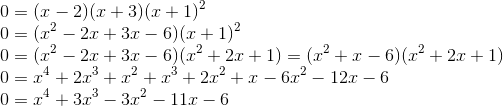
Expansion and simplification give us
Remember to multiply each term in one polynomial with each term in the other polynomial.
← Didn't Know|Knew It →
Which of the following is equivalent to  ?
?
Which of the following is equivalent to
Tap to reveal answer
To express this polynomial as a product of linear factors you have to find the zeros of the polynomial by the method of your choosing and then combine the linear expressions that yield those zeros.
Factoring will get you  , but then you are left to sort through the thrid degree polynomial. We can quickly synthetically divide the polynomial
  by its potential roots
  factors of
  . So that's
  .
.
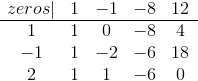
We know that  is a zero and dividing the original polynomial by
  and
and  gives us the polynomial
  . We can factor this or use the quadratic formula to give
  .
.
This leaves us with four linear expressions that compose the polynomial:

To express this polynomial as a product of linear factors you have to find the zeros of the polynomial by the method of your choosing and then combine the linear expressions that yield those zeros.
Factoring will get you
We know that
This leaves us with four linear expressions that compose the polynomial:
← Didn't Know|Knew It →
Factorize the following expression completely to its linear factors: 
Factorize the following expression completely to its linear factors:
Tap to reveal answer
Use the grouping method to factorize common terms:

Use the grouping method to factorize common terms:
← Didn't Know|Knew It →
Factorize the following expression completely to its linear factors: f(x)=

Factorize the following expression completely to its linear factors: f(x)=
Tap to reveal answer
Use grouping method to factorize common terms:

Use grouping method to factorize common terms:
← Didn't Know|Knew It →
Express the polynomial as a product of linear factors: 
Express the polynomial as a product of linear factors:
Tap to reveal answer
First pull out the common factor of 2, and then factorize:

First pull out the common factor of 2, and then factorize:
← Didn't Know|Knew It →
Find the real zeros of the equation using factorization: f(x)= 
Find the real zeros of the equation using factorization: f(x)=
Tap to reveal answer
Use grouping to factorize the common terms:

Use grouping to factorize the common terms:
← Didn't Know|Knew It →