Find the Product of a Matrix and a Scalar - Pre-Calculus
Card 1 of 48
Find the product.
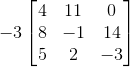
Find the product.
Tap to reveal answer
When we multiply a scalar (regular number) by a matrix, all we need to do is mulitply it to every entry inside the matrix:
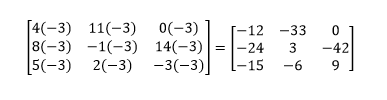
When we multiply a scalar (regular number) by a matrix, all we need to do is mulitply it to every entry inside the matrix:
← Didn't Know|Knew It →
Find the product.
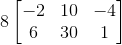
Find the product.
Tap to reveal answer
When we multiply a scalar (regular number) by a matrix, all we need to do is mulitply it through to every entry inside the matrix:
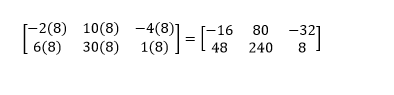
When we multiply a scalar (regular number) by a matrix, all we need to do is mulitply it through to every entry inside the matrix:
← Didn't Know|Knew It →
Find the product.

Find the product.
Tap to reveal answer
When we multiply a scalar (regular number) by a matrix, all we need to do is mulitply it through to every entry inside the matrix:
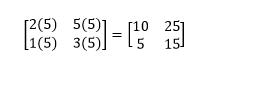
When we multiply a scalar (regular number) by a matrix, all we need to do is mulitply it through to every entry inside the matrix:
← Didn't Know|Knew It →
We consider the following matrix:
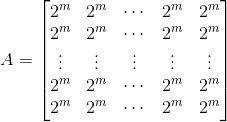
let 
what matrix do we get when we perform the following product:

We consider the following matrix:
let
what matrix do we get when we perform the following product:
Tap to reveal answer
We note k is simply a scalar. To do this multiplication all we need to do is to multply each entry of the matrix by k.
we see that when we multiply we have :

this gives the entry of the matrix kA.
Therefore the resulting matrix is :
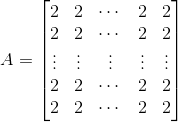
We note k is simply a scalar. To do this multiplication all we need to do is to multply each entry of the matrix by k.
we see that when we multiply we have :
this gives the entry of the matrix kA.
Therefore the resulting matrix is :
← Didn't Know|Knew It →
We consider the matrix defined below.
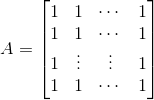
Find the sum : 
We consider the matrix defined below.
Find the sum :
Tap to reveal answer
Since we are adding the matrix to itself, we have the same size, we can perform the matrices addition.
We know that when adding matrices, we add them componenwise. Let (i,j) be any entry of the addition matrix. We add the entry form A to the entry from B which is the same as A. This means that to add A+A we simply add each entry of A to itself.
Since the entries from A are the same and given by 1 and the entries from B=A are the same and given by 1, we add these two to obtain:
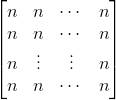
1+1 and this means that each entry of A+A is 2. We continue in this fashion by additing the entries of A each one to itself n times to obtain that the entries of A+A+....A( n times ) are given by:
Since we are adding the matrix to itself, we have the same size, we can perform the matrices addition.
We know that when adding matrices, we add them componenwise. Let (i,j) be any entry of the addition matrix. We add the entry form A to the entry from B which is the same as A. This means that to add A+A we simply add each entry of A to itself.
Since the entries from A are the same and given by 1 and the entries from B=A are the same and given by 1, we add these two to obtain:
1+1 and this means that each entry of A+A is 2. We continue in this fashion by additing the entries of A each one to itself n times to obtain that the entries of A+A+....A( n times ) are given by:
← Didn't Know|Knew It →
Let  be a positive integer and let
  be defined as below:
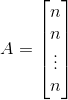
Find the product  .
.
Let
Find the product
Tap to reveal answer
We note n is simply a scalar. To do this multiplication all we need to do is to multply each entry of the matrix by n.
We see that when we multiply we have :  .
.
This means that each entry of the resulting matrix is  .
.
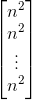
This gives the nA which is :
We note n is simply a scalar. To do this multiplication all we need to do is to multply each entry of the matrix by n.
We see that when we multiply we have :
This means that each entry of the resulting matrix is
This gives the nA which is :
← Didn't Know|Knew It →
Evaluate: 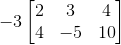
Evaluate:
Tap to reveal answer
This problem involves a scalar multiplication with a matrix. Simply distribute the negative three and multiply this value with every number in the 2 by 3 matrix. The rows and columns will not change.

This problem involves a scalar multiplication with a matrix. Simply distribute the negative three and multiply this value with every number in the 2 by 3 matrix. The rows and columns will not change.
← Didn't Know|Knew It →
Compute: 
Compute:
Tap to reveal answer
A scalar that multiplies a one by two matrix will result in a one by two matrix.
Multiply the scalar value with each value in the matrix.

A scalar that multiplies a one by two matrix will result in a one by two matrix.
Multiply the scalar value with each value in the matrix.
← Didn't Know|Knew It →
Simplify:
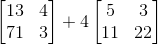
Simplify:
Tap to reveal answer
Scalar multiplication and addition of matrices are both very easy. Just like regular scalar values, you do multiplication first:

The addition of matrices is very easy. You merely need to add them directly together, correlating the spaces directly.


Scalar multiplication and addition of matrices are both very easy. Just like regular scalar values, you do multiplication first:
The addition of matrices is very easy. You merely need to add them directly together, correlating the spaces directly.
← Didn't Know|Knew It →
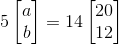
What is  ?
?
What is
Tap to reveal answer
You can begin by treating this equation just like it was:

That is, you can divide both sides by  :
:
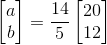
Now, for scalar multiplication of matrices, you merely need to multiply the scalar by each component:
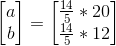
Then, simplify:

Therefore, 
You can begin by treating this equation just like it was:
That is, you can divide both sides by
Now, for scalar multiplication of matrices, you merely need to multiply the scalar by each component:
Then, simplify:
Therefore,
← Didn't Know|Knew It →
If  , what is
  ?
?
If
Tap to reveal answer
Begin by distributing the fraction through the matrix on the left side of the equation. This will simplify the contents, given that they are factors of  :
:
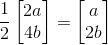
Now, this means that your equation looks like:

This simply means:

and
 or
or 
Therefore, 
Begin by distributing the fraction through the matrix on the left side of the equation. This will simplify the contents, given that they are factors of
Now, this means that your equation looks like:
This simply means:
and
Therefore,
← Didn't Know|Knew It →
Find 3A given:
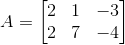
Find 3A given:
Tap to reveal answer
To multiply a scalar and a matrix, simly multiply each number in the matrix by the scalar. Thus,

To multiply a scalar and a matrix, simly multiply each number in the matrix by the scalar. Thus,
← Didn't Know|Knew It →
Find the product.
Find the product.
Tap to reveal answer
When we multiply a scalar (regular number) by a matrix, all we need to do is mulitply it to every entry inside the matrix:
When we multiply a scalar (regular number) by a matrix, all we need to do is mulitply it to every entry inside the matrix:
← Didn't Know|Knew It →
Find the product.
Find the product.
Tap to reveal answer
When we multiply a scalar (regular number) by a matrix, all we need to do is mulitply it through to every entry inside the matrix:
When we multiply a scalar (regular number) by a matrix, all we need to do is mulitply it through to every entry inside the matrix:
← Didn't Know|Knew It →
Find the product.
Find the product.
Tap to reveal answer
When we multiply a scalar (regular number) by a matrix, all we need to do is mulitply it through to every entry inside the matrix:
When we multiply a scalar (regular number) by a matrix, all we need to do is mulitply it through to every entry inside the matrix:
← Didn't Know|Knew It →
We consider the following matrix:
let
what matrix do we get when we perform the following product:
We consider the following matrix:
let
what matrix do we get when we perform the following product:
Tap to reveal answer
We note k is simply a scalar. To do this multiplication all we need to do is to multply each entry of the matrix by k.
we see that when we multiply we have :
this gives the entry of the matrix kA.
Therefore the resulting matrix is :
We note k is simply a scalar. To do this multiplication all we need to do is to multply each entry of the matrix by k.
we see that when we multiply we have :
this gives the entry of the matrix kA.
Therefore the resulting matrix is :
← Didn't Know|Knew It →
We consider the matrix defined below.
Find the sum :
We consider the matrix defined below.
Find the sum :
Tap to reveal answer
Since we are adding the matrix to itself, we have the same size, we can perform the matrices addition.
We know that when adding matrices, we add them componenwise. Let (i,j) be any entry of the addition matrix. We add the entry form A to the entry from B which is the same as A. This means that to add A+A we simply add each entry of A to itself.
Since the entries from A are the same and given by 1 and the entries from B=A are the same and given by 1, we add these two to obtain:
1+1 and this means that each entry of A+A is 2. We continue in this fashion by additing the entries of A each one to itself n times to obtain that the entries of A+A+....A( n times ) are given by:
Since we are adding the matrix to itself, we have the same size, we can perform the matrices addition.
We know that when adding matrices, we add them componenwise. Let (i,j) be any entry of the addition matrix. We add the entry form A to the entry from B which is the same as A. This means that to add A+A we simply add each entry of A to itself.
Since the entries from A are the same and given by 1 and the entries from B=A are the same and given by 1, we add these two to obtain:
1+1 and this means that each entry of A+A is 2. We continue in this fashion by additing the entries of A each one to itself n times to obtain that the entries of A+A+....A( n times ) are given by:
← Didn't Know|Knew It →
Let be a positive integer and let be defined as below:
Find the product .
Let
Find the product
Tap to reveal answer
We note n is simply a scalar. To do this multiplication all we need to do is to multply each entry of the matrix by n.
We see that when we multiply we have : .
This means that each entry of the resulting matrix is .
This gives the nA which is :
We note n is simply a scalar. To do this multiplication all we need to do is to multply each entry of the matrix by n.
We see that when we multiply we have :
This means that each entry of the resulting matrix is
This gives the nA which is :
← Didn't Know|Knew It →
Evaluate:
Evaluate:
Tap to reveal answer
This problem involves a scalar multiplication with a matrix. Simply distribute the negative three and multiply this value with every number in the 2 by 3 matrix. The rows and columns will not change.
This problem involves a scalar multiplication with a matrix. Simply distribute the negative three and multiply this value with every number in the 2 by 3 matrix. The rows and columns will not change.
← Didn't Know|Knew It →
Compute:
Compute:
Tap to reveal answer
A scalar that multiplies a one by two matrix will result in a one by two matrix.
Multiply the scalar value with each value in the matrix.
A scalar that multiplies a one by two matrix will result in a one by two matrix.
Multiply the scalar value with each value in the matrix.
← Didn't Know|Knew It →