Find the Limit of a Function - Pre-Calculus
Card 1 of 68
Let  .
.
Find  .
.
Let
Find
Tap to reveal answer
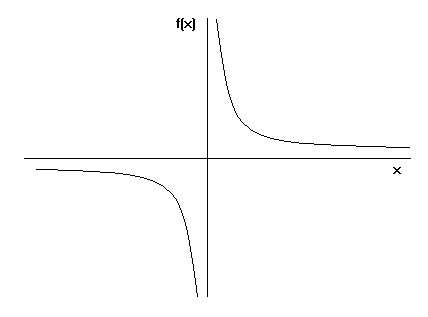
This is a graph of  . We know that
  is undefined; therefore, there is no value for
  . But as we take a look at the graph, we can see that as
  approaches 0 from the left,
  approaches negative infinity.
This can be illustrated by thinking of small negative numbers.


NOTE: Pay attention to one-sided limit specifications, as it is easy to pick the wrong answer choice if you're not careful.
 is actually infinity, not negative infinity.
This is a graph of
This can be illustrated by thinking of small negative numbers.
NOTE: Pay attention to one-sided limit specifications, as it is easy to pick the wrong answer choice if you're not careful.
← Didn't Know|Knew It →
The speed of a car traveling on the highway is given by the following function of time:

What can you say about the car's speed after a long time (that is, as  approaches infinity)?
The speed of a car traveling on the highway is given by the following function of time:
What can you say about the car's speed after a long time (that is, as
Tap to reveal answer
The function given is a polynomial with a term  , such that
  is greater than 1.
Whenever this is the case, we can say that the whole function diverges (approaches infinity) in the limit as  approaches infinity.
This tells us that the given function is not a very realistic description of a car's speed for large  !
!
The function given is a polynomial with a term
Whenever this is the case, we can say that the whole function diverges (approaches infinity) in the limit as
This tells us that the given function is not a very realistic description of a car's speed for large
← Didn't Know|Knew It →
Evaluate the limit below:

Evaluate the limit below:
Tap to reveal answer
 will approach
  when
when  approaches
  , so
, so  will be of type
  as shown below:

So, we can apply the L’ Hospital's Rule:


since:
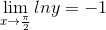
hence:

So, we can apply the L’ Hospital's Rule:
since:
hence:
← Didn't Know|Knew It →
Calculate  .
.
Calculate
Tap to reveal answer
This can be rewritten as follows:



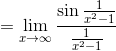
We can substitute  , noting that as
  ,
,  :
:
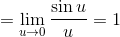 , which is the correct choice.
This can be rewritten as follows:
We can substitute
← Didn't Know|Knew It →
Evaluate the following limit.

Evaluate the following limit.
Tap to reveal answer
The function has a removable discontinuity at  . Once a factor of
  is "divided out" the resultant function is
  , which evaluates to
  as
as  approaches 0.
The function has a removable discontinuity at
← Didn't Know|Knew It →
Find the limit as x approaches infinity

Find the limit as x approaches infinity
Tap to reveal answer
As x approaches infinity we only need to look at the highest order of polynomial in both the numerator and denominator. Then we compare the highest order polynomial in both the numerator and denominator. If the denominator is higher order our limit goes to zero, if the numerator is higher our order our limit goes to positive or negative infinity (depending on the sign of the highest order x term). If our numerator and denominator have the same order the limit goes to a/b where a is the coefficient for the highest order x in the numerator and b is the coefficient for the highest order x in the denominator.
Our numerator has higher order and the coefficient for the x to the fourth term is negative so our limit goes to negative infinity.
As x approaches infinity we only need to look at the highest order of polynomial in both the numerator and denominator. Then we compare the highest order polynomial in both the numerator and denominator. If the denominator is higher order our limit goes to zero, if the numerator is higher our order our limit goes to positive or negative infinity (depending on the sign of the highest order x term). If our numerator and denominator have the same order the limit goes to a/b where a is the coefficient for the highest order x in the numerator and b is the coefficient for the highest order x in the denominator.
Our numerator has higher order and the coefficient for the x to the fourth term is negative so our limit goes to negative infinity.
← Didn't Know|Knew It →
Solve the limit as  approaches infinity.

Solve the limit as
Tap to reveal answer
As x approaches infinity we only need to look at the highest order of polynomial in both the numerator and denominator. Then we compare the highest order polynomial in both the numerator and denominator. If the denominator is higher order our limit goes to zero, if the numerator is higher our order our limit goes to positive or negative infinity (depending on the sign of the highest order x term). If our numerator and denominator have the same order the limit goes to a/b where a is the coefficient for the highest order x in the numerator and b is the coefficient for the highest order x in the denominator.
For our equation the orders are the same in x for the numerator and denominator (both 4). So we divide the coefficients of the highest order x terms to get our limit and we get

As x approaches infinity we only need to look at the highest order of polynomial in both the numerator and denominator. Then we compare the highest order polynomial in both the numerator and denominator. If the denominator is higher order our limit goes to zero, if the numerator is higher our order our limit goes to positive or negative infinity (depending on the sign of the highest order x term). If our numerator and denominator have the same order the limit goes to a/b where a is the coefficient for the highest order x in the numerator and b is the coefficient for the highest order x in the denominator.
For our equation the orders are the same in x for the numerator and denominator (both 4). So we divide the coefficients of the highest order x terms to get our limit and we get
← Didn't Know|Knew It →
Find the limit

Find the limit
Tap to reveal answer
When x=3/2 our denominator is zero so we can't just plug in 3/2 to get our limit. If we look at the numerator when x=3/2 we find that it is zero as well so our numerator can be factored. We see that our limit can be re-written as:

we then can cancel the 2x-3 from the numerator and denominator leaving us with:

and we can just plug in 3/2 into this limit to get

note: our function is not continuous at x=3/2 but the limit does exist.
When x=3/2 our denominator is zero so we can't just plug in 3/2 to get our limit. If we look at the numerator when x=3/2 we find that it is zero as well so our numerator can be factored. We see that our limit can be re-written as:
we then can cancel the 2x-3 from the numerator and denominator leaving us with:
and we can just plug in 3/2 into this limit to get
note: our function is not continuous at x=3/2 but the limit does exist.
← Didn't Know|Knew It →
Solve the following limit:

Solve the following limit:
Tap to reveal answer
To solve this problem we need to expand the term in the numerator 
when we do that we get

the second degree x terms cancel and we get

now we can cancel our h's in the numerator and denominator to get

then we can just plug 0 in for h and we get our answer
To solve this problem we need to expand the term in the numerator
when we do that we get
the second degree x terms cancel and we get
now we can cancel our h's in the numerator and denominator to get
then we can just plug 0 in for h and we get our answer
← Didn't Know|Knew It →
Finding limits of rational functions.
Let
 .
.
Find
 .
.
Finding limits of rational functions.
Let
Find
Tap to reveal answer
First factor the numerator to simplify the function.
 ,
,
so
 .
.
Now

 .
.
There is no denominator now, and hence no discontinuity. The limit can be found by simply plugging in  for
for  .
.
 .
.
First factor the numerator to simplify the function.
so
Now
There is no denominator now, and hence no discontinuity. The limit can be found by simply plugging in
← Didn't Know|Knew It →
The Michaelis-Menten equation is important in chemical kinetics. Suppose we are given the following equation relating K (reaction rate) and C (concentration):

Determine:

The Michaelis-Menten equation is important in chemical kinetics. Suppose we are given the following equation relating K (reaction rate) and C (concentration):
Determine:
Tap to reveal answer
There are a number of ways to solve this. Either we can solve by finding what K(C) evaluates to for larger values of C and see where they converge, i.e. :
K(10000) = 952.38
K(1000000) = 999.5
etc...
And we see that K(C) approaches 1000 for larger concentrations, C.
Or we can notice that the dominant term in the numerator is 1000C; dominant term in the denominator is C.
1000C / C = 1000, which will ultimately be our limit.
There are a number of ways to solve this. Either we can solve by finding what K(C) evaluates to for larger values of C and see where they converge, i.e. :
K(10000) = 952.38
K(1000000) = 999.5
etc...
And we see that K(C) approaches 1000 for larger concentrations, C.
Or we can notice that the dominant term in the numerator is 1000C; dominant term in the denominator is C.
1000C / C = 1000, which will ultimately be our limit.
← Didn't Know|Knew It →
Let  .
.
Find 
 .
.
Let
Find
Tap to reveal answer
To find 
 here, you need only plug in
  for
for  :
:

To find
← Didn't Know|Knew It →
Evaluate
 .
.
Evaluate
Tap to reveal answer
Find a common denominator for both the upper and lower expressions and then simplify:

Find a common denominator for both the upper and lower expressions and then simplify:
← Didn't Know|Knew It →
Find the limit of the function:

Find the limit of the function:
Tap to reveal answer
Substituting the value of  will yield
  , which is not in indeterminate form. Therefore, L'Hopital's rule cannot be used.
The question asks for the limit as x approaches to five from the right side in the graph. As the graph approaches closer and closer to  , the y-value decreases to negative infinity and will never touch
  .
.
The correct answer is: 
Substituting the value of
The question asks for the limit as x approaches to five from the right side in the graph. As the graph approaches closer and closer to
The correct answer is:
← Didn't Know|Knew It →
Find the limit.

Find the limit.
Tap to reveal answer
In the unsimplified form, the limit does not exist; however, the numerator can be factored and simplified.

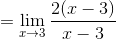

In the unsimplified form, the limit does not exist; however, the numerator can be factored and simplified.
← Didn't Know|Knew It →
Find the following limit:

Find the following limit:
Tap to reveal answer
To solve, simply realize you are dealing with a limit whose numerator and demominator have the same max power. Thus the limit is simply the division of their coefficient.
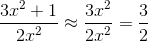
To solve, simply realize you are dealing with a limit whose numerator and demominator have the same max power. Thus the limit is simply the division of their coefficient.
← Didn't Know|Knew It →
Find the limit: 
Find the limit:
Tap to reveal answer
The first and only step is to substitute the value of  into the function. Since there is not a zero denominator or an indeterminate form, we do not have to worry about L'Hopital or an undefined limit.

The limit will approach to  .
.
The first and only step is to substitute the value of
The limit will approach to
← Didn't Know|Knew It →
Let .
Find .
Let
Find
Tap to reveal answer
This is a graph of . We know that is undefined; therefore, there is no value for . But as we take a look at the graph, we can see that as approaches 0 from the left, approaches negative infinity.
This can be illustrated by thinking of small negative numbers.
NOTE: Pay attention to one-sided limit specifications, as it is easy to pick the wrong answer choice if you're not careful.
is actually infinity, not negative infinity.
This is a graph of
This can be illustrated by thinking of small negative numbers.
NOTE: Pay attention to one-sided limit specifications, as it is easy to pick the wrong answer choice if you're not careful.
← Didn't Know|Knew It →
The speed of a car traveling on the highway is given by the following function of time:
What can you say about the car's speed after a long time (that is, as approaches infinity)?
The speed of a car traveling on the highway is given by the following function of time:
What can you say about the car's speed after a long time (that is, as
Tap to reveal answer
The function given is a polynomial with a term , such that is greater than 1.
Whenever this is the case, we can say that the whole function diverges (approaches infinity) in the limit as approaches infinity.
This tells us that the given function is not a very realistic description of a car's speed for large !
The function given is a polynomial with a term
Whenever this is the case, we can say that the whole function diverges (approaches infinity) in the limit as
This tells us that the given function is not a very realistic description of a car's speed for large
← Didn't Know|Knew It →
Evaluate the limit below:
Evaluate the limit below:
Tap to reveal answer
will approach when approaches , so will be of type as shown below:
So, we can apply the L’ Hospital's Rule:
since:
hence:
So, we can apply the L’ Hospital's Rule:
since:
hence:
← Didn't Know|Knew It →