Find roots of quadratic equation using discriminant - Pre-Calculus
Card 1 of 40
True or false: for a quadratic function of form ax2 + bx + c = 0, if the discriminant b2 - 4ac = 0, there is exactly one real root.
True or false: for a quadratic function of form ax2 + bx + c = 0, if the discriminant b2 - 4ac = 0, there is exactly one real root.
Tap to reveal answer
This is true. The discriminant b2 - 4ac is the part of the quadratic formula that lives inside of a square root function. As you plug in the constants a, b, and c into b2 - 4ac and evaluate, three cases can happen:
b2 - 4ac > 0
b2 - 4ac = 0
b2 - 4ac < 0
In the first case, having a positive number under a square root function will yield a result that is a positive number answer. However, because the quadratic function includes  , this scenario yields two real results.
In the middle case (the case of our example),  . Going back to the quadratic formula
  , you can see that when everything under the square root is simply 0, then you get only
  , which is why you have exactly one real root.
For the final case, if b2 - 4ac < 0, that means you have a negative number under a square root. This means that you will not have any real roots of the equation; however, you will have exactly two imaginary roots of the equation.
This is true. The discriminant b2 - 4ac is the part of the quadratic formula that lives inside of a square root function. As you plug in the constants a, b, and c into b2 - 4ac and evaluate, three cases can happen:
b2 - 4ac > 0
b2 - 4ac = 0
b2 - 4ac < 0
In the first case, having a positive number under a square root function will yield a result that is a positive number answer. However, because the quadratic function includes 
In the middle case (the case of our example), 


For the final case, if b2 - 4ac < 0, that means you have a negative number under a square root. This means that you will not have any real roots of the equation; however, you will have exactly two imaginary roots of the equation.
← Didn't Know|Knew It →
True or false: for a quadratic function of form ax2 + bx + c = 0, if the discriminant b2 - 4ac > 0, there are exactly 2 distinct real roots of the equation.
True or false: for a quadratic function of form ax2 + bx + c = 0, if the discriminant b2 - 4ac > 0, there are exactly 2 distinct real roots of the equation.
Tap to reveal answer
This is true. The discriminant b2 - 4ac is the part of the quadratic formula that lives inside of a square root function. As you plug in the constants a, b, and c into b2 - 4ac and evaluate, three cases can happen:
b2 - 4ac > 0
b2 - 4ac = 0
b2 - 4ac < 0
In the first case (the case of our example), having a positive number under a square root function will yield a result that is a positive number answer. However, because the quadratic function includes  , this scenario yields two real results.
In the middle case,  . Going back to the quadratic formula
  , you can see that when everything under the square root is simply 0, then you get only
  , which is why you have exactly one real root.
For the final case, if b2 - 4ac < 0, that means you have a negative number under a square root. This means that you will not have any real roots of the equation; however, you will have exactly two imaginary roots of the equation.
This is true. The discriminant b2 - 4ac is the part of the quadratic formula that lives inside of a square root function. As you plug in the constants a, b, and c into b2 - 4ac and evaluate, three cases can happen:
b2 - 4ac > 0
b2 - 4ac = 0
b2 - 4ac < 0
In the first case (the case of our example), having a positive number under a square root function will yield a result that is a positive number answer. However, because the quadratic function includes 
In the middle case, 


For the final case, if b2 - 4ac < 0, that means you have a negative number under a square root. This means that you will not have any real roots of the equation; however, you will have exactly two imaginary roots of the equation.
← Didn't Know|Knew It →
True or false: for a quadratic function of form ax2 + bx + c = 0, if the discriminant b2 - 4ac < 0, there are exactly two distinct real roots.
True or false: for a quadratic function of form ax2 + bx + c = 0, if the discriminant b2 - 4ac < 0, there are exactly two distinct real roots.
Tap to reveal answer
This is false. The discriminant b2 - 4ac is the part of the quadratic formula that lives inside of a square root function. As you plug in the constants a, b, and c into b2 - 4ac and evaluate, three cases can happen:
b2 - 4ac > 0
b2 - 4ac = 0
b2 - 4ac < 0
In the first case, having a positive number under a square root function will yield a result that is a positive number answer. However, because the quadratic function includes  , this scenario yields two real results.
In the middle case,  . Going back to the quadratic formula
  , you can see that when everything under the square root is simply 0, then you get only
  , which is why you have exactly one real root.
For the final case (the case of our example), if b2 - 4ac < 0, that means you have a negative number under a square root. This means that you will not have any real roots of the equation; however, you will have exactly two imaginary roots of the equation.
This is false. The discriminant b2 - 4ac is the part of the quadratic formula that lives inside of a square root function. As you plug in the constants a, b, and c into b2 - 4ac and evaluate, three cases can happen:
b2 - 4ac > 0
b2 - 4ac = 0
b2 - 4ac < 0
In the first case, having a positive number under a square root function will yield a result that is a positive number answer. However, because the quadratic function includes 
In the middle case, 


For the final case (the case of our example), if b2 - 4ac < 0, that means you have a negative number under a square root. This means that you will not have any real roots of the equation; however, you will have exactly two imaginary roots of the equation.
← Didn't Know|Knew It →
Use the formula b2 - 4ac to find the discriminant of the following equation: 4x2 + 19x - 5 = 0.
Then state how many roots it has, and whether they are real or imaginary. Finally, use the quadratic function to find the exact roots of the equation.
Use the formula b2 - 4ac to find the discriminant of the following equation: 4x2 + 19x - 5 = 0.
Then state how many roots it has, and whether they are real or imaginary. Finally, use the quadratic function to find the exact roots of the equation.
Tap to reveal answer
In the above equation, a = 4, b = 19, and c = -5. Therefore:
b2 - 4ac = (19)2 - 4(4)(-5) = 361 + 80 = 441.
When the discriminant is greater than 0, there are two distinct real roots. When the discriminant is equal to 0, there is exactly one real root. When the discriminant is less than zero, there are no real roots, but there are exactly two distinct imaginary roots. In this case, we have two real roots.
Finally, we use the quadratic function to find these exact roots. The quadratic function is:
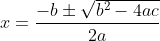
Plugging in our values of a, b, and c, we get:

This simplifies to:

which simplifies to

which gives us two answers:
 or
or 
These values of x are the two distinct real roots of the given equation.
In the above equation, a = 4, b = 19, and c = -5. Therefore:
b2 - 4ac = (19)2 - 4(4)(-5) = 361 + 80 = 441.
When the discriminant is greater than 0, there are two distinct real roots. When the discriminant is equal to 0, there is exactly one real root. When the discriminant is less than zero, there are no real roots, but there are exactly two distinct imaginary roots. In this case, we have two real roots.
Finally, we use the quadratic function to find these exact roots. The quadratic function is:
Plugging in our values of a, b, and c, we get:

This simplifies to:

which simplifies to

which gives us two answers:


These values of x are the two distinct real roots of the given equation.
← Didn't Know|Knew It →
Use the formula b2 - 4ac to find the discriminant of the following equation: 4x2 + 12x + 10 = 0.
Then state how many roots it has, and whether they are real or imaginary. Finally, use the quadratic function to find the exact roots of the equation.
Use the formula b2 - 4ac to find the discriminant of the following equation: 4x2 + 12x + 10 = 0.
Then state how many roots it has, and whether they are real or imaginary. Finally, use the quadratic function to find the exact roots of the equation.
Tap to reveal answer
In the above equation, a = 4, b = 12, and c = 10. Therefore:
b2 - 4ac = (12)2 - 4(4)(10) = 144 - 160 = -16.
When the discriminant is greater than 0, there are two distinct real roots. When the discriminant is equal to 0, there is exactly one real root. When the discriminant is less than zero, there are no real roots, but there are exactly two distinct imaginary roots. In this case, we have two distinct imaginary roots.
Finally, we use the quadratic function to find these exact roots. The quadratic function is:
Plugging in our values of a, b, and c, we get:

This simplifies to:


In other words, our two distinct imaginary roots are  and
and 
In the above equation, a = 4, b = 12, and c = 10. Therefore:
b2 - 4ac = (12)2 - 4(4)(10) = 144 - 160 = -16.
When the discriminant is greater than 0, there are two distinct real roots. When the discriminant is equal to 0, there is exactly one real root. When the discriminant is less than zero, there are no real roots, but there are exactly two distinct imaginary roots. In this case, we have two distinct imaginary roots.
Finally, we use the quadratic function to find these exact roots. The quadratic function is:
Plugging in our values of a, b, and c, we get:

This simplifies to:


In other words, our two distinct imaginary roots are 

← Didn't Know|Knew It →
Use the formula b2 - 4ac to find the discriminant of the following equation: -3x2 + 6x - 3 = 0.
Then state how many roots it has, and whether they are real or imaginary. Finally, use the quadratic function to find the exact roots of the equation.
Use the formula b2 - 4ac to find the discriminant of the following equation: -3x2 + 6x - 3 = 0.
Then state how many roots it has, and whether they are real or imaginary. Finally, use the quadratic function to find the exact roots of the equation.
Tap to reveal answer
In the above equation, a = -3, b = 6, and c = -3. Therefore:
b2 - 4ac = (6)2 - 4(-3)(-3) = 36 - 36 = 0.
When the discriminant is greater than 0, there are two distinct real roots. When the discriminant is equal to 0, there is exactly one real root. When the discriminant is less than zero, there are no real roots, but there are exactly two distinct imaginary roots. In this case, there is exactly one real root.
Finally, we use the quadratic function to find these exact root. The quadratic formula is:
Plugging in our values of a, b, and c, we get:

This simplifies to:

which simplifies to

which gives us one answer: x = 1
This value of x is the one distinct real root of the given equation.
In the above equation, a = -3, b = 6, and c = -3. Therefore:
b2 - 4ac = (6)2 - 4(-3)(-3) = 36 - 36 = 0.
When the discriminant is greater than 0, there are two distinct real roots. When the discriminant is equal to 0, there is exactly one real root. When the discriminant is less than zero, there are no real roots, but there are exactly two distinct imaginary roots. In this case, there is exactly one real root.
Finally, we use the quadratic function to find these exact root. The quadratic formula is:
Plugging in our values of a, b, and c, we get:

This simplifies to:

which simplifies to

which gives us one answer: x = 1
This value of x is the one distinct real root of the given equation.
← Didn't Know|Knew It →
Use the formula b2 - 4ac to find the discriminant of the following equation: x2 + 5x + 4 = 0.
Then state how many roots it has, and whether they are real or imaginary. Finally, use the quadratic function to find the exact roots of the equation.
Use the formula b2 - 4ac to find the discriminant of the following equation: x2 + 5x + 4 = 0.
Then state how many roots it has, and whether they are real or imaginary. Finally, use the quadratic function to find the exact roots of the equation.
Tap to reveal answer
In the above equation, a = 1, b = 5, and c = 4. Therefore:
b2 - 4ac = (5)2 - 4(1)(4) = 25 - 16 = 9.
When the discriminant is greater than 0, there are two distinct real roots. When the discriminant is equal to 0, there is exactly one real root. When the discriminant is less than zero, there are no real roots, but there are exactly two distinct imaginary roots. In this case, we have two real roots.
Finally, we use the quadratic function to find these exact roots. The quadratic function is:
Plugging in our values of a, b, and c, we get:
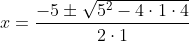
This simplifies to:
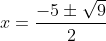
which simplifies to

which gives us two answers:
x = -1 or x = -4
These values of x are the two distinct real roots of the given equation.
In the above equation, a = 1, b = 5, and c = 4. Therefore:
b2 - 4ac = (5)2 - 4(1)(4) = 25 - 16 = 9.
When the discriminant is greater than 0, there are two distinct real roots. When the discriminant is equal to 0, there is exactly one real root. When the discriminant is less than zero, there are no real roots, but there are exactly two distinct imaginary roots. In this case, we have two real roots.
Finally, we use the quadratic function to find these exact roots. The quadratic function is:
Plugging in our values of a, b, and c, we get:
This simplifies to:
which simplifies to

which gives us two answers:
x = -1 or x = -4
These values of x are the two distinct real roots of the given equation.
← Didn't Know|Knew It →
Use the formula b2 - 4ac to find the discriminant of the following equation: -x2 + 3x - 3 = 0.
Then state how many roots it has, and whether they are real or imaginary. Finally, use the quadratic function to find the exact roots of the equation.
Use the formula b2 - 4ac to find the discriminant of the following equation: -x2 + 3x - 3 = 0.
Then state how many roots it has, and whether they are real or imaginary. Finally, use the quadratic function to find the exact roots of the equation.
Tap to reveal answer
In the above equation, a = -1, b = 3, and c = -3. Therefore:
b2 - 4ac = (3)2 - 4(-1)(-3) = 9 - 12 = -3.
When the discriminant is greater than 0, there are two distinct real roots. When the discriminant is equal to 0, there is exactly one real root. When the discriminant is less than zero, there are no real roots, but there are exactly two distinct imaginary roots. In this case, we have two distinct imaginary roots.
Finally, we use the quadratic function to find these exact roots. The quadratic function is:
Plugging in our values of a, b, and c, we get:

This simplifies to:
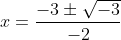
Because  , this simplifies to
  . In other words, our two distinct imaginary roots are
  and
and 
In the above equation, a = -1, b = 3, and c = -3. Therefore:
b2 - 4ac = (3)2 - 4(-1)(-3) = 9 - 12 = -3.
When the discriminant is greater than 0, there are two distinct real roots. When the discriminant is equal to 0, there is exactly one real root. When the discriminant is less than zero, there are no real roots, but there are exactly two distinct imaginary roots. In this case, we have two distinct imaginary roots.
Finally, we use the quadratic function to find these exact roots. The quadratic function is:
Plugging in our values of a, b, and c, we get:
This simplifies to:
Because 


← Didn't Know|Knew It →
Use the formula b2 - 4ac to find the discriminant of the following equation: x2 + 2x + 10 = 0.
Then state how many roots it has, and whether they are real or imaginary. Finally, use the quadratic function to find the exact roots of the equation.
Use the formula b2 - 4ac to find the discriminant of the following equation: x2 + 2x + 10 = 0.
Then state how many roots it has, and whether they are real or imaginary. Finally, use the quadratic function to find the exact roots of the equation.
Tap to reveal answer
In the above equation, a = 1, b = 2, and c = 10. Therefore:
b2 - 4ac = (2)2 - 4(1)(10) = 4 - 40 = -36.
When the discriminant is greater than 0, there are two distinct real roots. When the discriminant is equal to 0, there is exactly one real root. When the discriminant is less than zero, there are no real roots, but there are exactly two distinct imaginary roots. In this case, we have two distinct imaginary roots.
Finally, we use the quadratic function to find these exact roots. The quadratic function is:
Plugging in our values of a, b, and c, we get:
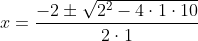
This simplifies to:
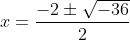
Because  , this simplifies to
  . We can further simplify this to
  . In other words, our two distinct imaginary roots are
  and
and  .
.
In the above equation, a = 1, b = 2, and c = 10. Therefore:
b2 - 4ac = (2)2 - 4(1)(10) = 4 - 40 = -36.
When the discriminant is greater than 0, there are two distinct real roots. When the discriminant is equal to 0, there is exactly one real root. When the discriminant is less than zero, there are no real roots, but there are exactly two distinct imaginary roots. In this case, we have two distinct imaginary roots.
Finally, we use the quadratic function to find these exact roots. The quadratic function is:
Plugging in our values of a, b, and c, we get:
This simplifies to:
Because 


← Didn't Know|Knew It →
Use the formula b2 - 4ac to find the discriminant of the following equation: x2 + 8x + 16 = 0.
Then state how many roots it has, and whether they are real or imaginary. Finally, use the quadratic function to find the exact roots of the equation.
Use the formula b2 - 4ac to find the discriminant of the following equation: x2 + 8x + 16 = 0.
Then state how many roots it has, and whether they are real or imaginary. Finally, use the quadratic function to find the exact roots of the equation.
Tap to reveal answer
In the above equation, a = 1, b = 8, and c = 16. Therefore:
b2 - 4ac = (8)2 - 4(1)(16) = 64 - 64 = 0.
When the discriminant is greater than 0, there are two distinct real roots. When the discriminant is equal to 0, there is exactly one real root. When the discriminant is less than zero, there are no real roots, but there are exactly two distinct imaginary roots. In this case, there is exactly one real root.
Finally, we use the quadratic function to find these exact root. The quadratic formula is:
Plugging in our values of a, b, and c, we get:
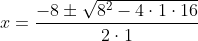
This simplifies to:
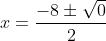
which simplifies to

This value of x is the one distinct real root of the given equation.
In the above equation, a = 1, b = 8, and c = 16. Therefore:
b2 - 4ac = (8)2 - 4(1)(16) = 64 - 64 = 0.
When the discriminant is greater than 0, there are two distinct real roots. When the discriminant is equal to 0, there is exactly one real root. When the discriminant is less than zero, there are no real roots, but there are exactly two distinct imaginary roots. In this case, there is exactly one real root.
Finally, we use the quadratic function to find these exact root. The quadratic formula is:
Plugging in our values of a, b, and c, we get:
This simplifies to:
which simplifies to

This value of x is the one distinct real root of the given equation.
← Didn't Know|Knew It →
True or false: for a quadratic function of form ax2 + bx + c = 0, if the discriminant b2 - 4ac = 0, there is exactly one real root.
True or false: for a quadratic function of form ax2 + bx + c = 0, if the discriminant b2 - 4ac = 0, there is exactly one real root.
Tap to reveal answer
This is true. The discriminant b2 - 4ac is the part of the quadratic formula that lives inside of a square root function. As you plug in the constants a, b, and c into b2 - 4ac and evaluate, three cases can happen:
b2 - 4ac > 0
b2 - 4ac = 0
b2 - 4ac < 0
In the first case, having a positive number under a square root function will yield a result that is a positive number answer. However, because the quadratic function includes , this scenario yields two real results.
In the middle case (the case of our example), . Going back to the quadratic formula , you can see that when everything under the square root is simply 0, then you get only , which is why you have exactly one real root.
For the final case, if b2 - 4ac < 0, that means you have a negative number under a square root. This means that you will not have any real roots of the equation; however, you will have exactly two imaginary roots of the equation.
This is true. The discriminant b2 - 4ac is the part of the quadratic formula that lives inside of a square root function. As you plug in the constants a, b, and c into b2 - 4ac and evaluate, three cases can happen:
b2 - 4ac > 0
b2 - 4ac = 0
b2 - 4ac < 0
In the first case, having a positive number under a square root function will yield a result that is a positive number answer. However, because the quadratic function includes
In the middle case (the case of our example),
For the final case, if b2 - 4ac < 0, that means you have a negative number under a square root. This means that you will not have any real roots of the equation; however, you will have exactly two imaginary roots of the equation.
← Didn't Know|Knew It →
True or false: for a quadratic function of form ax2 + bx + c = 0, if the discriminant b2 - 4ac > 0, there are exactly 2 distinct real roots of the equation.
True or false: for a quadratic function of form ax2 + bx + c = 0, if the discriminant b2 - 4ac > 0, there are exactly 2 distinct real roots of the equation.
Tap to reveal answer
This is true. The discriminant b2 - 4ac is the part of the quadratic formula that lives inside of a square root function. As you plug in the constants a, b, and c into b2 - 4ac and evaluate, three cases can happen:
b2 - 4ac > 0
b2 - 4ac = 0
b2 - 4ac < 0
In the first case (the case of our example), having a positive number under a square root function will yield a result that is a positive number answer. However, because the quadratic function includes , this scenario yields two real results.
In the middle case, . Going back to the quadratic formula , you can see that when everything under the square root is simply 0, then you get only , which is why you have exactly one real root.
For the final case, if b2 - 4ac < 0, that means you have a negative number under a square root. This means that you will not have any real roots of the equation; however, you will have exactly two imaginary roots of the equation.
This is true. The discriminant b2 - 4ac is the part of the quadratic formula that lives inside of a square root function. As you plug in the constants a, b, and c into b2 - 4ac and evaluate, three cases can happen:
b2 - 4ac > 0
b2 - 4ac = 0
b2 - 4ac < 0
In the first case (the case of our example), having a positive number under a square root function will yield a result that is a positive number answer. However, because the quadratic function includes
In the middle case,
For the final case, if b2 - 4ac < 0, that means you have a negative number under a square root. This means that you will not have any real roots of the equation; however, you will have exactly two imaginary roots of the equation.
← Didn't Know|Knew It →
True or false: for a quadratic function of form ax2 + bx + c = 0, if the discriminant b2 - 4ac < 0, there are exactly two distinct real roots.
True or false: for a quadratic function of form ax2 + bx + c = 0, if the discriminant b2 - 4ac < 0, there are exactly two distinct real roots.
Tap to reveal answer
This is false. The discriminant b2 - 4ac is the part of the quadratic formula that lives inside of a square root function. As you plug in the constants a, b, and c into b2 - 4ac and evaluate, three cases can happen:
b2 - 4ac > 0
b2 - 4ac = 0
b2 - 4ac < 0
In the first case, having a positive number under a square root function will yield a result that is a positive number answer. However, because the quadratic function includes , this scenario yields two real results.
In the middle case, . Going back to the quadratic formula , you can see that when everything under the square root is simply 0, then you get only , which is why you have exactly one real root.
For the final case (the case of our example), if b2 - 4ac < 0, that means you have a negative number under a square root. This means that you will not have any real roots of the equation; however, you will have exactly two imaginary roots of the equation.
This is false. The discriminant b2 - 4ac is the part of the quadratic formula that lives inside of a square root function. As you plug in the constants a, b, and c into b2 - 4ac and evaluate, three cases can happen:
b2 - 4ac > 0
b2 - 4ac = 0
b2 - 4ac < 0
In the first case, having a positive number under a square root function will yield a result that is a positive number answer. However, because the quadratic function includes
In the middle case,
For the final case (the case of our example), if b2 - 4ac < 0, that means you have a negative number under a square root. This means that you will not have any real roots of the equation; however, you will have exactly two imaginary roots of the equation.
← Didn't Know|Knew It →
Use the formula b2 - 4ac to find the discriminant of the following equation: 4x2 + 19x - 5 = 0.
Then state how many roots it has, and whether they are real or imaginary. Finally, use the quadratic function to find the exact roots of the equation.
Use the formula b2 - 4ac to find the discriminant of the following equation: 4x2 + 19x - 5 = 0.
Then state how many roots it has, and whether they are real or imaginary. Finally, use the quadratic function to find the exact roots of the equation.
Tap to reveal answer
In the above equation, a = 4, b = 19, and c = -5. Therefore:
b2 - 4ac = (19)2 - 4(4)(-5) = 361 + 80 = 441.
When the discriminant is greater than 0, there are two distinct real roots. When the discriminant is equal to 0, there is exactly one real root. When the discriminant is less than zero, there are no real roots, but there are exactly two distinct imaginary roots. In this case, we have two real roots.
Finally, we use the quadratic function to find these exact roots. The quadratic function is:
Plugging in our values of a, b, and c, we get:
This simplifies to:
which simplifies to
which gives us two answers:
or
These values of x are the two distinct real roots of the given equation.
In the above equation, a = 4, b = 19, and c = -5. Therefore:
b2 - 4ac = (19)2 - 4(4)(-5) = 361 + 80 = 441.
When the discriminant is greater than 0, there are two distinct real roots. When the discriminant is equal to 0, there is exactly one real root. When the discriminant is less than zero, there are no real roots, but there are exactly two distinct imaginary roots. In this case, we have two real roots.
Finally, we use the quadratic function to find these exact roots. The quadratic function is:
Plugging in our values of a, b, and c, we get:
This simplifies to:
which simplifies to
which gives us two answers:
These values of x are the two distinct real roots of the given equation.
← Didn't Know|Knew It →
Use the formula b2 - 4ac to find the discriminant of the following equation: 4x2 + 12x + 10 = 0.
Then state how many roots it has, and whether they are real or imaginary. Finally, use the quadratic function to find the exact roots of the equation.
Use the formula b2 - 4ac to find the discriminant of the following equation: 4x2 + 12x + 10 = 0.
Then state how many roots it has, and whether they are real or imaginary. Finally, use the quadratic function to find the exact roots of the equation.
Tap to reveal answer
In the above equation, a = 4, b = 12, and c = 10. Therefore:
b2 - 4ac = (12)2 - 4(4)(10) = 144 - 160 = -16.
When the discriminant is greater than 0, there are two distinct real roots. When the discriminant is equal to 0, there is exactly one real root. When the discriminant is less than zero, there are no real roots, but there are exactly two distinct imaginary roots. In this case, we have two distinct imaginary roots.
Finally, we use the quadratic function to find these exact roots. The quadratic function is:
Plugging in our values of a, b, and c, we get:
This simplifies to:
In other words, our two distinct imaginary roots are and
In the above equation, a = 4, b = 12, and c = 10. Therefore:
b2 - 4ac = (12)2 - 4(4)(10) = 144 - 160 = -16.
When the discriminant is greater than 0, there are two distinct real roots. When the discriminant is equal to 0, there is exactly one real root. When the discriminant is less than zero, there are no real roots, but there are exactly two distinct imaginary roots. In this case, we have two distinct imaginary roots.
Finally, we use the quadratic function to find these exact roots. The quadratic function is:
Plugging in our values of a, b, and c, we get:
This simplifies to:
In other words, our two distinct imaginary roots are
← Didn't Know|Knew It →
Use the formula b2 - 4ac to find the discriminant of the following equation: -3x2 + 6x - 3 = 0.
Then state how many roots it has, and whether they are real or imaginary. Finally, use the quadratic function to find the exact roots of the equation.
Use the formula b2 - 4ac to find the discriminant of the following equation: -3x2 + 6x - 3 = 0.
Then state how many roots it has, and whether they are real or imaginary. Finally, use the quadratic function to find the exact roots of the equation.
Tap to reveal answer
In the above equation, a = -3, b = 6, and c = -3. Therefore:
b2 - 4ac = (6)2 - 4(-3)(-3) = 36 - 36 = 0.
When the discriminant is greater than 0, there are two distinct real roots. When the discriminant is equal to 0, there is exactly one real root. When the discriminant is less than zero, there are no real roots, but there are exactly two distinct imaginary roots. In this case, there is exactly one real root.
Finally, we use the quadratic function to find these exact root. The quadratic formula is:
Plugging in our values of a, b, and c, we get:
This simplifies to:
which simplifies to
which gives us one answer: x = 1
This value of x is the one distinct real root of the given equation.
In the above equation, a = -3, b = 6, and c = -3. Therefore:
b2 - 4ac = (6)2 - 4(-3)(-3) = 36 - 36 = 0.
When the discriminant is greater than 0, there are two distinct real roots. When the discriminant is equal to 0, there is exactly one real root. When the discriminant is less than zero, there are no real roots, but there are exactly two distinct imaginary roots. In this case, there is exactly one real root.
Finally, we use the quadratic function to find these exact root. The quadratic formula is:
Plugging in our values of a, b, and c, we get:
This simplifies to:
which simplifies to
which gives us one answer: x = 1
This value of x is the one distinct real root of the given equation.
← Didn't Know|Knew It →
Use the formula b2 - 4ac to find the discriminant of the following equation: x2 + 5x + 4 = 0.
Then state how many roots it has, and whether they are real or imaginary. Finally, use the quadratic function to find the exact roots of the equation.
Use the formula b2 - 4ac to find the discriminant of the following equation: x2 + 5x + 4 = 0.
Then state how many roots it has, and whether they are real or imaginary. Finally, use the quadratic function to find the exact roots of the equation.
Tap to reveal answer
In the above equation, a = 1, b = 5, and c = 4. Therefore:
b2 - 4ac = (5)2 - 4(1)(4) = 25 - 16 = 9.
When the discriminant is greater than 0, there are two distinct real roots. When the discriminant is equal to 0, there is exactly one real root. When the discriminant is less than zero, there are no real roots, but there are exactly two distinct imaginary roots. In this case, we have two real roots.
Finally, we use the quadratic function to find these exact roots. The quadratic function is:
Plugging in our values of a, b, and c, we get:
This simplifies to:
which simplifies to
which gives us two answers:
x = -1 or x = -4
These values of x are the two distinct real roots of the given equation.
In the above equation, a = 1, b = 5, and c = 4. Therefore:
b2 - 4ac = (5)2 - 4(1)(4) = 25 - 16 = 9.
When the discriminant is greater than 0, there are two distinct real roots. When the discriminant is equal to 0, there is exactly one real root. When the discriminant is less than zero, there are no real roots, but there are exactly two distinct imaginary roots. In this case, we have two real roots.
Finally, we use the quadratic function to find these exact roots. The quadratic function is:
Plugging in our values of a, b, and c, we get:
This simplifies to:
which simplifies to
which gives us two answers:
x = -1 or x = -4
These values of x are the two distinct real roots of the given equation.
← Didn't Know|Knew It →
Use the formula b2 - 4ac to find the discriminant of the following equation: -x2 + 3x - 3 = 0.
Then state how many roots it has, and whether they are real or imaginary. Finally, use the quadratic function to find the exact roots of the equation.
Use the formula b2 - 4ac to find the discriminant of the following equation: -x2 + 3x - 3 = 0.
Then state how many roots it has, and whether they are real or imaginary. Finally, use the quadratic function to find the exact roots of the equation.
Tap to reveal answer
In the above equation, a = -1, b = 3, and c = -3. Therefore:
b2 - 4ac = (3)2 - 4(-1)(-3) = 9 - 12 = -3.
When the discriminant is greater than 0, there are two distinct real roots. When the discriminant is equal to 0, there is exactly one real root. When the discriminant is less than zero, there are no real roots, but there are exactly two distinct imaginary roots. In this case, we have two distinct imaginary roots.
Finally, we use the quadratic function to find these exact roots. The quadratic function is:
Plugging in our values of a, b, and c, we get:
This simplifies to:
Because , this simplifies to . In other words, our two distinct imaginary roots are and
In the above equation, a = -1, b = 3, and c = -3. Therefore:
b2 - 4ac = (3)2 - 4(-1)(-3) = 9 - 12 = -3.
When the discriminant is greater than 0, there are two distinct real roots. When the discriminant is equal to 0, there is exactly one real root. When the discriminant is less than zero, there are no real roots, but there are exactly two distinct imaginary roots. In this case, we have two distinct imaginary roots.
Finally, we use the quadratic function to find these exact roots. The quadratic function is:
Plugging in our values of a, b, and c, we get:
This simplifies to:
Because
← Didn't Know|Knew It →
Use the formula b2 - 4ac to find the discriminant of the following equation: x2 + 2x + 10 = 0.
Then state how many roots it has, and whether they are real or imaginary. Finally, use the quadratic function to find the exact roots of the equation.
Use the formula b2 - 4ac to find the discriminant of the following equation: x2 + 2x + 10 = 0.
Then state how many roots it has, and whether they are real or imaginary. Finally, use the quadratic function to find the exact roots of the equation.
Tap to reveal answer
In the above equation, a = 1, b = 2, and c = 10. Therefore:
b2 - 4ac = (2)2 - 4(1)(10) = 4 - 40 = -36.
When the discriminant is greater than 0, there are two distinct real roots. When the discriminant is equal to 0, there is exactly one real root. When the discriminant is less than zero, there are no real roots, but there are exactly two distinct imaginary roots. In this case, we have two distinct imaginary roots.
Finally, we use the quadratic function to find these exact roots. The quadratic function is:
Plugging in our values of a, b, and c, we get:
This simplifies to:
Because , this simplifies to . We can further simplify this to . In other words, our two distinct imaginary roots are and .
In the above equation, a = 1, b = 2, and c = 10. Therefore:
b2 - 4ac = (2)2 - 4(1)(10) = 4 - 40 = -36.
When the discriminant is greater than 0, there are two distinct real roots. When the discriminant is equal to 0, there is exactly one real root. When the discriminant is less than zero, there are no real roots, but there are exactly two distinct imaginary roots. In this case, we have two distinct imaginary roots.
Finally, we use the quadratic function to find these exact roots. The quadratic function is:
Plugging in our values of a, b, and c, we get:
This simplifies to:
Because
← Didn't Know|Knew It →
Use the formula b2 - 4ac to find the discriminant of the following equation: x2 + 8x + 16 = 0.
Then state how many roots it has, and whether they are real or imaginary. Finally, use the quadratic function to find the exact roots of the equation.
Use the formula b2 - 4ac to find the discriminant of the following equation: x2 + 8x + 16 = 0.
Then state how many roots it has, and whether they are real or imaginary. Finally, use the quadratic function to find the exact roots of the equation.
Tap to reveal answer
In the above equation, a = 1, b = 8, and c = 16. Therefore:
b2 - 4ac = (8)2 - 4(1)(16) = 64 - 64 = 0.
When the discriminant is greater than 0, there are two distinct real roots. When the discriminant is equal to 0, there is exactly one real root. When the discriminant is less than zero, there are no real roots, but there are exactly two distinct imaginary roots. In this case, there is exactly one real root.
Finally, we use the quadratic function to find these exact root. The quadratic formula is:
Plugging in our values of a, b, and c, we get:
This simplifies to:
which simplifies to
This value of x is the one distinct real root of the given equation.
In the above equation, a = 1, b = 8, and c = 16. Therefore:
b2 - 4ac = (8)2 - 4(1)(16) = 64 - 64 = 0.
When the discriminant is greater than 0, there are two distinct real roots. When the discriminant is equal to 0, there is exactly one real root. When the discriminant is less than zero, there are no real roots, but there are exactly two distinct imaginary roots. In this case, there is exactly one real root.
Finally, we use the quadratic function to find these exact root. The quadratic formula is:
Plugging in our values of a, b, and c, we get:
This simplifies to:
which simplifies to
This value of x is the one distinct real root of the given equation.
← Didn't Know|Knew It →