Find Complex Zeros of a Polynomial Using the Fundamental Theorem of Algebra - Pre-Calculus
Card 1 of 48
What are the roots of

including complex roots, if they exist?
What are the roots of
including complex roots, if they exist?
Tap to reveal answer
One of the roots is  because if we plug in 1, we get 0. We can factor the polynomial as

So now we solve the roots of  .
.

The root will not be real.
The roots of this polynomial are  .
.
So, the roots are 
One of the roots is
So now we solve the roots of
The root will not be real.
The roots of this polynomial are
So, the roots are
← Didn't Know|Knew It →
The polynomial  has a real zero at 1.5. Find the other two zeros.
The polynomial
Tap to reveal answer
If this polynomial has a real zero at 1.5, that means that the polynomial has a factor that when set equal to zero has a solution of  . We can figure out what this is this way:
 multiply both sides by 2
 is the factor
Now that we have one factor, we can divide to find the other two solutions:
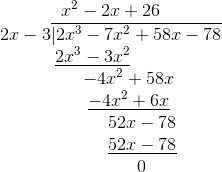
To finish solving, we can use the quadratic formula with the resulting quadratic,  :
:

If this polynomial has a real zero at 1.5, that means that the polynomial has a factor that when set equal to zero has a solution of
Now that we have one factor, we can divide to find the other two solutions:
To finish solving, we can use the quadratic formula with the resulting quadratic,
← Didn't Know|Knew It →
The polynomial  intersects the x-axis at point
  . Find the other two solutions.
The polynomial 
Tap to reveal answer
Since we know that one of the zeros of this polynomial is 3, we know that one of the factors is  . To find the other two zeros, we can divide the original polynomial by
  , either with long division or with synthetic division:
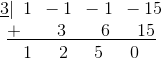
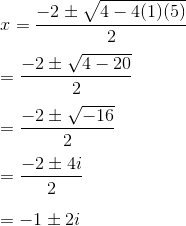
This gives us the second factor of  . We can get our solutions by using the quadratic formula:
Since we know that one of the zeros of this polynomial is 3, we know that one of the factors is
This gives us the second factor of
← Didn't Know|Knew It →
If the real zero of the polynomial  is 3, what are the complex zeros?
If the real zero of the polynomial
Tap to reveal answer
We know that the real zero of this polynomial is 3, so one of the factors must be  . To find the other factors, we can divide the original polynomial by
  , either by long division or synthetic division:
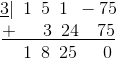
This gives us a second factor of  which we can solve using the quadratic formula:

We know that the real zero of this polynomial is 3, so one of the factors must be
This gives us a second factor of
← Didn't Know|Knew It →
Find all the real and complex zeroes of the following equation: 
Find all the real and complex zeroes of the following equation:

Tap to reveal answer
First, factorize the equation using grouping of common terms:

Next, setting each expression in parenthesis equal to zero yields the answers.


First, factorize the equation using grouping of common terms:

Next, setting each expression in parenthesis equal to zero yields the answers.


← Didn't Know|Knew It →
Find all the zeroes of the following equation and their multiplicity: 
Find all the zeroes of the following equation and their multiplicity:

Tap to reveal answer
First, pull out the common t and then factorize using quadratic factoring rules:

This equation has solutions at two values: when  and when
 Therefore, But since the degree on the former equation is one and the degree on the latter equation is two, the multiplicities are 1 and 2 respectively.
First, pull out the common t and then factorize using quadratic factoring rules:
This equation has solutions at two values: when 

← Didn't Know|Knew It →
Find a fourth degree polynomial whose zeroes are -2, 5, and 
Find a fourth degree polynomial whose zeroes are -2, 5, and

Tap to reveal answer
This one is a bit of a journey. The expressions for the first two zeroes are easily calculated,  and
and  respectively. The last expression must be broken up into two equations:
 which are then set equal to zero to yield the expressions
  and
and 
Finally, we multiply together all of the parenthesized expressions, which multiplies out to 
This one is a bit of a journey. The expressions for the first two zeroes are easily calculated, 


Finally, we multiply together all of the parenthesized expressions, which multiplies out to

← Didn't Know|Knew It →
The third degree polynomial expression  has a real zero at
  . Find all of the complex zeroes.
The third degree polynomial expression 

Tap to reveal answer
First, factor the expression by grouping:

To find the complex zeroes, set the term  equal to zero:

First, factor the expression by grouping:

To find the complex zeroes, set the term 

← Didn't Know|Knew It →
Find all the real and complex zeros of the following equation: 
Find all the real and complex zeros of the following equation:
Tap to reveal answer
First, factorize the equation using grouping of common terms:

Next, setting each expression in parentheses equal to zero yields the answers.

First, factorize the equation using grouping of common terms:
Next, setting each expression in parentheses equal to zero yields the answers.
← Didn't Know|Knew It →
Find all the zeroes of the following equation and their multiplicity: 
Find all the zeroes of the following equation and their multiplicity:
Tap to reveal answer
First, pull out the common t and then factorize using quadratic factoring rules: 
This equation has a solution as two values: when  , and when
  . Therefore, But since the degree on the former equation is one and the degree on the latter equation is two, the multiplicities are 1 and 2 respectively.
First, pull out the common t and then factorize using quadratic factoring rules:
This equation has a solution as two values: when 
← Didn't Know|Knew It →
Find a fourth-degree polynomial whose zeroes are  , and
, and 
Find a fourth-degree polynomial whose zeroes are 

Tap to reveal answer
This one is a bit of a journey. The expressions for the first two zeroes are easily calculated,  and
and  respectively. The last expression must be broken up into two equations:
  which are then set equal to zero to yield the expressions
 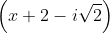 and
and 
Finally, we multiply together all of the parenthesized expressions, which multiplies out to 
This one is a bit of a journey. The expressions for the first two zeroes are easily calculated, 


Finally, we multiply together all of the parenthesized expressions, which multiplies out to
← Didn't Know|Knew It →
The third-degree polynomial expression  has a real zero at
  . Find all of the complex zeroes.
The third-degree polynomial expression 

Tap to reveal answer
First, factor the expression by grouping: 
To find the complex zeroes, set the term  equal to zero:
First, factor the expression by grouping:
To find the complex zeroes, set the term 
← Didn't Know|Knew It →
What are the roots of
including complex roots, if they exist?
What are the roots of
including complex roots, if they exist?
Tap to reveal answer
One of the roots is because if we plug in 1, we get 0. We can factor the polynomial as
So now we solve the roots of .
The root will not be real.
The roots of this polynomial are .
So, the roots are
One of the roots is
So now we solve the roots of
The root will not be real.
The roots of this polynomial are
So, the roots are
← Didn't Know|Knew It →
The polynomial has a real zero at 1.5. Find the other two zeros.
The polynomial
Tap to reveal answer
If this polynomial has a real zero at 1.5, that means that the polynomial has a factor that when set equal to zero has a solution of . We can figure out what this is this way:
multiply both sides by 2
is the factor
Now that we have one factor, we can divide to find the other two solutions:
To finish solving, we can use the quadratic formula with the resulting quadratic, :
If this polynomial has a real zero at 1.5, that means that the polynomial has a factor that when set equal to zero has a solution of
Now that we have one factor, we can divide to find the other two solutions:
To finish solving, we can use the quadratic formula with the resulting quadratic,
← Didn't Know|Knew It →
The polynomial intersects the x-axis at point . Find the other two solutions.
The polynomial
Tap to reveal answer
Since we know that one of the zeros of this polynomial is 3, we know that one of the factors is . To find the other two zeros, we can divide the original polynomial by , either with long division or with synthetic division:
This gives us the second factor of . We can get our solutions by using the quadratic formula:
Since we know that one of the zeros of this polynomial is 3, we know that one of the factors is
This gives us the second factor of
← Didn't Know|Knew It →
If the real zero of the polynomial is 3, what are the complex zeros?
If the real zero of the polynomial
Tap to reveal answer
We know that the real zero of this polynomial is 3, so one of the factors must be . To find the other factors, we can divide the original polynomial by , either by long division or synthetic division:
This gives us a second factor of which we can solve using the quadratic formula:
We know that the real zero of this polynomial is 3, so one of the factors must be
This gives us a second factor of
← Didn't Know|Knew It →
Find all the real and complex zeroes of the following equation:
Find all the real and complex zeroes of the following equation:
Tap to reveal answer
First, factorize the equation using grouping of common terms:
Next, setting each expression in parenthesis equal to zero yields the answers.
First, factorize the equation using grouping of common terms:
Next, setting each expression in parenthesis equal to zero yields the answers.
← Didn't Know|Knew It →
Find all the zeroes of the following equation and their multiplicity:
Find all the zeroes of the following equation and their multiplicity:
Tap to reveal answer
First, pull out the common t and then factorize using quadratic factoring rules:
This equation has solutions at two values: when and when
Therefore, But since the degree on the former equation is one and the degree on the latter equation is two, the multiplicities are 1 and 2 respectively.
First, pull out the common t and then factorize using quadratic factoring rules:
This equation has solutions at two values: when
← Didn't Know|Knew It →
Find a fourth degree polynomial whose zeroes are -2, 5, and
Find a fourth degree polynomial whose zeroes are -2, 5, and
Tap to reveal answer
This one is a bit of a journey. The expressions for the first two zeroes are easily calculated, and respectively. The last expression must be broken up into two equations:
which are then set equal to zero to yield the expressions and
Finally, we multiply together all of the parenthesized expressions, which multiplies out to
This one is a bit of a journey. The expressions for the first two zeroes are easily calculated,
Finally, we multiply together all of the parenthesized expressions, which multiplies out to
← Didn't Know|Knew It →
The third degree polynomial expression has a real zero at . Find all of the complex zeroes.
The third degree polynomial expression
Tap to reveal answer
First, factor the expression by grouping:
To find the complex zeroes, set the term equal to zero:
First, factor the expression by grouping:
To find the complex zeroes, set the term
← Didn't Know|Knew It →