Express Complex Numbers In Rectangular Form - Pre-Calculus
Card 1 of 32
Convert 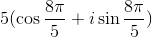 to rectangular form
Convert
Tap to reveal answer
To convert, evaluate the trig ratios and then distribute the radius:

To convert, evaluate the trig ratios and then distribute the radius:
← Didn't Know|Knew It →
Convert the following to rectangular form: 
Convert the following to rectangular form:
Tap to reveal answer
Distribute the coefficient and simplify:
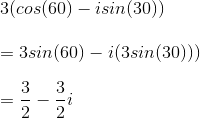
Distribute the coefficient and simplify:
← Didn't Know|Knew It →
Convert 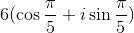 in rectangular form
Convert
Tap to reveal answer
To convert, just evaluate the trig ratios and then distribute the radius.

To convert, just evaluate the trig ratios and then distribute the radius.
← Didn't Know|Knew It →
Convert  to rectangular form
Convert
Tap to reveal answer
To convert to rectangular form, just evaluate the trig functions and then distribute the radius:

To convert to rectangular form, just evaluate the trig functions and then distribute the radius:
← Didn't Know|Knew It →
Represent the polar equation:

in rectangular form.
Represent the polar equation:
in rectangular form.
Tap to reveal answer
Using the general form of a polar equation:

we find that the value of  is
is  and the value of
  is
is  .
.
The rectangular form of the equation appears as  , and can be found by finding the trigonometric values of the cosine and sine equations.
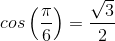
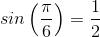
distributing the 3, we obtain the final answer of:

Using the general form of a polar equation:
we find that the value of
The rectangular form of the equation appears as
distributing the 3, we obtain the final answer of:
← Didn't Know|Knew It →
Represent the polar equation:

in rectangular form.
Represent the polar equation:
in rectangular form.
Tap to reveal answer
Using the general form of a polar equation:

we find that the value of  and the value of
  . The rectangular form of the equation appears as
  , and can be found by finding the trigonometric values of the cosine and sine equations.
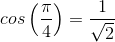
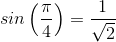
Distributing the 4, we obtain the final answer of:

Using the general form of a polar equation:
we find that the value of
Distributing the 4, we obtain the final answer of:
← Didn't Know|Knew It →
Represent the polar equation:

in rectangular form.
Represent the polar equation:
in rectangular form.
Tap to reveal answer
Using the general form of a polar equation:

we find that the value of  and the value of
  . The rectangular form of the equation appears as
  , and can be found by finding the trigonometric values of the cosine and sine equations.
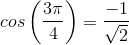
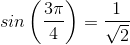
distributing the 5, we obtain the final answer of:
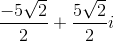
Using the general form of a polar equation:
we find that the value of
distributing the 5, we obtain the final answer of:
← Didn't Know|Knew It →
Convert the following to rectangular form:

Convert the following to rectangular form:
Tap to reveal answer
Distribute the coefficient 2, and evaluate each term:
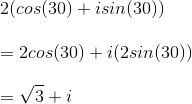
Distribute the coefficient 2, and evaluate each term:
← Didn't Know|Knew It →
Represent the polar equation:
in rectangular form.
Represent the polar equation:
in rectangular form.
Tap to reveal answer
Using the general form of a polar equation:
we find that the value of is and the value of is .
The rectangular form of the equation appears as , and can be found by finding the trigonometric values of the cosine and sine equations.
distributing the 3, we obtain the final answer of:
Using the general form of a polar equation:
we find that the value of
The rectangular form of the equation appears as
distributing the 3, we obtain the final answer of:
← Didn't Know|Knew It →
Represent the polar equation:
in rectangular form.
Represent the polar equation:
in rectangular form.
Tap to reveal answer
Using the general form of a polar equation:
we find that the value of and the value of . The rectangular form of the equation appears as , and can be found by finding the trigonometric values of the cosine and sine equations.
Distributing the 4, we obtain the final answer of:
Using the general form of a polar equation:
we find that the value of
Distributing the 4, we obtain the final answer of:
← Didn't Know|Knew It →
Represent the polar equation:
in rectangular form.
Represent the polar equation:
in rectangular form.
Tap to reveal answer
Using the general form of a polar equation:
we find that the value of and the value of . The rectangular form of the equation appears as , and can be found by finding the trigonometric values of the cosine and sine equations.
distributing the 5, we obtain the final answer of:
Using the general form of a polar equation:
we find that the value of
distributing the 5, we obtain the final answer of:
← Didn't Know|Knew It →
Convert the following to rectangular form:
Convert the following to rectangular form:
Tap to reveal answer
Distribute the coefficient 2, and evaluate each term:
Distribute the coefficient 2, and evaluate each term:
← Didn't Know|Knew It →
Convert the following to rectangular form:
Convert the following to rectangular form:
Tap to reveal answer
Distribute the coefficient and simplify:
Distribute the coefficient and simplify:
← Didn't Know|Knew It →
Convert in rectangular form
Convert
Tap to reveal answer
To convert, just evaluate the trig ratios and then distribute the radius.
To convert, just evaluate the trig ratios and then distribute the radius.
← Didn't Know|Knew It →
Convert to rectangular form
Convert
Tap to reveal answer
To convert to rectangular form, just evaluate the trig functions and then distribute the radius:
To convert to rectangular form, just evaluate the trig functions and then distribute the radius:
← Didn't Know|Knew It →
Convert to rectangular form
Convert
Tap to reveal answer
To convert, evaluate the trig ratios and then distribute the radius:
To convert, evaluate the trig ratios and then distribute the radius:
← Didn't Know|Knew It →
Represent the polar equation:
in rectangular form.
Represent the polar equation:
in rectangular form.
Tap to reveal answer
Using the general form of a polar equation:
we find that the value of is and the value of is .
The rectangular form of the equation appears as , and can be found by finding the trigonometric values of the cosine and sine equations.
distributing the 3, we obtain the final answer of:
Using the general form of a polar equation:
we find that the value of
The rectangular form of the equation appears as
distributing the 3, we obtain the final answer of:
← Didn't Know|Knew It →
Represent the polar equation:
in rectangular form.
Represent the polar equation:
in rectangular form.
Tap to reveal answer
Using the general form of a polar equation:
we find that the value of and the value of . The rectangular form of the equation appears as , and can be found by finding the trigonometric values of the cosine and sine equations.
Distributing the 4, we obtain the final answer of:
Using the general form of a polar equation:
we find that the value of
Distributing the 4, we obtain the final answer of:
← Didn't Know|Knew It →
Represent the polar equation:
in rectangular form.
Represent the polar equation:
in rectangular form.
Tap to reveal answer
Using the general form of a polar equation:
we find that the value of and the value of . The rectangular form of the equation appears as , and can be found by finding the trigonometric values of the cosine and sine equations.
distributing the 5, we obtain the final answer of:
Using the general form of a polar equation:
we find that the value of
distributing the 5, we obtain the final answer of:
← Didn't Know|Knew It →
Convert the following to rectangular form:
Convert the following to rectangular form:
Tap to reveal answer
Distribute the coefficient 2, and evaluate each term:
Distribute the coefficient 2, and evaluate each term:
← Didn't Know|Knew It →