Evaluating Trig Functions - Pre-Calculus
Card 1 of 52

What is the value of  (in degrees)?
What is the value of
Tap to reveal answer
One can setup the relationship
 .
.
After taking the arctangent,

the arctangent cancels out the tangent and we are left with the value of  .
.

One can setup the relationship
After taking the arctangent,
the arctangent cancels out the tangent and we are left with the value of
← Didn't Know|Knew It →

The above triangle is a right triangle. Find the value of  (in degrees).
The above triangle is a right triangle. Find the value of
Tap to reveal answer
One can setup the relationship

 .
.
After taking the arccosine,

the arccosine cancels out the cosine leaving just the value of  .
.

One can setup the relationship
After taking the arccosine,
the arccosine cancels out the cosine leaving just the value of
← Didn't Know|Knew It →
Solve for all x on the interval 

Solve for all x on the interval
Tap to reveal answer
Solve for all x on the interval 

We can begin by recalling which two quadrants have a positive sine. Because sine corresponds to the y-value, we know that sine is positive in quadrants I and II.
Next, recall where we get  .
.
 always corresponds to our
  -increment angles. In this case, the angles we are looking for are
  and
and  , because those are the two
  -increment angles in the first two quadrants.
Now, you might be saying, "what about  ? That is an increment of 45."
While that is true,  , not
, not 
So our answer is:
 ,
,
Solve for all x on the interval
We can begin by recalling which two quadrants have a positive sine. Because sine corresponds to the y-value, we know that sine is positive in quadrants I and II.
Next, recall where we get
Now, you might be saying, "what about
While that is true,
So our answer is:
← Didn't Know|Knew It →
Solve for all x on the interval 

Solve for all x on the interval
Tap to reveal answer
Solve for all x on the interval 

Remember Soh, Cah, Toa?
For this problem it helps to recall that 
Since our tangent is equal to 1 in this problem, we know that our opposite and adjacent sides must be the same (otherwise we wouldn't get "1" when we divided them)
Can you think of any angles in the first quadrant which yield equal x and y values?
If you guessed  you guessed right! Remember that your
  angle in the unit circle will give you a
  triangle, which will have equal height and base.
Solve for all x on the interval
Remember Soh, Cah, Toa?
For this problem it helps to recall that
Since our tangent is equal to 1 in this problem, we know that our opposite and adjacent sides must be the same (otherwise we wouldn't get "1" when we divided them)
Can you think of any angles in the first quadrant which yield equal x and y values?
If you guessed
← Didn't Know|Knew It →
Given the equation  , what is one possible value of
  ?
?
Given the equation
Tap to reveal answer
Find 1 possible value of  Given the following:

Recall that
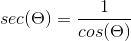
So if  , then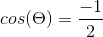
Thinking back to our unit circle, recall that cosine corresponds to the x-value. Therefore, we must be in quadrants II or III.
So, which angles correspond to an x-value of -0.5? Well, they must be the angles closest to the y-axis, which are our  increment angles.
This means our angle must be either

or

It must be  , because 240 is not an option.
Note that there are technically infinte solutions, because we are not given a specific interval. However, we only need to worry about one.
Find 1 possible value of
Recall that
So if
Thinking back to our unit circle, recall that cosine corresponds to the x-value. Therefore, we must be in quadrants II or III.
So, which angles correspond to an x-value of -0.5? Well, they must be the angles closest to the y-axis, which are our
This means our angle must be either
or
It must be
Note that there are technically infinte solutions, because we are not given a specific interval. However, we only need to worry about one.
← Didn't Know|Knew It →
Solve for  :
:

Solve for
Tap to reveal answer
If the sine of an angle, in this case  is
is  , the angle must be
  or
or  .
.
Then we need to solve for theta by dividing by 3:


If the sine of an angle, in this case
Then we need to solve for theta by dividing by 3:
← Didn't Know|Knew It →
Which of the following could be a value of  ?
?

Which of the following could be a value of
Tap to reveal answer
Which of the following could be a value of  ?
?

To begin, it will be helpful to recall the following property of tangent:
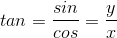
This means that if  our sine and cosine must have equal absolute values, but with opposite signs.
The only place where we will have equal values for sine and cosine will be at the locations halfway between our quadrantal angles (axes). In other words, our answer will align with one of the  angles.
Additionally, because our sine and cosine must have opposite signs (one negative and one positive), we need to be in either quadrant 2 or quadrant 4. There is only answer from either of those two, so our answer must be  .
.
Which of the following could be a value of
To begin, it will be helpful to recall the following property of tangent:
This means that if
The only place where we will have equal values for sine and cosine will be at the locations halfway between our quadrantal angles (axes). In other words, our answer will align with one of the
Additionally, because our sine and cosine must have opposite signs (one negative and one positive), we need to be in either quadrant 2 or quadrant 4. There is only answer from either of those two, so our answer must be
← Didn't Know|Knew It →
Find  if
if  and it is located in Quadrant I.
Find
Tap to reveal answer
Since we know the value of the trigonometric function and the triangle is located in Quadrant I, we can draw the triangle and get a sense of it. If the opposite side is 1 and the hypotenuse is 2, we know that we're dealing with a 30-60-90 special triangle. And since the opposite side of the angle is 1, we know that the angle is  .
.
Since we know the value of the trigonometric function and the triangle is located in Quadrant I, we can draw the triangle and get a sense of it. If the opposite side is 1 and the hypotenuse is 2, we know that we're dealing with a 30-60-90 special triangle. And since the opposite side of the angle is 1, we know that the angle is
← Didn't Know|Knew It →
What is the value of (in degrees)?
What is the value of
Tap to reveal answer
One can setup the relationship
.
After taking the arctangent,
the arctangent cancels out the tangent and we are left with the value of .
One can setup the relationship
After taking the arctangent,
the arctangent cancels out the tangent and we are left with the value of
← Didn't Know|Knew It →
The above triangle is a right triangle. Find the value of (in degrees).
The above triangle is a right triangle. Find the value of
Tap to reveal answer
One can setup the relationship
.
After taking the arccosine,
the arccosine cancels out the cosine leaving just the value of .
One can setup the relationship
After taking the arccosine,
the arccosine cancels out the cosine leaving just the value of
← Didn't Know|Knew It →
Solve for all x on the interval
Solve for all x on the interval
Tap to reveal answer
Solve for all x on the interval
We can begin by recalling which two quadrants have a positive sine. Because sine corresponds to the y-value, we know that sine is positive in quadrants I and II.
Next, recall where we get .
always corresponds to our -increment angles. In this case, the angles we are looking for are and , because those are the two -increment angles in the first two quadrants.
Now, you might be saying, "what about ? That is an increment of 45."
While that is true, , not
So our answer is:
,
Solve for all x on the interval
We can begin by recalling which two quadrants have a positive sine. Because sine corresponds to the y-value, we know that sine is positive in quadrants I and II.
Next, recall where we get
Now, you might be saying, "what about
While that is true,
So our answer is:
← Didn't Know|Knew It →
Solve for all x on the interval
Solve for all x on the interval
Tap to reveal answer
Solve for all x on the interval
Remember Soh, Cah, Toa?
For this problem it helps to recall that
Since our tangent is equal to 1 in this problem, we know that our opposite and adjacent sides must be the same (otherwise we wouldn't get "1" when we divided them)
Can you think of any angles in the first quadrant which yield equal x and y values?
If you guessed you guessed right! Remember that your angle in the unit circle will give you a triangle, which will have equal height and base.
Solve for all x on the interval
Remember Soh, Cah, Toa?
For this problem it helps to recall that
Since our tangent is equal to 1 in this problem, we know that our opposite and adjacent sides must be the same (otherwise we wouldn't get "1" when we divided them)
Can you think of any angles in the first quadrant which yield equal x and y values?
If you guessed
← Didn't Know|Knew It →
Given the equation , what is one possible value of ?
Given the equation
Tap to reveal answer
Find 1 possible value of Given the following:
Recall that
So if , then
Thinking back to our unit circle, recall that cosine corresponds to the x-value. Therefore, we must be in quadrants II or III.
So, which angles correspond to an x-value of -0.5? Well, they must be the angles closest to the y-axis, which are our increment angles.
This means our angle must be either
or
It must be , because 240 is not an option.
Note that there are technically infinte solutions, because we are not given a specific interval. However, we only need to worry about one.
Find 1 possible value of
Recall that
So if
Thinking back to our unit circle, recall that cosine corresponds to the x-value. Therefore, we must be in quadrants II or III.
So, which angles correspond to an x-value of -0.5? Well, they must be the angles closest to the y-axis, which are our
This means our angle must be either
or
It must be
Note that there are technically infinte solutions, because we are not given a specific interval. However, we only need to worry about one.
← Didn't Know|Knew It →
Solve for :
Solve for
Tap to reveal answer
If the sine of an angle, in this case is , the angle must be or .
Then we need to solve for theta by dividing by 3:
If the sine of an angle, in this case
Then we need to solve for theta by dividing by 3:
← Didn't Know|Knew It →
Which of the following could be a value of ?
Which of the following could be a value of
Tap to reveal answer
Which of the following could be a value of ?
To begin, it will be helpful to recall the following property of tangent:
This means that if our sine and cosine must have equal absolute values, but with opposite signs.
The only place where we will have equal values for sine and cosine will be at the locations halfway between our quadrantal angles (axes). In other words, our answer will align with one of the angles.
Additionally, because our sine and cosine must have opposite signs (one negative and one positive), we need to be in either quadrant 2 or quadrant 4. There is only answer from either of those two, so our answer must be .
Which of the following could be a value of
To begin, it will be helpful to recall the following property of tangent:
This means that if
The only place where we will have equal values for sine and cosine will be at the locations halfway between our quadrantal angles (axes). In other words, our answer will align with one of the
Additionally, because our sine and cosine must have opposite signs (one negative and one positive), we need to be in either quadrant 2 or quadrant 4. There is only answer from either of those two, so our answer must be
← Didn't Know|Knew It →
Find if and it is located in Quadrant I.
Find
Tap to reveal answer
Since we know the value of the trigonometric function and the triangle is located in Quadrant I, we can draw the triangle and get a sense of it. If the opposite side is 1 and the hypotenuse is 2, we know that we're dealing with a 30-60-90 special triangle. And since the opposite side of the angle is 1, we know that the angle is .
Since we know the value of the trigonometric function and the triangle is located in Quadrant I, we can draw the triangle and get a sense of it. If the opposite side is 1 and the hypotenuse is 2, we know that we're dealing with a 30-60-90 special triangle. And since the opposite side of the angle is 1, we know that the angle is
← Didn't Know|Knew It →
Find the value of  to the nearest tenth if
  and
and  .
.
Find the value of
Tap to reveal answer
Rewrite  in terms of sine and cosine.

Substitute the known values and evaluate.

The answer to the nearest tenth is  .
.
Rewrite
Substitute the known values and evaluate.
The answer to the nearest tenth is
← Didn't Know|Knew It →
Find the value of
 .
.
Find the value of
Tap to reveal answer
Before beginning this problem on a calculator, though this is not necessary since these are special angles, ensure that the mode of the calculator is in degrees.
Input the values of the expression and solve.

Before beginning this problem on a calculator, though this is not necessary since these are special angles, ensure that the mode of the calculator is in degrees.
Input the values of the expression and solve.
← Didn't Know|Knew It →
Find the decimal value of

Find the decimal value of
Tap to reveal answer
To determine the decimal value of the following trig function,  , make sure that the calculator is in radian mode.
Compute the expression.

To determine the decimal value of the following trig function,
Compute the expression.
← Didn't Know|Knew It →
Determine the value of  in decimal form.
Determine the value of
Tap to reveal answer
Ensure the calculator is in radian mode since the expression shows the angle in terms of  . Also convert cotangent to tangent.

Ensure the calculator is in radian mode since the expression shows the angle in terms of
← Didn't Know|Knew It →