Thermochemistry and Thermodynamics - Physical Chemistry
Card 1 of 120
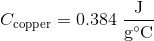
If a  copper wire gains
  of heat, what is the change in temperature of the wire?
If a
Tap to reveal answer
The thermal energy an object contains is given by:

Where  is the specific heat,
  is the change in temperature,
  is the mass, and
  is the amount of energy. We are given everything but the
  , so we rearrange the equation to
Plug in known values and solve:

The thermal energy an object contains is given by:
Where
Plug in known values and solve:
← Didn't Know|Knew It →
Which of the following are endothermic?
Which of the following are endothermic?
Tap to reveal answer
Endothermic processes involve a positive change in enthalpy. This means that the enthalpy of products is higher than the enthalpy of reactants and net heat energy is consumed. Phase changes that involve increasing the distance between particles (meaning conversion of solid to liquid (melting), liquid to gas (evaporation) and solid to gas (sublimation)) require an input of energy and are considered endothermic processes. On the other hand, phase changes that decrease the distance between particles (such as gas to liquid (condensation), liquid to solid (freezing), and gas to solid (deposition)) release energy and are considered exothermic processes.
Endothermic processes involve a positive change in enthalpy. This means that the enthalpy of products is higher than the enthalpy of reactants and net heat energy is consumed. Phase changes that involve increasing the distance between particles (meaning conversion of solid to liquid (melting), liquid to gas (evaporation) and solid to gas (sublimation)) require an input of energy and are considered endothermic processes. On the other hand, phase changes that decrease the distance between particles (such as gas to liquid (condensation), liquid to solid (freezing), and gas to solid (deposition)) release energy and are considered exothermic processes.
← Didn't Know|Knew It →
Which of the following is true regarding an exothermic reaction?
I. Entropy always increases
II. It is always spontaneous
III. It can facilitate other energy-consuming reactions
Which of the following is true regarding an exothermic reaction?
I. Entropy always increases
II. It is always spontaneous
III. It can facilitate other energy-consuming reactions
Tap to reveal answer
Exothermic reactions involve release of heat energy. This means that the energy of the products is lower than the energy of the reactants. Entropy is the measure of disorder in a system. It does not depend on the enthalpy and can increase or decrease during an exothermic process. Spontaneity is determined by looking at the change in Gibbs free energy,  . Negative
  corresponds to a spontaneous process and positive
  corresponds to a nonspontaneous process. While the equation for Gibbs free energy,
  , involves change in enthalpy, the spontaneity also depends on temperature and change in entropy. Exothermic reactions release energy in the form of heat. This heat energy can be used to power other processes that require energy; therefore, exothermic reactions can facilitate active processes that consume energy.
Exothermic reactions involve release of heat energy. This means that the energy of the products is lower than the energy of the reactants. Entropy is the measure of disorder in a system. It does not depend on the enthalpy and can increase or decrease during an exothermic process. Spontaneity is determined by looking at the change in Gibbs free energy,
← Didn't Know|Knew It →
In an reaction, the products are more stable than the reactants; in an reaction the reactants are more stable than the products.
In an reaction, the products are more stable than the reactants; in an reaction the reactants are more stable than the products.
Tap to reveal answer
Exergonic reactions release energy; therefore, the energy of products is lower than that of the reactants. Endergonic reactions consume energy; therefore, the energy of products is greater than that of the reactants. In other words, exergonic reactions are spontaneous, while endergonic reactions are nonspontaneous, and require the net input of energy to drive the reaction.
Exergonic reactions release energy; therefore, the energy of products is lower than that of the reactants. Endergonic reactions consume energy; therefore, the energy of products is greater than that of the reactants. In other words, exergonic reactions are spontaneous, while endergonic reactions are nonspontaneous, and require the net input of energy to drive the reaction.
← Didn't Know|Knew It →
Consider the following spontaneous reaction:

What can you conclude about the enthalpy change in this reaction?
Consider the following spontaneous reaction:
What can you conclude about the enthalpy change in this reaction?
Tap to reveal answer
We need to use the following equation to answer this question:

Above,  is change in Gibbs free energy,
  is change in enthalpy,
  is temperature, and
  is change in entropy. The question states that the reaction is spontaneous; therefore,
  is negative. We can also determine the
  for this reaction by looking at the phases of the products and reactants. Recall that entropy is a measure of disorder. When it comes to phases, gases have the highest entropy and solids have the lowest entropy. This is because in gases the molecules are spread out and have more room for disorder while solids are compressed and well packaged, decreasing the disorder of the atoms/molecules. Liquids are intermediate in entropy. In this reaction, we are creating a liquid from two molecules of gas; therefore, we are decreasing the entropy of the system (going to a more ordered, liquid state). The change in entropy for this reaction is negative.
Rearranging and solving the equation above for  gives us:

Since both  and
and  are negative,
  will always be negative (regardless of temperature). This is an exothermic reaction.
We need to use the following equation to answer this question:
Above,
Rearranging and solving the equation above for
Since both
← Didn't Know|Knew It →
For Constant Temperature, Gibbs Free Energy is defined as:

Where ,  is the change in Gibbs Free Energy,
  is the change in enthalpy,
  is temperature, and
  is the change in entropy.
Which of the following scenarios is not possible?
For Constant Temperature, Gibbs Free Energy is defined as:
Where ,
Which of the following scenarios is not possible?
Tap to reveal answer
The following condition is not possible:

This is because if enthalpy is positive, and entropy is negative, the negative sign in front of the temperature term in the formula becomes positive. Addition of 2 positive numbers can not be negative. Plugging in arbitrary numbers into the other conditions can show they are all possible.
Take the following condition:

Then Gibbs free energy  can either be positive or negative, depending on the magnitude of enthalpy, entropy, and temperature. (If enthalpy is much larger than entropy and temperature, then the difference will be positive, but if entropy *
  is greater than the enthalpy, then the difference will be negative).
The following condition is not possible:
This is because if enthalpy is positive, and entropy is negative, the negative sign in front of the temperature term in the formula becomes positive. Addition of 2 positive numbers can not be negative. Plugging in arbitrary numbers into the other conditions can show they are all possible.
Take the following condition:
Then Gibbs free energy
← Didn't Know|Knew It →
For constant temperature, Gibbs free energy is defined as:

Where ,  is the change in Gibbs free energy,
  is the change in enthalpy,
  is temperature, and
  is the change in entropy.
Given that a system is spontaneous, which of the following states are possible?
I. 
II. 
III. 
IV. 
For constant temperature, Gibbs free energy is defined as:
Where ,
Given that a system is spontaneous, which of the following states are possible?
I.
II.
III.
IV.
Tap to reveal answer
Condition I is always true. Condition II is never true, as Gibbs free energy cannot be negative if enthalpy is positive and entropy is negative. Condition III may be true if temperature is very high (this is the scenario when the  term dominates the
  term. Condition IV is not possible because
  and we were given a system with a Gibbs free Energy that is
  (we were told the system was spontaneous).
Condition I is always true. Condition II is never true, as Gibbs free energy cannot be negative if enthalpy is positive and entropy is negative. Condition III may be true if temperature is very high (this is the scenario when the
← Didn't Know|Knew It →
The enthalpy of a reaction is  and the entropy of a reaction is
  . Which of the following is the Gibbs free energy (in
  ) of this reaction?
The enthalpy of a reaction is
Tap to reveal answer
Gibbs free energy of a system can be solved using the following equation.

where  is change in Gibbs free energy,
  is change in enthalpy,
  is temperature in Kelvins and
  is change in entropy. To solve for
  we need all three of the variables. We are not given the temperature; therefore, we cannot solve for Gibbs free energy.
Gibbs free energy of a system can be solved using the following equation.
where
← Didn't Know|Knew It →
In an exergonic reaction, products will have Gibbs free energy and the reaction is .
In an exergonic reaction, products will have Gibbs free energy and the reaction is .
Tap to reveal answer
Exergonic reaction suggests that the Gibbs free energy is negative. Since the change in Gibbs free energy is defined as Gibbs free energy of products - Gibbs free energy of reactants, a negative change in Gibbs free energy suggests that the products have a lower Gibbs free energy than reactants. A reaction is spontaneous if it has negative Gibbs free energy; therefore, exergonic reactions are always spontaneous. This is because the reaction is producing a more stable product (lower energy) from a less stable reactant (higher energy).
Exergonic reaction suggests that the Gibbs free energy is negative. Since the change in Gibbs free energy is defined as Gibbs free energy of products - Gibbs free energy of reactants, a negative change in Gibbs free energy suggests that the products have a lower Gibbs free energy than reactants. A reaction is spontaneous if it has negative Gibbs free energy; therefore, exergonic reactions are always spontaneous. This is because the reaction is producing a more stable product (lower energy) from a less stable reactant (higher energy).
← Didn't Know|Knew It →
If a copper wire gains of heat, what is the change in temperature of the wire?
If a
Tap to reveal answer
The thermal energy an object contains is given by:
Where is the specific heat, is the change in temperature, is the mass, and is the amount of energy. We are given everything but the , so we rearrange the equation to
Plug in known values and solve:
The thermal energy an object contains is given by:
Where
Plug in known values and solve:
← Didn't Know|Knew It →
What is the process of converting a solid directly to a gas?
What is the process of converting a solid directly to a gas?
Tap to reveal answer
Certain substances, such as carbon dioxide, are able to skip the liquid phase and go from a solid to a gas under standard conditions. This process is called sublimation.
Certain substances, such as carbon dioxide, are able to skip the liquid phase and go from a solid to a gas under standard conditions. This process is called sublimation.
← Didn't Know|Knew It →
The heat capacity of a bomb calorimeter assembly is  . What is the heat of combustion of
  of sucrose in a bomb calorimeter that results in the temperature rising from
  to
to  ?
?
The heat capacity of a bomb calorimeter assembly is
Tap to reveal answer
A bomb calorimeter is a device used to measure the quantity of heat change for a process. The heat of a reaction which is denoted as  , is the negative of the thermal energy gained by the calorimeter:

The heat capacity of a calorimeter is:

Plugging the values given into the equation gives:

Using the relation provided earlier:

Because we are dealing with 1.1 grams of sucrose, the heat of combustion of sucrose is:

A bomb calorimeter is a device used to measure the quantity of heat change for a process. The heat of a reaction which is denoted as
The heat capacity of a calorimeter is:
Plugging the values given into the equation gives:
Using the relation provided earlier:
Because we are dealing with 1.1 grams of sucrose, the heat of combustion of sucrose is:
← Didn't Know|Knew It →
The heat capacity of a bomb calorimeter assembly is  . What is the heat of combustion of
  of caffeine in a bomb calorimeter that results in the temperature rising from
  to
to  ?
?
The heat capacity of a bomb calorimeter assembly is
Tap to reveal answer
A bomb calorimeter is a device used to measure the quantity of heat change for a process. The heat of a reaction which is denoted as q, is the negative of the thermal energy gained by the calorimeter:
The heat capacity of a calorimeter is:
Plugging the values given into the equation gives:

Using the relation provided earlier:

Because we are dealing with 1.65 grams of sucrose, the heat of combustion of sucrose is:

A bomb calorimeter is a device used to measure the quantity of heat change for a process. The heat of a reaction which is denoted as q, is the negative of the thermal energy gained by the calorimeter:
The heat capacity of a calorimeter is:
Plugging the values given into the equation gives:
Using the relation provided earlier:
Because we are dealing with 1.65 grams of sucrose, the heat of combustion of sucrose is:
← Didn't Know|Knew It →
Which of the following are endothermic?
Which of the following are endothermic?
Tap to reveal answer
Endothermic processes involve a positive change in enthalpy. This means that the enthalpy of products is higher than the enthalpy of reactants and net heat energy is consumed. Phase changes that involve increasing the distance between particles (meaning conversion of solid to liquid (melting), liquid to gas (evaporation) and solid to gas (sublimation)) require an input of energy and are considered endothermic processes. On the other hand, phase changes that decrease the distance between particles (such as gas to liquid (condensation), liquid to solid (freezing), and gas to solid (deposition)) release energy and are considered exothermic processes.
Endothermic processes involve a positive change in enthalpy. This means that the enthalpy of products is higher than the enthalpy of reactants and net heat energy is consumed. Phase changes that involve increasing the distance between particles (meaning conversion of solid to liquid (melting), liquid to gas (evaporation) and solid to gas (sublimation)) require an input of energy and are considered endothermic processes. On the other hand, phase changes that decrease the distance between particles (such as gas to liquid (condensation), liquid to solid (freezing), and gas to solid (deposition)) release energy and are considered exothermic processes.
← Didn't Know|Knew It →
Which of the following is true regarding an exothermic reaction?
I. Entropy always increases
II. It is always spontaneous
III. It can facilitate other energy-consuming reactions
Which of the following is true regarding an exothermic reaction?
I. Entropy always increases
II. It is always spontaneous
III. It can facilitate other energy-consuming reactions
Tap to reveal answer
Exothermic reactions involve release of heat energy. This means that the energy of the products is lower than the energy of the reactants. Entropy is the measure of disorder in a system. It does not depend on the enthalpy and can increase or decrease during an exothermic process. Spontaneity is determined by looking at the change in Gibbs free energy, . Negative corresponds to a spontaneous process and positive corresponds to a nonspontaneous process. While the equation for Gibbs free energy, , involves change in enthalpy, the spontaneity also depends on temperature and change in entropy. Exothermic reactions release energy in the form of heat. This heat energy can be used to power other processes that require energy; therefore, exothermic reactions can facilitate active processes that consume energy.
Exothermic reactions involve release of heat energy. This means that the energy of the products is lower than the energy of the reactants. Entropy is the measure of disorder in a system. It does not depend on the enthalpy and can increase or decrease during an exothermic process. Spontaneity is determined by looking at the change in Gibbs free energy,
← Didn't Know|Knew It →
In an reaction, the products are more stable than the reactants; in an reaction the reactants are more stable than the products.
In an reaction, the products are more stable than the reactants; in an reaction the reactants are more stable than the products.
Tap to reveal answer
Exergonic reactions release energy; therefore, the energy of products is lower than that of the reactants. Endergonic reactions consume energy; therefore, the energy of products is greater than that of the reactants. In other words, exergonic reactions are spontaneous, while endergonic reactions are nonspontaneous, and require the net input of energy to drive the reaction.
Exergonic reactions release energy; therefore, the energy of products is lower than that of the reactants. Endergonic reactions consume energy; therefore, the energy of products is greater than that of the reactants. In other words, exergonic reactions are spontaneous, while endergonic reactions are nonspontaneous, and require the net input of energy to drive the reaction.
← Didn't Know|Knew It →
Consider the following spontaneous reaction:
What can you conclude about the enthalpy change in this reaction?
Consider the following spontaneous reaction:
What can you conclude about the enthalpy change in this reaction?
Tap to reveal answer
We need to use the following equation to answer this question:
Above, is change in Gibbs free energy, is change in enthalpy, is temperature, and is change in entropy. The question states that the reaction is spontaneous; therefore, is negative. We can also determine the for this reaction by looking at the phases of the products and reactants. Recall that entropy is a measure of disorder. When it comes to phases, gases have the highest entropy and solids have the lowest entropy. This is because in gases the molecules are spread out and have more room for disorder while solids are compressed and well packaged, decreasing the disorder of the atoms/molecules. Liquids are intermediate in entropy. In this reaction, we are creating a liquid from two molecules of gas; therefore, we are decreasing the entropy of the system (going to a more ordered, liquid state). The change in entropy for this reaction is negative.
Rearranging and solving the equation above for gives us:
Since both and are negative, will always be negative (regardless of temperature). This is an exothermic reaction.
We need to use the following equation to answer this question:
Above,
Rearranging and solving the equation above for
Since both
← Didn't Know|Knew It →
Which of the following is true regarding enthalpy and entropy?
Which of the following is true regarding enthalpy and entropy?
Tap to reveal answer
Enthalpy is the amount of internal energy contained in a compound whereas entropy is the amount of intrinsic disorder within the compound. Enthalpy is zero for elemental compounds such hydrogen gas and oxygen gas; therefore, enthalpy is nonzero for water (regardless of phase). Entropy, or the amount of disorder, is always highest for gases and lowest for solids. This is because gas molecules are widely spread out and, therefore, are more disordered than solids and liquids. Hydrogen gas will have a higher entropy than liquid water.
Enthalpy is the amount of internal energy contained in a compound whereas entropy is the amount of intrinsic disorder within the compound. Enthalpy is zero for elemental compounds such hydrogen gas and oxygen gas; therefore, enthalpy is nonzero for water (regardless of phase). Entropy, or the amount of disorder, is always highest for gases and lowest for solids. This is because gas molecules are widely spread out and, therefore, are more disordered than solids and liquids. Hydrogen gas will have a higher entropy than liquid water.
← Didn't Know|Knew It →
According to the law of thermodynamics, which of the following statement(s) is/are true?
I. Enthalpy of a system is always increasing
II. Entropy of a system is always increasing
III. Absolute entropy can never be negative
According to the law of thermodynamics, which of the following statement(s) is/are true?
I. Enthalpy of a system is always increasing
II. Entropy of a system is always increasing
III. Absolute entropy can never be negative
Tap to reveal answer
The first law of thermodynamics states that the energy of the universe is always constant, which implies that energy cannot be created or destroyed. The energy lost by a system is gained by surroundings and vice versa; however, the total energy of the universe is always constant. The second law of thermodynamics states that the entropy, or the amount of disorder in the universe, is always increasing. This suggests that the universe is always going towards a more disordered state. Based on these two laws, we can determine that statement I and statement II are false. Note that these two statements are talking about the system, rather than the universe. The energy (in the form of enthalpy) and entropy can increase or decrease in a system. The surroundings will compensate accordingly to keep the energy of universe constant and increase the entropy. Absolute entropy of a system, surroundings or the universe can never be negative because it isn’t possible to have negative disorder (this is due to the definition of entropy; just remember that entropy can never be negative). Note that the change in entropy can, however, be negative.
The first law of thermodynamics states that the energy of the universe is always constant, which implies that energy cannot be created or destroyed. The energy lost by a system is gained by surroundings and vice versa; however, the total energy of the universe is always constant. The second law of thermodynamics states that the entropy, or the amount of disorder in the universe, is always increasing. This suggests that the universe is always going towards a more disordered state. Based on these two laws, we can determine that statement I and statement II are false. Note that these two statements are talking about the system, rather than the universe. The energy (in the form of enthalpy) and entropy can increase or decrease in a system. The surroundings will compensate accordingly to keep the energy of universe constant and increase the entropy. Absolute entropy of a system, surroundings or the universe can never be negative because it isn’t possible to have negative disorder (this is due to the definition of entropy; just remember that entropy can never be negative). Note that the change in entropy can, however, be negative.
← Didn't Know|Knew It →
What is the specific heat capacity for a 50-gram sample of metal that increases in temperature by 10 degrees celsius when 2000 joules of energy is added?
What is the specific heat capacity for a 50-gram sample of metal that increases in temperature by 10 degrees celsius when 2000 joules of energy is added?
Tap to reveal answer
Use the equation:

We can calculate the specific heat capacity for the unknown metal. Since we know the added heat  , the mass of the sample
  , and the change in temperature
  , we can solve for
  .
.

Use the equation:
We can calculate the specific heat capacity for the unknown metal. Since we know the added heat
← Didn't Know|Knew It →