Equilibrium and Kinetics - Physical Chemistry
Card 1 of 156
Which of the following is true regarding competitive inhibition?
I. They form covalent bonds with the active site
II. They are reversible
III. They are similar to allosteric inhibitors
Which of the following is true regarding competitive inhibition?
I. They form covalent bonds with the active site
II. They are reversible
III. They are similar to allosteric inhibitors
Tap to reveal answer
Competitive inhibition decreases enzyme activity by binding to the active site of the enzyme. Recall that active sites are sites on enzymes where the substrates bind. Upon binding to the enzyme, the substrates undergo changes that facilitate and speed up the chemical reaction. A competitive inhibitor binds to this active site and prevents the substrate from binding. With no binding, the substrate will not undergo the necessary changes and, subsequently, the chemical reaction. A key characterisitic of competitive inhibitors is that the bond between the inhibitor and the active site is reversible. This means that the chemical bonds involved here are weak, reversible noncovalent bonds such as hydrogen bonds and van der Waals forces. Covalent bonds are very strong and are usually found in irreversible interactions.
Allosteric inhibitors are molecules that bind to enzymes at their allosteric site(s). In this way, the allosteric inhibiton is very similar to, and is a subset of, another type of enzyme inhibition, noncompetitive inhibition.
Competitive inhibition decreases enzyme activity by binding to the active site of the enzyme. Recall that active sites are sites on enzymes where the substrates bind. Upon binding to the enzyme, the substrates undergo changes that facilitate and speed up the chemical reaction. A competitive inhibitor binds to this active site and prevents the substrate from binding. With no binding, the substrate will not undergo the necessary changes and, subsequently, the chemical reaction. A key characterisitic of competitive inhibitors is that the bond between the inhibitor and the active site is reversible. This means that the chemical bonds involved here are weak, reversible noncovalent bonds such as hydrogen bonds and van der Waals forces. Covalent bonds are very strong and are usually found in irreversible interactions.
Allosteric inhibitors are molecules that bind to enzymes at their allosteric site(s). In this way, the allosteric inhibiton is very similar to, and is a subset of, another type of enzyme inhibition, noncompetitive inhibition.
← Didn't Know|Knew It →
Which of the following is true regarding noncompetitive inhibitors?
I. They do not form covalent bonds with the active site
II. They alter both Km and Vmax
III. They alter the shape of the active site
Which of the following is true regarding noncompetitive inhibitors?
I. They do not form covalent bonds with the active site
II. They alter both Km and Vmax
III. They alter the shape of the active site
Tap to reveal answer
Noncompetitive inhibitors bind to enzymes and prevent the formation of the enzyme-substrate complex. These inhibitors bind to a location other than the active site. Upon binding, the inhibitors alter the conformation of the active site and prevent the binding of substrate. They form covalent bonds with the enzyme; therefore, these are irreversible inhibitors and are hard to remove.  and
and  are altered by both types of inhibitors (competitive and noncompetitive). Competitive inhibitors alter the
  whereas the noncompetitive inhibitors alter the
  .
.
This implies that competitive inhibition can be overcome by increasing substrate concentration whereas noncompetitive inhibition cannot. Molecularly this makes sense. Competitive inhibitors bind reversibly to the active site and prevent binding of substrate. If we were to drastically increase its concentration, substrate will compete with and remove the competitive inhibitor from the active site. Noncompetitive inhibitors, on the other hand, alter the conformation of the active site, making it hard for substrates to bind to the active site; therefore, the substrate will not be able bind, regardless of the substrate concentration.
Noncompetitive inhibitors bind to enzymes and prevent the formation of the enzyme-substrate complex. These inhibitors bind to a location other than the active site. Upon binding, the inhibitors alter the conformation of the active site and prevent the binding of substrate. They form covalent bonds with the enzyme; therefore, these are irreversible inhibitors and are hard to remove.
This implies that competitive inhibition can be overcome by increasing substrate concentration whereas noncompetitive inhibition cannot. Molecularly this makes sense. Competitive inhibitors bind reversibly to the active site and prevent binding of substrate. If we were to drastically increase its concentration, substrate will compete with and remove the competitive inhibitor from the active site. Noncompetitive inhibitors, on the other hand, alter the conformation of the active site, making it hard for substrates to bind to the active site; therefore, the substrate will not be able bind, regardless of the substrate concentration.
← Didn't Know|Knew It →
A researcher is analyzing the effects of an unknown inhibitor. He observes that the inhibition can be overcome by increasing the concentration of the substrate. What can you conclude about this inhibitor?
A researcher is analyzing the effects of an unknown inhibitor. He observes that the inhibition can be overcome by increasing the concentration of the substrate. What can you conclude about this inhibitor?
Tap to reveal answer
Recall that competitive inhibition can be overcome by increasing substrate concentration. Competitive inhibitors alter the Michaelis constant,  , but maintain the
  (maximum reaction rate). Inhibitors act to decrease the reaction rate. To figure out the effect of competitive inhibitors on the Michaelis constant, we need to look at the Michaelis-Menten equation.

where  is reaction rate,
  is maximum reaction rate,
  is substrate concentration, and
  is the Michaelis constant. Since reaction rate is inversely proportional to the
  , competitive inhibitors will increase
  and, thereby, decrease reaction rate.
Recall that competitive inhibition can be overcome by increasing substrate concentration. Competitive inhibitors alter the Michaelis constant,
where
← Didn't Know|Knew It →
The slope of a Lineweaver-Burk plot is  and the x-intercept is
  . Upon addition of a noncompetitive inhibitor the slope increases to
  . Which of the following is the correct value of
  (Michaelis constant) after the addition of the inhibitor?
The slope of a Lineweaver-Burk plot is
Tap to reveal answer
To answer this question we need to first figure out the equation for slope and x-intercept of Lineweaver-Burk plot. The Linweaver-Burk plot is a graphical way to plot the Michaelis-Menten equation. It is defined as the reciprocal of Michaelis-Menten equation. Michaelis-Menten equation is as follows.

where  is reaction rate,
  is maximum reaction rate,
  is substrate concentration, and
  is the Michaelis constant. Taking the reciprocal of this gives us

The slope, therefore, is  . The x-intercept can be found by plugging in zero for the Y value (the reaction rate,
  ). The x-intercept is
  .
.
The question states that the slope is  and the x-intercept is
  . Using the equation for x-intercept we can solve for
  .
.


Using the equation for slope we can solve for 


Recall that the addition of a noncompetitive inhibitor alters the  but not the
  ; therefore,
  is still
  after the addition of noncompetitive inhibitior.
Note that if we were asked to solve for the  , we would have had to use the new slope (
 ) and the same
  value (
 ).
).
To answer this question we need to first figure out the equation for slope and x-intercept of Lineweaver-Burk plot. The Linweaver-Burk plot is a graphical way to plot the Michaelis-Menten equation. It is defined as the reciprocal of Michaelis-Menten equation. Michaelis-Menten equation is as follows.
where
The slope, therefore, is
The question states that the slope is
Using the equation for slope we can solve for
Recall that the addition of a noncompetitive inhibitor alters the
Note that if we were asked to solve for the
← Didn't Know|Knew It →
Upon addition of an inhibitor, which of the following is expected to happen in a catalytic reaction?
Upon addition of an inhibitor, which of the following is expected to happen in a catalytic reaction?
Tap to reveal answer
Inhibitors are molecules that prevent the action of catalysts. They bind to catalysts and prevent substrate binding, thereby halting the catalytic action. Since catalysts increase the speed of a reaction, addition of an inhibitor will lower the speed of the reaction. This does not mean that the reaction will stop proceeding; it simple means that it will take longer for the reaction to complete (reach equilibrium).
Remember that a catalyst speeds up both the forward and the reverse reaction; therefore, inhibitors will slow down both reactions. As mentioned, inhibitors will only slow down the reaction. The amount of products produced (equilibrium) will not change, although it will take longer for products to form.
Inhibitors are molecules that prevent the action of catalysts. They bind to catalysts and prevent substrate binding, thereby halting the catalytic action. Since catalysts increase the speed of a reaction, addition of an inhibitor will lower the speed of the reaction. This does not mean that the reaction will stop proceeding; it simple means that it will take longer for the reaction to complete (reach equilibrium).
Remember that a catalyst speeds up both the forward and the reverse reaction; therefore, inhibitors will slow down both reactions. As mentioned, inhibitors will only slow down the reaction. The amount of products produced (equilibrium) will not change, although it will take longer for products to form.
← Didn't Know|Knew It →
inhibitors bind to the active site and inhibitors alter the binding affinity of substrate and catalyst.
inhibitors bind to the active site and inhibitors alter the binding affinity of substrate and catalyst.
Tap to reveal answer
There are two main types of inhibitors. Competitive inhibitors bind to the active site of the catalyst and prevent substrate from binding. This phenomenon causes a decreasing in the binding affinity of substrate and catalyst. However, competitive inhibitors can be overcome by adding excess substrates. The substrates will dissociate the competitive inhibitor and carry out the reaction; therefore, the reaction can still be carried out at a faster rate and the maximum rate of reaction is not altered.
Noncompetitive inhibitors bind to the catalyst at an allosteric site. They alter the conformation of the active site and prevent substrate binding. They cannot be overcome by addition of excess substrate; therefore, they lower the maximum rate of reaction.
There are two main types of inhibitors. Competitive inhibitors bind to the active site of the catalyst and prevent substrate from binding. This phenomenon causes a decreasing in the binding affinity of substrate and catalyst. However, competitive inhibitors can be overcome by adding excess substrates. The substrates will dissociate the competitive inhibitor and carry out the reaction; therefore, the reaction can still be carried out at a faster rate and the maximum rate of reaction is not altered.
Noncompetitive inhibitors bind to the catalyst at an allosteric site. They alter the conformation of the active site and prevent substrate binding. They cannot be overcome by addition of excess substrate; therefore, they lower the maximum rate of reaction.
← Didn't Know|Knew It →


A saturated aqueous solution of calcium hydroxide is prepared. Given the information above, how will adding  of
of  affect the solubility and the
  of the solution?
A saturated aqueous solution of calcium hydroxide is prepared. Given the information above, how will adding
Tap to reveal answer
Adding  contributes
  ions into the solution, driving the reaction to the left, and decreasing the solubility of the calcium hydroxide. This is known as the common-ion effect. The
  remains unchanged. This is due to the fact that only a change in temperature can bring about a change in an equilibrium constant.
Adding
← Didn't Know|Knew It →
Ammonia is created using the Haber-Bosch process:

A reaction vessel is used to combine the nitrogen and hydrogen gas until the vessel is at equilibrium.
What will happen to the system if ammonia is removed from the vessel?
Ammonia is created using the Haber-Bosch process:
A reaction vessel is used to combine the nitrogen and hydrogen gas until the vessel is at equilibrium.
What will happen to the system if ammonia is removed from the vessel?
Tap to reveal answer
When a system is at equilibrium, it is possible to predict how a system will respond to sudden changes using Le Chatelier's principle. In this scenario, ammonia has been removed from the system. This will cause the reaction to produce more ammonia, and proceed to the right in order to reestablish equilibrium.
When a system is at equilibrium, it is possible to predict how a system will respond to sudden changes using Le Chatelier's principle. In this scenario, ammonia has been removed from the system. This will cause the reaction to produce more ammonia, and proceed to the right in order to reestablish equilibrium.
← Didn't Know|Knew It →
Ammonia is created using the Haber-Bosch process:

A reaction vessel is used to combine the nitrogen and hydrogen gas. The reaction proceeds until the vessel is at equilibrium.
What would you predict to happen if the pressure of the vessel increases?
Ammonia is created using the Haber-Bosch process:
A reaction vessel is used to combine the nitrogen and hydrogen gas. The reaction proceeds until the vessel is at equilibrium.
What would you predict to happen if the pressure of the vessel increases?
Tap to reveal answer
According to Le Chatelier's principle, a change in pressure will cause a shift in order to counteract the pressure change. When the pressure of a vessel is increased, the side of the reaction with fewer gas molecules will be preferred in order to minimize contact between gas molecules. For this reaction, there are four gas molecules on the left side and two gas molecules on the right side. As a result, the products side will be preferred and more ammonia will be created.
According to Le Chatelier's principle, a change in pressure will cause a shift in order to counteract the pressure change. When the pressure of a vessel is increased, the side of the reaction with fewer gas molecules will be preferred in order to minimize contact between gas molecules. For this reaction, there are four gas molecules on the left side and two gas molecules on the right side. As a result, the products side will be preferred and more ammonia will be created.
← Didn't Know|Knew It →
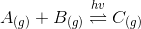
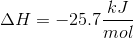
Based on the given information, under what conditions should this reaction be carried out to promote the most formation of product?
Based on the given information, under what conditions should this reaction be carried out to promote the most formation of product?
Tap to reveal answer
High pressure will favor the side of the reaction with fewer moles of gas, which in this case is the product side.
The reaction is exothermic, meaning that it generates heat. By removing heat from the reaction, we are constantly stressing the system towards the product side.
Finally, the reaction should occur under a lamp. This is due to the hv symbol above the double arrows, which signifies that light promotes the reaction. Note: had the hv symbol been below the double arrows, the reaction should have occurred in the dark.
High pressure will favor the side of the reaction with fewer moles of gas, which in this case is the product side.
The reaction is exothermic, meaning that it generates heat. By removing heat from the reaction, we are constantly stressing the system towards the product side.
Finally, the reaction should occur under a lamp. This is due to the hv symbol above the double arrows, which signifies that light promotes the reaction. Note: had the hv symbol been below the double arrows, the reaction should have occurred in the dark.
← Didn't Know|Knew It →
A saturated aqueous solution of calcium hydroxide is prepared. Given the information above, how will adding of affect the solubility and the of the solution?
A saturated aqueous solution of calcium hydroxide is prepared. Given the information above, how will adding
Tap to reveal answer
Adding contributes ions into the solution, driving the reaction to the left, and decreasing the solubility of the calcium hydroxide. This is known as the common-ion effect. The remains unchanged. This is due to the fact that only a change in temperature can bring about a change in an equilibrium constant.
Adding
← Didn't Know|Knew It →
Ammonia is created using the Haber-Bosch process:
A reaction vessel is used to combine the nitrogen and hydrogen gas until the vessel is at equilibrium.
What will happen to the system if ammonia is removed from the vessel?
Ammonia is created using the Haber-Bosch process:
A reaction vessel is used to combine the nitrogen and hydrogen gas until the vessel is at equilibrium.
What will happen to the system if ammonia is removed from the vessel?
Tap to reveal answer
When a system is at equilibrium, it is possible to predict how a system will respond to sudden changes using Le Chatelier's principle. In this scenario, ammonia has been removed from the system. This will cause the reaction to produce more ammonia, and proceed to the right in order to reestablish equilibrium.
When a system is at equilibrium, it is possible to predict how a system will respond to sudden changes using Le Chatelier's principle. In this scenario, ammonia has been removed from the system. This will cause the reaction to produce more ammonia, and proceed to the right in order to reestablish equilibrium.
← Didn't Know|Knew It →
Ammonia is created using the Haber-Bosch process:
A reaction vessel is used to combine the nitrogen and hydrogen gas. The reaction proceeds until the vessel is at equilibrium.
What would you predict to happen if the pressure of the vessel increases?
Ammonia is created using the Haber-Bosch process:
A reaction vessel is used to combine the nitrogen and hydrogen gas. The reaction proceeds until the vessel is at equilibrium.
What would you predict to happen if the pressure of the vessel increases?
Tap to reveal answer
According to Le Chatelier's principle, a change in pressure will cause a shift in order to counteract the pressure change. When the pressure of a vessel is increased, the side of the reaction with fewer gas molecules will be preferred in order to minimize contact between gas molecules. For this reaction, there are four gas molecules on the left side and two gas molecules on the right side. As a result, the products side will be preferred and more ammonia will be created.
According to Le Chatelier's principle, a change in pressure will cause a shift in order to counteract the pressure change. When the pressure of a vessel is increased, the side of the reaction with fewer gas molecules will be preferred in order to minimize contact between gas molecules. For this reaction, there are four gas molecules on the left side and two gas molecules on the right side. As a result, the products side will be preferred and more ammonia will be created.
← Didn't Know|Knew It →
Based on the given information, under what conditions should this reaction be carried out to promote the most formation of product?
Based on the given information, under what conditions should this reaction be carried out to promote the most formation of product?
Tap to reveal answer
High pressure will favor the side of the reaction with fewer moles of gas, which in this case is the product side.
The reaction is exothermic, meaning that it generates heat. By removing heat from the reaction, we are constantly stressing the system towards the product side.
Finally, the reaction should occur under a lamp. This is due to the hv symbol above the double arrows, which signifies that light promotes the reaction. Note: had the hv symbol been below the double arrows, the reaction should have occurred in the dark.
High pressure will favor the side of the reaction with fewer moles of gas, which in this case is the product side.
The reaction is exothermic, meaning that it generates heat. By removing heat from the reaction, we are constantly stressing the system towards the product side.
Finally, the reaction should occur under a lamp. This is due to the hv symbol above the double arrows, which signifies that light promotes the reaction. Note: had the hv symbol been below the double arrows, the reaction should have occurred in the dark.
← Didn't Know|Knew It →
Which of the following is true regarding the Michaelis constant?
Which of the following is true regarding the Michaelis constant?
Tap to reveal answer
Michaelis constant, or  , is defined as the concentration of substrate at which the reaction rate is half the maximum (
 ). It is a useful measure of how much substrate is needed for reaction to proceed rapidly. A reaction with a high Michaelis constant will need lots of substrate to reach high reaction rates whereas a reaction with low Michaelis constant will need small amounts of substrate to reach high reaction rates.
Michaelis constant, or
← Didn't Know|Knew It →
Which of the following will have the greatest increase in reaction rate?
Which of the following will have the greatest increase in reaction rate?
Tap to reveal answer
Reaction rate, according to Michaelis-Menten model is as follows.
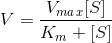
where  is reaction rate,
  is maximum reaction rate,
  is substrate concentration, and
  is the Michaelis constant. If we analyze the given options, we will observe that the greatest increase in
  occurs when
  is doubled (increased by a factor of 2). Increasing substrate concentration by a factor of 2 will have nearly the same effect; however, since
  is also found in the denominator it will only slightly contribute to an increase in
  .
.
Note that the units for  is molarity,
  is molarity, and
  is
is  . Solving for
  will give us units of
  .
.
Reaction rate, according to Michaelis-Menten model is as follows.
where
Note that the units for
← Didn't Know|Knew It →
Consider the following reaction parameters.
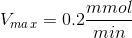
Substrate concentration = 
Michaelis constant = 
What can you conclude about the reaction rate?
Consider the following reaction parameters.
Substrate concentration =
Michaelis constant =
What can you conclude about the reaction rate?
Tap to reveal answer
To solve this problem we need to use the Michaelis-Menten equation.
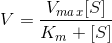
where  is reaction rate,
  is maximum reaction rate,
  is substrate concentration, and
  is the Michaelis constant. If we plug in the given values we get a reaction rate of
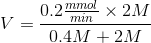

Note that the Michaelis-Menten equation implies that the  will never exceed
  . Regardless of how high the substrate concentration is, the reaction rate will approach
  but will never equal or exceed it. You can try this by substituting very high values for substrate concentration. The
  will get very close to 0.2 (
 ) but will never equal or exceed it.
To solve this problem we need to use the Michaelis-Menten equation.
where
Note that the Michaelis-Menten equation implies that the
← Didn't Know|Knew It →
The Michaelis-Menten model implies that the Michaelis constant will the reaction rate.
The Michaelis-Menten model implies that the Michaelis constant will the reaction rate.
Tap to reveal answer
The Michaelis-Menten equation is as follows.
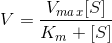
Where  is reaction rate,
  is maximum reaction rate,
  is substrate concentration, and
  is the Michaelis constant. Since the Michaelis constant,
  , is in the denominator, the reaction rate is inversely proportional to the Michaelis constant; therefore, increasing the Michaelis constant will decrease the reaction rate.
The Michaelis-Menten equation is as follows.
Where
← Didn't Know|Knew It →
A 50mL solution of 0.2M hydrochloric acid is titrated with a 0.2M sodium hydroxide solution. What is the pH when 50mL of sodium hydroxide has been added?
A 50mL solution of 0.2M hydrochloric acid is titrated with a 0.2M sodium hydroxide solution. What is the pH when 50mL of sodium hydroxide has been added?
Tap to reveal answer
When the molar amount of acid equals the molar amount of base, the solution has reached what is known as the equivalence point. When a strong acid is titrated with a strong base, such as in this example, the two agents will neutralize each other completely. Because the conjugate base for the acid is incredibly weak, it will not manipulate the pH. As a result, the pH at this equivalence point is 7.00.
When the molar amount of acid equals the molar amount of base, the solution has reached what is known as the equivalence point. When a strong acid is titrated with a strong base, such as in this example, the two agents will neutralize each other completely. Because the conjugate base for the acid is incredibly weak, it will not manipulate the pH. As a result, the pH at this equivalence point is 7.00.
← Didn't Know|Knew It →
A 50mL solution of 0.2M hydrochloric acid is titrated with a 0.2M sodium hydroxide solution. What is the pH of the solution after 48mL of the sodium hydroxide solution has been added?
A 50mL solution of 0.2M hydrochloric acid is titrated with a 0.2M sodium hydroxide solution. What is the pH of the solution after 48mL of the sodium hydroxide solution has been added?
Tap to reveal answer
Since a strong acid is being titrated with a strong base, we can simply subtract how many moles of base have been added from how many moles of acid were originally present.


Using the same equation, we found we have added 0.0096 moles of sodium hydroxide.

Subtracting this amount from the hydrochloric acid leaves us with 0.0004 moles of acid.

Keep in mind that we must divide this molar amount by the new volume, after the base has been added.

Since this is a strong acid, we can simply take the negative log of this concentration, and are left with a pH of 2.39.

Since a strong acid is being titrated with a strong base, we can simply subtract how many moles of base have been added from how many moles of acid were originally present.
Using the same equation, we found we have added 0.0096 moles of sodium hydroxide.
Subtracting this amount from the hydrochloric acid leaves us with 0.0004 moles of acid.
Keep in mind that we must divide this molar amount by the new volume, after the base has been added.
Since this is a strong acid, we can simply take the negative log of this concentration, and are left with a pH of 2.39.
← Didn't Know|Knew It →