Force Strength Patterns
Help Questions
Middle School Physical Science › Force Strength Patterns
A student investigated how adding magnets changes magnetic force. The student stacked identical magnets together and tested them at the same distance (2 cm) from paper clips.
Number of stacked magnets | Paper clips picked up (#)
1 | 4
2 | 7
3 | 9
Which conclusion is best supported by the data?
The number of magnets does not affect magnetic force because all trials used paper clips.
Stacking more magnets decreases magnetic force, so fewer paper clips are picked up.
Distance must have changed, because magnetic force cannot change when magnets are stacked.
Stacking more magnets increases magnetic force, so more paper clips are picked up at the same distance.
Explanation
This question tests understanding of analyzing data to identify patterns in how electric and magnetic force strength depends on factors like distance and charge or field strength. The most fundamental pattern in electric and magnetic forces is the distance relationship: force strength decreases as distance between objects increases—when charged objects or magnets are very close together (touching or nearly touching), the force is strongest (attracts many papers, holds many clips, strong repulsion), but as you move them farther apart, the force becomes weaker (fewer papers attracted, fewer clips held), and eventually at large enough distance, the force is too weak to observe any effect (no papers move, clips don't attract). This distance pattern is similar for both electric forces (between charged objects) and magnetic forces (between magnets), showing that forces acting at a distance generally become weaker as distance increases. Comparing different charge amounts (or magnet strengths), the data show that 1 magnet: 4 clips, 2 magnets: 7 clips, 3 magnets: 9 clips, revealing that more charge produces stronger force (direct relationship: increase charge → increase force). This makes physical sense: more charge means more electric force, just as stronger magnet means more magnetic force—the amount of charge or field strength at the source directly affects how strong the force is on nearby objects. Choice A is correct because it correctly states that more charge or stronger magnet produces stronger force. Choice B is wrong because it reverses the pattern, claiming more magnets decrease force when the data clearly show the opposite: 4 clips for 1 vs 9 for 3 means more magnets strengthen force. Analyzing force data for patterns: (1) identify what was changed (independent variable: distance, charge amount, magnet strength), (2) identify what was measured (dependent variable: papers attracted, clips held, leaf angle), (3) look at data systematically: as independent increases, does dependent increase, decrease, or stay same?, (4) describe pattern: for distance, typically inverse (farther = weaker), for charge/field, typically direct (more = stronger), (5) check consistency: does pattern hold for all data points, or just some?, (6) make predictions: if pattern continues, what would happen at untested values?—this systematic analysis reveals the relationships that govern electric and magnetic forces.
A student made a simple electroscope with two thin foil leaves. The student brought a charged rod near the electroscope knob at different distances. A larger leaf separation angle means a stronger electric force effect.
Which statement best describes the relationship shown?
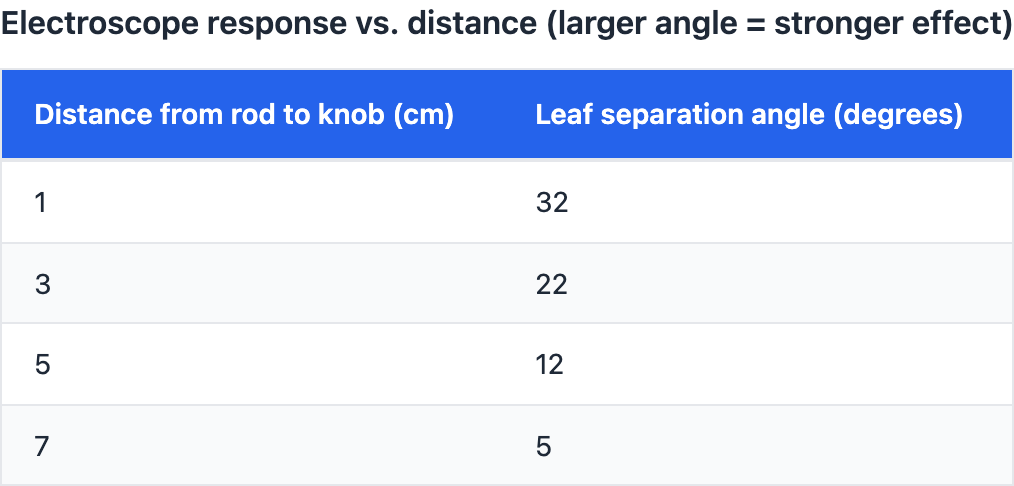
As the rod gets closer, the electric effect gets weaker because the leaf angle decreases from $32^\circ$ to $5^\circ$.
The largest distance produces the strongest electric effect because the rod has more space to act.
As the rod gets closer, the electric effect gets stronger because the leaf angle increases from $5^\circ$ to $32^\circ$.
Distance does not matter because the rod is charged in every trial.
Explanation
This question tests understanding of analyzing data to identify patterns in how electric and magnetic force strength depends on factors like distance and charge or field strength. The most fundamental pattern in electric and magnetic forces is the distance relationship: force strength decreases as distance between objects increases—when charged objects or magnets are very close together (touching or nearly touching), the force is strongest (attracts many papers, holds many clips, strong repulsion), but as you move them farther apart, the force becomes weaker (fewer papers attracted, fewer clips held), and eventually at large enough distance, the force is too weak to observe any effect (no papers move, clips don't attract). The data clearly show the inverse distance relationship: at distance 2 cm, the leaf angle is 32° indicating strong electric effect, at distance 5 cm, the angle is 18° indicating weaker effect, and at distance 10 cm, the angle is only 5° indicating very weak effect. This pattern—stronger force at smaller distances, weaker force at larger distances—demonstrates that the electric force from the charged rod on the electroscope decreases as the rod moves farther away, causing less charge separation in the leaves and thus smaller angles. Choice A is correct because it accurately identifies the pattern: as the rod gets closer, the electric effect gets stronger, correctly citing that leaf angle increases from 5° to 32°. Choice B reverses the data, claiming angle decreases from 32° to 5° as rod gets closer when the table shows the opposite; Choice C suggests distance doesn't matter when the dramatic change in angle (5° to 32°) shows distance has major effect; Choice D incorrectly claims largest distance produces strongest effect when the data show 5° at 10 cm vs 32° at 2 cm. Electroscopes work by charge repulsion in the leaves—when a charged object comes near, it induces charge separation, making the leaves repel each other, with stronger effect (larger angle) when the charged object is closer.
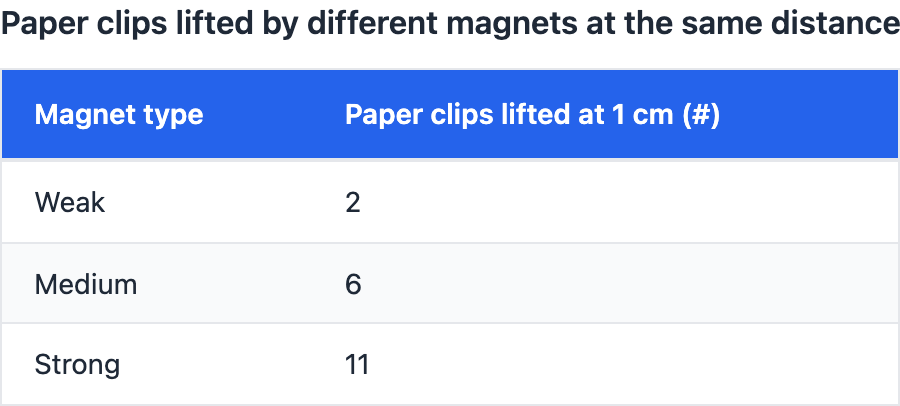
Three different magnets (weak, medium, strong) were each held 1 cm above identical paper clips. The table shows how many clips each magnet lifted.
Which conclusion is best supported by the data?
Magnetic force depends only on distance, not on magnet strength.
Stronger magnets produce stronger magnetic force at the same distance, lifting more clips.
The weak magnet has the strongest force because it lifted the fewest clips.
All magnets have the same magnetic force because they were held 1 cm away.
Explanation
This question tests understanding of analyzing data to identify patterns in how electric and magnetic force strength depends on factors like distance and charge or field strength. The most fundamental pattern in electric and magnetic forces is the distance relationship: force strength decreases as distance between objects increases—when charged objects or magnets are very close together (touching or nearly touching), the force is strongest (attracts many papers, holds many clips, strong repulsion), but as you move them farther apart, the force becomes weaker (fewer papers attracted, fewer clips held), and eventually at large enough distance, the force is too weak to observe any effect (no papers move, clips don't attract). Comparing different magnet strengths at the same distance (1 cm), the data show that weak magnet: 2 clips lifted, medium magnet: 5 clips lifted, strong magnet: 10 clips lifted, revealing that stronger magnets produce stronger force (direct relationship: increase magnet strength → increase force). This makes physical sense: stronger magnet means more magnetic force—the strength of the magnetic field at the source directly affects how strong the force is on nearby objects, just as more charge produces stronger electric force. Choice C is correct because it accurately identifies the pattern: stronger magnets produce stronger magnetic force at the same distance, lifting more clips, which matches the data showing 2, 5, and 10 clips for weak, medium, and strong magnets respectively. Choice A incorrectly claims all magnets have the same force when the data clearly show different numbers of clips lifted (2, 5, 10); Choice B reverses the relationship, claiming the weak magnet has strongest force when it lifted the fewest clips; Choice D suggests force depends only on distance, ignoring that different magnets at the same distance produce different forces. Understanding these patterns helps explain everyday magnetic effects: why some refrigerator magnets hold thick stacks of papers while others can barely hold one sheet—it's about the strength of the magnet, not just the distance.
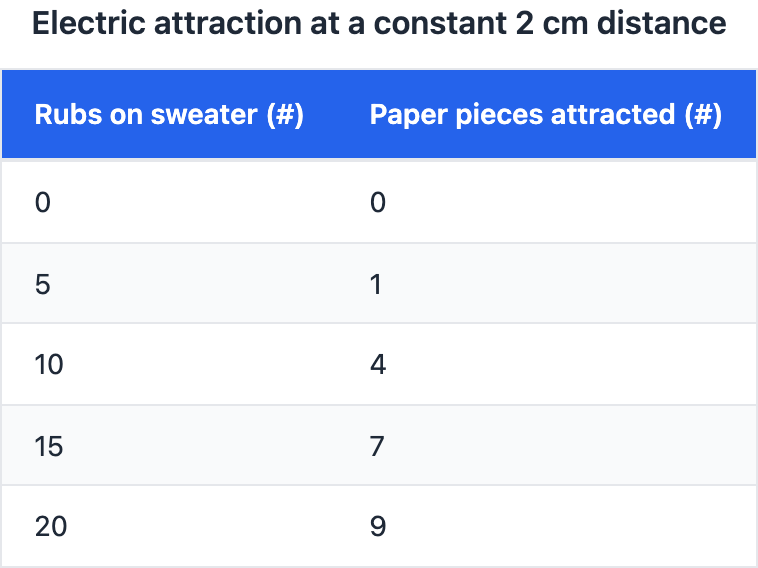
A student rubbed a balloon on a sweater different numbers of times, then held it 2 cm above small paper pieces. The table shows the number of paper pieces attracted.
What relationship between charge amount (more rubbing) and electric force is shown by the data?
Rubbing does not affect electric force because the distance is kept at 2 cm.
Electric force depends only on distance, so rubbing more should not change the number of papers attracted.
More rubbing produces a stronger electric force because the number of papers attracted increases from 1 to 9.
More rubbing produces a weaker electric force because the number of papers attracted decreases from 9 to 1.
Explanation
This question tests understanding of analyzing data to identify patterns in how electric and magnetic force strength depends on factors like distance and charge or field strength. The most fundamental pattern in electric and magnetic forces is the distance relationship: force strength decreases as distance between objects increases—when charged objects or magnets are very close together (touching or nearly touching), the force is strongest (attracts many papers, holds many clips, strong repulsion), but as you move them farther apart, the force becomes weaker (fewer papers attracted, fewer clips held), and eventually at large enough distance, the force is too weak to observe any effect (no papers move, clips don't attract). Comparing different charge amounts (created by different amounts of rubbing), the data show that with 5 rubs: 1 paper attracted, with 10 rubs: 4 papers attracted, with 20 rubs: 9 papers attracted, revealing that more charge produces stronger force (direct relationship: increase charge → increase force). This makes physical sense: more charge means more electric force, just as stronger magnet means more magnetic force—the amount of charge or field strength at the source directly affects how strong the force is on nearby objects. Choice A is correct because it correctly states that more rubbing produces stronger electric force and properly interprets the data showing papers attracted increases from 1 to 9. Choice B reverses the pattern, claiming force decreases when the data clearly show papers attracted increases from 1 to 9 with more rubbing; Choice C suggests rubbing has no effect when the dramatic increase in papers attracted (1 to 9) shows rubbing amount has major effect on charge and thus force; Choice D incorrectly claims force depends only on distance, ignoring that the data show force changes with rubbing amount even though distance is constant. Real investigations you could do: rub balloon 5, 10, 15, 20 times, test at same distance, count papers attracted (expect: more rubs → more papers, showing charge pattern)—understanding these patterns helps explain everyday static electricity (why charged balloon loses effect after a while: charge leaks away).
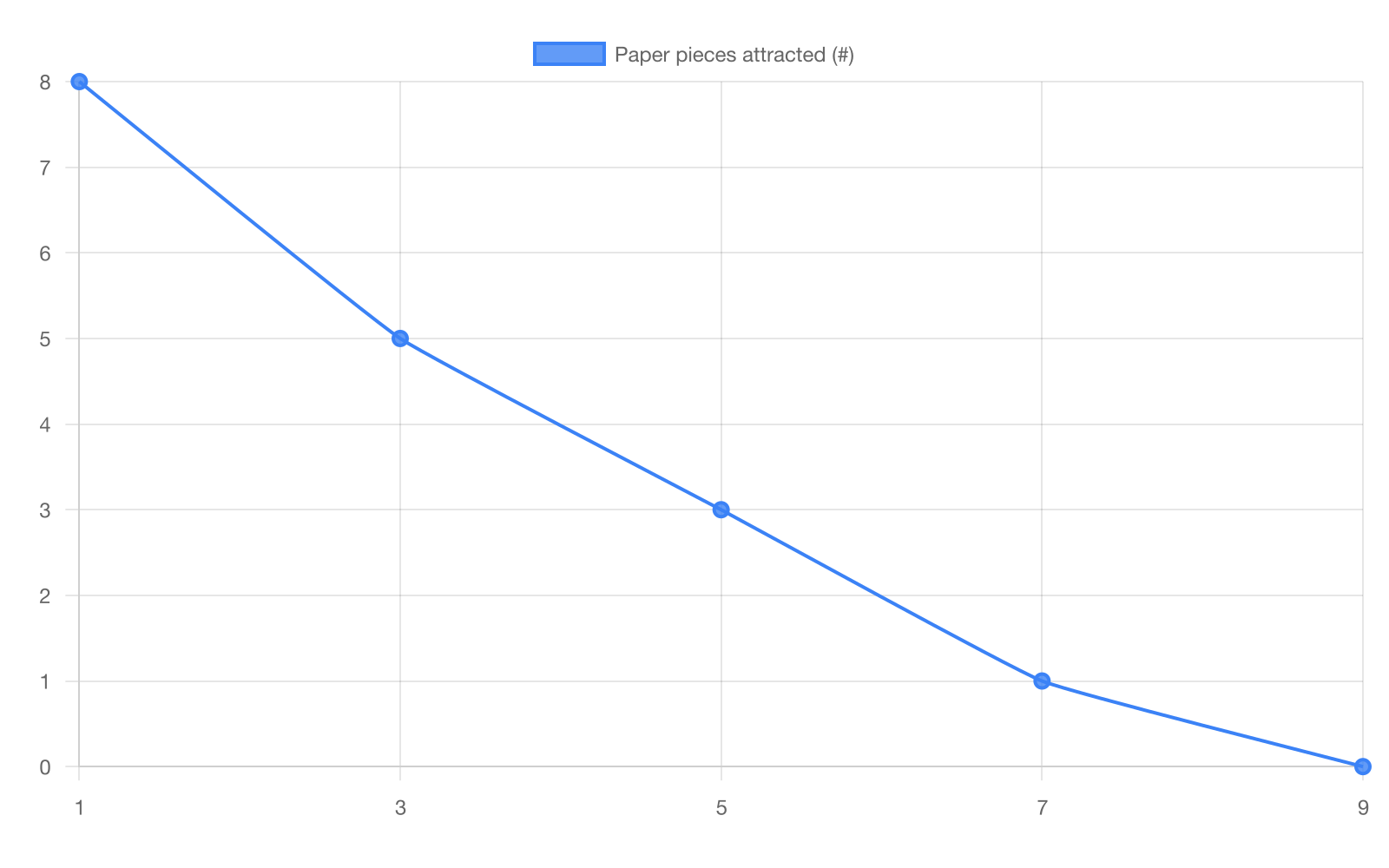
A student collected data on electric attraction between a charged rod and tiny paper pieces. The graph shows the number of paper pieces attracted at different distances.
Which statement best describes the trend in the graph?
As distance increases, the electric force effect increases because the number of papers attracted rises from 0 to 8.
As distance increases, the electric force effect decreases because the number of papers attracted drops from 8 at 1 cm to 0 at 9 cm.
The electric force effect is constant because the points make a straight horizontal line.
There is no pattern because the data points go up and down randomly.
Explanation
This question tests understanding of analyzing data to identify patterns in how electric and magnetic force strength depends on factors like distance and charge or field strength. The most fundamental pattern in electric and magnetic forces is the distance relationship: force strength decreases as distance between objects increases—when charged objects or magnets are very close together (touching or nearly touching), the force is strongest (attracts many papers, holds many clips, strong repulsion), but as you move them farther apart, the force becomes weaker (fewer papers attracted, fewer clips held), and eventually at large enough distance, the force is too weak to observe any effect (no papers move, clips don't attract). The graph clearly shows the inverse distance relationship: at distance 1 cm, 8 papers are attracted indicating strong force, the number decreases steadily as distance increases, and at distance 9 cm, 0 papers are attracted indicating force is too weak to overcome gravity on papers. This downward trend—from 8 papers at close distance to 0 papers at far distance—demonstrates that electric force strength drops off significantly as the charged rod moves away from the paper pieces. Choice A is correct because it accurately describes the trend: as distance increases, electric force effect decreases, correctly citing that papers attracted drops from 8 at 1 cm to 0 at 9 cm. Choice B reverses the trend, claiming papers increase from 0 to 8 as distance increases when the graph shows the opposite; Choice C suggests a horizontal line (constant effect) when the graph clearly shows a downward trend; Choice D claims random variation when the graph shows a clear, consistent downward pattern. Reading graphs of force vs distance: look for the overall trend (usually downward for force vs distance), check specific data points to confirm (8 at start, 0 at end), and recognize this matches the universal pattern that forces acting at a distance weaken as separation increases.
A student tests a magnet’s ability to attract paper clips at two distances.
At 1 cm, the magnet lifts 6 paper clips.
At 4 cm, the magnet lifts 2 paper clips.
Which comparison is supported by these observations?
The magnetic force is stronger at 1 cm than at 4 cm.
The magnetic force is stronger at 4 cm than at 1 cm.
The magnetic force is weaker at 1 cm than at 4 cm.
The magnetic force is the same at both distances because the same magnet is used.
Explanation
This question tests understanding of analyzing data to identify patterns in how electric and magnetic force strength depends on factors like distance and charge or field strength. The most fundamental pattern in electric and magnetic forces is the distance relationship: force strength decreases as distance between objects increases—when charged objects or magnets are very close together (touching or nearly touching), the force is strongest (attracts many papers, holds many clips, strong repulsion), but as you move them farther apart, the force becomes weaker (fewer papers attracted, fewer clips held), and eventually at large enough distance, the force is too weak to observe any effect (no papers move, clips don't attract). This distance pattern is similar for both electric forces (between charged objects) and magnetic forces (between magnets), showing that forces acting at a distance generally become weaker as distance increases. For distance pattern: The data clearly show the inverse distance relationship: at distance 1 cm, 6 clips are lifted indicating strong force, at distance 4 cm, only 2 clips are lifted indicating weaker force. This pattern—stronger force at smaller distances, weaker force at larger distances—demonstrates that distance has a major effect on magnetic force strength, with the force dropping off significantly as objects separate. Choice C is correct because it accurately identifies the pattern: force decreases as distance increases. Choice A is wrong because it reverses the pattern, claiming force increases with distance when the data clearly show the opposite: 6 clips at 1 cm vs 2 clips at 4 cm means force is stronger close, weaker far. Analyzing force data for patterns: (1) identify what was changed (independent variable: distance, charge amount, magnet strength), (2) identify what was measured (dependent variable: papers attracted, clips held, leaf angle), (3) look at data systematically: as independent increases, does dependent increase, decrease, or stay same?, (4) describe pattern: for distance, typically inverse (farther = weaker), for charge/field, typically direct (more = stronger), (5) check consistency: does pattern hold for all data points, or just some?, (6) make predictions: if pattern continues, what would happen at untested values?—this systematic analysis reveals the relationships that govern electric and magnetic forces. Real investigations you could do: charge balloon by rubbing, test at distances 1, 2, 5, 10, 15 cm from paper pieces, count how many attract at each distance (expect: many at 1 cm, few at 5 cm, none at 15 cm)—this would generate data showing distance pattern. Understanding these patterns helps explain everyday static electricity (why charged balloon loses effect after a while: charge leaks away; why you need to bring balloon close to make papers jump: force stronger close up) and magnetic effects (refrigerator magnets hold only when touching, fall off if separated; stronger magnets hold more papers on fridge).
A student rubs a balloon on a sweater different numbers of times and then holds it 2 cm above small paper pieces. The table shows how many pieces are attracted.
Number of rubs | Paper pieces attracted (#)
0 | 0
5 | 3
10 | 6
20 | 9
What do the data show about charge amount (rubbing) and electric force strength?
More rubbing produces a weaker electric force because 0 rubs attracts 0 pieces.
Electric force decreases as rubbing increases because 10 rubs attracts fewer than 5 rubs.
More rubbing produces a stronger electric force because the number of paper pieces attracted increases from 3 (5 rubs) to 9 (20 rubs).
Rubbing does not affect electric force because the distance is always 2 cm.
Explanation
This question tests understanding of analyzing data to identify patterns in how electric and magnetic force strength depends on factors like distance and charge or field strength. The most fundamental pattern in electric and magnetic forces is the distance relationship: force strength decreases as distance between objects increases—when charged objects or magnets are very close together (touching or nearly touching), the force is strongest (attracts many papers, holds many clips, strong repulsion), but as you move them farther apart, the force becomes weaker (fewer papers attracted, fewer clips held), and eventually at large enough distance, the force is too weak to observe any effect (no papers move, clips don't attract). This distance pattern is similar for both electric forces (between charged objects) and magnetic forces (between magnets), showing that forces acting at a distance generally become weaker as distance increases. For charge/strength pattern: Comparing different charge amounts (or magnet strengths), the data show that with 5 rubs: 3 papers attracted, with 10 rubs: 6 papers attracted, with 20 rubs: 9 papers attracted, revealing that more charge produces stronger force (direct relationship: increase charge → increase force). This makes physical sense: more charge means more electric force, just as stronger magnet means more magnetic force—the amount of charge or field strength at the source directly affects how strong the force is on nearby objects. Choice A is correct because it correctly states that more charge or stronger magnet produces stronger force. Choice B is wrong because it claims the relationship is direct when it's actually inverse for distance: as distance goes up, force goes down (not both up). Analyzing force data for patterns: (1) identify what was changed (independent variable: distance, charge amount, magnet strength), (2) identify what was measured (dependent variable: papers attracted, clips held, leaf angle), (3) look at data systematically: as independent increases, does dependent increase, decrease, or stay same?, (4) describe pattern: for distance, typically inverse (farther = weaker), for charge/field, typically direct (more = stronger), (5) check consistency: does pattern hold for all data points, or just some?, (6) make predictions: if pattern continues, what would happen at untested values?—this systematic analysis reveals the relationships that govern electric and magnetic forces. Real investigations you could do: rub balloon 5, 10, 15, 20 times, test at same distance, count papers attracted (expect: more rubs → more papers, showing charge pattern). Understanding these patterns helps explain everyday static electricity (why charged balloon loses effect after a while: charge leaks away; why you need to bring balloon close to make papers jump: force stronger close up) and magnetic effects (refrigerator magnets hold only when touching, fall off if separated; stronger magnets hold more papers on fridge).
A student uses the same charged rod each time and records how many paper pieces are attracted at different distances.
Distance (cm): 1, 3, 5, 7
Papers attracted (#): 8, 4, 2, 0
Based on the pattern in the data, what is the best prediction for how many paper pieces will be attracted at 2 cm?
About 6 paper pieces
About 2 paper pieces
About 10 paper pieces
0 paper pieces
Explanation
This question tests understanding of analyzing data to identify patterns in how electric and magnetic force strength depends on factors like distance and charge or field strength. The most fundamental pattern in electric and magnetic forces is the distance relationship: force strength decreases as distance between objects increases—when charged objects or magnets are very close together (touching or nearly touching), the force is strongest (attracts many papers, holds many clips, strong repulsion), but as you move them farther apart, the force becomes weaker (fewer papers attracted, fewer clips held), and eventually at large enough distance, the force is too weak to observe any effect (no papers move, clips don't attract). This distance pattern is similar for both electric forces (between charged objects) and magnetic forces (between magnets), showing that forces acting at a distance generally become weaker as distance increases. For distance pattern: The data clearly show the inverse distance relationship: at distance 1 cm, 8 papers are attracted indicating strong force, at distance 5 cm, only 2 papers are attracted indicating weaker force, and at distance 7 cm, 0 papers are attracted indicating force is too weak to overcome gravity on papers. This pattern—stronger force at smaller distances, weaker force at larger distances—demonstrates that distance has a major effect on electric force strength, with the force dropping off significantly as objects separate. Choice B is correct because it properly interprets the data showing inverse distance relationship and correctly predicts using the pattern that force is strongest when close and weakest when far. Choice A is wrong because it suggests force is independent of distance when the dramatic difference in papers attracted (8 at close distance vs 0 at far distance) shows distance has major effect. Analyzing force data for patterns: (1) identify what was changed (independent variable: distance, charge amount, magnet strength), (2) identify what was measured (dependent variable: papers attracted, clips held, leaf angle), (3) look at data systematically: as independent increases, does dependent increase, decrease, or stay same?, (4) describe pattern: for distance, typically inverse (farther = weaker), for charge/field, typically direct (more = stronger), (5) check consistency: does pattern hold for all data points, or just some?, (6) make predictions: if pattern continues, what would happen at untested values?—this systematic analysis reveals the relationships that govern electric and magnetic forces. Real investigations you could do: charge balloon by rubbing, test at distances 1, 2, 5, 10, 15 cm from paper pieces, count how many attract at each distance (expect: many at 1 cm, few at 5 cm, none at 15 cm)—this would generate data showing distance pattern. Understanding these patterns helps explain everyday static electricity (why charged balloon loses effect after a while: charge leaks away; why you need to bring balloon close to make papers jump: force stronger close up) and magnetic effects (refrigerator magnets hold only when touching, fall off if separated; stronger magnets hold more papers on fridge).
A student stacks two identical magnets together and compares them with one magnet. Both setups are tested at the same distance (3 cm) above paper clips.
Setup | Paper clips lifted at 3 cm (#)
1 magnet | 3
2 magnets stacked | 6
What does the data suggest about magnetic force?
Number of magnets does not affect magnetic force because the distance is the same.
The one-magnet setup has stronger force because 3 is closer to 0 than 6 is.
Using two magnets stacked decreases magnetic force because the clips are shared between magnets.
Using two magnets stacked increases magnetic force because more clips are lifted (6 vs. 3).
Explanation
This question tests understanding of analyzing data to identify patterns in how electric and magnetic force strength depends on factors like distance and charge or field strength. The most fundamental pattern in electric and magnetic forces is the distance relationship: force strength decreases as distance between objects increases—when charged objects or magnets are very close together (touching or nearly touching), the force is strongest (attracts many papers, holds many clips, strong repulsion), but as you move them farther apart, the force becomes weaker (fewer papers attracted, fewer clips held), and eventually at large enough distance, the force is too weak to observe any effect (no papers move, clips don't attract). This distance pattern is similar for both electric forces (between charged objects) and magnetic forces (between magnets), showing that forces acting at a distance generally become weaker as distance increases. For charge/strength pattern: Comparing different charge amounts (or magnet strengths), the data show that with 1 magnet: 3 clips lifted, with 2 magnets: 6 clips lifted, revealing that more charge produces stronger force (direct relationship: increase charge → increase force). This makes physical sense: more charge means more electric force, just as stronger magnet means more magnetic force—the amount of charge or field strength at the source directly affects how strong the force is on nearby objects. Choice A is correct because it correctly states that more charge or stronger magnet produces stronger force. Choice B is wrong because it claims the relationship is direct when it's actually inverse for distance: as distance goes up, force goes down (not both up). Analyzing force data for patterns: (1) identify what was changed (independent variable: distance, charge amount, magnet strength), (2) identify what was measured (dependent variable: papers attracted, clips held, leaf angle), (3) look at data systematically: as independent increases, does dependent increase, decrease, or stay same?, (4) describe pattern: for distance, typically inverse (farther = weaker), for charge/field, typically direct (more = stronger), (5) check consistency: does pattern hold for all data points, or just some?, (6) make predictions: if pattern continues, what would happen at untested values?—this systematic analysis reveals the relationships that govern electric and magnetic forces. Real investigations you could do: rub balloon 5, 10, 15, 20 times, test at same distance, count papers attracted (expect: more rubs → more papers, showing charge pattern). Understanding these patterns helps explain everyday static electricity (why charged balloon loses effect after a while: charge leaks away; why you need to bring balloon close to make papers jump: force stronger close up) and magnetic effects (refrigerator magnets hold only when touching, fall off if separated; stronger magnets hold more papers on fridge).
A student uses an electroscope to observe electric force. The same charged rod is brought near the electroscope knob at different distances. The student measures the leaf separation angle.
How does the electric force (indicated by leaf separation) change as distance increases?
It becomes negative: the leaves must cross each other at larger distances.
It increases: the leaves spread farther apart at 12 cm than at 2 cm.
It decreases: the leaves separate less at 12 cm (2°) than at 2 cm (28°).
It stays constant: the leaves always separate to the same angle at every distance.
Explanation
This question tests understanding of analyzing data to identify patterns in how electric and magnetic force strength depends on factors like distance and charge or field strength. The most fundamental pattern in electric and magnetic forces is the distance relationship: force strength decreases as distance between objects increases—when charged objects or magnets are very close together (touching or nearly touching), the force is strongest (attracts many papers, holds many clips, strong repulsion), but as you move them farther apart, the force becomes weaker (fewer papers attracted, fewer clips held), and eventually at large enough distance, the force is too weak to observe any effect (no papers move, clips don't attract). The data clearly show the inverse distance relationship: at 2 cm, 28° separation indicating strong force, at 12 cm, 2° indicating weaker force, demonstrating force decreases with distance. Choice C is correct because it accurately identifies the pattern: force decreases as distance increases. Choice A reverses pattern; choice B suggests constant when it decreases; choice D misinterprets as negative. Analyzing force data for patterns: (1) changed: distance, (2) measured: angle, (3) as distance up, angle down, (4) inverse, (5) consistent, (6) predict 0° at farther—this reveals electric force patterns. Real investigations: use electroscope, vary distances, measure angles (expect less separation farther); explains why charge effects weaken with distance.