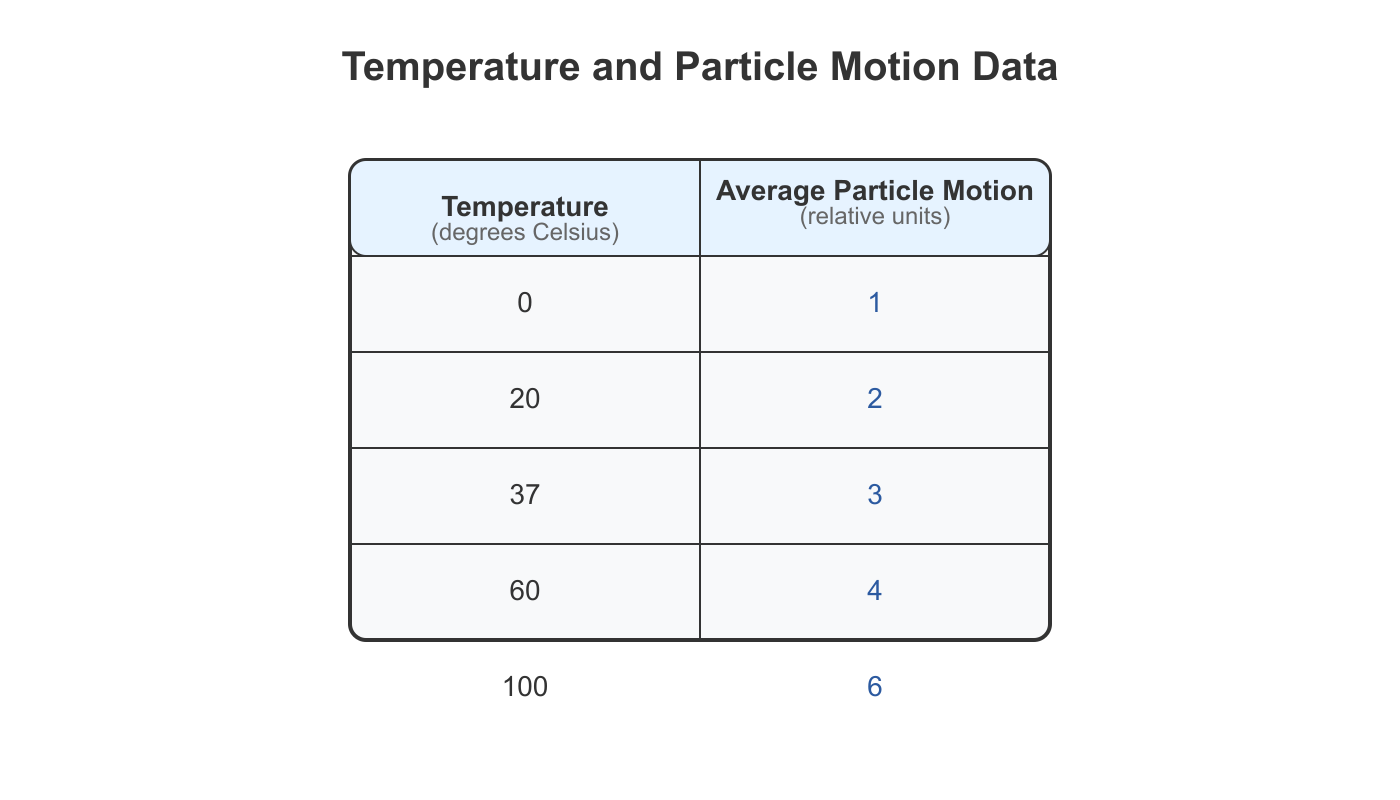
Temperature and Particle Motion - Middle School Physical Science
Card 1 of 25
What happens to average kinetic energy of particles when temperature decreases?
Tap to reveal answer
Average kinetic energy decreases. Lower temperature means slower particle motion.
← Didn't Know|Knew It →
Find the correct comparison: which has higher $\text{KE}_{\text{avg}}$, $273\ \text{K}$ or $300\ \text{K}$?
Tap to reveal answer
$300\ \text{K}$ has higher $\text{KE}_{\text{avg}}$. Higher Kelvin temperature means higher average kinetic energy.
← Didn't Know|Knew It →
A sample cools from $350\ \text{K}$ to $300\ \text{K}$. Does average kinetic energy increase or decrease?
Tap to reveal answer
Decrease. Lower temperature always means lower $\text{KE}_{\text{avg}}$.
← Didn't Know|Knew It →
If Kelvin temperature is cut in half from $500\ \text{K}$ to $250\ \text{K}$, what happens to $\text{KE}_{\text{avg}}$ for an ideal gas?
Tap to reveal answer
It is cut in half. $\text{KE}_{\text{avg}}$ is directly proportional to Kelvin temperature.
← Didn't Know|Knew It →
If Kelvin temperature doubles from $200\ \text{K}$ to $400\ \text{K}$, what happens to $\text{KE}_{\text{avg}}$ for an ideal gas?
Tap to reveal answer
It doubles. $\text{KE}_{\text{avg}}$ is directly proportional to Kelvin temperature.
← Didn't Know|Knew It →
Which has greater average kinetic energy: particles at $300\ \text{K}$ or $600\ \text{K}$?
Tap to reveal answer
Particles at $600\ \text{K}$. Higher Kelvin temperature always means higher $\text{KE}_{\text{avg}}$.
← Didn't Know|Knew It →
Identify the correct comparison: at the same temperature, do particles in different substances have the same average kinetic energy?
Tap to reveal answer
Yes, they have the same average kinetic energy at the same temperature. Temperature defines average kinetic energy regardless of substance.
← Didn't Know|Knew It →
Which option best describes why cooling a substance lowers its temperature?
Tap to reveal answer
Cooling removes energy from particles, decreasing average kinetic energy. Lost energy makes particles move slower.
← Didn't Know|Knew It →
Which option best describes why heating a substance raises its temperature?
Tap to reveal answer
Heating transfers energy to particles, increasing average kinetic energy. Added energy makes particles move faster.
← Didn't Know|Knew It →
Identify what happens to particle collisions when temperature increases in a gas.
Tap to reveal answer
Collisions become more frequent and more energetic. Faster particles collide harder and more often.
← Didn't Know|Knew It →
Which quantity depends on the amount of matter: temperature or total thermal energy?
Tap to reveal answer
Total thermal energy depends on the amount of matter. More particles mean more total energy at the same temperature.
← Didn't Know|Knew It →
Which statement is correct: temperature measures total kinetic energy or average kinetic energy?
Tap to reveal answer
Temperature measures average kinetic energy. Temperature is the average, not the sum of all particle energies.
← Didn't Know|Knew It →
Identify the temperature scale that is proportional to average kinetic energy of particles.
Tap to reveal answer
Kelvin temperature scale. Only Kelvin starts at absolute zero where $\text{KE}_{\text{avg}} = 0$.
← Didn't Know|Knew It →
What is the correct relationship between average kinetic energy and temperature?
Tap to reveal answer
Average kinetic energy is directly proportional to temperature. Doubling temperature doubles average kinetic energy.
← Didn't Know|Knew It →
Which option best describes particle motion at a lower temperature: faster or slower?
Tap to reveal answer
Slower particle motion. Lower temperature always means lower average kinetic energy.
← Didn't Know|Knew It →
Which option best describes particle motion at a higher temperature: faster or slower?
Tap to reveal answer
Faster particle motion. Higher temperature always means higher average kinetic energy.
← Didn't Know|Knew It →
What happens to average kinetic energy of particles when temperature increases?
Tap to reveal answer
Average kinetic energy increases. Higher temperature means faster particle motion.
← Didn't Know|Knew It →
What is temperature in terms of particle motion in a substance?
Tap to reveal answer
Temperature is the measure of average kinetic energy of particles. Higher temperatures mean particles move faster on average.
← Didn't Know|Knew It →
What happens to average kinetic energy during melting, even though heat is added?
Tap to reveal answer
It stays constant (temperature stays constant). Energy goes into breaking bonds, not increasing motion.
← Didn't Know|Knew It →
What is temperature in particle terms, using average kinetic energy?
Tap to reveal answer
Temperature measures the average kinetic energy of particles. Higher temperature means particles move faster on average.
← Didn't Know|Knew It →
What happens to average particle kinetic energy when temperature increases?
Tap to reveal answer
Average kinetic energy increases. Faster particle motion means higher temperature.
← Didn't Know|Knew It →
What happens to average particle kinetic energy when temperature decreases?
Tap to reveal answer
Average kinetic energy decreases. Slower particle motion means lower temperature.
← Didn't Know|Knew It →
Which type of energy change is directly linked to a temperature change: kinetic or potential?
Tap to reveal answer
Kinetic energy (average kinetic energy) is directly linked. Temperature directly measures particle motion energy.
← Didn't Know|Knew It →
What is the direction of energy transfer as heat from hotter to colder objects?
Tap to reveal answer
Heat transfers from higher temperature to lower temperature. Energy flows from hot to cold until equilibrium.
← Didn't Know|Knew It →
What happens to particle speed, on average, as temperature rises?
Tap to reveal answer
Average particle speed increases. Higher kinetic energy means faster motion.
← Didn't Know|Knew It →