Use Punnett Squares - Middle School Life Science
Card 1 of 160
The allele for longer necks in giraffes is dominant to the allele for shorter necks.
What are the phenotypes of the cross between two homozygous parents, one with a long neck and one with a short neck?
The allele for longer necks in giraffes is dominant to the allele for shorter necks.
What are the phenotypes of the cross between two homozygous parents, one with a long neck and one with a short neck?
Tap to reveal answer
The answer is 100% long necks. A homozygous dominant crossed with a homozygous recessive parent is shown below.

The answer is 100% long necks. A homozygous dominant crossed with a homozygous recessive parent is shown below.
← Didn't Know|Knew It →

The parents genotypes from this cross are .
The parents genotypes from this cross are .
Tap to reveal answer
The answer is "homozygous recessive and heterozygous" because homozygous means two of the same allele, while heterozygous means two different alleles. Dominant alleles are represented by capital letters and recessive alleles are represented by lowercase letters.
The answer is "homozygous recessive and heterozygous" because homozygous means two of the same allele, while heterozygous means two different alleles. Dominant alleles are represented by capital letters and recessive alleles are represented by lowercase letters.
← Didn't Know|Knew It →
A dog gives birth to 5 puppies. What percentage of chromosomes does each puppy share with its mother?
A dog gives birth to 5 puppies. What percentage of chromosomes does each puppy share with its mother?
Tap to reveal answer
The answer is 50% because each puppy shares 50% of chromosomes with its mother and 50% with its father.
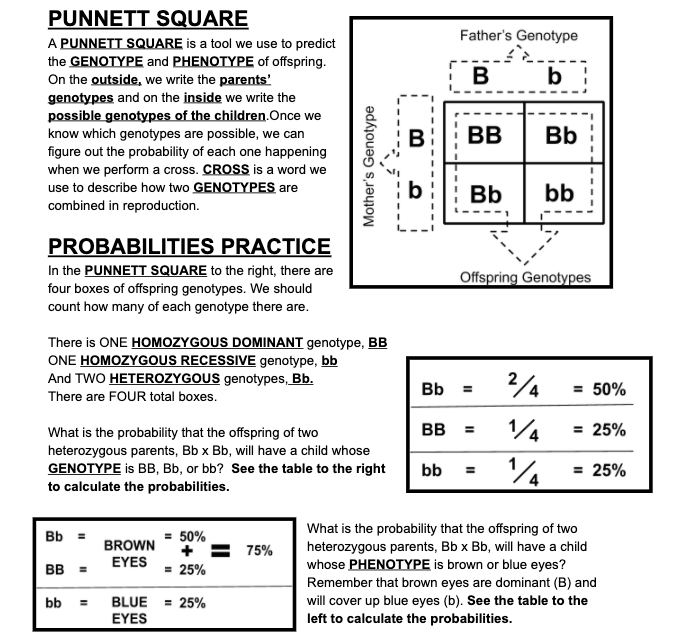
The answer is 50% because each puppy shares 50% of chromosomes with its mother and 50% with its father.
← Didn't Know|Knew It →
In butterflies, the gene for black wings (B) is dominant to the gene for blue wings (b). For which of the following parental genotypes would 100% of offspring be expected to be blue?
In butterflies, the gene for black wings (B) is dominant to the gene for blue wings (b). For which of the following parental genotypes would 100% of offspring be expected to be blue?
Tap to reveal answer
The answer is "bb x bb" because in all the other scenarios, the black gene would be dominant over the blue gene in at least one offspring.
The answer is "bb x bb" because in all the other scenarios, the black gene would be dominant over the blue gene in at least one offspring.
← Didn't Know|Knew It →
In poodles, the allele for black fur (B) is dominant to the gene for brown fur (b). Two poodles are crossed. One poodle is homozygous for black fur, and the other is heterozygous. What percentage of the offspring are expected to have black fur?
In poodles, the allele for black fur (B) is dominant to the gene for brown fur (b). Two poodles are crossed. One poodle is homozygous for black fur, and the other is heterozygous. What percentage of the offspring are expected to have black fur?
Tap to reveal answer
The answer is 100%. All offspring are expected to have black fur because all offspring will have at least one dominant allele for black fur which will overpower any allele for brown fur.
The answer is 100%. All offspring are expected to have black fur because all offspring will have at least one dominant allele for black fur which will overpower any allele for brown fur.
← Didn't Know|Knew It →
Polycystic Kidney Disease (PKD) is a disease that can cause kidney failure. This disease is usually caused by a dominant allele. What is the chance that a child will have PKD if the father is unaffected and the mother is heterozygous for PKD?
Polycystic Kidney Disease (PKD) is a disease that can cause kidney failure. This disease is usually caused by a dominant allele. What is the chance that a child will have PKD if the father is unaffected and the mother is heterozygous for PKD?
Tap to reveal answer
The answer is "50%."
The answer is "50%."
← Didn't Know|Knew It →

The allele for black feet in a species of duck is dominant to the allele for brown feet. What are the phenotypes of the offspring from the cross shown in the punnet square above?
The allele for black feet in a species of duck is dominant to the allele for brown feet. What are the phenotypes of the offspring from the cross shown in the punnet square above?
Tap to reveal answer
The answer is "75% black feet and 25% brown feet" because phenotypes are the physical expression of an allele pair and the dominant allele for black feet will overpower the allele for brown feet.
The answer is "75% black feet and 25% brown feet" because phenotypes are the physical expression of an allele pair and the dominant allele for black feet will overpower the allele for brown feet.
← Didn't Know|Knew It →
The allele for blue eyes is "t" while the allele for brown eyes is "T". What percentage of offspring produced by two parents with blue eyes would also have blue eyes?
The allele for blue eyes is "t" while the allele for brown eyes is "T". What percentage of offspring produced by two parents with blue eyes would also have blue eyes?
Tap to reveal answer
The answer is 100%. Since both parents had to have homozygous recessive alleles for blue eyes in order to express them, they both must have "tt" for a genotype. The following punnet square shows the results.

The answer is 100%. Since both parents had to have homozygous recessive alleles for blue eyes in order to express them, they both must have "tt" for a genotype. The following punnet square shows the results.
← Didn't Know|Knew It →
Brown fur is dominant to white fur in a species of rabbit and is represented with the alleles "B" and "b".
What are the resulting percentages of genotypes of a cross between a homozygous dominant parent and a heterozygous parent?
Brown fur is dominant to white fur in a species of rabbit and is represented with the alleles "B" and "b".
What are the resulting percentages of genotypes of a cross between a homozygous dominant parent and a heterozygous parent?
Tap to reveal answer
The answer is 50% BB and 50% Bb, as shown in the punnet square below. The phrase "homozygous dominant" means the genotype of one parent is BB while "heterozygous" is a genotype of Bb.

The answer is 50% BB and 50% Bb, as shown in the punnet square below. The phrase "homozygous dominant" means the genotype of one parent is BB while "heterozygous" is a genotype of Bb.
← Didn't Know|Knew It →
In a population of rats at a pet store, the allele for black fur is dominant (B) and the allele for brown fur is recessive (b). A rat with the genotype BB is crossed with a rat with the genotype Bb. Which describes the phenotype of the parent rats?
In a population of rats at a pet store, the allele for black fur is dominant (B) and the allele for brown fur is recessive (b). A rat with the genotype BB is crossed with a rat with the genotype Bb. Which describes the phenotype of the parent rats?
Tap to reveal answer
The answer is "Both are black." because each rat has a dominant allele for black fur.
The answer is "Both are black." because each rat has a dominant allele for black fur.
← Didn't Know|Knew It →
A dog gives birth to 5 puppies. What percentage of chromosomes does each puppy share with its mother?
A dog gives birth to 5 puppies. What percentage of chromosomes does each puppy share with its mother?
Tap to reveal answer
The answer is 50% because each puppy shares 50% of chromosomes with its mother and 50% with its father.
The answer is 50% because each puppy shares 50% of chromosomes with its mother and 50% with its father.
← Didn't Know|Knew It →
In a population of rats at a pet store, the allele for black fur is dominant (B) and the allele for brown fur is recessive (b). A rat with the genotype BB is crossed with a rat with the genotype Bb. Which describes the phenotype of the parent rats?
In a population of rats at a pet store, the allele for black fur is dominant (B) and the allele for brown fur is recessive (b). A rat with the genotype BB is crossed with a rat with the genotype Bb. Which describes the phenotype of the parent rats?
Tap to reveal answer
The answer is "Both are black." because each rat has a dominant allele for black fur.
The answer is "Both are black." because each rat has a dominant allele for black fur.
← Didn't Know|Knew It →
In poodles, the allele for black fur (B) is dominant to the gene for brown fur (b). Two poodles are crossed. One poodle is homozygous for black fur, and the other is heterozygous. What percentage of the offspring are expected to have black fur?
In poodles, the allele for black fur (B) is dominant to the gene for brown fur (b). Two poodles are crossed. One poodle is homozygous for black fur, and the other is heterozygous. What percentage of the offspring are expected to have black fur?
Tap to reveal answer
The answer is 100%. All offspring are expected to have black fur because all offspring will have at least one dominant allele for black fur which will overpower any allele for brown fur.
The answer is 100%. All offspring are expected to have black fur because all offspring will have at least one dominant allele for black fur which will overpower any allele for brown fur.
← Didn't Know|Knew It →
Polycystic Kidney Disease (PKD) is a disease that can cause kidney failure. This disease is usually caused by a dominant allele. What is the chance that a child will have PKD if the father is unaffected and the mother is heterozygous for PKD?
Polycystic Kidney Disease (PKD) is a disease that can cause kidney failure. This disease is usually caused by a dominant allele. What is the chance that a child will have PKD if the father is unaffected and the mother is heterozygous for PKD?
Tap to reveal answer
The answer is "50%."
The answer is "50%."
← Didn't Know|Knew It →
The allele for blue eyes is "t" while the allele for brown eyes is "T". What percentage of offspring produced by two parents with blue eyes would also have blue eyes?
The allele for blue eyes is "t" while the allele for brown eyes is "T". What percentage of offspring produced by two parents with blue eyes would also have blue eyes?
Tap to reveal answer
The answer is 100%. Since both parents had to have homozygous recessive alleles for blue eyes in order to express them, they both must have "tt" for a genotype. The following punnet square shows the results.
The answer is 100%. Since both parents had to have homozygous recessive alleles for blue eyes in order to express them, they both must have "tt" for a genotype. The following punnet square shows the results.
← Didn't Know|Knew It →
Brown fur is dominant to white fur in a species of rabbit and is represented with the alleles "B" and "b".
What are the resulting percentages of genotypes of a cross between a homozygous dominant parent and a heterozygous parent?
Brown fur is dominant to white fur in a species of rabbit and is represented with the alleles "B" and "b".
What are the resulting percentages of genotypes of a cross between a homozygous dominant parent and a heterozygous parent?
Tap to reveal answer
The answer is 50% BB and 50% Bb, as shown in the punnet square below. The phrase "homozygous dominant" means the genotype of one parent is BB while "heterozygous" is a genotype of Bb.
The answer is 50% BB and 50% Bb, as shown in the punnet square below. The phrase "homozygous dominant" means the genotype of one parent is BB while "heterozygous" is a genotype of Bb.
← Didn't Know|Knew It →
The allele for black feet in a species of duck is dominant to the allele for brown feet. What are the phenotypes of the offspring from the cross shown in the punnet square above?
The allele for black feet in a species of duck is dominant to the allele for brown feet. What are the phenotypes of the offspring from the cross shown in the punnet square above?
Tap to reveal answer
The answer is "75% black feet and 25% brown feet" because phenotypes are the physical expression of an allele pair and the dominant allele for black feet will overpower the allele for brown feet.
The answer is "75% black feet and 25% brown feet" because phenotypes are the physical expression of an allele pair and the dominant allele for black feet will overpower the allele for brown feet.
← Didn't Know|Knew It →
The allele for longer necks in giraffes is dominant to the allele for shorter necks.
What are the phenotypes of the cross between two homozygous parents, one with a long neck and one with a short neck?
The allele for longer necks in giraffes is dominant to the allele for shorter necks.
What are the phenotypes of the cross between two homozygous parents, one with a long neck and one with a short neck?
Tap to reveal answer
The answer is 100% long necks. A homozygous dominant crossed with a homozygous recessive parent is shown below.
The answer is 100% long necks. A homozygous dominant crossed with a homozygous recessive parent is shown below.
← Didn't Know|Knew It →
The parents genotypes from this cross are .
The parents genotypes from this cross are .
Tap to reveal answer
The answer is "homozygous recessive and heterozygous" because homozygous means two of the same allele, while heterozygous means two different alleles. Dominant alleles are represented by capital letters and recessive alleles are represented by lowercase letters.
The answer is "homozygous recessive and heterozygous" because homozygous means two of the same allele, while heterozygous means two different alleles. Dominant alleles are represented by capital letters and recessive alleles are represented by lowercase letters.
← Didn't Know|Knew It →
In butterflies, the gene for black wings (B) is dominant to the gene for blue wings (b). For which of the following parental genotypes would 100% of offspring be expected to be blue?
In butterflies, the gene for black wings (B) is dominant to the gene for blue wings (b). For which of the following parental genotypes would 100% of offspring be expected to be blue?
Tap to reveal answer
The answer is "bb x bb" because in all the other scenarios, the black gene would be dominant over the blue gene in at least one offspring.
The answer is "bb x bb" because in all the other scenarios, the black gene would be dominant over the blue gene in at least one offspring.
← Didn't Know|Knew It →