Theories of Motivation - MCAT Psychological and Social Foundations
Card 1 of 8
Excerpt from "The Chicago Employment Agency and the Immigrant Worker," Grace Abbott, American Journal of Sociology 1908 14:3, 289-305
In the late nineteenth and early twentieth centuries, immigrants poured into the United States without knowledge of English or American customs. They were also usually unaware of the local cost of living or typical wage. These immigrants turned to employment agencies that would help them find work, for a fee. The extreme dependence of immigrants on the employment agencies coupled with their general ignorance of the American system brought about an ethical dilemma for the employment agent in which it became very easy to take advantage of people seeking a job. This resulted in an extreme prejudice directed at immigrants by the American employment system. A study was conducted in the early 1900s gauged the degree of corruption among employment agents and the results of this study have been provided (see Tables 1, 2, and 3)
Table 1
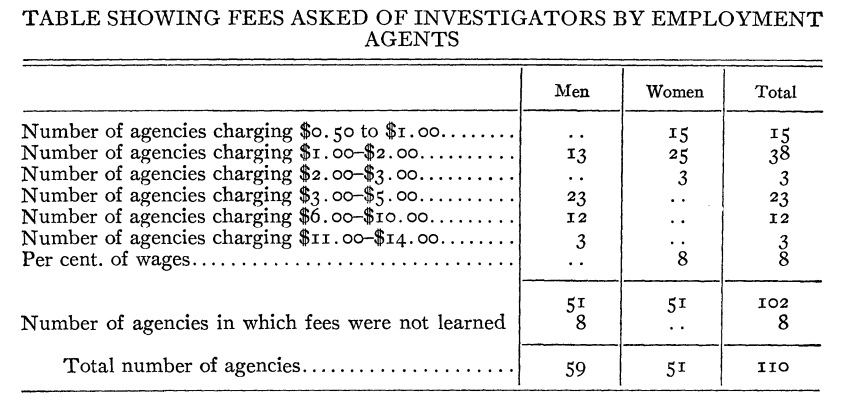
Table 2

Table 3

People are often concerned with meeting basic needs, such as food and clothing, before pursuing recreational or religious desires. Who is best known for describing this motivational prioritization?
Excerpt from "The Chicago Employment Agency and the Immigrant Worker," Grace Abbott, American Journal of Sociology 1908 14:3, 289-305
In the late nineteenth and early twentieth centuries, immigrants poured into the United States without knowledge of English or American customs. They were also usually unaware of the local cost of living or typical wage. These immigrants turned to employment agencies that would help them find work, for a fee. The extreme dependence of immigrants on the employment agencies coupled with their general ignorance of the American system brought about an ethical dilemma for the employment agent in which it became very easy to take advantage of people seeking a job. This resulted in an extreme prejudice directed at immigrants by the American employment system. A study was conducted in the early 1900s gauged the degree of corruption among employment agents and the results of this study have been provided (see Tables 1, 2, and 3)
Table 1
Table 2
Table 3
People are often concerned with meeting basic needs, such as food and clothing, before pursuing recreational or religious desires. Who is best known for describing this motivational prioritization?
Tap to reveal answer
Abraham Maslow is well known for the “Maslow’s hierarchy of needs.” It describes a prioritization of human needs ranging from homeostasis (breathing, staying warm), making up the broad bottom of the pyramid, to self-transcendence at the top. Piaget and Erickson both studied human development. Pavlov’s motivational theories centered around classical conditioning.
Abraham Maslow is well known for the “Maslow’s hierarchy of needs.” It describes a prioritization of human needs ranging from homeostasis (breathing, staying warm), making up the broad bottom of the pyramid, to self-transcendence at the top. Piaget and Erickson both studied human development. Pavlov’s motivational theories centered around classical conditioning.
← Didn't Know|Knew It →
Excerpt from “Two Kinds of Vocational Education” by Julius T. House, 1921
American Journal of Sociology, Vol. 27, No. 2 (Sep., 1921), pp. 222-225
There are two schools of thinkers interested in vocational education. One of these is individualistic, thinks in teams of fitting the child to the job, accepts the present economic system with little, if any, criticism. It would isolate consideration of the vocation, so far as possible, from consideration of its social purposes. Psychologically its plan is based upon habit, with no thought of developing in the child a sense of the relation of his work to the whole social process. To secure the result sought there must be early separation of technical schools from the rest of the school system. It is proposed to begin with the seventh grade, the so-called junior high school.
The purpose of the technical school is and will be to get the answer, already known to the teacher, by the shortest route. Emphasis will be laid on rapid calculation; swift, effective movement; automatic response. The typewriter, the shorthand notebook, the hammer and nail, the stove, the furnace, the retort, are the instruments of education. A technique of salesmanship and advertising, without the regard to the ethics of these operations and with no comprehension of the principles of psychology, is developed. Rough-and-ready adaptation to a rough-and-ready business world is the goal.
Certain results follow: (1) Even more rigid division of industrial life between two groups: those who manage, in whom power of initiative is vested; those who are skilled in narrow processes with no outlook upon the meaning of the work. (2) The exploitation of this isolated class. (3) The establishment of an institution to perpetuate this condition. Custom is already being instituted of sending the children of poor families to this manual-skill-producing school. (4) Public taxation to support institutions to assist business based on the supposition that when business prospers moral values take care of themselves.
The second group of thinkers, seemingly few but with men like John Dewey leading, are interested in vocational education as a means of introducing the child more intimately into the life of society. It is believed that such study should be directed to the perception of the relation of vocations to all the social process. Therefore all the students are to study all the vocations. The choice of a life-work will be, then, only a by-product of the training—important indeed, but still a by-product. Already such work is done in the grades. It remains only to enlarge it and relate it to the proper sciences as the later years of school life are reached.
Inferring from the text, would the author likely say that an individualistic system, in which a child is immediately fitted for a job, or a social system, in which a child is introduce to many disciplines before ultimately choosing a job, is more likely to encourage higher levels of attainment in Maslow’s Hierarchy of Needs?
Excerpt from “Two Kinds of Vocational Education” by Julius T. House, 1921
American Journal of Sociology, Vol. 27, No. 2 (Sep., 1921), pp. 222-225
There are two schools of thinkers interested in vocational education. One of these is individualistic, thinks in teams of fitting the child to the job, accepts the present economic system with little, if any, criticism. It would isolate consideration of the vocation, so far as possible, from consideration of its social purposes. Psychologically its plan is based upon habit, with no thought of developing in the child a sense of the relation of his work to the whole social process. To secure the result sought there must be early separation of technical schools from the rest of the school system. It is proposed to begin with the seventh grade, the so-called junior high school.
The purpose of the technical school is and will be to get the answer, already known to the teacher, by the shortest route. Emphasis will be laid on rapid calculation; swift, effective movement; automatic response. The typewriter, the shorthand notebook, the hammer and nail, the stove, the furnace, the retort, are the instruments of education. A technique of salesmanship and advertising, without the regard to the ethics of these operations and with no comprehension of the principles of psychology, is developed. Rough-and-ready adaptation to a rough-and-ready business world is the goal.
Certain results follow: (1) Even more rigid division of industrial life between two groups: those who manage, in whom power of initiative is vested; those who are skilled in narrow processes with no outlook upon the meaning of the work. (2) The exploitation of this isolated class. (3) The establishment of an institution to perpetuate this condition. Custom is already being instituted of sending the children of poor families to this manual-skill-producing school. (4) Public taxation to support institutions to assist business based on the supposition that when business prospers moral values take care of themselves.
The second group of thinkers, seemingly few but with men like John Dewey leading, are interested in vocational education as a means of introducing the child more intimately into the life of society. It is believed that such study should be directed to the perception of the relation of vocations to all the social process. Therefore all the students are to study all the vocations. The choice of a life-work will be, then, only a by-product of the training—important indeed, but still a by-product. Already such work is done in the grades. It remains only to enlarge it and relate it to the proper sciences as the later years of school life are reached.
Inferring from the text, would the author likely say that an individualistic system, in which a child is immediately fitted for a job, or a social system, in which a child is introduce to many disciplines before ultimately choosing a job, is more likely to encourage higher levels of attainment in Maslow’s Hierarchy of Needs?
Tap to reveal answer
The author’s argument is in favor of a social system in which education is broad and focused on society as a whole rather than simply a task. This expanded vision would enable people to have higher sights and goals. While it is true that an individualistic system may lead to quicker jobs, the author is not in favor of this system. The author would likely argue that underemployment, or work-place exploitation, would lead to a stagnation on Maslow’s Hierarchy of Needs. Food and water are important, but not directly applicable to the question. Therefore only one answer is correct: "Social System: A wider breadth of education will drive a person to seek more than simply financial success."
The author’s argument is in favor of a social system in which education is broad and focused on society as a whole rather than simply a task. This expanded vision would enable people to have higher sights and goals. While it is true that an individualistic system may lead to quicker jobs, the author is not in favor of this system. The author would likely argue that underemployment, or work-place exploitation, would lead to a stagnation on Maslow’s Hierarchy of Needs. Food and water are important, but not directly applicable to the question. Therefore only one answer is correct: "Social System: A wider breadth of education will drive a person to seek more than simply financial success."
← Didn't Know|Knew It →
Excerpt from "The Chicago Employment Agency and the Immigrant Worker," Grace Abbott, American Journal of Sociology 1908 14:3, 289-305
In the late nineteenth and early twentieth centuries, immigrants poured into the United States without knowledge of English or American customs. They were also usually unaware of the local cost of living or typical wage. These immigrants turned to employment agencies that would help them find work, for a fee. The extreme dependence of immigrants on the employment agencies coupled with their general ignorance of the American system brought about an ethical dilemma for the employment agent in which it became very easy to take advantage of people seeking a job. This resulted in an extreme prejudice directed at immigrants by the American employment system. A study was conducted in the early 1900s gauged the degree of corruption among employment agents and the results of this study have been provided (see Tables 1, 2, and 3)
Table 1
Table 2
Table 3
People are often concerned with meeting basic needs, such as food and clothing, before pursuing recreational or religious desires. Who is best known for describing this motivational prioritization?
Excerpt from "The Chicago Employment Agency and the Immigrant Worker," Grace Abbott, American Journal of Sociology 1908 14:3, 289-305
In the late nineteenth and early twentieth centuries, immigrants poured into the United States without knowledge of English or American customs. They were also usually unaware of the local cost of living or typical wage. These immigrants turned to employment agencies that would help them find work, for a fee. The extreme dependence of immigrants on the employment agencies coupled with their general ignorance of the American system brought about an ethical dilemma for the employment agent in which it became very easy to take advantage of people seeking a job. This resulted in an extreme prejudice directed at immigrants by the American employment system. A study was conducted in the early 1900s gauged the degree of corruption among employment agents and the results of this study have been provided (see Tables 1, 2, and 3)
Table 1
Table 2
Table 3
People are often concerned with meeting basic needs, such as food and clothing, before pursuing recreational or religious desires. Who is best known for describing this motivational prioritization?
Tap to reveal answer
Abraham Maslow is well known for the “Maslow’s hierarchy of needs.” It describes a prioritization of human needs ranging from homeostasis (breathing, staying warm), making up the broad bottom of the pyramid, to self-transcendence at the top. Piaget and Erickson both studied human development. Pavlov’s motivational theories centered around classical conditioning.
Abraham Maslow is well known for the “Maslow’s hierarchy of needs.” It describes a prioritization of human needs ranging from homeostasis (breathing, staying warm), making up the broad bottom of the pyramid, to self-transcendence at the top. Piaget and Erickson both studied human development. Pavlov’s motivational theories centered around classical conditioning.
← Didn't Know|Knew It →
Excerpt from “Two Kinds of Vocational Education” by Julius T. House, 1921
American Journal of Sociology, Vol. 27, No. 2 (Sep., 1921), pp. 222-225
There are two schools of thinkers interested in vocational education. One of these is individualistic, thinks in teams of fitting the child to the job, accepts the present economic system with little, if any, criticism. It would isolate consideration of the vocation, so far as possible, from consideration of its social purposes. Psychologically its plan is based upon habit, with no thought of developing in the child a sense of the relation of his work to the whole social process. To secure the result sought there must be early separation of technical schools from the rest of the school system. It is proposed to begin with the seventh grade, the so-called junior high school.
The purpose of the technical school is and will be to get the answer, already known to the teacher, by the shortest route. Emphasis will be laid on rapid calculation; swift, effective movement; automatic response. The typewriter, the shorthand notebook, the hammer and nail, the stove, the furnace, the retort, are the instruments of education. A technique of salesmanship and advertising, without the regard to the ethics of these operations and with no comprehension of the principles of psychology, is developed. Rough-and-ready adaptation to a rough-and-ready business world is the goal.
Certain results follow: (1) Even more rigid division of industrial life between two groups: those who manage, in whom power of initiative is vested; those who are skilled in narrow processes with no outlook upon the meaning of the work. (2) The exploitation of this isolated class. (3) The establishment of an institution to perpetuate this condition. Custom is already being instituted of sending the children of poor families to this manual-skill-producing school. (4) Public taxation to support institutions to assist business based on the supposition that when business prospers moral values take care of themselves.
The second group of thinkers, seemingly few but with men like John Dewey leading, are interested in vocational education as a means of introducing the child more intimately into the life of society. It is believed that such study should be directed to the perception of the relation of vocations to all the social process. Therefore all the students are to study all the vocations. The choice of a life-work will be, then, only a by-product of the training—important indeed, but still a by-product. Already such work is done in the grades. It remains only to enlarge it and relate it to the proper sciences as the later years of school life are reached.
Inferring from the text, would the author likely say that an individualistic system, in which a child is immediately fitted for a job, or a social system, in which a child is introduce to many disciplines before ultimately choosing a job, is more likely to encourage higher levels of attainment in Maslow’s Hierarchy of Needs?
Excerpt from “Two Kinds of Vocational Education” by Julius T. House, 1921
American Journal of Sociology, Vol. 27, No. 2 (Sep., 1921), pp. 222-225
There are two schools of thinkers interested in vocational education. One of these is individualistic, thinks in teams of fitting the child to the job, accepts the present economic system with little, if any, criticism. It would isolate consideration of the vocation, so far as possible, from consideration of its social purposes. Psychologically its plan is based upon habit, with no thought of developing in the child a sense of the relation of his work to the whole social process. To secure the result sought there must be early separation of technical schools from the rest of the school system. It is proposed to begin with the seventh grade, the so-called junior high school.
The purpose of the technical school is and will be to get the answer, already known to the teacher, by the shortest route. Emphasis will be laid on rapid calculation; swift, effective movement; automatic response. The typewriter, the shorthand notebook, the hammer and nail, the stove, the furnace, the retort, are the instruments of education. A technique of salesmanship and advertising, without the regard to the ethics of these operations and with no comprehension of the principles of psychology, is developed. Rough-and-ready adaptation to a rough-and-ready business world is the goal.
Certain results follow: (1) Even more rigid division of industrial life between two groups: those who manage, in whom power of initiative is vested; those who are skilled in narrow processes with no outlook upon the meaning of the work. (2) The exploitation of this isolated class. (3) The establishment of an institution to perpetuate this condition. Custom is already being instituted of sending the children of poor families to this manual-skill-producing school. (4) Public taxation to support institutions to assist business based on the supposition that when business prospers moral values take care of themselves.
The second group of thinkers, seemingly few but with men like John Dewey leading, are interested in vocational education as a means of introducing the child more intimately into the life of society. It is believed that such study should be directed to the perception of the relation of vocations to all the social process. Therefore all the students are to study all the vocations. The choice of a life-work will be, then, only a by-product of the training—important indeed, but still a by-product. Already such work is done in the grades. It remains only to enlarge it and relate it to the proper sciences as the later years of school life are reached.
Inferring from the text, would the author likely say that an individualistic system, in which a child is immediately fitted for a job, or a social system, in which a child is introduce to many disciplines before ultimately choosing a job, is more likely to encourage higher levels of attainment in Maslow’s Hierarchy of Needs?
Tap to reveal answer
The author’s argument is in favor of a social system in which education is broad and focused on society as a whole rather than simply a task. This expanded vision would enable people to have higher sights and goals. While it is true that an individualistic system may lead to quicker jobs, the author is not in favor of this system. The author would likely argue that underemployment, or work-place exploitation, would lead to a stagnation on Maslow’s Hierarchy of Needs. Food and water are important, but not directly applicable to the question. Therefore only one answer is correct: "Social System: A wider breadth of education will drive a person to seek more than simply financial success."
The author’s argument is in favor of a social system in which education is broad and focused on society as a whole rather than simply a task. This expanded vision would enable people to have higher sights and goals. While it is true that an individualistic system may lead to quicker jobs, the author is not in favor of this system. The author would likely argue that underemployment, or work-place exploitation, would lead to a stagnation on Maslow’s Hierarchy of Needs. Food and water are important, but not directly applicable to the question. Therefore only one answer is correct: "Social System: A wider breadth of education will drive a person to seek more than simply financial success."
← Didn't Know|Knew It →
Excerpt from "The Chicago Employment Agency and the Immigrant Worker," Grace Abbott, American Journal of Sociology 1908 14:3, 289-305
In the late nineteenth and early twentieth centuries, immigrants poured into the United States without knowledge of English or American customs. They were also usually unaware of the local cost of living or typical wage. These immigrants turned to employment agencies that would help them find work, for a fee. The extreme dependence of immigrants on the employment agencies coupled with their general ignorance of the American system brought about an ethical dilemma for the employment agent in which it became very easy to take advantage of people seeking a job. This resulted in an extreme prejudice directed at immigrants by the American employment system. A study was conducted in the early 1900s gauged the degree of corruption among employment agents and the results of this study have been provided (see Tables 1, 2, and 3)
Table 1
Table 2
Table 3
People are often concerned with meeting basic needs, such as food and clothing, before pursuing recreational or religious desires. Who is best known for describing this motivational prioritization?
Excerpt from "The Chicago Employment Agency and the Immigrant Worker," Grace Abbott, American Journal of Sociology 1908 14:3, 289-305
In the late nineteenth and early twentieth centuries, immigrants poured into the United States without knowledge of English or American customs. They were also usually unaware of the local cost of living or typical wage. These immigrants turned to employment agencies that would help them find work, for a fee. The extreme dependence of immigrants on the employment agencies coupled with their general ignorance of the American system brought about an ethical dilemma for the employment agent in which it became very easy to take advantage of people seeking a job. This resulted in an extreme prejudice directed at immigrants by the American employment system. A study was conducted in the early 1900s gauged the degree of corruption among employment agents and the results of this study have been provided (see Tables 1, 2, and 3)
Table 1
Table 2
Table 3
People are often concerned with meeting basic needs, such as food and clothing, before pursuing recreational or religious desires. Who is best known for describing this motivational prioritization?
Tap to reveal answer
Abraham Maslow is well known for the “Maslow’s hierarchy of needs.” It describes a prioritization of human needs ranging from homeostasis (breathing, staying warm), making up the broad bottom of the pyramid, to self-transcendence at the top. Piaget and Erickson both studied human development. Pavlov’s motivational theories centered around classical conditioning.
Abraham Maslow is well known for the “Maslow’s hierarchy of needs.” It describes a prioritization of human needs ranging from homeostasis (breathing, staying warm), making up the broad bottom of the pyramid, to self-transcendence at the top. Piaget and Erickson both studied human development. Pavlov’s motivational theories centered around classical conditioning.
← Didn't Know|Knew It →
Excerpt from “Two Kinds of Vocational Education” by Julius T. House, 1921
American Journal of Sociology, Vol. 27, No. 2 (Sep., 1921), pp. 222-225
There are two schools of thinkers interested in vocational education. One of these is individualistic, thinks in teams of fitting the child to the job, accepts the present economic system with little, if any, criticism. It would isolate consideration of the vocation, so far as possible, from consideration of its social purposes. Psychologically its plan is based upon habit, with no thought of developing in the child a sense of the relation of his work to the whole social process. To secure the result sought there must be early separation of technical schools from the rest of the school system. It is proposed to begin with the seventh grade, the so-called junior high school.
The purpose of the technical school is and will be to get the answer, already known to the teacher, by the shortest route. Emphasis will be laid on rapid calculation; swift, effective movement; automatic response. The typewriter, the shorthand notebook, the hammer and nail, the stove, the furnace, the retort, are the instruments of education. A technique of salesmanship and advertising, without the regard to the ethics of these operations and with no comprehension of the principles of psychology, is developed. Rough-and-ready adaptation to a rough-and-ready business world is the goal.
Certain results follow: (1) Even more rigid division of industrial life between two groups: those who manage, in whom power of initiative is vested; those who are skilled in narrow processes with no outlook upon the meaning of the work. (2) The exploitation of this isolated class. (3) The establishment of an institution to perpetuate this condition. Custom is already being instituted of sending the children of poor families to this manual-skill-producing school. (4) Public taxation to support institutions to assist business based on the supposition that when business prospers moral values take care of themselves.
The second group of thinkers, seemingly few but with men like John Dewey leading, are interested in vocational education as a means of introducing the child more intimately into the life of society. It is believed that such study should be directed to the perception of the relation of vocations to all the social process. Therefore all the students are to study all the vocations. The choice of a life-work will be, then, only a by-product of the training—important indeed, but still a by-product. Already such work is done in the grades. It remains only to enlarge it and relate it to the proper sciences as the later years of school life are reached.
Inferring from the text, would the author likely say that an individualistic system, in which a child is immediately fitted for a job, or a social system, in which a child is introduce to many disciplines before ultimately choosing a job, is more likely to encourage higher levels of attainment in Maslow’s Hierarchy of Needs?
Excerpt from “Two Kinds of Vocational Education” by Julius T. House, 1921
American Journal of Sociology, Vol. 27, No. 2 (Sep., 1921), pp. 222-225
There are two schools of thinkers interested in vocational education. One of these is individualistic, thinks in teams of fitting the child to the job, accepts the present economic system with little, if any, criticism. It would isolate consideration of the vocation, so far as possible, from consideration of its social purposes. Psychologically its plan is based upon habit, with no thought of developing in the child a sense of the relation of his work to the whole social process. To secure the result sought there must be early separation of technical schools from the rest of the school system. It is proposed to begin with the seventh grade, the so-called junior high school.
The purpose of the technical school is and will be to get the answer, already known to the teacher, by the shortest route. Emphasis will be laid on rapid calculation; swift, effective movement; automatic response. The typewriter, the shorthand notebook, the hammer and nail, the stove, the furnace, the retort, are the instruments of education. A technique of salesmanship and advertising, without the regard to the ethics of these operations and with no comprehension of the principles of psychology, is developed. Rough-and-ready adaptation to a rough-and-ready business world is the goal.
Certain results follow: (1) Even more rigid division of industrial life between two groups: those who manage, in whom power of initiative is vested; those who are skilled in narrow processes with no outlook upon the meaning of the work. (2) The exploitation of this isolated class. (3) The establishment of an institution to perpetuate this condition. Custom is already being instituted of sending the children of poor families to this manual-skill-producing school. (4) Public taxation to support institutions to assist business based on the supposition that when business prospers moral values take care of themselves.
The second group of thinkers, seemingly few but with men like John Dewey leading, are interested in vocational education as a means of introducing the child more intimately into the life of society. It is believed that such study should be directed to the perception of the relation of vocations to all the social process. Therefore all the students are to study all the vocations. The choice of a life-work will be, then, only a by-product of the training—important indeed, but still a by-product. Already such work is done in the grades. It remains only to enlarge it and relate it to the proper sciences as the later years of school life are reached.
Inferring from the text, would the author likely say that an individualistic system, in which a child is immediately fitted for a job, or a social system, in which a child is introduce to many disciplines before ultimately choosing a job, is more likely to encourage higher levels of attainment in Maslow’s Hierarchy of Needs?
Tap to reveal answer
The author’s argument is in favor of a social system in which education is broad and focused on society as a whole rather than simply a task. This expanded vision would enable people to have higher sights and goals. While it is true that an individualistic system may lead to quicker jobs, the author is not in favor of this system. The author would likely argue that underemployment, or work-place exploitation, would lead to a stagnation on Maslow’s Hierarchy of Needs. Food and water are important, but not directly applicable to the question. Therefore only one answer is correct: "Social System: A wider breadth of education will drive a person to seek more than simply financial success."
The author’s argument is in favor of a social system in which education is broad and focused on society as a whole rather than simply a task. This expanded vision would enable people to have higher sights and goals. While it is true that an individualistic system may lead to quicker jobs, the author is not in favor of this system. The author would likely argue that underemployment, or work-place exploitation, would lead to a stagnation on Maslow’s Hierarchy of Needs. Food and water are important, but not directly applicable to the question. Therefore only one answer is correct: "Social System: A wider breadth of education will drive a person to seek more than simply financial success."
← Didn't Know|Knew It →
Excerpt from "The Chicago Employment Agency and the Immigrant Worker," Grace Abbott, American Journal of Sociology 1908 14:3, 289-305
In the late nineteenth and early twentieth centuries, immigrants poured into the United States without knowledge of English or American customs. They were also usually unaware of the local cost of living or typical wage. These immigrants turned to employment agencies that would help them find work, for a fee. The extreme dependence of immigrants on the employment agencies coupled with their general ignorance of the American system brought about an ethical dilemma for the employment agent in which it became very easy to take advantage of people seeking a job. This resulted in an extreme prejudice directed at immigrants by the American employment system. A study was conducted in the early 1900s gauged the degree of corruption among employment agents and the results of this study have been provided (see Tables 1, 2, and 3)
Table 1
Table 2
Table 3
People are often concerned with meeting basic needs, such as food and clothing, before pursuing recreational or religious desires. Who is best known for describing this motivational prioritization?
Excerpt from "The Chicago Employment Agency and the Immigrant Worker," Grace Abbott, American Journal of Sociology 1908 14:3, 289-305
In the late nineteenth and early twentieth centuries, immigrants poured into the United States without knowledge of English or American customs. They were also usually unaware of the local cost of living or typical wage. These immigrants turned to employment agencies that would help them find work, for a fee. The extreme dependence of immigrants on the employment agencies coupled with their general ignorance of the American system brought about an ethical dilemma for the employment agent in which it became very easy to take advantage of people seeking a job. This resulted in an extreme prejudice directed at immigrants by the American employment system. A study was conducted in the early 1900s gauged the degree of corruption among employment agents and the results of this study have been provided (see Tables 1, 2, and 3)
Table 1
Table 2
Table 3
People are often concerned with meeting basic needs, such as food and clothing, before pursuing recreational or religious desires. Who is best known for describing this motivational prioritization?
Tap to reveal answer
Abraham Maslow is well known for the “Maslow’s hierarchy of needs.” It describes a prioritization of human needs ranging from homeostasis (breathing, staying warm), making up the broad bottom of the pyramid, to self-transcendence at the top. Piaget and Erickson both studied human development. Pavlov’s motivational theories centered around classical conditioning.
Abraham Maslow is well known for the “Maslow’s hierarchy of needs.” It describes a prioritization of human needs ranging from homeostasis (breathing, staying warm), making up the broad bottom of the pyramid, to self-transcendence at the top. Piaget and Erickson both studied human development. Pavlov’s motivational theories centered around classical conditioning.
← Didn't Know|Knew It →
Excerpt from “Two Kinds of Vocational Education” by Julius T. House, 1921
American Journal of Sociology, Vol. 27, No. 2 (Sep., 1921), pp. 222-225
There are two schools of thinkers interested in vocational education. One of these is individualistic, thinks in teams of fitting the child to the job, accepts the present economic system with little, if any, criticism. It would isolate consideration of the vocation, so far as possible, from consideration of its social purposes. Psychologically its plan is based upon habit, with no thought of developing in the child a sense of the relation of his work to the whole social process. To secure the result sought there must be early separation of technical schools from the rest of the school system. It is proposed to begin with the seventh grade, the so-called junior high school.
The purpose of the technical school is and will be to get the answer, already known to the teacher, by the shortest route. Emphasis will be laid on rapid calculation; swift, effective movement; automatic response. The typewriter, the shorthand notebook, the hammer and nail, the stove, the furnace, the retort, are the instruments of education. A technique of salesmanship and advertising, without the regard to the ethics of these operations and with no comprehension of the principles of psychology, is developed. Rough-and-ready adaptation to a rough-and-ready business world is the goal.
Certain results follow: (1) Even more rigid division of industrial life between two groups: those who manage, in whom power of initiative is vested; those who are skilled in narrow processes with no outlook upon the meaning of the work. (2) The exploitation of this isolated class. (3) The establishment of an institution to perpetuate this condition. Custom is already being instituted of sending the children of poor families to this manual-skill-producing school. (4) Public taxation to support institutions to assist business based on the supposition that when business prospers moral values take care of themselves.
The second group of thinkers, seemingly few but with men like John Dewey leading, are interested in vocational education as a means of introducing the child more intimately into the life of society. It is believed that such study should be directed to the perception of the relation of vocations to all the social process. Therefore all the students are to study all the vocations. The choice of a life-work will be, then, only a by-product of the training—important indeed, but still a by-product. Already such work is done in the grades. It remains only to enlarge it and relate it to the proper sciences as the later years of school life are reached.
Inferring from the text, would the author likely say that an individualistic system, in which a child is immediately fitted for a job, or a social system, in which a child is introduce to many disciplines before ultimately choosing a job, is more likely to encourage higher levels of attainment in Maslow’s Hierarchy of Needs?
Excerpt from “Two Kinds of Vocational Education” by Julius T. House, 1921
American Journal of Sociology, Vol. 27, No. 2 (Sep., 1921), pp. 222-225
There are two schools of thinkers interested in vocational education. One of these is individualistic, thinks in teams of fitting the child to the job, accepts the present economic system with little, if any, criticism. It would isolate consideration of the vocation, so far as possible, from consideration of its social purposes. Psychologically its plan is based upon habit, with no thought of developing in the child a sense of the relation of his work to the whole social process. To secure the result sought there must be early separation of technical schools from the rest of the school system. It is proposed to begin with the seventh grade, the so-called junior high school.
The purpose of the technical school is and will be to get the answer, already known to the teacher, by the shortest route. Emphasis will be laid on rapid calculation; swift, effective movement; automatic response. The typewriter, the shorthand notebook, the hammer and nail, the stove, the furnace, the retort, are the instruments of education. A technique of salesmanship and advertising, without the regard to the ethics of these operations and with no comprehension of the principles of psychology, is developed. Rough-and-ready adaptation to a rough-and-ready business world is the goal.
Certain results follow: (1) Even more rigid division of industrial life between two groups: those who manage, in whom power of initiative is vested; those who are skilled in narrow processes with no outlook upon the meaning of the work. (2) The exploitation of this isolated class. (3) The establishment of an institution to perpetuate this condition. Custom is already being instituted of sending the children of poor families to this manual-skill-producing school. (4) Public taxation to support institutions to assist business based on the supposition that when business prospers moral values take care of themselves.
The second group of thinkers, seemingly few but with men like John Dewey leading, are interested in vocational education as a means of introducing the child more intimately into the life of society. It is believed that such study should be directed to the perception of the relation of vocations to all the social process. Therefore all the students are to study all the vocations. The choice of a life-work will be, then, only a by-product of the training—important indeed, but still a by-product. Already such work is done in the grades. It remains only to enlarge it and relate it to the proper sciences as the later years of school life are reached.
Inferring from the text, would the author likely say that an individualistic system, in which a child is immediately fitted for a job, or a social system, in which a child is introduce to many disciplines before ultimately choosing a job, is more likely to encourage higher levels of attainment in Maslow’s Hierarchy of Needs?
Tap to reveal answer
The author’s argument is in favor of a social system in which education is broad and focused on society as a whole rather than simply a task. This expanded vision would enable people to have higher sights and goals. While it is true that an individualistic system may lead to quicker jobs, the author is not in favor of this system. The author would likely argue that underemployment, or work-place exploitation, would lead to a stagnation on Maslow’s Hierarchy of Needs. Food and water are important, but not directly applicable to the question. Therefore only one answer is correct: "Social System: A wider breadth of education will drive a person to seek more than simply financial success."
The author’s argument is in favor of a social system in which education is broad and focused on society as a whole rather than simply a task. This expanded vision would enable people to have higher sights and goals. While it is true that an individualistic system may lead to quicker jobs, the author is not in favor of this system. The author would likely argue that underemployment, or work-place exploitation, would lead to a stagnation on Maslow’s Hierarchy of Needs. Food and water are important, but not directly applicable to the question. Therefore only one answer is correct: "Social System: A wider breadth of education will drive a person to seek more than simply financial success."
← Didn't Know|Knew It →