Wavelength, Frequency, and Period - MCAT Chemical and Physical Foundations of Biological Systems
Card 1 of 91
What is the relationship between frequency and period of a sine wave?
What is the relationship between frequency and period of a sine wave?
Tap to reveal answer
The period of a wave is equal to the reciprocal of the frequency:

Respectively, frequency is the reciprocal of period. By definition, the product of two reciprocals is one.
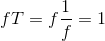
The period of a wave is equal to the reciprocal of the frequency:
Respectively, frequency is the reciprocal of period. By definition, the product of two reciprocals is one.
← Didn't Know|Knew It →
A stretched string of length L, mass M, and tension T is vibrating at its fundamental frequency. Which of the following changes takes place if the vibration frequency of the string increases, but tension and mass density remain constant?
A stretched string of length L, mass M, and tension T is vibrating at its fundamental frequency. Which of the following changes takes place if the vibration frequency of the string increases, but tension and mass density remain constant?
Tap to reveal answer
We can use the equation  together with
  . If T is constant, v cannot change assuming the mass density, m/L, is constant. Thus,
  must be constant; if f increases,
  must decrease.
We can use the equation
← Didn't Know|Knew It →
Picture a transverse wave traveling through water. After the crest of one wave hits a stationary object in the water, an observer counts eight more crests hitting the same object in fifteen seconds. The frequency of the waves is .
Picture a transverse wave traveling through water. After the crest of one wave hits a stationary object in the water, an observer counts eight more crests hitting the same object in fifteen seconds. The frequency of the waves is .
Tap to reveal answer
Right away you can rule out the answers with units in seconds, as the unit of frequency is an inverse second, or Hz. Frequency is measured in cycles per second. If eight crests pass a given point in fifteen seconds, the frequency is given by the number of crests divided by the time period.
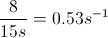
Right away you can rule out the answers with units in seconds, as the unit of frequency is an inverse second, or Hz. Frequency is measured in cycles per second. If eight crests pass a given point in fifteen seconds, the frequency is given by the number of crests divided by the time period.
← Didn't Know|Knew It →
A transverse wave has a velocity of 5.2m/s. If ten cycles pass a given point in 1.6s, what are the wave’s period and wavelength?
A transverse wave has a velocity of 5.2m/s. If ten cycles pass a given point in 1.6s, what are the wave’s period and wavelength?
Tap to reveal answer
First calculate the frequency of the wave (cycles/sec). The problem tells us that there are ten cycles in 1.6s.
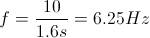
Next find the period by taking the inverse of the frequency.
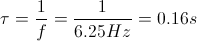
Finally, find the wavelength by dividing the velocity by the frequency.

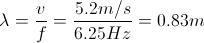
First calculate the frequency of the wave (cycles/sec). The problem tells us that there are ten cycles in 1.6s.
Next find the period by taking the inverse of the frequency.
Finally, find the wavelength by dividing the velocity by the frequency.
← Didn't Know|Knew It →
What are the frequency and wavelength of a sound wave with a period of 0.04s and a velocity of 575m/s?
What are the frequency and wavelength of a sound wave with a period of 0.04s and a velocity of 575m/s?
Tap to reveal answer
Solve for frequency by taking the inverse of the period.
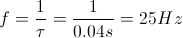
Next, solve for wavelength by dividing velocity by frequency.

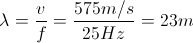
Solve for frequency by taking the inverse of the period.
Next, solve for wavelength by dividing velocity by frequency.
← Didn't Know|Knew It →
What is the beat frequency if f1 = 200Hz and f2 = 150Hz?
What is the beat frequency if f1 = 200Hz and f2 = 150Hz?
Tap to reveal answer
Beat frequency is the difference between the two frequencies.

200Hz – 150Hz = 50Hz
Beat frequency is the difference between the two frequencies.
200Hz – 150Hz = 50Hz
← Didn't Know|Knew It →
What is the frequency of a typical soundwave traveling at 340m/s with a wavelength of 40mm?
What is the frequency of a typical soundwave traveling at 340m/s with a wavelength of 40mm?
Tap to reveal answer
Using the equation  we can find the frequency of the soundwave.


Using the equation
← Didn't Know|Knew It →
What is the wavelength of a sound traveling at a frequency of 3000Hz?
What is the wavelength of a sound traveling at a frequency of 3000Hz?
Tap to reveal answer
The wavelength of a sound can be found by utilizing the equation,  . where v is the velocity of sound,
  is the wavelength, and f is the frequency. You should know that sound normally travels with a speed of 340m/s, unless otherwise stated. With the information given we can find the wavelength of the traveling sound to be 0.11m.

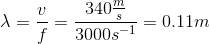
The wavelength of a sound can be found by utilizing the equation,
← Didn't Know|Knew It →
An incandescent light bulb is shown through a glass prism. The certain wavlength of the light is then directed into a glass cuvette containing an unknown concentration of protein. Commonly, this process is called spectroscopy and is used to determine the concentrations of DNA, RNA, and proteins in solutions. The indices of reflection of air, glass, and the solution are 1, 1.5, and 1.3, respectively.
What property of light does not change when it enters the prism?
An incandescent light bulb is shown through a glass prism. The certain wavlength of the light is then directed into a glass cuvette containing an unknown concentration of protein. Commonly, this process is called spectroscopy and is used to determine the concentrations of DNA, RNA, and proteins in solutions. The indices of reflection of air, glass, and the solution are 1, 1.5, and 1.3, respectively.
What property of light does not change when it enters the prism?
Tap to reveal answer
The frequency of light does not change when it enters a medium with a different index of refraction; in this case, that new medium is the glass of the prism. From the velocity of light equation we know the relationship between velocity and frequency.

v is the velocity of light,  is the wavelength, and f is the frequency. When light enters the prism, its velocity changes due to the new index of refraction, but its frequency remains constant.
Because the frequency does not change, we can see that velocity is directly proportional to wavelength; thus, the shorter the wavelength, the slower the velocity. So both wavelength and velocity change when frequency is constant.
The frequency of light does not change when it enters a medium with a different index of refraction; in this case, that new medium is the glass of the prism. From the velocity of light equation we know the relationship between velocity and frequency.
v is the velocity of light,
Because the frequency does not change, we can see that velocity is directly proportional to wavelength; thus, the shorter the wavelength, the slower the velocity. So both wavelength and velocity change when frequency is constant.
← Didn't Know|Knew It →
At a local concert, a speaker is set up to produce low-pitched base sounds with a frequency range of 20Hz to 200Hz, which can be modeled as sine waves. In a simplified model, the sound waves the speaker produces can be modeled as a cylindrical pipe with one end closed that travel through the air at a velocity of  , where T is the temperature in °C.
What is the wavelength of a 150Hz beat at 20ºC?
At a local concert, a speaker is set up to produce low-pitched base sounds with a frequency range of 20Hz to 200Hz, which can be modeled as sine waves. In a simplified model, the sound waves the speaker produces can be modeled as a cylindrical pipe with one end closed that travel through the air at a velocity of
What is the wavelength of a 150Hz beat at 20ºC?
Tap to reveal answer
This question is asking us to determine the wavelength of a sound wave at a specific temperature. From the equation presented to us in the paragraph above, we can calculate the wave velocity.


Now, we can use this velocity to calculate the wavelength.

This question is asking us to determine the wavelength of a sound wave at a specific temperature. From the equation presented to us in the paragraph above, we can calculate the wave velocity.
Now, we can use this velocity to calculate the wavelength.
← Didn't Know|Knew It →
Two tuning forks, with frequencies of 442Hz and 444Hz, are struck and a beat frequency is observed. What is this beat frequency?
Two tuning forks, with frequencies of 442Hz and 444Hz, are struck and a beat frequency is observed. What is this beat frequency?
Tap to reveal answer
The beat frequency is simply the difference between two frequencies.

We are given the frequency of each tuning fork, so we can use the equation to solve for the beat frequency.

The beat frequency is simply the difference between two frequencies.
We are given the frequency of each tuning fork, so we can use the equation to solve for the beat frequency.
← Didn't Know|Knew It →
An electron falls from an excited state to its ground state, emitting a photon at  . What is the frequency of the emitted light?
An electron falls from an excited state to its ground state, emitting a photon at
Tap to reveal answer
The relationship between wavelength and frequency is given by the equation:

In this case, the velocity will be equal to the speed of light.
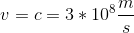
Using this value and the given wavelength, we can find the frequency of the photon. Keep in mind that the wavelength must be given in meters.


The relationship between wavelength and frequency is given by the equation:
In this case, the velocity will be equal to the speed of light.
Using this value and the given wavelength, we can find the frequency of the photon. Keep in mind that the wavelength must be given in meters.
← Didn't Know|Knew It →
Waves hit a beach every three seconds. The horizontal distance between an adjacent maximum and minimum is one meter. What is the speed of the waves?
Waves hit a beach every three seconds. The horizontal distance between an adjacent maximum and minimum is one meter. What is the speed of the waves?
Tap to reveal answer
Wave velocity is given by the product of frequency and wavelength:

In the question, we are given the period (waves per second). To find the frequency, we will need to take the reciprocal of the period.

Using the values given in the question, we can find the velocity of the waves. The wavelength is twice the distance between adjacent maxima and minima, making our wavelength two meters.

Wave velocity is given by the product of frequency and wavelength:
In the question, we are given the period (waves per second). To find the frequency, we will need to take the reciprocal of the period.
Using the values given in the question, we can find the velocity of the waves. The wavelength is twice the distance between adjacent maxima and minima, making our wavelength two meters.
← Didn't Know|Knew It →
What is the frequency of a typical soundwave traveling at 340m/s with a wavelength of 40mm?
What is the frequency of a typical soundwave traveling at 340m/s with a wavelength of 40mm?
Tap to reveal answer
Using the equation we can find the frequency of the soundwave.
Using the equation
← Didn't Know|Knew It →
A stretched string of length L, mass M, and tension T is vibrating at its fundamental frequency. Which of the following changes takes place if the vibration frequency of the string increases, but tension and mass density remain constant?
A stretched string of length L, mass M, and tension T is vibrating at its fundamental frequency. Which of the following changes takes place if the vibration frequency of the string increases, but tension and mass density remain constant?
Tap to reveal answer
We can use the equation together with . If T is constant, v cannot change assuming the mass density, m/L, is constant. Thus, must be constant; if f increases, must decrease.
We can use the equation
← Didn't Know|Knew It →
Picture a transverse wave traveling through water. After the crest of one wave hits a stationary object in the water, an observer counts eight more crests hitting the same object in fifteen seconds. The frequency of the waves is .
Picture a transverse wave traveling through water. After the crest of one wave hits a stationary object in the water, an observer counts eight more crests hitting the same object in fifteen seconds. The frequency of the waves is .
Tap to reveal answer
Right away you can rule out the answers with units in seconds, as the unit of frequency is an inverse second, or Hz. Frequency is measured in cycles per second. If eight crests pass a given point in fifteen seconds, the frequency is given by the number of crests divided by the time period.
Right away you can rule out the answers with units in seconds, as the unit of frequency is an inverse second, or Hz. Frequency is measured in cycles per second. If eight crests pass a given point in fifteen seconds, the frequency is given by the number of crests divided by the time period.
← Didn't Know|Knew It →
A transverse wave has a velocity of 5.2m/s. If ten cycles pass a given point in 1.6s, what are the wave’s period and wavelength?
A transverse wave has a velocity of 5.2m/s. If ten cycles pass a given point in 1.6s, what are the wave’s period and wavelength?
Tap to reveal answer
First calculate the frequency of the wave (cycles/sec). The problem tells us that there are ten cycles in 1.6s.
Next find the period by taking the inverse of the frequency.
Finally, find the wavelength by dividing the velocity by the frequency.
First calculate the frequency of the wave (cycles/sec). The problem tells us that there are ten cycles in 1.6s.
Next find the period by taking the inverse of the frequency.
Finally, find the wavelength by dividing the velocity by the frequency.
← Didn't Know|Knew It →
What are the frequency and wavelength of a sound wave with a period of 0.04s and a velocity of 575m/s?
What are the frequency and wavelength of a sound wave with a period of 0.04s and a velocity of 575m/s?
Tap to reveal answer
Solve for frequency by taking the inverse of the period.
Next, solve for wavelength by dividing velocity by frequency.
Solve for frequency by taking the inverse of the period.
Next, solve for wavelength by dividing velocity by frequency.
← Didn't Know|Knew It →
What is the beat frequency if f1 = 200Hz and f2 = 150Hz?
What is the beat frequency if f1 = 200Hz and f2 = 150Hz?
Tap to reveal answer
Beat frequency is the difference between the two frequencies.
200Hz – 150Hz = 50Hz
Beat frequency is the difference between the two frequencies.
200Hz – 150Hz = 50Hz
← Didn't Know|Knew It →
What is the wavelength of a sound traveling at a frequency of 3000Hz?
What is the wavelength of a sound traveling at a frequency of 3000Hz?
Tap to reveal answer
The wavelength of a sound can be found by utilizing the equation, . where v is the velocity of sound, is the wavelength, and f is the frequency. You should know that sound normally travels with a speed of 340m/s, unless otherwise stated. With the information given we can find the wavelength of the traveling sound to be 0.11m.
The wavelength of a sound can be found by utilizing the equation,
← Didn't Know|Knew It →