Thermodynamics of Phase Changes - MCAT Chemical and Physical Foundations of Biological Systems
Card 1 of 98
A scientist prepares an experiment to demonstrate the second law of thermodynamics for a chemistry class. In order to conduct the experiment, the scientist brings the class outside in January and gathers a cup of water and a portable stove.
The temperature outside is –10 degrees Celsius. The scientist asks the students to consider the following when answering his questions:
Gibbs Free Energy Formula:
ΔG = ΔH – TΔS
Liquid-Solid Water Phase Change Reaction:
H2O(l) ⇌ H2O(s) + X
The scientist prepares two scenarios.
Scenario 1:
The scientist buries the cup of water outside in the snow, returns to the classroom with his class for one hour, and the class then checks on the cup. They find that the water has frozen in the cup.
Scenario 2:
The scientist then places the frozen cup of water on the stove and starts the gas. The class finds that the water melts quickly.
After the water melts, the scientist asks the students to consider two hypothetical scenarios as a thought experiment.
Scenario 3:
Once the liquid water at the end of scenario 2 melts completely, the scientist turns off the gas and monitors what happens to the water. Despite being in the cold air, the water never freezes.
Scenario 4:
The scientist takes the frozen water from the end of scenario 1, puts it on the active stove, and the water remains frozen.
When the scientist moves the frozen water to the stove, the water melts. If the temperature of the stove is kept such that the reaction is at equilibrium, and the water is almost entirely melted, which of the following is a possible Keq value for the Liquid-Solid Water Phase Change Reaction as it is written?
A scientist prepares an experiment to demonstrate the second law of thermodynamics for a chemistry class. In order to conduct the experiment, the scientist brings the class outside in January and gathers a cup of water and a portable stove.
The temperature outside is –10 degrees Celsius. The scientist asks the students to consider the following when answering his questions:
Gibbs Free Energy Formula:
ΔG = ΔH – TΔS
Liquid-Solid Water Phase Change Reaction:
H2O(l) ⇌ H2O(s) + X
The scientist prepares two scenarios.
Scenario 1:
The scientist buries the cup of water outside in the snow, returns to the classroom with his class for one hour, and the class then checks on the cup. They find that the water has frozen in the cup.
Scenario 2:
The scientist then places the frozen cup of water on the stove and starts the gas. The class finds that the water melts quickly.
After the water melts, the scientist asks the students to consider two hypothetical scenarios as a thought experiment.
Scenario 3:
Once the liquid water at the end of scenario 2 melts completely, the scientist turns off the gas and monitors what happens to the water. Despite being in the cold air, the water never freezes.
Scenario 4:
The scientist takes the frozen water from the end of scenario 1, puts it on the active stove, and the water remains frozen.
When the scientist moves the frozen water to the stove, the water melts. If the temperature of the stove is kept such that the reaction is at equilibrium, and the water is almost entirely melted, which of the following is a possible Keq value for the Liquid-Solid Water Phase Change Reaction as it is written?
Tap to reveal answer
Once the water is almost entirely melted, the reaction is heavily skewed to the left side of the reaction. Notice the reaction is written with liquid water on the left. The equilibrium constant equation is written with the product (right-side) concentrations over the reactant concentrations; therefore, if there is a relative abundance of the reactants to products, K will be less than 1, but not all the way down to zero.
Once the water is almost entirely melted, the reaction is heavily skewed to the left side of the reaction. Notice the reaction is written with liquid water on the left. The equilibrium constant equation is written with the product (right-side) concentrations over the reactant concentrations; therefore, if there is a relative abundance of the reactants to products, K will be less than 1, but not all the way down to zero.
← Didn't Know|Knew It →
A scientist prepares an experiment to demonstrate the second law of thermodynamics for a chemistry class. In order to conduct the experiment, the scientist brings the class outside in January and gathers a cup of water and a portable stove.
The temperature outside is –10 degrees Celsius. The scientist asks the students to consider the following when answering his questions:
Gibbs Free Energy Formula:
ΔG = ΔH – TΔS
Liquid-Solid Water Phase Change Reaction:
H2O(l) ⇌ H2O(s) + X
The scientist prepares two scenarios.
Scenario 1:
The scientist buries the cup of water outside in the snow, returns to the classroom with his class for one hour, and the class then checks on the cup. They find that the water has frozen in the cup.
Scenario 2:
The scientist then places the frozen cup of water on the stove and starts the gas. The class finds that the water melts quickly.
After the water melts, the scientist asks the students to consider two hypothetical scenarios as a thought experiment.
Scenario 3:
Once the liquid water at the end of scenario 2 melts completely, the scientist turns off the gas and monitors what happens to the water. Despite being in the cold air, the water never freezes.
Scenario 4:
The scientist takes the frozen water from the end of scenario 1, puts it on the active stove, and the water remains frozen.
Which of the following are possible quantities for the “X” present on the right side of the Liquid-Solid Water Phase Change Reaction?
I. Entropy
II. Heat
III. Water Vapor
A scientist prepares an experiment to demonstrate the second law of thermodynamics for a chemistry class. In order to conduct the experiment, the scientist brings the class outside in January and gathers a cup of water and a portable stove.
The temperature outside is –10 degrees Celsius. The scientist asks the students to consider the following when answering his questions:
Gibbs Free Energy Formula:
ΔG = ΔH – TΔS
Liquid-Solid Water Phase Change Reaction:
H2O(l) ⇌ H2O(s) + X
The scientist prepares two scenarios.
Scenario 1:
The scientist buries the cup of water outside in the snow, returns to the classroom with his class for one hour, and the class then checks on the cup. They find that the water has frozen in the cup.
Scenario 2:
The scientist then places the frozen cup of water on the stove and starts the gas. The class finds that the water melts quickly.
After the water melts, the scientist asks the students to consider two hypothetical scenarios as a thought experiment.
Scenario 3:
Once the liquid water at the end of scenario 2 melts completely, the scientist turns off the gas and monitors what happens to the water. Despite being in the cold air, the water never freezes.
Scenario 4:
The scientist takes the frozen water from the end of scenario 1, puts it on the active stove, and the water remains frozen.
Which of the following are possible quantities for the “X” present on the right side of the Liquid-Solid Water Phase Change Reaction?
I. Entropy
II. Heat
III. Water Vapor
Tap to reveal answer
As water freezes, it releases heat into the universe to balance the local loss of entropy encountered by ordering atoms into a rigid solid structure. Entropy, in contrast, is not a commodity that can be released by a reaction in the same way as heat. Also, water vapor would not be released on only one side of the equation. Water vapor would exist with in equilibrium with both solid and liquid, but would not appear as an additional product with the solid phase in this reaction.
As water freezes, it releases heat into the universe to balance the local loss of entropy encountered by ordering atoms into a rigid solid structure. Entropy, in contrast, is not a commodity that can be released by a reaction in the same way as heat. Also, water vapor would not be released on only one side of the equation. Water vapor would exist with in equilibrium with both solid and liquid, but would not appear as an additional product with the solid phase in this reaction.
← Didn't Know|Knew It →
A scientist prepares an experiment to demonstrate the second law of thermodynamics for a chemistry class. In order to conduct the experiment, the scientist brings the class outside in January and gathers a cup of water and a portable stove.
The temperature outside is –10 degrees Celsius. The scientist asks the students to consider the following when answering his questions:
Gibbs Free Energy Formula:
ΔG = ΔH – TΔS
Liquid-Solid Water Phase Change Reaction:
H2O(l) ⇌ H2O(s) + X
The scientist prepares two scenarios.
Scenario 1:
The scientist buries the cup of water outside in the snow, returns to the classroom with his class for one hour, and the class then checks on the cup. They find that the water has frozen in the cup.
Scenario 2:
The scientist then places the frozen cup of water on the stove and starts the gas. The class finds that the water melts quickly.
After the water melts, the scientist asks the students to consider two hypothetical scenarios as a thought experiment.
Scenario 3:
Once the liquid water at the end of scenario 2 melts completely, the scientist turns off the gas and monitors what happens to the water. Despite being in the cold air, the water never freezes.
Scenario 4:
The scientist takes the frozen water from the end of scenario 1, puts it on the active stove, and the water remains frozen.
In scenario 1, the Gibbs Free Energy and Keq of the Liquid-Solid Water Phase Change Reaction, as the reaction begins, is best characterized as .
A scientist prepares an experiment to demonstrate the second law of thermodynamics for a chemistry class. In order to conduct the experiment, the scientist brings the class outside in January and gathers a cup of water and a portable stove.
The temperature outside is –10 degrees Celsius. The scientist asks the students to consider the following when answering his questions:
Gibbs Free Energy Formula:
ΔG = ΔH – TΔS
Liquid-Solid Water Phase Change Reaction:
H2O(l) ⇌ H2O(s) + X
The scientist prepares two scenarios.
Scenario 1:
The scientist buries the cup of water outside in the snow, returns to the classroom with his class for one hour, and the class then checks on the cup. They find that the water has frozen in the cup.
Scenario 2:
The scientist then places the frozen cup of water on the stove and starts the gas. The class finds that the water melts quickly.
After the water melts, the scientist asks the students to consider two hypothetical scenarios as a thought experiment.
Scenario 3:
Once the liquid water at the end of scenario 2 melts completely, the scientist turns off the gas and monitors what happens to the water. Despite being in the cold air, the water never freezes.
Scenario 4:
The scientist takes the frozen water from the end of scenario 1, puts it on the active stove, and the water remains frozen.
In scenario 1, the Gibbs Free Energy and Keq of the Liquid-Solid Water Phase Change Reaction, as the reaction begins, is best characterized as .
Tap to reveal answer
As scenario 1 begins, the reaction is spontaneous as written, and so the Gibbs Free Energy is negative. Additionally, the Van't Hoff equation proves that Keq increases with decreasing temperature in exothermic reactions. As this reaction is exothermic and placed in low-temperature conditions, the relative abundance of the products will become the prevailing state. Keq, therefore, increases.
As scenario 1 begins, the reaction is spontaneous as written, and so the Gibbs Free Energy is negative. Additionally, the Van't Hoff equation proves that Keq increases with decreasing temperature in exothermic reactions. As this reaction is exothermic and placed in low-temperature conditions, the relative abundance of the products will become the prevailing state. Keq, therefore, increases.
← Didn't Know|Knew It →
Imagine a graph that shows the amount of heat being added to water. Heat (q) is on the x-axis, and the temperature of the water is on the y-axis. As more heat is added to the water, the temperature will increase, however, there are two parts of the graph that appear to plateau, and it takes a set amount of heat in order to continue raising the water's temperature.
What is the explanation for these plateaus on the graph?
Imagine a graph that shows the amount of heat being added to water. Heat (q) is on the x-axis, and the temperature of the water is on the y-axis. As more heat is added to the water, the temperature will increase, however, there are two parts of the graph that appear to plateau, and it takes a set amount of heat in order to continue raising the water's temperature.
What is the explanation for these plateaus on the graph?
Tap to reveal answer
There are two plateaus on the graph, at 273K and 373K. These are the melting point and boiling points of water, respectively. At these temperatures, heat is responsible for breaking the hydrogen bonds between molecules in order to cause the phase change. The amount of heat required to melt the ice is called the enthalpy of fusion, and the amount of heat necessary to vaporize water is called the enthalpy of vaporization.
There are two plateaus on the graph, at 273K and 373K. These are the melting point and boiling points of water, respectively. At these temperatures, heat is responsible for breaking the hydrogen bonds between molecules in order to cause the phase change. The amount of heat required to melt the ice is called the enthalpy of fusion, and the amount of heat necessary to vaporize water is called the enthalpy of vaporization.
← Didn't Know|Knew It →
The enthalpy of fusion for water is  .
.
The specific heat capacity for ice is  .
.
The specific heat capacity for water is  .
.
How much heat is necessary to raise  of water from
  to
to  ?
?
The enthalpy of fusion for water is
The specific heat capacity for ice is
The specific heat capacity for water is
How much heat is necessary to raise
Tap to reveal answer
Solving this problem means solving for three steps.
1. The heat needed to raise the temperature from –20oC to 0oC.
2. Melting the ice (changing phases).
3. Raising the water temperature from 0oC to 50oC.
Steps 1 and 3 are both solved by the equation  .
.
Step 2 is solved using the enthalpy of fusion, and is multiplied by the number of grams being melted: 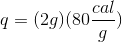 .
.
Combining the steps, we get the following expression.



Solving this problem means solving for three steps.
1. The heat needed to raise the temperature from –20oC to 0oC.
2. Melting the ice (changing phases).
3. Raising the water temperature from 0oC to 50oC.
Steps 1 and 3 are both solved by the equation
Step 2 is solved using the enthalpy of fusion, and is multiplied by the number of grams being melted:
Combining the steps, we get the following expression.
← Didn't Know|Knew It →
 of energy is added to a
  sample, which undergoes a phase change from liquid to gas as a result. The temperature remains constant throughout the process. What does the
  quantity represent?
Tap to reveal answer
The energy required to cause a liquid-gas phase change is called the heat of vaporization, and is usually given in the units of kilojoules per mole. Enthalpy of vaporization and heat of vaporization are the same quantity.
When the heat of vaporization is given for a single gram of substance, with the units of Joules per gram, it is termed the specific heat of vaporization. This is the quantity given in the question: the energy required to vaporize exactly one gram of the sample.
Specific heat capacity refers to the energy needed to raise the temperature of one gram of a sample by one degree Celsius.
The energy required to cause a liquid-gas phase change is called the heat of vaporization, and is usually given in the units of kilojoules per mole. Enthalpy of vaporization and heat of vaporization are the same quantity.
When the heat of vaporization is given for a single gram of substance, with the units of Joules per gram, it is termed the specific heat of vaporization. This is the quantity given in the question: the energy required to vaporize exactly one gram of the sample.
Specific heat capacity refers to the energy needed to raise the temperature of one gram of a sample by one degree Celsius.
← Didn't Know|Knew It →
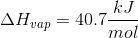
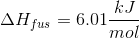
The molar heats of fusion and vaporization for water are given below:
Which of the following is not true?
The molar heats of fusion and vaporization for water are given below:
Which of the following is not true?
Tap to reveal answer
Vaporization and condensation refer to the transition from liquid to gas and from gas to liquid, respectively. Fusion and freezing, in contrast, refer to the transition from solid to liquid and from liquid to solid, respectively. Vaporization (boiling) and fusion (melting) each require an input of energy, making them endothermic processes with positive changes in enthalpy. Condensation and freezing result in a decrease in energy and an output of enthalpy, making them exothermic.
The given enthalpy of fusion tells us that  are consumed for every mole of water. If two moles of water are present, then
  are consumed during melting.
Enthalpy of vaporization will be equal and opposite the enthalpy of condensation. Since condensation is exothermic, heat will be released and the change in enthalpy must be negative (not positive).
Heat of condensation: 
Vaporization and condensation refer to the transition from liquid to gas and from gas to liquid, respectively. Fusion and freezing, in contrast, refer to the transition from solid to liquid and from liquid to solid, respectively. Vaporization (boiling) and fusion (melting) each require an input of energy, making them endothermic processes with positive changes in enthalpy. Condensation and freezing result in a decrease in energy and an output of enthalpy, making them exothermic.
The given enthalpy of fusion tells us that
Enthalpy of vaporization will be equal and opposite the enthalpy of condensation. Since condensation is exothermic, heat will be released and the change in enthalpy must be negative (not positive).
Heat of condensation:
← Didn't Know|Knew It →
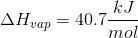
The molar heats of fusion and vaporization for water are given below:
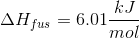
 of water solidify and
  of water vaporize within a closed system. What is the change in energy of the surroundings?
The molar heats of fusion and vaporization for water are given below:
Tap to reveal answer
We must use the given heats of fusion and vaporization to calculate the energy change involved in these two processes.
First, calculate the energy change when  of water solidifies. Convert the mass to moles and multiply by the heat released during freezing. This value will be equal in magnitude, but opposite in sign to the heat of fusion.

From this calculation we find that  of heat is released into the surroundings (a negative sign denotes an exothermic process).
Next, find the energy change associated with the vaporization of  of water, using the given heat of vaporization:

We find that  of energy is absorbed when this quantity of water is vaporized.
Adding the two together we find a total of  .
.

Since this is a positive number, that means that the energy is absorbed from the surroundings (endothermic).
We must use the given heats of fusion and vaporization to calculate the energy change involved in these two processes.
First, calculate the energy change when
From this calculation we find that
Next, find the energy change associated with the vaporization of
We find that
Adding the two together we find a total of
Since this is a positive number, that means that the energy is absorbed from the surroundings (endothermic).
← Didn't Know|Knew It →
The molar heats of fusion and vaporization for water are given below:
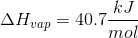
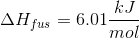
Which of the following explains why the heat of vaporization is much greater than the heat of fusion?
The molar heats of fusion and vaporization for water are given below:
Which of the following explains why the heat of vaporization is much greater than the heat of fusion?
Tap to reveal answer
Notice that most of these are true statements (the only incorrect statement is that fusion is an exothermic process). The key is finding the statement that best explains why the heat of vaporization is greater than the heat of fusion. Essentially, we are looking for the reason why a transition from liquid to gas requires more energy than a transition from solid to liquid.
It is true that more heat is required to vaporize a given quantity of water, but the reason for this can be found on a molecular level. Gas molecules have a relatively high kinetic energy. The large difference in kinetic energies between the states accounts for the difference in heats of fusion and vaporization. Solids are the lowest energy state, followed by liquids, and then gases. The difference in energy between equal amounts of solid and liquid is given by the heat of fusion, while the difference in energy between equal amounts of liquid and gas is given by the heat of vaporization. The discrepancy in energy is reflected in the difference between these two heat quantities.
Notice that most of these are true statements (the only incorrect statement is that fusion is an exothermic process). The key is finding the statement that best explains why the heat of vaporization is greater than the heat of fusion. Essentially, we are looking for the reason why a transition from liquid to gas requires more energy than a transition from solid to liquid.
It is true that more heat is required to vaporize a given quantity of water, but the reason for this can be found on a molecular level. Gas molecules have a relatively high kinetic energy. The large difference in kinetic energies between the states accounts for the difference in heats of fusion and vaporization. Solids are the lowest energy state, followed by liquids, and then gases. The difference in energy between equal amounts of solid and liquid is given by the heat of fusion, while the difference in energy between equal amounts of liquid and gas is given by the heat of vaporization. The discrepancy in energy is reflected in the difference between these two heat quantities.
← Didn't Know|Knew It →
The molar heats of fusion and vaporization for water are given below:
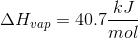
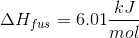
A certain amount of snow is formed in the atmosphere, and  of energy is released. How much water was solidified?

The molar heats of fusion and vaporization for water are given below:
A certain amount of snow is formed in the atmosphere, and
Tap to reveal answer
Use the given molar heat of fusion to calculate the amount of snow formed. Remember that heats of fusion and solidification are opposite processes, so the magnitudes of molar heats of fusion and solidification are the same and signs are opposite. This indicates that fusion (melting) is endothermic, while solidification is exothermic.

The given change in energy will be negative, since the question states that it is released from the system into the atmosphere.


Convert moles to grams, and grams to pounds.

Use the given molar heat of fusion to calculate the amount of snow formed. Remember that heats of fusion and solidification are opposite processes, so the magnitudes of molar heats of fusion and solidification are the same and signs are opposite. This indicates that fusion (melting) is endothermic, while solidification is exothermic.
The given change in energy will be negative, since the question states that it is released from the system into the atmosphere.
Convert moles to grams, and grams to pounds.
← Didn't Know|Knew It →
The molar heats of fusion and vaporization for water are given below:
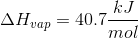
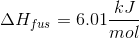
Given the following information, which substance would be expected to have an intermolecular force strength similar to that of water?
Substance ΔHfus ΔHvap Acetone 5.72 kJ/mol 29.1 kJ/mol Ethanol 4.60 kJ/mol 43.5 kJ/mol Hydrogen 0.12 kJ/mol 0.90 kJ/mol Ammonia 5.65 kJ/mol 23.4 kJ/mol
The molar heats of fusion and vaporization for water are given below:
Given the following information, which substance would be expected to have an intermolecular force strength similar to that of water?
| Substance | ΔHfus | ΔHvap |
|---|---|---|
| Acetone | 5.72 kJ/mol | 29.1 kJ/mol |
| Ethanol | 4.60 kJ/mol | 43.5 kJ/mol |
| Hydrogen | 0.12 kJ/mol | 0.90 kJ/mol |
| Ammonia | 5.65 kJ/mol | 23.4 kJ/mol |
Tap to reveal answer
Intermolecular forces play a key role in determining the energy required for phase changes. Strong intermolecular forces result in more resistance to changes that result in greater distance between molecules (greater entropy), as the forces cause the molecules to "stick" to one another. When a liquid is vaporized, the strength of the intermolecular force is overcome; similar heats of vaporization indicate similar intermolecular forces. A similar concept governs the transition from solid to liquid. If two compounds share similar enthalpies of fusion and vaporization, then they likely have similar intermolecular forces.
In the given table, ethanol enthalpy values are most similar to those of water, meaning it likely has similar intermolecular forces.
Intermolecular forces play a key role in determining the energy required for phase changes. Strong intermolecular forces result in more resistance to changes that result in greater distance between molecules (greater entropy), as the forces cause the molecules to "stick" to one another. When a liquid is vaporized, the strength of the intermolecular force is overcome; similar heats of vaporization indicate similar intermolecular forces. A similar concept governs the transition from solid to liquid. If two compounds share similar enthalpies of fusion and vaporization, then they likely have similar intermolecular forces.
In the given table, ethanol enthalpy values are most similar to those of water, meaning it likely has similar intermolecular forces.
← Didn't Know|Knew It →
The following diagram shows the temperature of a substance as constant heat is supplied. Suppose the substance began in a solid state.
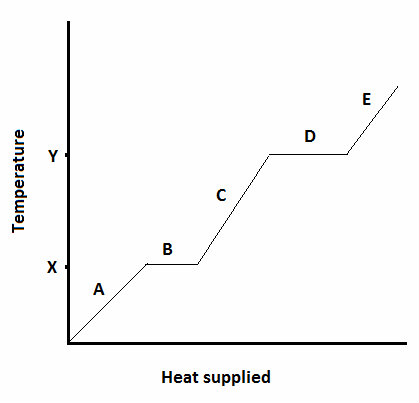
What is the freezing point of the substance?
The following diagram shows the temperature of a substance as constant heat is supplied. Suppose the substance began in a solid state.
What is the freezing point of the substance?
Tap to reveal answer
Freezing point is always a temperature, meaning it must correspond to a single point on the y-axis. During the freezing/melting process, heat is absorbed/released from the system without any change in temperature. This results in the temperature plateau at the freezing point.
While the substance is freezing during interval B, the freezing point is the temperature at which it freezes, X.
Freezing point is always a temperature, meaning it must correspond to a single point on the y-axis. During the freezing/melting process, heat is absorbed/released from the system without any change in temperature. This results in the temperature plateau at the freezing point.
While the substance is freezing during interval B, the freezing point is the temperature at which it freezes, X.
← Didn't Know|Knew It →
The following diagram shows the temperature of a substance as constant heat is supplied. Suppose the substance began in a solid state.
The slope of the graph is zero at intervals B and D because .
The following diagram shows the temperature of a substance as constant heat is supplied. Suppose the substance began in a solid state.
The slope of the graph is zero at intervals B and D because .
Tap to reveal answer
During intervals B and D, fusion and vaporization are taking place, respectively. Instead of raising the temperature of the substance, the energy that is added during these phase changes is used to overcome intermolecular forces. The energy breaks the attraction between particles, allowing them to separate and gain the properties of a higher energy phase (liquid or gas).
When the slope is not zero, the phase is steady and the added heat energy is used to increase the molecular kinetic energy of the particles, resulting in a temperature increase.
During intervals B and D, fusion and vaporization are taking place, respectively. Instead of raising the temperature of the substance, the energy that is added during these phase changes is used to overcome intermolecular forces. The energy breaks the attraction between particles, allowing them to separate and gain the properties of a higher energy phase (liquid or gas).
When the slope is not zero, the phase is steady and the added heat energy is used to increase the molecular kinetic energy of the particles, resulting in a temperature increase.
← Didn't Know|Knew It →
The following diagram shows the temperature of a substance as constant heat is supplied. Suppose the substance began in a solid state.
If  of the substance begins at interval E and ends at interval C, the substance and energy is .
The following diagram shows the temperature of a substance as constant heat is supplied. Suppose the substance began in a solid state.
If
Tap to reveal answer
Plateaus in the graph represent phase changes: period B shows the transitions between solid and liquid, and period D shows the transitions between liquid and gas. When the substance transitions through period D, it undergoes either vaporization (C to E transition) or condensation (E to C transition). If the substances starts out at interval E and ends at interval C, then it has undergone condensation.
Condensation involves transition from a high energy gas to a lower energy liquid, and has a net decrease in heat energy and temperature. This heat release is known as an exothermic process.
Plateaus in the graph represent phase changes: period B shows the transitions between solid and liquid, and period D shows the transitions between liquid and gas. When the substance transitions through period D, it undergoes either vaporization (C to E transition) or condensation (E to C transition). If the substances starts out at interval E and ends at interval C, then it has undergone condensation.
Condensation involves transition from a high energy gas to a lower energy liquid, and has a net decrease in heat energy and temperature. This heat release is known as an exothermic process.
← Didn't Know|Knew It →
The following diagram shows the temperature of a substance as constant heat is supplied. Suppose the substance began in a solid state.
What is the freezing point of the substance?
The following diagram shows the temperature of a substance as constant heat is supplied. Suppose the substance began in a solid state.
What is the freezing point of the substance?
Tap to reveal answer
Freezing point is always a temperature, meaning it must correspond to a single point on the y-axis. During the freezing/melting process, heat is absorbed/released from the system without any change in temperature. This results in the temperature plateau at the freezing point.
While the substance is freezing during interval B, the freezing point is the temperature at which it freezes, X.
Freezing point is always a temperature, meaning it must correspond to a single point on the y-axis. During the freezing/melting process, heat is absorbed/released from the system without any change in temperature. This results in the temperature plateau at the freezing point.
While the substance is freezing during interval B, the freezing point is the temperature at which it freezes, X.
← Didn't Know|Knew It →
A scientist prepares an experiment to demonstrate the second law of thermodynamics for a chemistry class. In order to conduct the experiment, the scientist brings the class outside in January and gathers a cup of water and a portable stove.
The temperature outside is –10 degrees Celsius. The scientist asks the students to consider the following when answering his questions:
Gibbs Free Energy Formula:
ΔG = ΔH – TΔS
Liquid-Solid Water Phase Change Reaction:
H2O(l) ⇌ H2O(s) + X
The scientist prepares two scenarios.
Scenario 1:
The scientist buries the cup of water outside in the snow, returns to the classroom with his class for one hour, and the class then checks on the cup. They find that the water has frozen in the cup.
Scenario 2:
The scientist then places the frozen cup of water on the stove and starts the gas. The class finds that the water melts quickly.
After the water melts, the scientist asks the students to consider two hypothetical scenarios as a thought experiment.
Scenario 3:
Once the liquid water at the end of scenario 2 melts completely, the scientist turns off the gas and monitors what happens to the water. Despite being in the cold air, the water never freezes.
Scenario 4:
The scientist takes the frozen water from the end of scenario 1, puts it on the active stove, and the water remains frozen.
When the scientist moves the frozen water to the stove, the water melts. If the temperature of the stove is kept such that the reaction is at equilibrium, and the water is almost entirely melted, which of the following is a possible Keq value for the Liquid-Solid Water Phase Change Reaction as it is written?
A scientist prepares an experiment to demonstrate the second law of thermodynamics for a chemistry class. In order to conduct the experiment, the scientist brings the class outside in January and gathers a cup of water and a portable stove.
The temperature outside is –10 degrees Celsius. The scientist asks the students to consider the following when answering his questions:
Gibbs Free Energy Formula:
ΔG = ΔH – TΔS
Liquid-Solid Water Phase Change Reaction:
H2O(l) ⇌ H2O(s) + X
The scientist prepares two scenarios.
Scenario 1:
The scientist buries the cup of water outside in the snow, returns to the classroom with his class for one hour, and the class then checks on the cup. They find that the water has frozen in the cup.
Scenario 2:
The scientist then places the frozen cup of water on the stove and starts the gas. The class finds that the water melts quickly.
After the water melts, the scientist asks the students to consider two hypothetical scenarios as a thought experiment.
Scenario 3:
Once the liquid water at the end of scenario 2 melts completely, the scientist turns off the gas and monitors what happens to the water. Despite being in the cold air, the water never freezes.
Scenario 4:
The scientist takes the frozen water from the end of scenario 1, puts it on the active stove, and the water remains frozen.
When the scientist moves the frozen water to the stove, the water melts. If the temperature of the stove is kept such that the reaction is at equilibrium, and the water is almost entirely melted, which of the following is a possible Keq value for the Liquid-Solid Water Phase Change Reaction as it is written?
Tap to reveal answer
Once the water is almost entirely melted, the reaction is heavily skewed to the left side of the reaction. Notice the reaction is written with liquid water on the left. The equilibrium constant equation is written with the product (right-side) concentrations over the reactant concentrations; therefore, if there is a relative abundance of the reactants to products, K will be less than 1, but not all the way down to zero.
Once the water is almost entirely melted, the reaction is heavily skewed to the left side of the reaction. Notice the reaction is written with liquid water on the left. The equilibrium constant equation is written with the product (right-side) concentrations over the reactant concentrations; therefore, if there is a relative abundance of the reactants to products, K will be less than 1, but not all the way down to zero.
← Didn't Know|Knew It →
A scientist prepares an experiment to demonstrate the second law of thermodynamics for a chemistry class. In order to conduct the experiment, the scientist brings the class outside in January and gathers a cup of water and a portable stove.
The temperature outside is –10 degrees Celsius. The scientist asks the students to consider the following when answering his questions:
Gibbs Free Energy Formula:
ΔG = ΔH – TΔS
Liquid-Solid Water Phase Change Reaction:
H2O(l) ⇌ H2O(s) + X
The scientist prepares two scenarios.
Scenario 1:
The scientist buries the cup of water outside in the snow, returns to the classroom with his class for one hour, and the class then checks on the cup. They find that the water has frozen in the cup.
Scenario 2:
The scientist then places the frozen cup of water on the stove and starts the gas. The class finds that the water melts quickly.
After the water melts, the scientist asks the students to consider two hypothetical scenarios as a thought experiment.
Scenario 3:
Once the liquid water at the end of scenario 2 melts completely, the scientist turns off the gas and monitors what happens to the water. Despite being in the cold air, the water never freezes.
Scenario 4:
The scientist takes the frozen water from the end of scenario 1, puts it on the active stove, and the water remains frozen.
Which of the following are possible quantities for the “X” present on the right side of the Liquid-Solid Water Phase Change Reaction?
I. Entropy
II. Heat
III. Water Vapor
A scientist prepares an experiment to demonstrate the second law of thermodynamics for a chemistry class. In order to conduct the experiment, the scientist brings the class outside in January and gathers a cup of water and a portable stove.
The temperature outside is –10 degrees Celsius. The scientist asks the students to consider the following when answering his questions:
Gibbs Free Energy Formula:
ΔG = ΔH – TΔS
Liquid-Solid Water Phase Change Reaction:
H2O(l) ⇌ H2O(s) + X
The scientist prepares two scenarios.
Scenario 1:
The scientist buries the cup of water outside in the snow, returns to the classroom with his class for one hour, and the class then checks on the cup. They find that the water has frozen in the cup.
Scenario 2:
The scientist then places the frozen cup of water on the stove and starts the gas. The class finds that the water melts quickly.
After the water melts, the scientist asks the students to consider two hypothetical scenarios as a thought experiment.
Scenario 3:
Once the liquid water at the end of scenario 2 melts completely, the scientist turns off the gas and monitors what happens to the water. Despite being in the cold air, the water never freezes.
Scenario 4:
The scientist takes the frozen water from the end of scenario 1, puts it on the active stove, and the water remains frozen.
Which of the following are possible quantities for the “X” present on the right side of the Liquid-Solid Water Phase Change Reaction?
I. Entropy
II. Heat
III. Water Vapor
Tap to reveal answer
As water freezes, it releases heat into the universe to balance the local loss of entropy encountered by ordering atoms into a rigid solid structure. Entropy, in contrast, is not a commodity that can be released by a reaction in the same way as heat. Also, water vapor would not be released on only one side of the equation. Water vapor would exist with in equilibrium with both solid and liquid, but would not appear as an additional product with the solid phase in this reaction.
As water freezes, it releases heat into the universe to balance the local loss of entropy encountered by ordering atoms into a rigid solid structure. Entropy, in contrast, is not a commodity that can be released by a reaction in the same way as heat. Also, water vapor would not be released on only one side of the equation. Water vapor would exist with in equilibrium with both solid and liquid, but would not appear as an additional product with the solid phase in this reaction.
← Didn't Know|Knew It →
A scientist prepares an experiment to demonstrate the second law of thermodynamics for a chemistry class. In order to conduct the experiment, the scientist brings the class outside in January and gathers a cup of water and a portable stove.
The temperature outside is –10 degrees Celsius. The scientist asks the students to consider the following when answering his questions:
Gibbs Free Energy Formula:
ΔG = ΔH – TΔS
Liquid-Solid Water Phase Change Reaction:
H2O(l) ⇌ H2O(s) + X
The scientist prepares two scenarios.
Scenario 1:
The scientist buries the cup of water outside in the snow, returns to the classroom with his class for one hour, and the class then checks on the cup. They find that the water has frozen in the cup.
Scenario 2:
The scientist then places the frozen cup of water on the stove and starts the gas. The class finds that the water melts quickly.
After the water melts, the scientist asks the students to consider two hypothetical scenarios as a thought experiment.
Scenario 3:
Once the liquid water at the end of scenario 2 melts completely, the scientist turns off the gas and monitors what happens to the water. Despite being in the cold air, the water never freezes.
Scenario 4:
The scientist takes the frozen water from the end of scenario 1, puts it on the active stove, and the water remains frozen.
In scenario 1, the Gibbs Free Energy and Keq of the Liquid-Solid Water Phase Change Reaction, as the reaction begins, is best characterized as .
A scientist prepares an experiment to demonstrate the second law of thermodynamics for a chemistry class. In order to conduct the experiment, the scientist brings the class outside in January and gathers a cup of water and a portable stove.
The temperature outside is –10 degrees Celsius. The scientist asks the students to consider the following when answering his questions:
Gibbs Free Energy Formula:
ΔG = ΔH – TΔS
Liquid-Solid Water Phase Change Reaction:
H2O(l) ⇌ H2O(s) + X
The scientist prepares two scenarios.
Scenario 1:
The scientist buries the cup of water outside in the snow, returns to the classroom with his class for one hour, and the class then checks on the cup. They find that the water has frozen in the cup.
Scenario 2:
The scientist then places the frozen cup of water on the stove and starts the gas. The class finds that the water melts quickly.
After the water melts, the scientist asks the students to consider two hypothetical scenarios as a thought experiment.
Scenario 3:
Once the liquid water at the end of scenario 2 melts completely, the scientist turns off the gas and monitors what happens to the water. Despite being in the cold air, the water never freezes.
Scenario 4:
The scientist takes the frozen water from the end of scenario 1, puts it on the active stove, and the water remains frozen.
In scenario 1, the Gibbs Free Energy and Keq of the Liquid-Solid Water Phase Change Reaction, as the reaction begins, is best characterized as .
Tap to reveal answer
As scenario 1 begins, the reaction is spontaneous as written, and so the Gibbs Free Energy is negative. Additionally, the Van't Hoff equation proves that Keq increases with decreasing temperature in exothermic reactions. As this reaction is exothermic and placed in low-temperature conditions, the relative abundance of the products will become the prevailing state. Keq, therefore, increases.
As scenario 1 begins, the reaction is spontaneous as written, and so the Gibbs Free Energy is negative. Additionally, the Van't Hoff equation proves that Keq increases with decreasing temperature in exothermic reactions. As this reaction is exothermic and placed in low-temperature conditions, the relative abundance of the products will become the prevailing state. Keq, therefore, increases.
← Didn't Know|Knew It →
Imagine a graph that shows the amount of heat being added to water. Heat (q) is on the x-axis, and the temperature of the water is on the y-axis. As more heat is added to the water, the temperature will increase, however, there are two parts of the graph that appear to plateau, and it takes a set amount of heat in order to continue raising the water's temperature.
What is the explanation for these plateaus on the graph?
Imagine a graph that shows the amount of heat being added to water. Heat (q) is on the x-axis, and the temperature of the water is on the y-axis. As more heat is added to the water, the temperature will increase, however, there are two parts of the graph that appear to plateau, and it takes a set amount of heat in order to continue raising the water's temperature.
What is the explanation for these plateaus on the graph?
Tap to reveal answer
There are two plateaus on the graph, at 273K and 373K. These are the melting point and boiling points of water, respectively. At these temperatures, heat is responsible for breaking the hydrogen bonds between molecules in order to cause the phase change. The amount of heat required to melt the ice is called the enthalpy of fusion, and the amount of heat necessary to vaporize water is called the enthalpy of vaporization.
There are two plateaus on the graph, at 273K and 373K. These are the melting point and boiling points of water, respectively. At these temperatures, heat is responsible for breaking the hydrogen bonds between molecules in order to cause the phase change. The amount of heat required to melt the ice is called the enthalpy of fusion, and the amount of heat necessary to vaporize water is called the enthalpy of vaporization.
← Didn't Know|Knew It →
The enthalpy of fusion for water is .
The specific heat capacity for ice is .
The specific heat capacity for water is .
How much heat is necessary to raise of water from to ?
The enthalpy of fusion for water is
The specific heat capacity for ice is
The specific heat capacity for water is
How much heat is necessary to raise
Tap to reveal answer
Solving this problem means solving for three steps.
1. The heat needed to raise the temperature from –20oC to 0oC.
2. Melting the ice (changing phases).
3. Raising the water temperature from 0oC to 50oC.
Steps 1 and 3 are both solved by the equation .
Step 2 is solved using the enthalpy of fusion, and is multiplied by the number of grams being melted: .
Combining the steps, we get the following expression.
Solving this problem means solving for three steps.
1. The heat needed to raise the temperature from –20oC to 0oC.
2. Melting the ice (changing phases).
3. Raising the water temperature from 0oC to 50oC.
Steps 1 and 3 are both solved by the equation
Step 2 is solved using the enthalpy of fusion, and is multiplied by the number of grams being melted:
Combining the steps, we get the following expression.
← Didn't Know|Knew It →