Reaction Calculations and Limiting Reagent - MCAT Chemical and Physical Foundations of Biological Systems
Card 1 of 161
Balance the chemical reaction.

Balance the chemical reaction.
Tap to reveal answer
The reaction given is the complete oxidation of glucose. Reactants are glucose and oxygen (from inhalation) and products are carbon dioxide and water, which are released through exhalation and excretion.
The complete balanced reaction is:

When balancing reactions, it is generally easiest to leave oxygen and hydrogen alone until the end. First, balance the carbon. Next, balance the hydrogen since it is only found in one reactant molecule and one product molecule. Finally, balance the oxygen.
The reaction given is the complete oxidation of glucose. Reactants are glucose and oxygen (from inhalation) and products are carbon dioxide and water, which are released through exhalation and excretion.
The complete balanced reaction is:
When balancing reactions, it is generally easiest to leave oxygen and hydrogen alone until the end. First, balance the carbon. Next, balance the hydrogen since it is only found in one reactant molecule and one product molecule. Finally, balance the oxygen.
← Didn't Know|Knew It →

Given the unbalanced equation above, how many moles of hydrocholoric acid would be required to produce four moles of potassium chloride?
Given the unbalanced equation above, how many moles of hydrocholoric acid would be required to produce four moles of potassium chloride?
Tap to reveal answer
It is first necessary to balance the equation.

So, sixteen moles of hydrochloric acid (HCl) would produce two moles of potassium chloride (KCl). Multiplying this ratio times two, thirty-two moles of HCl would produce four moles of KCl.
It is first necessary to balance the equation.
So, sixteen moles of hydrochloric acid (HCl) would produce two moles of potassium chloride (KCl). Multiplying this ratio times two, thirty-two moles of HCl would produce four moles of KCl.
← Didn't Know|Knew It →
Given the unbalanced equation below, how many grams of carbon dioxide will be produced from one mole of glucose and three moles of oxygen?

Given the unbalanced equation below, how many grams of carbon dioxide will be produced from one mole of glucose and three moles of oxygen?
Tap to reveal answer
The first step to solve will be to balance the chemical reaction:

We see that we see that for every one mole of glucose used, six moles of carbon dioxide will be made. Similarly, for every six moles of oxygen used, six moles of carbon dioxide will be formed. For the reaction to carry out to completion, however, there must exist six moles of oxygen for every one mole of glucose. In the problem's circumstances, one of these compounds becomes the limiting reactant, in this case it is oxygen.

We only have three moles of oxygen, but we would need six to react all the given glucose, making oxygen the limiting reagent. We need to find the carbon dioxide produced from the limited amount of oxygen present. Use the molar ratio between oxygen and carbon dioxide and the molar mass of carbon dioxide to solve.

The first step to solve will be to balance the chemical reaction:
We see that we see that for every one mole of glucose used, six moles of carbon dioxide will be made. Similarly, for every six moles of oxygen used, six moles of carbon dioxide will be formed. For the reaction to carry out to completion, however, there must exist six moles of oxygen for every one mole of glucose. In the problem's circumstances, one of these compounds becomes the limiting reactant, in this case it is oxygen.
We only have three moles of oxygen, but we would need six to react all the given glucose, making oxygen the limiting reagent. We need to find the carbon dioxide produced from the limited amount of oxygen present. Use the molar ratio between oxygen and carbon dioxide and the molar mass of carbon dioxide to solve.
← Didn't Know|Knew It →
Which represents the correct balanced equation for the reaction between silver (I) nitrate and magnesium hydroxide?
Which represents the correct balanced equation for the reaction between silver (I) nitrate and magnesium hydroxide?
Tap to reveal answer
Silver (I) nitrate is AgNO3. Recognizing this allows us to eliminate two answer choices, which incorrectly substitute nitrogen (N) for nitrate (NO3) or balance the molecular charges incorrectly. Of the two remaining choices, only one is balanced correctly.
Silver (I) nitrate is AgNO3. Recognizing this allows us to eliminate two answer choices, which incorrectly substitute nitrogen (N) for nitrate (NO3) or balance the molecular charges incorrectly. Of the two remaining choices, only one is balanced correctly.
← Didn't Know|Knew It →

5.6g of manganese reacts with 650mL of 6.0M hydrochloric acid to form manganese (V) chloride and hydrogen gas. Along with the products, a large amount of heat is evolved.
What is the limiting reagent, and how much of the excess reagent will remain after the reaction?
5.6g of manganese reacts with 650mL of 6.0M hydrochloric acid to form manganese (V) chloride and hydrogen gas. Along with the products, a large amount of heat is evolved.
What is the limiting reagent, and how much of the excess reagent will remain after the reaction?
Tap to reveal answer
Find the volume of hydrochloric acid (HCl) needed to react completely with 5.6g of manganese (Mn).

Since we only need 85mL of acid to react with 5.6g manganese, we have an excess of 565mL hydrochloric acid, and manganese is the limiting reagent.
Find the volume of hydrochloric acid (HCl) needed to react completely with 5.6g of manganese (Mn).
Since we only need 85mL of acid to react with 5.6g manganese, we have an excess of 565mL hydrochloric acid, and manganese is the limiting reagent.
← Didn't Know|Knew It →

5.6 grams of manganese reacts with 650 mL of 6.0 M hydrochloric acid to form manganese (V) chloride and hydrogen gas. Along with the products, a large amount of heat is evolved.
Assuming standard temperature and pressure, what volume of hydrogen gas is produced by this reaction?
5.6 grams of manganese reacts with 650 mL of 6.0 M hydrochloric acid to form manganese (V) chloride and hydrogen gas. Along with the products, a large amount of heat is evolved.
Assuming standard temperature and pressure, what volume of hydrogen gas is produced by this reaction?
Tap to reveal answer
Convert 5.6g of manganese (limiting reagent) to volume of hydrogen gas.

Convert 5.6g of manganese (limiting reagent) to volume of hydrogen gas.
← Didn't Know|Knew It →
What products will be formed by the reaction between copper (II) fluoride and sodium sulfate?
What products will be formed by the reaction between copper (II) fluoride and sodium sulfate?
Tap to reveal answer
Recognize that this is a double replacement reaction in which ion pairs will switch. After reaction, copper (II) will now be paired with sulfate, and sodium with flouride according to the (unbalanced) equation below. Remember that sulfate has a charge of -2, and flouride of -1.

Recognize that this is a double replacement reaction in which ion pairs will switch. After reaction, copper (II) will now be paired with sulfate, and sodium with flouride according to the (unbalanced) equation below. Remember that sulfate has a charge of -2, and flouride of -1.
← Didn't Know|Knew It →
When sodium nitrate reacts with iron (III) bromide to produce iron (III) nitrate, what is the molar ratio of iron (III) nitrate to sodium bromide?
When sodium nitrate reacts with iron (III) bromide to produce iron (III) nitrate, what is the molar ratio of iron (III) nitrate to sodium bromide?
Tap to reveal answer
The first step is writing, and then balancing, the chemical equation for this reaction.

From this, we are able to see that for every one mole of iron (III) nitrate that is produced, three moles of sodium bromide are produced (a 1 to 3 ratio).
The first step is writing, and then balancing, the chemical equation for this reaction.
From this, we are able to see that for every one mole of iron (III) nitrate that is produced, three moles of sodium bromide are produced (a 1 to 3 ratio).
← Didn't Know|Knew It →
How many milliliters of 0.5M NaOH are required to react completely with 10g of BaCO3?
How many milliliters of 0.5M NaOH are required to react completely with 10g of BaCO3?
Tap to reveal answer
First, write a balanced equation for the reaction.

Next, convert 10g BaCO3 to milliliters of NaOH.

First, write a balanced equation for the reaction.
Next, convert 10g BaCO3 to milliliters of NaOH.
← Didn't Know|Knew It →

A chemist combines 100g of zinc and 200g of copper (II) sulfate. According to the above chemical reaction, how many grams of zinc sulfate are formed?
A chemist combines 100g of zinc and 200g of copper (II) sulfate. According to the above chemical reaction, how many grams of zinc sulfate are formed?
Tap to reveal answer
We don't know which of the reactants is limiting, so we'll need to calculate how much zinc sulfate would be produced by the given amount of each of the reactants, assuming the other is in excess. Whichever reactant would produce less zinc sulfate is the limiting reactant, and the amount of zinc sulfate produced by that reactant is the actual amount that can be produced by this mixture.
If we start with 100g of zinc, we yield 247g of zinc sulfate.

Starting with 200g of copper(II)sulfate, we yield 202g of zinc sulfate.

Less zinc sulfate can be produced by the given amount of copper(II) sulfate, so copper(II) sulfate is the limiting reactant, and 202g of zinc sulfate are actually produced by the given mixture.
We don't know which of the reactants is limiting, so we'll need to calculate how much zinc sulfate would be produced by the given amount of each of the reactants, assuming the other is in excess. Whichever reactant would produce less zinc sulfate is the limiting reactant, and the amount of zinc sulfate produced by that reactant is the actual amount that can be produced by this mixture.
If we start with 100g of zinc, we yield 247g of zinc sulfate.
Starting with 200g of copper(II)sulfate, we yield 202g of zinc sulfate.
Less zinc sulfate can be produced by the given amount of copper(II) sulfate, so copper(II) sulfate is the limiting reactant, and 202g of zinc sulfate are actually produced by the given mixture.
← Didn't Know|Knew It →
Sodium chloride can be created by the following reaction.

What type of reaction is shown here?
Sodium chloride can be created by the following reaction.
What type of reaction is shown here?
Tap to reveal answer
In this reaction, only one element is replaced by another. NaBr becomes NaCl, with a single-replacement of chlorine for bromine. The diatomic halogens are not considered as replacing one another, as they are not bound to a cation.
A comparison of single- and double-replacements reactions is shown below.
Single-replacement: 
Double-replacement: 
In this reaction, only one element is replaced by another. NaBr becomes NaCl, with a single-replacement of chlorine for bromine. The diatomic halogens are not considered as replacing one another, as they are not bound to a cation.
A comparison of single- and double-replacements reactions is shown below.
Single-replacement:
Double-replacement:
← Didn't Know|Knew It →
The combustion of liquid hexane in air at 298K gives gaseous carbon dioxide and liquid water. Write a balanced chemical equation for this reaction, including the physical states of all the compounds involved.
The combustion of liquid hexane in air at 298K gives gaseous carbon dioxide and liquid water. Write a balanced chemical equation for this reaction, including the physical states of all the compounds involved.
Tap to reveal answer
Any combustion reaction of a hydrocarbon involves oxygen gas as a reactant, and produces carbon dioxide and water as products. In this case, two moles of hexane react with nineteen moles of oxygen to produce twelve moles of carbon dioxide and fourteen moles of water. Carbon dioxide is a gas at room temperature, and water is a liquid.
Hexane: 
Reaction: 
Now we can begin to balance the reaction.

Everything is balanced except oxygen; there is an odd number of oxygen to the right and an even number to the left. We can adjust this by multiplying everything by two.


Any combustion reaction of a hydrocarbon involves oxygen gas as a reactant, and produces carbon dioxide and water as products. In this case, two moles of hexane react with nineteen moles of oxygen to produce twelve moles of carbon dioxide and fourteen moles of water. Carbon dioxide is a gas at room temperature, and water is a liquid.
Hexane:
Reaction:
Now we can begin to balance the reaction.
Everything is balanced except oxygen; there is an odd number of oxygen to the right and an even number to the left. We can adjust this by multiplying everything by two.
← Didn't Know|Knew It →
Five kilograms of oxygen are consumed in a chemical reaction that generates two photons per oxygen molecule. How many photons were generated?
Five kilograms of oxygen are consumed in a chemical reaction that generates two photons per oxygen molecule. How many photons were generated?
Tap to reveal answer
First, use Avogadro's law and the molar weight of oxygen to determine the number of oxygen atoms.


We know that two photons are formed from every oxygen molecule. We can use basic stoichiometry to find the number of photons generated.

First, use Avogadro's law and the molar weight of oxygen to determine the number of oxygen atoms.
We know that two photons are formed from every oxygen molecule. We can use basic stoichiometry to find the number of photons generated.
← Didn't Know|Knew It →
Which of the following produces a  solution of potassium chloride?
Which of the following produces a
Tap to reveal answer
We will be looking for a solution that results in one mole of potassium chloride per ten liters of water.
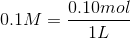
We will need to find the molecular weight of potassium chloride.

In order to get the desired concentration, we will need to add one-tenth of this amount to one liter of water.
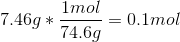
Our ratio, then is:

The only answer to follow this ratio is  of potassium chloride in
  .
.
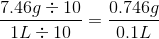
We will be looking for a solution that results in one mole of potassium chloride per ten liters of water.
We will need to find the molecular weight of potassium chloride.
In order to get the desired concentration, we will need to add one-tenth of this amount to one liter of water.
Our ratio, then is:
The only answer to follow this ratio is
← Didn't Know|Knew It →

If you begin with  of aluminum chloride and unlimited silver nitrate, how many grams of silver chloride can be produced?
If you begin with
Tap to reveal answer
This is a stoichiometry question requiring us to convert between grams, moles, reactants, and products.
Use the periodic table to find the molar masses of the two compounds in question.


We can use the reaction formula to find the ratio of aluminum chloride to silver chloride. In this case, the ratio is 1:3.

Now we can set up a calculation to convert grams of aluminum chloride to grams of silver chloride, making sure that all units cancel appropriately.

This is a stoichiometry question requiring us to convert between grams, moles, reactants, and products.
Use the periodic table to find the molar masses of the two compounds in question.
We can use the reaction formula to find the ratio of aluminum chloride to silver chloride. In this case, the ratio is 1:3.
Now we can set up a calculation to convert grams of aluminum chloride to grams of silver chloride, making sure that all units cancel appropriately.
← Didn't Know|Knew It →
Complete the reaction.

Complete the reaction.
Tap to reveal answer
The reaction of a salt, like  , with an acid, like
  , is a double-replacement reaction. The products are a salt of the original acid (
 ), and a second acid formed from the original salt (
 ). Remember to keep the equation balanced.

The reaction of a salt, like
← Didn't Know|Knew It →
Hydrogen can be produced on a large scale by a method called the Bosch process, by which steam is passed over heated iron shavings. The reaction is shown below:

Alternatively, hydrogen can be produced by reacting steam with natural gas, according to the following equation:

Suppose equal masses of iron and methane were available, along with excess water. What is the difference in the amount of hydrogen molecules that can be produced?
Hydrogen can be produced on a large scale by a method called the Bosch process, by which steam is passed over heated iron shavings. The reaction is shown below:
Alternatively, hydrogen can be produced by reacting steam with natural gas, according to the following equation:
Suppose equal masses of iron and methane were available, along with excess water. What is the difference in the amount of hydrogen molecules that can be produced?
Tap to reveal answer
To determine which method will produce more hydrogen molecules, convert equal masses of each reactant into molecules of hydrogen gas. The conversion requires us to convert the initial compound to moles, multiply by the molar ratio from the reaction to find moles of hydrogen, and multiply by Avogadro's number to convert to molecules.


Dividing these solutions, we see that the methane method produces roughly eight times the amount of hydrogen molecules.
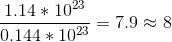
To determine which method will produce more hydrogen molecules, convert equal masses of each reactant into molecules of hydrogen gas. The conversion requires us to convert the initial compound to moles, multiply by the molar ratio from the reaction to find moles of hydrogen, and multiply by Avogadro's number to convert to molecules.
Dividing these solutions, we see that the methane method produces roughly eight times the amount of hydrogen molecules.
← Didn't Know|Knew It →
Hydrogen can be produced on a large scale by a method called the Bosch process, by which steam is passed over heated iron shavings. The reaction is shown below:
Alternatively, hydrogen can be produced by reacting steam with natural gas, according to the following equation:
How many molecules of carbon monoxide are produced per liter of hydrogen, when using the natural gas method of production at STP?
Hydrogen can be produced on a large scale by a method called the Bosch process, by which steam is passed over heated iron shavings. The reaction is shown below:
Alternatively, hydrogen can be produced by reacting steam with natural gas, according to the following equation:
How many molecules of carbon monoxide are produced per liter of hydrogen, when using the natural gas method of production at STP?
Tap to reveal answer
Since the reaction takes place at STP, we can convert liters of hydrogen to moles using a constant.

Using this value, we can find the moles of carbon monoxide produced and convert to molecules by using Avogadro's number.

Since the reaction takes place at STP, we can convert liters of hydrogen to moles using a constant.
Using this value, we can find the moles of carbon monoxide produced and convert to molecules by using Avogadro's number.
← Didn't Know|Knew It →
Hydrogen can be produced on a large scale by a method called the Bosch process, by which steam is passed over heated iron shavings. The reaction is shown below:
Alternatively, hydrogen can be produced by reacting steam with natural gas, according to the following equation:
Suppose  of iron react with
  of steam to create iron oxide and hydrogen. What is the limiting reagent and how much of the excess reactant remains?
Hydrogen can be produced on a large scale by a method called the Bosch process, by which steam is passed over heated iron shavings. The reaction is shown below:
Alternatively, hydrogen can be produced by reacting steam with natural gas, according to the following equation:
Suppose
Tap to reveal answer
In order to identify an excess reactant, we use stoichiometry to convert atoms of iron to mass of steam.

We have  of steam available, but only require
  to fully react the given iron. Iron is thus the limiting reagent, since it will be fully consumed first.

There will be  of excess steam.
In order to identify an excess reactant, we use stoichiometry to convert atoms of iron to mass of steam.
We have
There will be
← Didn't Know|Knew It →
Hydrogen can be produced on a large scale by a method called the Bosch process, by which steam is passed over heated iron shavings. The reaction is shown below:
Alternatively, hydrogen can be produced by reacting steam with natural gas, according to the following equation:
Which hydrogen production method would be more efficient in areas where water is scarce?
Hydrogen can be produced on a large scale by a method called the Bosch process, by which steam is passed over heated iron shavings. The reaction is shown below:
Alternatively, hydrogen can be produced by reacting steam with natural gas, according to the following equation:
Which hydrogen production method would be more efficient in areas where water is scarce?
Tap to reveal answer
The question asks us to consider water scarcity. Assuming our goal is to utilize minimal water to produce maximal hydrogen, the natural gas method is most efficient as is produces more hydrogen per mole of water consumed.
One mole of water produces three moles of hydrogen.
Four moles of water produce four moles of hydrogen.
The question asks us to consider water scarcity. Assuming our goal is to utilize minimal water to produce maximal hydrogen, the natural gas method is most efficient as is produces more hydrogen per mole of water consumed.
One mole of water produces three moles of hydrogen.
Four moles of water produce four moles of hydrogen.
← Didn't Know|Knew It →