Potential Energy (Gravitational and Spring) - MCAT Chemical and Physical Foundations of Biological Systems
Card 1 of 98
A 2kg mass is attached to a massless spring with force constant 100N/m. The system rests on a frictionless horizontal surface. If the spring is compressed 5cm, then released, what is the maximum velocity of the mass?
A 2kg mass is attached to a massless spring with force constant 100N/m. The system rests on a frictionless horizontal surface. If the spring is compressed 5cm, then released, what is the maximum velocity of the mass?
Tap to reveal answer
Use conservation of energy to compare the point of maximum compression and the point of maximum velocity. At maximum compression, all energy is spring potential energy, where $E_{s}$= $$\frac{1}{2}$kx^{2}$, and at maximum velocity all energy is kinetic, where $E_{k}$= $$\frac{1}{2}$mv^{2}$. Since energy must be conserved, these two energies must be equal: $$\frac{1}{2}$kx^{2}$ = $$\frac{1}{2}$mv^{2}$.
Plugging in the given information for Es and solving for v gives the following series of calculations:

.125 Joules = $$\frac{1}{2}$mv^{2}$
.125 = $v^{2}$
v = .354 m/s = 35.4 cm/s
Use conservation of energy to compare the point of maximum compression and the point of maximum velocity. At maximum compression, all energy is spring potential energy, where $E_{s}$= $$\frac{1}{2}$kx^{2}$, and at maximum velocity all energy is kinetic, where $E_{k}$= $$\frac{1}{2}$mv^{2}$. Since energy must be conserved, these two energies must be equal: $$\frac{1}{2}$kx^{2}$ = $$\frac{1}{2}$mv^{2}$.
Plugging in the given information for Es and solving for v gives the following series of calculations:
.125 Joules = $$\frac{1}{2}$mv^{2}$
.125 = $v^{2}$
v = .354 m/s = 35.4 cm/s
← Didn't Know|Knew It →
A 2kg lead ball is loaded into a spring cannon and the cannon is set at a 45º angle on a platform. The spring has a spring constant of 100N/m and the ball and spring system is compressed by 1m before launch. While the ball is in flight air resistance can be neglected, and the ball finishes its flight by landing at a cushion placed some distance away from the cannon.
How much energy is stored in the spring before the ball is launched?
A 2kg lead ball is loaded into a spring cannon and the cannon is set at a 45º angle on a platform. The spring has a spring constant of 100N/m and the ball and spring system is compressed by 1m before launch. While the ball is in flight air resistance can be neglected, and the ball finishes its flight by landing at a cushion placed some distance away from the cannon.
How much energy is stored in the spring before the ball is launched?
Tap to reveal answer
In order to determine how much energy is stored, we first need to understand what type of energy we want to consider. A spring stores potential energy; the potential energy of the spring is maximized at maximal displacement from its resting state. In order to compute the potential energy stored, we need both the spring constant (100N/m) and the displacement from resting (1m).
PEs = ½k(Δx)2 = ½(100N/m)(1m)2 = 50J
In order to determine how much energy is stored, we first need to understand what type of energy we want to consider. A spring stores potential energy; the potential energy of the spring is maximized at maximal displacement from its resting state. In order to compute the potential energy stored, we need both the spring constant (100N/m) and the displacement from resting (1m).
PEs = ½k(Δx)2 = ½(100N/m)(1m)2 = 50J
← Didn't Know|Knew It →
Two children are playing with sleds on a snow-covered hill. Sam weighs 50kg, and his sled weighs 10kg. Sally weighs 40kg, and her sled weighs 12kg. When they arrive, they climb up the hill using boots. Halfway up the 50-meter hill, Sally slips and rolls back down to the bottom. Sam continues climbing, and eventually Sally joins him at the top.
They then decide to sled down the hill, but disagree about who will go first.
Scenario 1:
Sam goes down the hill first, claiming that he will reach a higher velocity. If Sally had gone first, Sam says they could collide.
Scenario 2:
Sally goes down the hill first, claiming that she will experience lower friction and thus reach a higher velocity. If Sam had gone first, Sally says they could collide.
Scenario 3:
Unable to agree, Sam and Sally tether themselves with a rope and go down together.
How much potential energy does Sally have at the top of the hill on her sled?
Two children are playing with sleds on a snow-covered hill. Sam weighs 50kg, and his sled weighs 10kg. Sally weighs 40kg, and her sled weighs 12kg. When they arrive, they climb up the hill using boots. Halfway up the 50-meter hill, Sally slips and rolls back down to the bottom. Sam continues climbing, and eventually Sally joins him at the top.
They then decide to sled down the hill, but disagree about who will go first.
Scenario 1:
Sam goes down the hill first, claiming that he will reach a higher velocity. If Sally had gone first, Sam says they could collide.
Scenario 2:
Sally goes down the hill first, claiming that she will experience lower friction and thus reach a higher velocity. If Sam had gone first, Sally says they could collide.
Scenario 3:
Unable to agree, Sam and Sally tether themselves with a rope and go down together.
How much potential energy does Sally have at the top of the hill on her sled?
Tap to reveal answer
This is a tricky question only because you have to keep your units straight. The formula is simply PE = mgh.
PE = 52kg * 10m/s2 * 50m = 26,000J = 26kJ
This is a tricky question only because you have to keep your units straight. The formula is simply PE = mgh.
PE = 52kg * 10m/s2 * 50m = 26,000J = 26kJ
← Didn't Know|Knew It →
A 2kg mass is suspended on a rope that wraps around a frictionless pulley attached to the ceiling with a mass of 0.01kg and a radius of 0.25m. The other end of the rope is attached to a massless suspended platform, upon which 0.5kg weights may be placed. While the system is initially at equilibrium, the rope is later cut above the weight, and the platform subsequently raised by pulling on the rope.
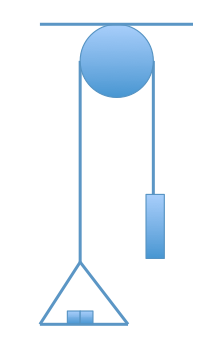
After the rope is cut and the platform falls, we want to pull the platform back up to 5m above the ground. How much energy is required to raise the platform?
A 2kg mass is suspended on a rope that wraps around a frictionless pulley attached to the ceiling with a mass of 0.01kg and a radius of 0.25m. The other end of the rope is attached to a massless suspended platform, upon which 0.5kg weights may be placed. While the system is initially at equilibrium, the rope is later cut above the weight, and the platform subsequently raised by pulling on the rope.
After the rope is cut and the platform falls, we want to pull the platform back up to 5m above the ground. How much energy is required to raise the platform?
Tap to reveal answer
First, we need to understand what type of energy we are considering. As the resistive force to motion is due to gravity, we are talking about gravitational potential energy. We need to use the formula U = mgh.
Plugging in the values that are provided, we can solve for the potential energy (U).
U = (2kg)(9.8m/s2)(5m) = 98J
The amount of work required is equal to the change in potential energy of the platform.
First, we need to understand what type of energy we are considering. As the resistive force to motion is due to gravity, we are talking about gravitational potential energy. We need to use the formula U = mgh.
Plugging in the values that are provided, we can solve for the potential energy (U).
U = (2kg)(9.8m/s2)(5m) = 98J
The amount of work required is equal to the change in potential energy of the platform.
← Didn't Know|Knew It →
If a ball is attached to a spring that has a spring constant of 20N/m and is compressed 0.1m, what is the total energy of the oscillation?
If a ball is attached to a spring that has a spring constant of 20N/m and is compressed 0.1m, what is the total energy of the oscillation?
Tap to reveal answer
The total energy of a simple harmonic oscillating system can be determined by the equation  . A is the amplitude of the oscillation, k is the spring constant, and E is the total energy. Plugging in values given by the equation, the total energy is equal to 0.1J.

The total energy of a simple harmonic oscillating system can be determined by the equation
← Didn't Know|Knew It →
A spring in a pinball machine is compressed  from its equilibrium position. It is released and it fires the
  pinball at a velocity of
  into play. No energy is lost to friction and all of the energy in the spring is transferred to the pinball. What is the spring constant in the spring?
A spring in a pinball machine is compressed
Tap to reveal answer
The energy in a spring is given by the equation  , where
  is the spring constant and
  is the displacement from the equilibrium position. The energy is transferred into kinetic energy in the pinball.
The kinetic energy in the pinball is found using the equation  .
.
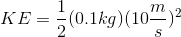


Now that we have kinetic energy, we can find the equal energy that was stored in the spring to begin.

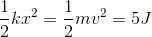
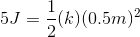

The energy in a spring is given by the equation
The kinetic energy in the pinball is found using the equation
Now that we have kinetic energy, we can find the equal energy that was stored in the spring to begin.
← Didn't Know|Knew It →
A 2kg box slides down a ramp a distance of two meters before it reaches the ground. The ramp has an angle of 30o. The coefficient of kinetic friction for the ramp is 0.1.
What is the gravitational potential energy of the box relative to the ground when at the top of the ramp?
A 2kg box slides down a ramp a distance of two meters before it reaches the ground. The ramp has an angle of 30o. The coefficient of kinetic friction for the ramp is 0.1.
What is the gravitational potential energy of the box relative to the ground when at the top of the ramp?
Tap to reveal answer
Gravitational potential energy is determined using the equation  , with
  being the mass of the object,
  being the gravitational acceleration, and
  being the height of the object relative to the ground. Because we know the length of the ramp and the angle of the ramp, we can solve for the box's height above the ground.
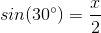


Now that we have the height, we simply plug the given values into the equation.

Gravitational potential energy is determined using the equation
Now that we have the height, we simply plug the given values into the equation.
← Didn't Know|Knew It →
A block with mass,  , is attached to a spring with a spring constant,
  . The spring is compressed a maximum distance,
  , and released. What is the maximum velocity the block reaches after the spring is released?
A block with mass,
Tap to reveal answer
The spring potential is given by the equation  and the equation for kinetic energy is given by
  .
.
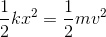
When  is at a maximum distance (the amplitude) the velocity is zero, and the spring ONLY has potential energy. When it is released, the total energy is part kinetic and part potential. When the amplitude is at zero (equilibrium), the velocity is at a maximum and all the potential energy is converted into kinetic energy. We can then set the two equations equal to each other to solve the maximum velocity.


The spring potential is given by the equation
When
← Didn't Know|Knew It →
A spring is used to launch a  ball straight up to a maximum height of
  . The spring constant of the spring is
  .
.
What was the displacement of the spring required to launch the ball?
A spring is used to launch a
What was the displacement of the spring required to launch the ball?
Tap to reveal answer
We can use conservation of energy to calculate the displacement. The spring must be displaced so that its potential energy is equal to the gravitational potential energy of the ball at its maximum height.

Substituting in the expressions for potential energy of the spring and gravitational potential energy, we can start to set up an equation using the given variables.


We are given the spring constant, the mass, and the maximum height. Using these values, and the acceleration for gravity, we can solve for the spring displacement.

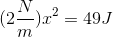


Note that, since we are taking the square root, the displacement answer could be either positive or negative. Since the spring is being compressed to launch the ball (rather than stretched), the displacement should be negative.
We can use conservation of energy to calculate the displacement. The spring must be displaced so that its potential energy is equal to the gravitational potential energy of the ball at its maximum height.
Substituting in the expressions for potential energy of the spring and gravitational potential energy, we can start to set up an equation using the given variables.
We are given the spring constant, the mass, and the maximum height. Using these values, and the acceleration for gravity, we can solve for the spring displacement.
Note that, since we are taking the square root, the displacement answer could be either positive or negative. Since the spring is being compressed to launch the ball (rather than stretched), the displacement should be negative.
← Didn't Know|Knew It →
A massless spring rests horizontally on a table, with its right end attached to a  block and with its left end attached to a wall. The block is then pushed against the spring, compressing it
  from its equilibrium position. After being released, the block's velocity as it moves back through the equilibrium point is
  . What is the spring constant of this spring?
A massless spring rests horizontally on a table, with its right end attached to a
Tap to reveal answer
Use conservation of energy to equate the initial spring potential energy and the final kinetic energy:

The initial situation is defined when the spring and block are compressed, and the final situation is defined to be when the block moves back through the equilibrium point. For a spring, the potential energy is maximal when the spring is compressed and the kinetic energy is maximal when the mass passes equilibrium. We can set up a equation based on these factors.


Use the equations for spring potential energy and for kinetic energy to incorporate the appropriate variables into the equation.

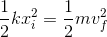
We are given values for the displacement, mass, and final velocity. Using these values, we can isolate the spring constant.



Use conservation of energy to equate the initial spring potential energy and the final kinetic energy:
The initial situation is defined when the spring and block are compressed, and the final situation is defined to be when the block moves back through the equilibrium point. For a spring, the potential energy is maximal when the spring is compressed and the kinetic energy is maximal when the mass passes equilibrium. We can set up a equation based on these factors.
Use the equations for spring potential energy and for kinetic energy to incorporate the appropriate variables into the equation.
We are given values for the displacement, mass, and final velocity. Using these values, we can isolate the spring constant.
← Didn't Know|Knew It →
A certain chocolate candy bar contains  . How high can a
  barbell be lifted with the energy contained in this candy bar?

A certain chocolate candy bar contains
Tap to reveal answer
Our first step is to convert kilocalories to Joules.

Now that we have converted to standard units, we can use the formula for gravitational potential energy to find the height.

We know our energy limit from the candy bar, the mass of the barbell, and the gravitational acceleration.

Solve to isolate the height.
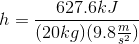

Note that we end up with kilometers because we used kilojoules in our calculation.
Our first step is to convert kilocalories to Joules.
Now that we have converted to standard units, we can use the formula for gravitational potential energy to find the height.
We know our energy limit from the candy bar, the mass of the barbell, and the gravitational acceleration.
Solve to isolate the height.
Note that we end up with kilometers because we used kilojoules in our calculation.
← Didn't Know|Knew It →
What is the potential energy of a  block of cement being held by a crane at a height of
  ?
?
What is the potential energy of a
Tap to reveal answer
Our formula for gravitational potential energy is:

 is mass in kilograms,
  is the acceleration of gravity, and
  is the height in meters. We know each of these values, allowing us to solve for the energy by multiplication.

Our formula for gravitational potential energy is:
← Didn't Know|Knew It →
A  pyramid stone is raised to a height of
  . What is the potential energy of the system?
A
Tap to reveal answer
No matter how you raise the stone (all at once, in multiple vertical steps, or along a ramp) the final potential energy is the same. Gravitational potential energy of a given object is solely dependent on height.

Use the given mass, the acceleration of gravity, and the final height to calculate the potential energy of the system.


Since work is equal to the change in potential energy of a system, this value also gives the total work done to raise the stone.
No matter how you raise the stone (all at once, in multiple vertical steps, or along a ramp) the final potential energy is the same. Gravitational potential energy of a given object is solely dependent on height.
Use the given mass, the acceleration of gravity, and the final height to calculate the potential energy of the system.
Since work is equal to the change in potential energy of a system, this value also gives the total work done to raise the stone.
← Didn't Know|Knew It →
Two students (student X and student Y) lift a boulder vertically from point A to point B. Student X directly lifts the boulder from point A to point B, whereas student Y uses a pulley to lift the boulder. This allows student Y to apply a force ( ) that is three times smaller than the force applied by student X (
 ). Both students apply force upwards and take the same amount of time to complete this task.
The vertical distance between point A and point B is  .
.
Student Z uses an inclined plane to lift the boulder and exerts only one third of  . Which of the following quantities is not equal for student Z and student X?
I. The change in potential energy
II. The distance travelled
III. The sum of the change in kinetic energy and change in potential energy
Two students (student X and student Y) lift a boulder vertically from point A to point B. Student X directly lifts the boulder from point A to point B, whereas student Y uses a pulley to lift the boulder. This allows student Y to apply a force (
The vertical distance between point A and point B is
Student Z uses an inclined plane to lift the boulder and exerts only one third of
I. The change in potential energy
II. The distance travelled
III. The sum of the change in kinetic energy and change in potential energy
Tap to reveal answer
The change in potential energy is defined as:

This means that the potential energy is only dependent on the change in vertical height, which is the same for both students. Since both students travel the same distance, the change in potential energy is equal and statement I is true.
Student X directly lift the boulder whereas student Z uses an inclined plane. Student Z slides the boulder along a larger distance than student X, even if their total displacement ends up begin equal; therefore, statement II is false.
Recall that the sum of change in kinetic energy and change in potential energy is equal to work, which is the same for both students (work is path independent in a gravitational field). The total work for both students will be equal, and statement III will be true.
The only statement that is not equal for both students is statement II.
The change in potential energy is defined as:
This means that the potential energy is only dependent on the change in vertical height, which is the same for both students. Since both students travel the same distance, the change in potential energy is equal and statement I is true.
Student X directly lift the boulder whereas student Z uses an inclined plane. Student Z slides the boulder along a larger distance than student X, even if their total displacement ends up begin equal; therefore, statement II is false.
Recall that the sum of change in kinetic energy and change in potential energy is equal to work, which is the same for both students (work is path independent in a gravitational field). The total work for both students will be equal, and statement III will be true.
The only statement that is not equal for both students is statement II.
← Didn't Know|Knew It →
A 2kg lead ball is loaded into a spring cannon and the cannon is set at a 45º angle on a platform. The spring has a spring constant of 100N/m and the ball and spring system is compressed by 1m before launch. While the ball is in flight air resistance can be neglected, and the ball finishes its flight by landing at a cushion placed some distance away from the cannon.
How much energy is stored in the spring before the ball is launched?
A 2kg lead ball is loaded into a spring cannon and the cannon is set at a 45º angle on a platform. The spring has a spring constant of 100N/m and the ball and spring system is compressed by 1m before launch. While the ball is in flight air resistance can be neglected, and the ball finishes its flight by landing at a cushion placed some distance away from the cannon.
How much energy is stored in the spring before the ball is launched?
Tap to reveal answer
In order to determine how much energy is stored, we first need to understand what type of energy we want to consider. A spring stores potential energy; the potential energy of the spring is maximized at maximal displacement from its resting state. In order to compute the potential energy stored, we need both the spring constant (100N/m) and the displacement from resting (1m).
PEs = ½k(Δx)2 = ½(100N/m)(1m)2 = 50J
In order to determine how much energy is stored, we first need to understand what type of energy we want to consider. A spring stores potential energy; the potential energy of the spring is maximized at maximal displacement from its resting state. In order to compute the potential energy stored, we need both the spring constant (100N/m) and the displacement from resting (1m).
PEs = ½k(Δx)2 = ½(100N/m)(1m)2 = 50J
← Didn't Know|Knew It →
Two children are playing with sleds on a snow-covered hill. Sam weighs 50kg, and his sled weighs 10kg. Sally weighs 40kg, and her sled weighs 12kg. When they arrive, they climb up the hill using boots. Halfway up the 50-meter hill, Sally slips and rolls back down to the bottom. Sam continues climbing, and eventually Sally joins him at the top.
They then decide to sled down the hill, but disagree about who will go first.
Scenario 1:
Sam goes down the hill first, claiming that he will reach a higher velocity. If Sally had gone first, Sam says they could collide.
Scenario 2:
Sally goes down the hill first, claiming that she will experience lower friction and thus reach a higher velocity. If Sam had gone first, Sally says they could collide.
Scenario 3:
Unable to agree, Sam and Sally tether themselves with a rope and go down together.
How much potential energy does Sally have at the top of the hill on her sled?
Two children are playing with sleds on a snow-covered hill. Sam weighs 50kg, and his sled weighs 10kg. Sally weighs 40kg, and her sled weighs 12kg. When they arrive, they climb up the hill using boots. Halfway up the 50-meter hill, Sally slips and rolls back down to the bottom. Sam continues climbing, and eventually Sally joins him at the top.
They then decide to sled down the hill, but disagree about who will go first.
Scenario 1:
Sam goes down the hill first, claiming that he will reach a higher velocity. If Sally had gone first, Sam says they could collide.
Scenario 2:
Sally goes down the hill first, claiming that she will experience lower friction and thus reach a higher velocity. If Sam had gone first, Sally says they could collide.
Scenario 3:
Unable to agree, Sam and Sally tether themselves with a rope and go down together.
How much potential energy does Sally have at the top of the hill on her sled?
Tap to reveal answer
This is a tricky question only because you have to keep your units straight. The formula is simply PE = mgh.
PE = 52kg * 10m/s2 * 50m = 26,000J = 26kJ
This is a tricky question only because you have to keep your units straight. The formula is simply PE = mgh.
PE = 52kg * 10m/s2 * 50m = 26,000J = 26kJ
← Didn't Know|Knew It →
A 2kg mass is suspended on a rope that wraps around a frictionless pulley attached to the ceiling with a mass of 0.01kg and a radius of 0.25m. The other end of the rope is attached to a massless suspended platform, upon which 0.5kg weights may be placed. While the system is initially at equilibrium, the rope is later cut above the weight, and the platform subsequently raised by pulling on the rope.
After the rope is cut and the platform falls, we want to pull the platform back up to 5m above the ground. How much energy is required to raise the platform?
A 2kg mass is suspended on a rope that wraps around a frictionless pulley attached to the ceiling with a mass of 0.01kg and a radius of 0.25m. The other end of the rope is attached to a massless suspended platform, upon which 0.5kg weights may be placed. While the system is initially at equilibrium, the rope is later cut above the weight, and the platform subsequently raised by pulling on the rope.
After the rope is cut and the platform falls, we want to pull the platform back up to 5m above the ground. How much energy is required to raise the platform?
Tap to reveal answer
First, we need to understand what type of energy we are considering. As the resistive force to motion is due to gravity, we are talking about gravitational potential energy. We need to use the formula U = mgh.
Plugging in the values that are provided, we can solve for the potential energy (U).
U = (2kg)(9.8m/s2)(5m) = 98J
The amount of work required is equal to the change in potential energy of the platform.
First, we need to understand what type of energy we are considering. As the resistive force to motion is due to gravity, we are talking about gravitational potential energy. We need to use the formula U = mgh.
Plugging in the values that are provided, we can solve for the potential energy (U).
U = (2kg)(9.8m/s2)(5m) = 98J
The amount of work required is equal to the change in potential energy of the platform.
← Didn't Know|Knew It →
A 2kg mass is attached to a massless spring with force constant 100N/m. The system rests on a frictionless horizontal surface. If the spring is compressed 5cm, then released, what is the maximum velocity of the mass?
A 2kg mass is attached to a massless spring with force constant 100N/m. The system rests on a frictionless horizontal surface. If the spring is compressed 5cm, then released, what is the maximum velocity of the mass?
Tap to reveal answer
Use conservation of energy to compare the point of maximum compression and the point of maximum velocity. At maximum compression, all energy is spring potential energy, where $E_{s}$= $$\frac{1}{2}$kx^{2}$, and at maximum velocity all energy is kinetic, where $E_{k}$= $$\frac{1}{2}$mv^{2}$. Since energy must be conserved, these two energies must be equal: $$\frac{1}{2}$kx^{2}$ = $$\frac{1}{2}$mv^{2}$.
Plugging in the given information for Es and solving for v gives the following series of calculations:
.125 Joules = $$\frac{1}{2}$mv^{2}$
.125 = $v^{2}$
v = .354 m/s = 35.4 cm/s
Use conservation of energy to compare the point of maximum compression and the point of maximum velocity. At maximum compression, all energy is spring potential energy, where $E_{s}$= $$\frac{1}{2}$kx^{2}$, and at maximum velocity all energy is kinetic, where $E_{k}$= $$\frac{1}{2}$mv^{2}$. Since energy must be conserved, these two energies must be equal: $$\frac{1}{2}$kx^{2}$ = $$\frac{1}{2}$mv^{2}$.
Plugging in the given information for Es and solving for v gives the following series of calculations:
.125 Joules = $$\frac{1}{2}$mv^{2}$
.125 = $v^{2}$
v = .354 m/s = 35.4 cm/s
← Didn't Know|Knew It →
If a ball is attached to a spring that has a spring constant of 20N/m and is compressed 0.1m, what is the total energy of the oscillation?
If a ball is attached to a spring that has a spring constant of 20N/m and is compressed 0.1m, what is the total energy of the oscillation?
Tap to reveal answer
The total energy of a simple harmonic oscillating system can be determined by the equation . A is the amplitude of the oscillation, k is the spring constant, and E is the total energy. Plugging in values given by the equation, the total energy is equal to 0.1J.
The total energy of a simple harmonic oscillating system can be determined by the equation
← Didn't Know|Knew It →
A spring in a pinball machine is compressed from its equilibrium position. It is released and it fires the pinball at a velocity of into play. No energy is lost to friction and all of the energy in the spring is transferred to the pinball. What is the spring constant in the spring?
A spring in a pinball machine is compressed
Tap to reveal answer
The energy in a spring is given by the equation , where is the spring constant and is the displacement from the equilibrium position. The energy is transferred into kinetic energy in the pinball.
The kinetic energy in the pinball is found using the equation .
Now that we have kinetic energy, we can find the equal energy that was stored in the spring to begin.
The energy in a spring is given by the equation
The kinetic energy in the pinball is found using the equation
Now that we have kinetic energy, we can find the equal energy that was stored in the spring to begin.
← Didn't Know|Knew It →