Mirrors and Lenses - MCAT Chemical and Physical Foundations of Biological Systems
Card 1 of 112
In a microscope has a  tube length and objective lens with a focal length of
  . The viewer's eye is
  from the objective lens, and they desire a magnification of
  . What must the focal length of the eyepiece lens be to achieve this magnification?
In a microscope has a
Tap to reveal answer
The total magnification of a compound microscope is the product of the objective lens magnification and the eyepiece magnification.

Objective magnification and eyepiece magnification are given by the following equations:


We are given the tube length and focal length of the objective lens, allowing us to solve for its magnification.

We also know the distance of the viewer's eye. Use this value in the eyepiece magnification equation.
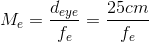
Finally, combine the eyepiece magnification and objective lens magnification into the original equation for total magnification.

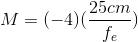
Use the given value for total magnification to solve for the focal length of the eyepiece lens.
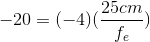


The total magnification of a compound microscope is the product of the objective lens magnification and the eyepiece magnification.
Objective magnification and eyepiece magnification are given by the following equations:
We are given the tube length and focal length of the objective lens, allowing us to solve for its magnification.
We also know the distance of the viewer's eye. Use this value in the eyepiece magnification equation.
Finally, combine the eyepiece magnification and objective lens magnification into the original equation for total magnification.
Use the given value for total magnification to solve for the focal length of the eyepiece lens.
← Didn't Know|Knew It →
A compound microscope consists of an eyepiece with an angular magnification of 25 and an objective lens of unknown focal length. If the length of the microscope tube is 25cm, what magnitude of objective focal length is necessary to achieve an overall magnification of 500?
A compound microscope consists of an eyepiece with an angular magnification of 25 and an objective lens of unknown focal length. If the length of the microscope tube is 25cm, what magnitude of objective focal length is necessary to achieve an overall magnification of 500?
Tap to reveal answer
Relevant equations:


 = length of microscope tube
 = focal length of objective
 = focal length of eyepiece
 = linear magnification of objective
 = angular magnification of eyepiece
 = total magnification of microscope
Given:


Step 1: Plug the expression for  into the equation for total magnification,
  .
.
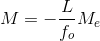
Step 2: Rearrange to isolate the unknown, 

Step 3: Plug in given quantities, taking the absolute value to find the magnitude of  .
.

Relevant equations:
Given:
Step 1: Plug the expression for
Step 2: Rearrange to isolate the unknown,
Step 3: Plug in given quantities, taking the absolute value to find the magnitude of
← Didn't Know|Knew It →
What diameter of telescope objective lens is necessary to resolve two stars that primarily emit 600nm light and have an angular separation of  ?
?
What diameter of telescope objective lens is necessary to resolve two stars that primarily emit 600nm light and have an angular separation of
Tap to reveal answer
Relevant equations:

 = angular separation of sources, in radians
 = wavelength of light emitted by sources, in meters
 = diameter of telescope
Step 1: Rearrange equation to isolate the unknown,  :
:

Step 2: Plug in the given numbers for wavelength and angular separation:

Relevant equations:
Step 1: Rearrange equation to isolate the unknown,
Step 2: Plug in the given numbers for wavelength and angular separation:
← Didn't Know|Knew It →
In a microscope has a tube length and objective lens with a focal length of . The viewer's eye is from the objective lens, and they desire a magnification of . What must the focal length of the eyepiece lens be to achieve this magnification?
In a microscope has a
Tap to reveal answer
The total magnification of a compound microscope is the product of the objective lens magnification and the eyepiece magnification.
Objective magnification and eyepiece magnification are given by the following equations:
We are given the tube length and focal length of the objective lens, allowing us to solve for its magnification.
We also know the distance of the viewer's eye. Use this value in the eyepiece magnification equation.
Finally, combine the eyepiece magnification and objective lens magnification into the original equation for total magnification.
Use the given value for total magnification to solve for the focal length of the eyepiece lens.
The total magnification of a compound microscope is the product of the objective lens magnification and the eyepiece magnification.
Objective magnification and eyepiece magnification are given by the following equations:
We are given the tube length and focal length of the objective lens, allowing us to solve for its magnification.
We also know the distance of the viewer's eye. Use this value in the eyepiece magnification equation.
Finally, combine the eyepiece magnification and objective lens magnification into the original equation for total magnification.
Use the given value for total magnification to solve for the focal length of the eyepiece lens.
← Didn't Know|Knew It →
A compound microscope consists of an eyepiece with an angular magnification of 25 and an objective lens of unknown focal length. If the length of the microscope tube is 25cm, what magnitude of objective focal length is necessary to achieve an overall magnification of 500?
A compound microscope consists of an eyepiece with an angular magnification of 25 and an objective lens of unknown focal length. If the length of the microscope tube is 25cm, what magnitude of objective focal length is necessary to achieve an overall magnification of 500?
Tap to reveal answer
Relevant equations:
= length of microscope tube
= focal length of objective
= focal length of eyepiece
= linear magnification of objective
= angular magnification of eyepiece
= total magnification of microscope
Given:
Step 1: Plug the expression for into the equation for total magnification, .
Step 2: Rearrange to isolate the unknown,
Step 3: Plug in given quantities, taking the absolute value to find the magnitude of .
Relevant equations:
Given:
Step 1: Plug the expression for
Step 2: Rearrange to isolate the unknown,
Step 3: Plug in given quantities, taking the absolute value to find the magnitude of
← Didn't Know|Knew It →
What diameter of telescope objective lens is necessary to resolve two stars that primarily emit 600nm light and have an angular separation of ?
What diameter of telescope objective lens is necessary to resolve two stars that primarily emit 600nm light and have an angular separation of
Tap to reveal answer
Relevant equations:
= angular separation of sources, in radians
= wavelength of light emitted by sources, in meters
= diameter of telescope
Step 1: Rearrange equation to isolate the unknown, :
Step 2: Plug in the given numbers for wavelength and angular separation:
Relevant equations:
Step 1: Rearrange equation to isolate the unknown,
Step 2: Plug in the given numbers for wavelength and angular separation:
← Didn't Know|Knew It →
How far from a converging lens must an object be placed to produce an image that is NOT real and inverted? Given the answer as  in terms of the focal length,
  .
.
How far from a converging lens must an object be placed to produce an image that is NOT real and inverted? Given the answer as
Tap to reveal answer
When an object is placed a distance from a converging lens or mirror that is equal to the focal length, no image is produced. To test this out, stand in front of a single concave mirror and continue to back up until you no longer see an image. Once you've reached this point, you will be standing one focal length away from the mirror.
When the object is less than one focal length away from the converging lens/mirror, the image will be virtual and upright.
If you don't have these trends committed to memory, you can derive them from the equation  .
.
When  is a negative integer the image is virtual, and when it is a positive integer the image is real.
When an object is placed a distance from a converging lens or mirror that is equal to the focal length, no image is produced. To test this out, stand in front of a single concave mirror and continue to back up until you no longer see an image. Once you've reached this point, you will be standing one focal length away from the mirror.
When the object is less than one focal length away from the converging lens/mirror, the image will be virtual and upright.
If you don't have these trends committed to memory, you can derive them from the equation
When
← Didn't Know|Knew It →
A virtual image is formed  from a convex mirror with a focal length of
  . How far from the mirror is the object that created this image?
A virtual image is formed
Tap to reveal answer
Use the equation:

Focal length is negative for convex mirrors, and image distance is negative for virtual images. We are given these values in the question, allowing us to calculate the object distance.
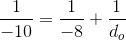


Use the equation:
Focal length is negative for convex mirrors, and image distance is negative for virtual images. We are given these values in the question, allowing us to calculate the object distance.
← Didn't Know|Knew It →
A certain farsighted person cannot focus on objects closer to his eyes than  . What focal length eyeglass lenses are needed in order to focus on a newspaper held at
  from the person's eyes, if the glasses are worn
  from his eyes?
A certain farsighted person cannot focus on objects closer to his eyes than
Tap to reveal answer
First we need the object and image distances away from the eyeglass lenses. Here, the newspaper is the object and the  focal point is where the image needs to be located. Find the distance from the object to the lens, and the distance of the image to the lens, by subtracting out the distance from the lens to the eye.


Now apply the thin lens equation to determine focal length.

Recall that if the image is on the same side of the lens as the object, then image distance is negative.
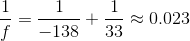
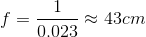
First we need the object and image distances away from the eyeglass lenses. Here, the newspaper is the object and the
Now apply the thin lens equation to determine focal length.
Recall that if the image is on the same side of the lens as the object, then image distance is negative.
← Didn't Know|Knew It →
An object is placed 50cm in front of a concave mirror of radius 60cm. How far from the mirror is the image?
An object is placed 50cm in front of a concave mirror of radius 60cm. How far from the mirror is the image?
Tap to reveal answer
Relevant equations:


Step 1: Find the focal length of the mirror.

Step 2: Plug this focal length and the object distance into the lens equation.
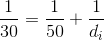

Relevant equations:
Step 1: Find the focal length of the mirror.
Step 2: Plug this focal length and the object distance into the lens equation.
← Didn't Know|Knew It →
An object that is 3cm tall is placed 30cm from a convex spherical mirror of radius 40cm, along its central axis. What is the height of the image that is formed?
An object that is 3cm tall is placed 30cm from a convex spherical mirror of radius 40cm, along its central axis. What is the height of the image that is formed?
Tap to reveal answer
Relevant equations:


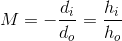
Step 1: Find the focal length of the mirror (remembering that convex mirrors have negative focal lengths, by convention).

Step 2: Find the image distance using the thin lens equation.
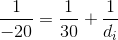

Step 3: Use the magnification equation to relate the object distances and heights.
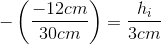

Relevant equations:
Step 1: Find the focal length of the mirror (remembering that convex mirrors have negative focal lengths, by convention).
Step 2: Find the image distance using the thin lens equation.
Step 3: Use the magnification equation to relate the object distances and heights.
← Didn't Know|Knew It →
A person approaches a plane mirror at 5m/s. How fast do they approach the mirror image?
A person approaches a plane mirror at 5m/s. How fast do they approach the mirror image?
Tap to reveal answer
The image distance for a plane mirror is always equal to the object distance because the magnification is 1.

If the object and image are the same distance from the mirror and magnification is 1, then as the object approaches the mirror at a certain speed, the image is approaching the plane mirror at the same speed, therefore you approach the image more quickly than you approach the mirror, since you travel 5m/s toward the mirror and the image travels 5m/s toward the mirror.
The image distance for a plane mirror is always equal to the object distance because the magnification is 1.
If the object and image are the same distance from the mirror and magnification is 1, then as the object approaches the mirror at a certain speed, the image is approaching the plane mirror at the same speed, therefore you approach the image more quickly than you approach the mirror, since you travel 5m/s toward the mirror and the image travels 5m/s toward the mirror.
← Didn't Know|Knew It →
A man stands ten meters away from a converging mirror with a focal length of two meters. What is true of the image he sees?
A man stands ten meters away from a converging mirror with a focal length of two meters. What is true of the image he sees?
Tap to reveal answer
The first thing to consider when answering this question is the fact that real images are always inverted and virtual images are always upright. Once you have determined one or the other, two answer choices can be eliminated.
The first equation that is necessary for this question is  .
.

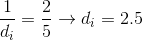
From this we can determine that  is equal to
  . Since
  is a positive number we know the image is real, and thus inverted.
The second equation to consider is for magnification:  .
.
If the absolute value of  is greater than one, the image is magnified, and if the value is less than one, it is minimized.
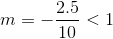
We would expect the image to be minimized.
The first thing to consider when answering this question is the fact that real images are always inverted and virtual images are always upright. Once you have determined one or the other, two answer choices can be eliminated.
The first equation that is necessary for this question is
From this we can determine that
The second equation to consider is for magnification:
If the absolute value of
We would expect the image to be minimized.
← Didn't Know|Knew It →
For a nearsighted person, the image of a distant object is formed .
For a nearsighted person, the image of a distant object is formed .
Tap to reveal answer
In nearsightedness, the person cannot see far objects due to increased refraction. This causes the image to be formed in front of the retina. This condition is corrected using a diverging lens to compensate for the "over refraction" by the deformed cornea.
In nearsightedness, the person cannot see far objects due to increased refraction. This causes the image to be formed in front of the retina. This condition is corrected using a diverging lens to compensate for the "over refraction" by the deformed cornea.
← Didn't Know|Knew It →
An object is placed 50cm in front of a converging lens whose focal length is 20cm. Which of the following best describes the image that is formed?
An object is placed 50cm in front of a converging lens whose focal length is 20cm. Which of the following best describes the image that is formed?
Tap to reveal answer
Relevant equations:


Step 1: Plug in the given focal length and object distance to find the image distance:
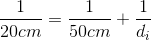

Step 2: Find the magnification and orientation of the image:
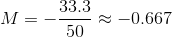
A negative magnification means the image is inverted, and therefore real. A magnification smaller than 1 means the image is smaller than the object.
The following result is true, in general, for converging lenses: if the object is outside  , then the image is inverted, real, and smaller than the object.
Relevant equations:
Step 1: Plug in the given focal length and object distance to find the image distance:
Step 2: Find the magnification and orientation of the image:
A negative magnification means the image is inverted, and therefore real. A magnification smaller than 1 means the image is smaller than the object.
The following result is true, in general, for converging lenses: if the object is outside
← Didn't Know|Knew It →
Jimmy is farsighted and uses a convex lens to correct his vision. Wendy is nearsighted and uses a concave lens to correct her vision. They both wear glasses. During a camping trip, they notice they do not have any matches, and decide to use their glasses to start the fire. Whose glasses could be used to start the fire?
Jimmy is farsighted and uses a convex lens to correct his vision. Wendy is nearsighted and uses a concave lens to correct her vision. They both wear glasses. During a camping trip, they notice they do not have any matches, and decide to use their glasses to start the fire. Whose glasses could be used to start the fire?
Tap to reveal answer
This question deals with an application of optics. In this case we have a farsighted person and a near sighted person. The farsighted person would use a convex lens, which is a converging lens. This would allow all of the rays of light to converge on a single point, allowing them to heat the object up and start a fire. Wendy’s glasses are diverging lenses, which would cause the rays to separate.
This question deals with an application of optics. In this case we have a farsighted person and a near sighted person. The farsighted person would use a convex lens, which is a converging lens. This would allow all of the rays of light to converge on a single point, allowing them to heat the object up and start a fire. Wendy’s glasses are diverging lenses, which would cause the rays to separate.
← Didn't Know|Knew It →
A concave mirror has a radius of curvature of 0.85m. Where is the mirror's focal point?
A concave mirror has a radius of curvature of 0.85m. Where is the mirror's focal point?
Tap to reveal answer
Since the mirror is concave, the focal point will be in front of the mirror. The focal length is equal to one half of the radius of curvature.

Rc is the radius of curvature. Plugging in 0.85m for Rc allows us to solve for the focal length.

0.43m is equal to 43cm.
Since the mirror is concave, the focal point will be in front of the mirror. The focal length is equal to one half of the radius of curvature.
Rc is the radius of curvature. Plugging in 0.85m for Rc allows us to solve for the focal length.
0.43m is equal to 43cm.
← Didn't Know|Knew It →
The focal point for a mirror is 56cm behind the mirror. Is the mirror concave or convex, and what is its radius of curvature?
The focal point for a mirror is 56cm behind the mirror. Is the mirror concave or convex, and what is its radius of curvature?
Tap to reveal answer
Since the focal point falls behind the mirror it must be convex. The radius of curvature can be found using the focal length equation.


Since the focal point falls behind the mirror it must be convex. The radius of curvature can be found using the focal length equation.
← Didn't Know|Knew It →
A lens has a focal length of  . What is the strength and type of lens?
A lens has a focal length of
Tap to reveal answer
Since the focal length is negative, the lens is diverging.
The diopter of a lens is found through the following formula:

Since the focal length of the lens is  :
:
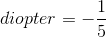
Since the focal length is negative, the lens is diverging.
The diopter of a lens is found through the following formula:
Since the focal length of the lens is
← Didn't Know|Knew It →
Jimmy is farsighted and uses a convex lens to correct his vision. Wendy is nearsighted and uses a concave lens to correct her vision. They both wear glasses. During a camping trip, they notice they do not have any matches, and decide to use their glasses to start the fire. Whose glasses could be used to start the fire?
Jimmy is farsighted and uses a convex lens to correct his vision. Wendy is nearsighted and uses a concave lens to correct her vision. They both wear glasses. During a camping trip, they notice they do not have any matches, and decide to use their glasses to start the fire. Whose glasses could be used to start the fire?
Tap to reveal answer
This question deals with an application of optics. In this case we have a farsighted person and a near sighted person. The farsighted person would use a convex lens, which is a converging lens. This would allow all of the rays of light to converge on a single point, allowing them to heat the object up and start a fire. Wendy’s glasses are diverging lenses, which would cause the rays to separate.
This question deals with an application of optics. In this case we have a farsighted person and a near sighted person. The farsighted person would use a convex lens, which is a converging lens. This would allow all of the rays of light to converge on a single point, allowing them to heat the object up and start a fire. Wendy’s glasses are diverging lenses, which would cause the rays to separate.
← Didn't Know|Knew It →