Gibbs Free Energy - MCAT Chemical and Physical Foundations of Biological Systems
Card 1 of 105
Diffusion can be defined as the net transfer of molecules down a gradient of differing concentrations. This is a passive and spontaneous process and relies on the random movement of molecules and Brownian motion. Diffusion is an important biological process, especially in the respiratory system where oxygen diffuses from alveoli, the basic unit of lung mechanics, to red blood cells in the capillaries.
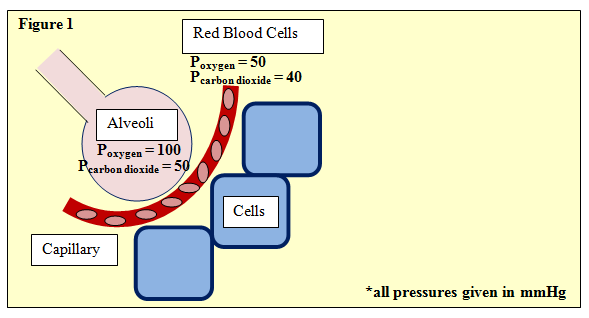
Figure 1 depicts this process, showing an alveoli separated from neighboring cells by a capillary with red blood cells. The partial pressures of oxygen and carbon dioxide are given. One such equation used in determining gas exchange is Fick's law, given by:
ΔV = (Area/Thickness) · Dgas · (P1 – P2)
Where ΔV is flow rate and area and thickness refer to the permeable membrane through which the gas passes, in this case, the wall of the avlveoli. P1 and P2 refer to the partial pressures upstream and downstream, respectively. Further, Dgas, the diffusion constant of the gas, is defined as:
Dgas = Solubility / (Molecular Weight)^(1/2)
In any diffusion process, what is ΔG, Gibbs energy?
Diffusion can be defined as the net transfer of molecules down a gradient of differing concentrations. This is a passive and spontaneous process and relies on the random movement of molecules and Brownian motion. Diffusion is an important biological process, especially in the respiratory system where oxygen diffuses from alveoli, the basic unit of lung mechanics, to red blood cells in the capillaries.
Figure 1 depicts this process, showing an alveoli separated from neighboring cells by a capillary with red blood cells. The partial pressures of oxygen and carbon dioxide are given. One such equation used in determining gas exchange is Fick's law, given by:
ΔV = (Area/Thickness) · Dgas · (P1 – P2)
Where ΔV is flow rate and area and thickness refer to the permeable membrane through which the gas passes, in this case, the wall of the avlveoli. P1 and P2 refer to the partial pressures upstream and downstream, respectively. Further, Dgas, the diffusion constant of the gas, is defined as:
Dgas = Solubility / (Molecular Weight)^(1/2)
In any diffusion process, what is ΔG, Gibbs energy?
Tap to reveal answer
The key here is that diffusion, as mentioned in the passage, is a passive or spontaneous process. That is, it occurs without any energy expenditure, and therefore for any diffusion process, ΔG must be less than 0. In contrast, other transport mechanisms, such as active transport, require ATP as an energy source, and therefore ΔG ≥ 0.
The key here is that diffusion, as mentioned in the passage, is a passive or spontaneous process. That is, it occurs without any energy expenditure, and therefore for any diffusion process, ΔG must be less than 0. In contrast, other transport mechanisms, such as active transport, require ATP as an energy source, and therefore ΔG ≥ 0.
← Didn't Know|Knew It →
A scientist prepares an experiment to demonstrate the second law of thermodynamics for a chemistry class. In order to conduct the experiment, the scientist brings the class outside in January and gathers a cup of water and a portable stove.
The temperature outside is –10 degrees Celsius. The scientist asks the students to consider the following when answering his questions:
Gibbs Free Energy Formula:
ΔG = ΔH – TΔS
Liquid-Solid Water Phase Change Reaction:
H2O(l) ⇌ H2O(s) + X
The scientist prepares two scenarios.
Scenario 1:
The scientist buries the cup of water outside in the snow, returns to the classroom with his class for one hour, and the class then checks on the cup. They find that the water has frozen in the cup.
Scenario 2:
The scientist then places the frozen cup of water on the stove and starts the gas. The class finds that the water melts quickly.
After the water melts, the scientist asks the students to consider two hypothetical scenarios as a thought experiment.
Scenario 3:
Once the liquid water at the end of scenario 2 melts completely, the scientist turns off the gas and monitors what happens to the water. Despite being in the cold air, the water never freezes.
Scenario 4:
The scientist takes the frozen water from the end of scenario 1, puts it on the active stove, and the water remains frozen.
In scenario 1, the reaction of water freezing has which of the following quantities for the Gibbs Free Energy Formula?
A scientist prepares an experiment to demonstrate the second law of thermodynamics for a chemistry class. In order to conduct the experiment, the scientist brings the class outside in January and gathers a cup of water and a portable stove.
The temperature outside is –10 degrees Celsius. The scientist asks the students to consider the following when answering his questions:
Gibbs Free Energy Formula:
ΔG = ΔH – TΔS
Liquid-Solid Water Phase Change Reaction:
H2O(l) ⇌ H2O(s) + X
The scientist prepares two scenarios.
Scenario 1:
The scientist buries the cup of water outside in the snow, returns to the classroom with his class for one hour, and the class then checks on the cup. They find that the water has frozen in the cup.
Scenario 2:
The scientist then places the frozen cup of water on the stove and starts the gas. The class finds that the water melts quickly.
After the water melts, the scientist asks the students to consider two hypothetical scenarios as a thought experiment.
Scenario 3:
Once the liquid water at the end of scenario 2 melts completely, the scientist turns off the gas and monitors what happens to the water. Despite being in the cold air, the water never freezes.
Scenario 4:
The scientist takes the frozen water from the end of scenario 1, puts it on the active stove, and the water remains frozen.
In scenario 1, the reaction of water freezing has which of the following quantities for the Gibbs Free Energy Formula?
Tap to reveal answer
As water freezes, heat is released. The H value in the equation must therefore be negative. Also as water freezes, there is a local decline in the amount of disorder. The S, or entropy, term in the Gibbs equation refers to entropy of the system. Thus, this term must be negative as well.
As water freezes, heat is released. The H value in the equation must therefore be negative. Also as water freezes, there is a local decline in the amount of disorder. The S, or entropy, term in the Gibbs equation refers to entropy of the system. Thus, this term must be negative as well.
← Didn't Know|Knew It →
A scientist prepares an experiment to demonstrate the second law of thermodynamics for a chemistry class. In order to conduct the experiment, the scientist brings the class outside in January and gathers a cup of water and a portable stove.
The temperature outside is –10 degrees Celsius. The scientist asks the students to consider the following when answering his questions:
Gibbs Free Energy Formula:
ΔG = ΔH – TΔS
Liquid-Solid Water Phase Change Reaction:
H2O(l) ⇌ H2O(s) + X
The scientist prepares two scenarios.
Scenario 1:
The scientist buries the cup of water outside in the snow, returns to the classroom with his class for one hour, and the class then checks on the cup. They find that the water has frozen in the cup.
Scenario 2:
The scientist then places the frozen cup of water on the stove and starts the gas. The class finds that the water melts quickly.
After the water melts, the scientist asks the students to consider two hypothetical scenarios as a thought experiment.
Scenario 3:
Once the liquid water at the end of scenario 2 melts completely, the scientist turns off the gas and monitors what happens to the water. Despite being in the cold air, the water never freezes.
Scenario 4:
The scientist takes the frozen water from the end of scenario 1, puts it on the active stove, and the water remains frozen.
Which of the following statements is true of scenario 3?
A scientist prepares an experiment to demonstrate the second law of thermodynamics for a chemistry class. In order to conduct the experiment, the scientist brings the class outside in January and gathers a cup of water and a portable stove.
The temperature outside is –10 degrees Celsius. The scientist asks the students to consider the following when answering his questions:
Gibbs Free Energy Formula:
ΔG = ΔH – TΔS
Liquid-Solid Water Phase Change Reaction:
H2O(l) ⇌ H2O(s) + X
The scientist prepares two scenarios.
Scenario 1:
The scientist buries the cup of water outside in the snow, returns to the classroom with his class for one hour, and the class then checks on the cup. They find that the water has frozen in the cup.
Scenario 2:
The scientist then places the frozen cup of water on the stove and starts the gas. The class finds that the water melts quickly.
After the water melts, the scientist asks the students to consider two hypothetical scenarios as a thought experiment.
Scenario 3:
Once the liquid water at the end of scenario 2 melts completely, the scientist turns off the gas and monitors what happens to the water. Despite being in the cold air, the water never freezes.
Scenario 4:
The scientist takes the frozen water from the end of scenario 1, puts it on the active stove, and the water remains frozen.
Which of the following statements is true of scenario 3?
Tap to reveal answer
The reaction described in scenario 3 is the persistence of fully liquid water in the face of low temperatures. In other words, the Liquid-Solid Water Phase Change Reaction is far to the left. As X must be heat, and there is a shortage of heat in the cold air, the reaction would have to be driven to the right via Le Chatlier's Principle. It could never be spontaneous to the left.
The reaction described in scenario 3 is the persistence of fully liquid water in the face of low temperatures. In other words, the Liquid-Solid Water Phase Change Reaction is far to the left. As X must be heat, and there is a shortage of heat in the cold air, the reaction would have to be driven to the right via Le Chatlier's Principle. It could never be spontaneous to the left.
← Didn't Know|Knew It →
A scientist prepares an experiment to demonstrate the second law of thermodynamics for a chemistry class. In order to conduct the experiment, the scientist brings the class outside in January and gathers a cup of water and a portable stove.
The temperature outside is –10 degrees Celsius. The scientist asks the students to consider the following when answering his questions:
Gibbs Free Energy Formula:
ΔG = ΔH – TΔS
Liquid-Solid Water Phase Change Reaction:
H2O(l) ⇌ H2O(s) + X
The scientist prepares two scenarios.
Scenario 1:
The scientist buries the cup of water outside in the snow, returns to the classroom with his class for one hour, and the class then checks on the cup. They find that the water has frozen in the cup.
Scenario 2:
The scientist then places the frozen cup of water on the stove and starts the gas. The class finds that the water melts quickly.
After the water melts, the scientist asks the students to consider two hypothetical scenarios as a thought experiment.
Scenario 3:
Once the liquid water at the end of scenario 2 melts completely, the scientist turns off the gas and monitors what happens to the water. Despite being in the cold air, the water never freezes.
Scenario 4:
The scientist takes the frozen water from the end of scenario 1, puts it on the active stove, and the water remains frozen.
If a spontaneous reaction is harnessed to do work, how much useful work can the reaction do?
A scientist prepares an experiment to demonstrate the second law of thermodynamics for a chemistry class. In order to conduct the experiment, the scientist brings the class outside in January and gathers a cup of water and a portable stove.
The temperature outside is –10 degrees Celsius. The scientist asks the students to consider the following when answering his questions:
Gibbs Free Energy Formula:
ΔG = ΔH – TΔS
Liquid-Solid Water Phase Change Reaction:
H2O(l) ⇌ H2O(s) + X
The scientist prepares two scenarios.
Scenario 1:
The scientist buries the cup of water outside in the snow, returns to the classroom with his class for one hour, and the class then checks on the cup. They find that the water has frozen in the cup.
Scenario 2:
The scientist then places the frozen cup of water on the stove and starts the gas. The class finds that the water melts quickly.
After the water melts, the scientist asks the students to consider two hypothetical scenarios as a thought experiment.
Scenario 3:
Once the liquid water at the end of scenario 2 melts completely, the scientist turns off the gas and monitors what happens to the water. Despite being in the cold air, the water never freezes.
Scenario 4:
The scientist takes the frozen water from the end of scenario 1, puts it on the active stove, and the water remains frozen.
If a spontaneous reaction is harnessed to do work, how much useful work can the reaction do?
Tap to reveal answer
The definition of Gibbs Free Energy is the amount of useful work that a reaction is able to do under defined conditions. It considers the amount of energy that is lost forever to the universe to comply with the Second Law of Thermodynamics.
The definition of Gibbs Free Energy is the amount of useful work that a reaction is able to do under defined conditions. It considers the amount of energy that is lost forever to the universe to comply with the Second Law of Thermodynamics.
← Didn't Know|Knew It →
ATP stores energy through its ability to lose a phosphate group to form ADP in the following reaction

At body temperature, the thermodynamic values for ATP hydrolysis are as follow.
ΔG = –30kJ/mol
ΔH = –20kJ/mol
ΔS = 34kJ/mol
Glycolysis is an energy-liberating process (ΔG = –218kJ/mol, ΔH = –20 kJ/mol) that is coupled with the conversion of two ADP molecules into two ATP molecules according to the following reaction.

What is the value of ΔG for the reaction below?
**
ATP stores energy through its ability to lose a phosphate group to form ADP in the following reaction
At body temperature, the thermodynamic values for ATP hydrolysis are as follow.
ΔG = –30kJ/mol
ΔH = –20kJ/mol
ΔS = 34kJ/mol
Glycolysis is an energy-liberating process (ΔG = –218kJ/mol, ΔH = –20 kJ/mol) that is coupled with the conversion of two ADP molecules into two ATP molecules according to the following reaction.
What is the value of ΔG for the reaction below?
**
Tap to reveal answer
First, recognize that if ΔG for the formation of ADP is –30 kJ/mol, the ΔG for the formation of ATP must be +30 kJ/mol. Next, we can combine the ΔG of glycolysis with the ΔG of the formation of two ATP molecules (notice the coefficient of 2 in order to balance ATP in the equation).
ΔGglucose = –218kJ/mol
ΔGATP = 30kJ/mol
ΔGtotal = –218 kJ/mol + 2(30kJ/mol) = –158kJ/mol
First, recognize that if ΔG for the formation of ADP is –30 kJ/mol, the ΔG for the formation of ATP must be +30 kJ/mol. Next, we can combine the ΔG of glycolysis with the ΔG of the formation of two ATP molecules (notice the coefficient of 2 in order to balance ATP in the equation).
ΔGglucose = –218kJ/mol
ΔGATP = 30kJ/mol
ΔGtotal = –218 kJ/mol + 2(30kJ/mol) = –158kJ/mol
← Didn't Know|Knew It →
For any given chemical reaction, one can draw an energy diagram. Energy diagrams depict the energy levels of the different steps in a reaction, while also indicating the net change in energy and giving clues to relative reaction rate.
Below, a reaction diagram is shown for a reaction that a scientist is studying in a lab. A student began the reaction the evening before, but the scientist is unsure as to the type of the reaction. He cannot find the student’s notes, except for the reaction diagram below.
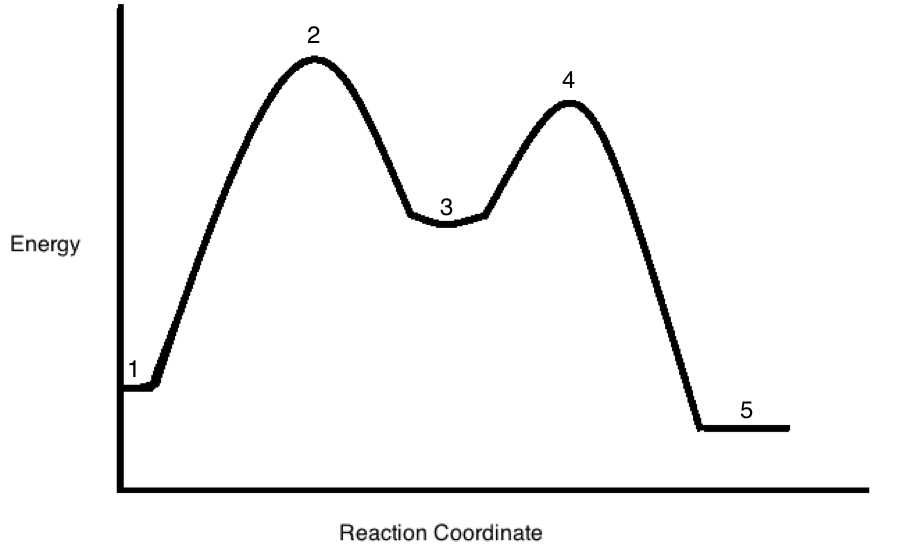
Instead of "Energy" on the Y-axis, the graduate student in the passage instead labels the axis "Heat." In this case, what can we say for sure about the reaction in question?
(Note: consider the reaction in the vessel to be the system, and the remainder of the universe as the surroundings)
For any given chemical reaction, one can draw an energy diagram. Energy diagrams depict the energy levels of the different steps in a reaction, while also indicating the net change in energy and giving clues to relative reaction rate.
Below, a reaction diagram is shown for a reaction that a scientist is studying in a lab. A student began the reaction the evening before, but the scientist is unsure as to the type of the reaction. He cannot find the student’s notes, except for the reaction diagram below.
Instead of "Energy" on the Y-axis, the graduate student in the passage instead labels the axis "Heat." In this case, what can we say for sure about the reaction in question?
(Note: consider the reaction in the vessel to be the system, and the remainder of the universe as the surroundings)
Tap to reveal answer
With the change to the chart described in the passage, we know that the system is losing heat from reactants to products (5 is lower than 1). This heat is going out of the system to the surroundings, increasing entropy of the universe. Because of this, the system may either gain or lose entropy.
Any entropy losses in the system, however, must be more than balanced by the entropy gained via heat in the surroundings. The universe (system + surroundings) always has a net gain of entropy. Essentailly, since the value for the surroundings will be positive, the value for the system may be either positive or negative, as long at their sum remains positive.
With the change to the chart described in the passage, we know that the system is losing heat from reactants to products (5 is lower than 1). This heat is going out of the system to the surroundings, increasing entropy of the universe. Because of this, the system may either gain or lose entropy.
Any entropy losses in the system, however, must be more than balanced by the entropy gained via heat in the surroundings. The universe (system + surroundings) always has a net gain of entropy. Essentailly, since the value for the surroundings will be positive, the value for the system may be either positive or negative, as long at their sum remains positive.
← Didn't Know|Knew It →
Imagine there is an endothermic reaction where entropy is increased in the system. This reaction is not spontaneous at room temperature. What can be done in order to make the reaction spontaneous?
Imagine there is an endothermic reaction where entropy is increased in the system. This reaction is not spontaneous at room temperature. What can be done in order to make the reaction spontaneous?
Tap to reveal answer
The Gibbs free energy equation is written as  .
.
Since a negative  results in a spontaneous reaction, we can manipulate the variables in order to make the reaction progress. Since entropy is positive in this equation, an increasing temperature will eventually equal the positive enthalpy of the reaction. Once the temperature overtakes the enthalpy, the reaction will be spontaneous.
In order to be spontaneous, in this case,  .
.
The Gibbs free energy equation is written as
Since a negative
In order to be spontaneous, in this case,
← Didn't Know|Knew It →
Imagine the following reaction:  .
.
The reaction has an equilibrium constant of 45.8. The initial concentrations of A, B, and C result in a reaction quotient of 35.6.
Which of the following is true at the beginning of the reaction?
Imagine the following reaction:
The reaction has an equilibrium constant of 45.8. The initial concentrations of A, B, and C result in a reaction quotient of 35.6.
Which of the following is true at the beginning of the reaction?
Tap to reveal answer
When a reaction is spontaneous,  is less than 0. Since the reaction quotient (Q) is less than the equilibrium constant (Keq), the reaction will proceed in the forward direction.
When a reaction is spontaneous,
← Didn't Know|Knew It →
Imagine a galvanic cell which uses solid zinc and aqueous iron ions to produce a voltage.


Based on the above reaction, which of the following statements is false?
Imagine a galvanic cell which uses solid zinc and aqueous iron ions to produce a voltage.
Based on the above reaction, which of the following statements is false?
Tap to reveal answer
A positive cell potential means that the reaction is spontaneous, and is true of all galvanic cells. This is seen in the equation  , where "
 " is the number of electrons in moles that are transferred in the balanced equation, "
 " is Faraday's constant, and "
 " is the cell potential. A positive cell potential results in a negative
  meaning the reaction is spontaneous.
A negative  value means that the equilibrium constant for the reaction is greater than 1, while a positive value mean the equilibrium constant is less than 1.
A positive cell potential means that the reaction is spontaneous, and is true of all galvanic cells. This is seen in the equation
A negative
← Didn't Know|Knew It →
The combustion of liquid hexane in air at 298K gives gaseous carbon dioxide and liquid water, as shown in this reaction.
 .
.
The  for this reaction at 298K is
  .
.
At 298K, the  for the above reaction would be . At very low temperature, the
  would be , meaning the reaction would be at very low temperature. Assume
  is the same at 298K and at very low temperature.
The combustion of liquid hexane in air at 298K gives gaseous carbon dioxide and liquid water, as shown in this reaction.
The
At 298K, the
Tap to reveal answer
 for this reaction is negative, because the reactants have nineteen moles of gas while the products have only twelve. Entropy will always decrease in the system if there is a decrease in the number of moles of gas; we know that entropy must be negative for this reaction.
To determine the  at low temperature, use the following formula for Gibbs free energy.

The reaction is exothermic because we are giver that the enthalpy is negative.

The entropy,  , is also negative, as discussed above.
This makes our equation  .
.
Remember that temperature is given in Kelvin, and will never be negative. At very low temperatures, the  term will be dominant, and will be less than zero, making
  negative. A negative value for
  indicates that the reaction will be spontaneous.
To determine the
The reaction is exothermic because we are giver that the enthalpy is negative.
The entropy,
This makes our equation
Remember that temperature is given in Kelvin, and will never be negative. At very low temperatures, the
← Didn't Know|Knew It →
A scientist is studying a reaction, and places the reactants in a beaker at room temperature. The reaction progresses, and she analyzes the products via NMR. Based on the NMR readout, she determines the reaction proceeds as follows:

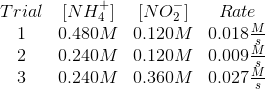
In an attempt to better understand the reaction process, she varies the concentrations of the reactants and studies how the rate of the reaction changes. The table below shows the reaction concentrations as she makes modifications in three experimental trials.
After beginning the reaction described in the passage, a scientist waits as it comes to equilibrium at standard conditions. He calculates the equilibrium constant to be much greater than 1. Which of the following must be true?
A scientist is studying a reaction, and places the reactants in a beaker at room temperature. The reaction progresses, and she analyzes the products via NMR. Based on the NMR readout, she determines the reaction proceeds as follows:
In an attempt to better understand the reaction process, she varies the concentrations of the reactants and studies how the rate of the reaction changes. The table below shows the reaction concentrations as she makes modifications in three experimental trials.
After beginning the reaction described in the passage, a scientist waits as it comes to equilibrium at standard conditions. He calculates the equilibrium constant to be much greater than 1. Which of the following must be true?
Tap to reveal answer
If the equilibrium constant of a reaction is much greater than 1, its equilibrium is characterized by having a relative abundance of products to reactants.
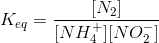

This ratio implies that the reaction is spontaneous, and can be formally stated in terms of Gibbs free energy.

If the equilibrium constant of a reaction is much greater than 1, its equilibrium is characterized by having a relative abundance of products to reactants.
This ratio implies that the reaction is spontaneous, and can be formally stated in terms of Gibbs free energy.
← Didn't Know|Knew It →
If the overall reaction has a positive change in entropy, which of the following statements about the reaction spontaneity is true?
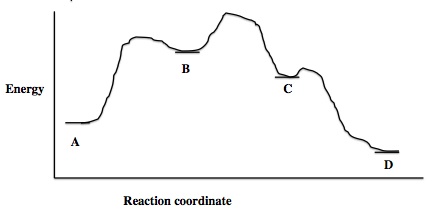
If the overall reaction has a positive change in entropy, which of the following statements about the reaction spontaneity is true?
Tap to reveal answer
A reaction is spontaneous if the change of Gibbs free energy  is less than zero.

The total reaction is the change  .
.
For this question, the change of enthalpy  is negative, since D is lower in energy than A. There is a net release of energy, making the reaction exothermic. The question states that the change of entropy
  is positive, and temperature is always positive when measured in Kelvin. We can return to the Gibbs free energy equation to see the result of these characteristics.


Both terms on the right side are always negative, and  would always be negative. The reaction would be spontaneous at any temperature.
A reaction is spontaneous if the change of Gibbs free energy
The total reaction is the change
For this question, the change of enthalpy
Both terms on the right side are always negative, and
← Didn't Know|Knew It →
Which set of conditions will result in a reaction always being non-spontaneous?
Which set of conditions will result in a reaction always being non-spontaneous?
Tap to reveal answer
A chemical reaction will be spontaneous when its change in Gibbs free energy, or  , is negative. This value can be represented numerically by the equation:

First, let's look at the value for  . The equation is more likely to yield a negative
  value if this variable is below zero, so we want a negative value for
  .
.  , however, is being subtracted, so a positive
  value will give us a more negative
  . In combination, these conditions give us a negative value minus a positive one, which will always yield a negative answer.
If a reaction with a negative  and a positive
  is always spontaneous, we can reason that a reaction with a positive
  and negative
  can never be spontaneous. This combination will yield a positive value minus a negative value, always resulting in a positive solution.
A chemical reaction will be spontaneous when its change in Gibbs free energy, or
First, let's look at the value for
If a reaction with a negative
← Didn't Know|Knew It →
Which of the following conditions will result in a spontaneous reaction?
Which of the following conditions will result in a spontaneous reaction?
Tap to reveal answer
This question tests two distinct, but related, principles: equilibrium constant and Gibbs free energy.
Equilibrium constant is given by the following equation, only when the concentrations represent equilibrium quantities of the compounds involved:
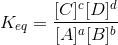
In contrast, the reaction quotient is determined by this same equation when the compounds are not in equilibrium. What this means is that a reaction with a reaction quotient greater than the equilibrium constant at a given moment has an excess of products, compared to equilibrium. In contrast, a reaction with a reaction quotient less than the equilibrium constant has a relative abundance of reactions. In this later scenario, the reaction will proceed toward the products in order to achieve equilibrium.
An equilibrium constant greater than one indicates that there are more products than reactants at equilibrium, thus favoring the forward reaction and indicating spontaneity.
In summary, the equilibrium constant must be greater than the reaction quotient or greater than one in order for the reaction to be considered spontaneous.
Evaluating Gibbs free energy is much simpler: a negative value for Gibbs free energy indicates a spontaneous reaction. The equation  is always true, and the inequality listed in one of the answer choices cannot exist.
This question tests two distinct, but related, principles: equilibrium constant and Gibbs free energy.
Equilibrium constant is given by the following equation, only when the concentrations represent equilibrium quantities of the compounds involved:
In contrast, the reaction quotient is determined by this same equation when the compounds are not in equilibrium. What this means is that a reaction with a reaction quotient greater than the equilibrium constant at a given moment has an excess of products, compared to equilibrium. In contrast, a reaction with a reaction quotient less than the equilibrium constant has a relative abundance of reactions. In this later scenario, the reaction will proceed toward the products in order to achieve equilibrium.
An equilibrium constant greater than one indicates that there are more products than reactants at equilibrium, thus favoring the forward reaction and indicating spontaneity.
In summary, the equilibrium constant must be greater than the reaction quotient or greater than one in order for the reaction to be considered spontaneous.
Evaluating Gibbs free energy is much simpler: a negative value for Gibbs free energy indicates a spontaneous reaction. The equation
← Didn't Know|Knew It →
A galvanic cell is set up, and is determined to have a standard cell potential of  . Which prediction must be true, based on this voltage?
A galvanic cell is set up, and is determined to have a standard cell potential of
Tap to reveal answer
There is an inherent relationship between cell potential, Gibb's free energy, and the equilibrium constant. Under standard conditions, a positive cell potential will signify a spontaneous reaction. This indicates that the Gibb's free energy ( ) for the reaction must be negative. It also means that the equilibrium constant must be greater than one, indicating that the reaction favors the products over the reactants.
Electrons will always travel from the site of oxidation (anode) toward the site of reduction (cathode), regardless of reaction spontaneity.
There is an inherent relationship between cell potential, Gibb's free energy, and the equilibrium constant. Under standard conditions, a positive cell potential will signify a spontaneous reaction. This indicates that the Gibb's free energy (
Electrons will always travel from the site of oxidation (anode) toward the site of reduction (cathode), regardless of reaction spontaneity.
← Didn't Know|Knew It →
A galvanic cell is set up, and is determined to have a standard cell potential of . Which prediction must be true, based on this voltage?
A galvanic cell is set up, and is determined to have a standard cell potential of
Tap to reveal answer
There is an inherent relationship between cell potential, Gibb's free energy, and the equilibrium constant. Under standard conditions, a positive cell potential will signify a spontaneous reaction. This indicates that the Gibb's free energy () for the reaction must be negative. It also means that the equilibrium constant must be greater than one, indicating that the reaction favors the products over the reactants.
Electrons will always travel from the site of oxidation (anode) toward the site of reduction (cathode), regardless of reaction spontaneity.
There is an inherent relationship between cell potential, Gibb's free energy, and the equilibrium constant. Under standard conditions, a positive cell potential will signify a spontaneous reaction. This indicates that the Gibb's free energy (
Electrons will always travel from the site of oxidation (anode) toward the site of reduction (cathode), regardless of reaction spontaneity.
← Didn't Know|Knew It →
Diffusion can be defined as the net transfer of molecules down a gradient of differing concentrations. This is a passive and spontaneous process and relies on the random movement of molecules and Brownian motion. Diffusion is an important biological process, especially in the respiratory system where oxygen diffuses from alveoli, the basic unit of lung mechanics, to red blood cells in the capillaries.
Figure 1 depicts this process, showing an alveoli separated from neighboring cells by a capillary with red blood cells. The partial pressures of oxygen and carbon dioxide are given. One such equation used in determining gas exchange is Fick's law, given by:
ΔV = (Area/Thickness) · Dgas · (P1 – P2)
Where ΔV is flow rate and area and thickness refer to the permeable membrane through which the gas passes, in this case, the wall of the avlveoli. P1 and P2 refer to the partial pressures upstream and downstream, respectively. Further, Dgas, the diffusion constant of the gas, is defined as:
Dgas = Solubility / (Molecular Weight)^(1/2)
In any diffusion process, what is ΔG, Gibbs energy?
Diffusion can be defined as the net transfer of molecules down a gradient of differing concentrations. This is a passive and spontaneous process and relies on the random movement of molecules and Brownian motion. Diffusion is an important biological process, especially in the respiratory system where oxygen diffuses from alveoli, the basic unit of lung mechanics, to red blood cells in the capillaries.
Figure 1 depicts this process, showing an alveoli separated from neighboring cells by a capillary with red blood cells. The partial pressures of oxygen and carbon dioxide are given. One such equation used in determining gas exchange is Fick's law, given by:
ΔV = (Area/Thickness) · Dgas · (P1 – P2)
Where ΔV is flow rate and area and thickness refer to the permeable membrane through which the gas passes, in this case, the wall of the avlveoli. P1 and P2 refer to the partial pressures upstream and downstream, respectively. Further, Dgas, the diffusion constant of the gas, is defined as:
Dgas = Solubility / (Molecular Weight)^(1/2)
In any diffusion process, what is ΔG, Gibbs energy?
Tap to reveal answer
The key here is that diffusion, as mentioned in the passage, is a passive or spontaneous process. That is, it occurs without any energy expenditure, and therefore for any diffusion process, ΔG must be less than 0. In contrast, other transport mechanisms, such as active transport, require ATP as an energy source, and therefore ΔG ≥ 0.
The key here is that diffusion, as mentioned in the passage, is a passive or spontaneous process. That is, it occurs without any energy expenditure, and therefore for any diffusion process, ΔG must be less than 0. In contrast, other transport mechanisms, such as active transport, require ATP as an energy source, and therefore ΔG ≥ 0.
← Didn't Know|Knew It →
A scientist prepares an experiment to demonstrate the second law of thermodynamics for a chemistry class. In order to conduct the experiment, the scientist brings the class outside in January and gathers a cup of water and a portable stove.
The temperature outside is –10 degrees Celsius. The scientist asks the students to consider the following when answering his questions:
Gibbs Free Energy Formula:
ΔG = ΔH – TΔS
Liquid-Solid Water Phase Change Reaction:
H2O(l) ⇌ H2O(s) + X
The scientist prepares two scenarios.
Scenario 1:
The scientist buries the cup of water outside in the snow, returns to the classroom with his class for one hour, and the class then checks on the cup. They find that the water has frozen in the cup.
Scenario 2:
The scientist then places the frozen cup of water on the stove and starts the gas. The class finds that the water melts quickly.
After the water melts, the scientist asks the students to consider two hypothetical scenarios as a thought experiment.
Scenario 3:
Once the liquid water at the end of scenario 2 melts completely, the scientist turns off the gas and monitors what happens to the water. Despite being in the cold air, the water never freezes.
Scenario 4:
The scientist takes the frozen water from the end of scenario 1, puts it on the active stove, and the water remains frozen.
In scenario 1, the reaction of water freezing has which of the following quantities for the Gibbs Free Energy Formula?
A scientist prepares an experiment to demonstrate the second law of thermodynamics for a chemistry class. In order to conduct the experiment, the scientist brings the class outside in January and gathers a cup of water and a portable stove.
The temperature outside is –10 degrees Celsius. The scientist asks the students to consider the following when answering his questions:
Gibbs Free Energy Formula:
ΔG = ΔH – TΔS
Liquid-Solid Water Phase Change Reaction:
H2O(l) ⇌ H2O(s) + X
The scientist prepares two scenarios.
Scenario 1:
The scientist buries the cup of water outside in the snow, returns to the classroom with his class for one hour, and the class then checks on the cup. They find that the water has frozen in the cup.
Scenario 2:
The scientist then places the frozen cup of water on the stove and starts the gas. The class finds that the water melts quickly.
After the water melts, the scientist asks the students to consider two hypothetical scenarios as a thought experiment.
Scenario 3:
Once the liquid water at the end of scenario 2 melts completely, the scientist turns off the gas and monitors what happens to the water. Despite being in the cold air, the water never freezes.
Scenario 4:
The scientist takes the frozen water from the end of scenario 1, puts it on the active stove, and the water remains frozen.
In scenario 1, the reaction of water freezing has which of the following quantities for the Gibbs Free Energy Formula?
Tap to reveal answer
As water freezes, heat is released. The H value in the equation must therefore be negative. Also as water freezes, there is a local decline in the amount of disorder. The S, or entropy, term in the Gibbs equation refers to entropy of the system. Thus, this term must be negative as well.
As water freezes, heat is released. The H value in the equation must therefore be negative. Also as water freezes, there is a local decline in the amount of disorder. The S, or entropy, term in the Gibbs equation refers to entropy of the system. Thus, this term must be negative as well.
← Didn't Know|Knew It →
A scientist prepares an experiment to demonstrate the second law of thermodynamics for a chemistry class. In order to conduct the experiment, the scientist brings the class outside in January and gathers a cup of water and a portable stove.
The temperature outside is –10 degrees Celsius. The scientist asks the students to consider the following when answering his questions:
Gibbs Free Energy Formula:
ΔG = ΔH – TΔS
Liquid-Solid Water Phase Change Reaction:
H2O(l) ⇌ H2O(s) + X
The scientist prepares two scenarios.
Scenario 1:
The scientist buries the cup of water outside in the snow, returns to the classroom with his class for one hour, and the class then checks on the cup. They find that the water has frozen in the cup.
Scenario 2:
The scientist then places the frozen cup of water on the stove and starts the gas. The class finds that the water melts quickly.
After the water melts, the scientist asks the students to consider two hypothetical scenarios as a thought experiment.
Scenario 3:
Once the liquid water at the end of scenario 2 melts completely, the scientist turns off the gas and monitors what happens to the water. Despite being in the cold air, the water never freezes.
Scenario 4:
The scientist takes the frozen water from the end of scenario 1, puts it on the active stove, and the water remains frozen.
Which of the following statements is true of scenario 3?
A scientist prepares an experiment to demonstrate the second law of thermodynamics for a chemistry class. In order to conduct the experiment, the scientist brings the class outside in January and gathers a cup of water and a portable stove.
The temperature outside is –10 degrees Celsius. The scientist asks the students to consider the following when answering his questions:
Gibbs Free Energy Formula:
ΔG = ΔH – TΔS
Liquid-Solid Water Phase Change Reaction:
H2O(l) ⇌ H2O(s) + X
The scientist prepares two scenarios.
Scenario 1:
The scientist buries the cup of water outside in the snow, returns to the classroom with his class for one hour, and the class then checks on the cup. They find that the water has frozen in the cup.
Scenario 2:
The scientist then places the frozen cup of water on the stove and starts the gas. The class finds that the water melts quickly.
After the water melts, the scientist asks the students to consider two hypothetical scenarios as a thought experiment.
Scenario 3:
Once the liquid water at the end of scenario 2 melts completely, the scientist turns off the gas and monitors what happens to the water. Despite being in the cold air, the water never freezes.
Scenario 4:
The scientist takes the frozen water from the end of scenario 1, puts it on the active stove, and the water remains frozen.
Which of the following statements is true of scenario 3?
Tap to reveal answer
The reaction described in scenario 3 is the persistence of fully liquid water in the face of low temperatures. In other words, the Liquid-Solid Water Phase Change Reaction is far to the left. As X must be heat, and there is a shortage of heat in the cold air, the reaction would have to be driven to the right via Le Chatlier's Principle. It could never be spontaneous to the left.
The reaction described in scenario 3 is the persistence of fully liquid water in the face of low temperatures. In other words, the Liquid-Solid Water Phase Change Reaction is far to the left. As X must be heat, and there is a shortage of heat in the cold air, the reaction would have to be driven to the right via Le Chatlier's Principle. It could never be spontaneous to the left.
← Didn't Know|Knew It →
A scientist prepares an experiment to demonstrate the second law of thermodynamics for a chemistry class. In order to conduct the experiment, the scientist brings the class outside in January and gathers a cup of water and a portable stove.
The temperature outside is –10 degrees Celsius. The scientist asks the students to consider the following when answering his questions:
Gibbs Free Energy Formula:
ΔG = ΔH – TΔS
Liquid-Solid Water Phase Change Reaction:
H2O(l) ⇌ H2O(s) + X
The scientist prepares two scenarios.
Scenario 1:
The scientist buries the cup of water outside in the snow, returns to the classroom with his class for one hour, and the class then checks on the cup. They find that the water has frozen in the cup.
Scenario 2:
The scientist then places the frozen cup of water on the stove and starts the gas. The class finds that the water melts quickly.
After the water melts, the scientist asks the students to consider two hypothetical scenarios as a thought experiment.
Scenario 3:
Once the liquid water at the end of scenario 2 melts completely, the scientist turns off the gas and monitors what happens to the water. Despite being in the cold air, the water never freezes.
Scenario 4:
The scientist takes the frozen water from the end of scenario 1, puts it on the active stove, and the water remains frozen.
If a spontaneous reaction is harnessed to do work, how much useful work can the reaction do?
A scientist prepares an experiment to demonstrate the second law of thermodynamics for a chemistry class. In order to conduct the experiment, the scientist brings the class outside in January and gathers a cup of water and a portable stove.
The temperature outside is –10 degrees Celsius. The scientist asks the students to consider the following when answering his questions:
Gibbs Free Energy Formula:
ΔG = ΔH – TΔS
Liquid-Solid Water Phase Change Reaction:
H2O(l) ⇌ H2O(s) + X
The scientist prepares two scenarios.
Scenario 1:
The scientist buries the cup of water outside in the snow, returns to the classroom with his class for one hour, and the class then checks on the cup. They find that the water has frozen in the cup.
Scenario 2:
The scientist then places the frozen cup of water on the stove and starts the gas. The class finds that the water melts quickly.
After the water melts, the scientist asks the students to consider two hypothetical scenarios as a thought experiment.
Scenario 3:
Once the liquid water at the end of scenario 2 melts completely, the scientist turns off the gas and monitors what happens to the water. Despite being in the cold air, the water never freezes.
Scenario 4:
The scientist takes the frozen water from the end of scenario 1, puts it on the active stove, and the water remains frozen.
If a spontaneous reaction is harnessed to do work, how much useful work can the reaction do?
Tap to reveal answer
The definition of Gibbs Free Energy is the amount of useful work that a reaction is able to do under defined conditions. It considers the amount of energy that is lost forever to the universe to comply with the Second Law of Thermodynamics.
The definition of Gibbs Free Energy is the amount of useful work that a reaction is able to do under defined conditions. It considers the amount of energy that is lost forever to the universe to comply with the Second Law of Thermodynamics.
← Didn't Know|Knew It →