Fluids and Gases - MCAT Chemical and Physical Foundations of Biological Systems
Card 1 of 658
Use the following information to answer questions 1-6:
The circulatory system of humans is a closed system consisting of a pump that moves blood throughout the body through arteries, capillaries, and veins. The capillaries are small and thin, allowing blood to easily perfuse the organ systems. Being a closed system, we can model the human circulatory system like an electrical circuit, making modifications for the use of a fluid rather than electrons. The heart acts as the primary force for movement of the fluid, the fluid moves through arteries and veins, and resistance to blood flow occurs depending on perfusion rates.
To model the behavior of fluids in the circulatory system, we can modify Ohm’s law of V = IR to ∆P = FR where ∆P is the change in pressure (mmHg), F is the rate of flow (ml/min), and R is resistance to flow (mm Hg/ml/min). Resistance to fluid flow in a tube is described by Poiseuille’s law: R = 8hl/πr4 where l is the length of the tube, h is the viscosity of the fluid, and r is the radius of the tube. Viscosity of blood is higher than water due to the presence of blood cells such as erythrocytes, leukocytes, and thrombocytes.
The above equations hold true for smooth, laminar flow. Deviations occur, however, when turbulent flow is present. Turbulent flow can be described as nonlinear or tumultuous, with whirling, glugging or otherwise unpredictable flow rates. Turbulence can occur when the anatomy of the tube deviates, for example during sharp bends or compressions. We can also get turbulent flow when the velocity exceeds critical velocity vc, defined below.
vc = NRh/ρD
NR is Reynold’s constant, h is the viscosity of the fluid, ρ is the density of the fluid, and D is the diameter of the tube. The density of blood is measured to be 1060 kg/m3.
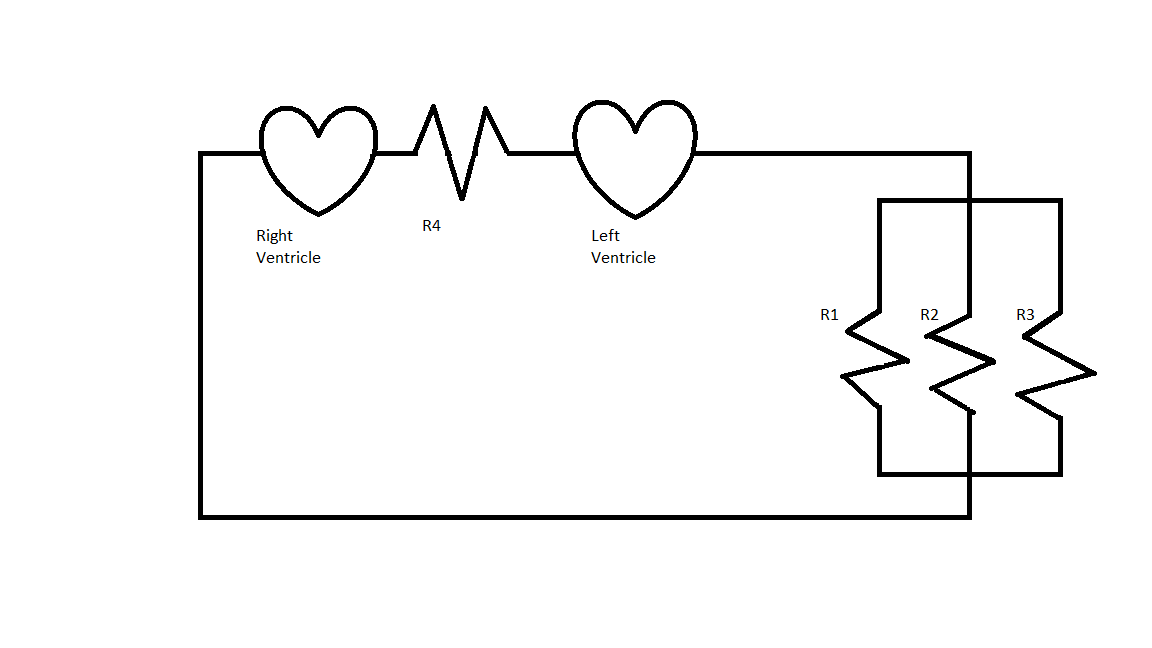
Another key feature of the circulatory system is that it is set up such that the organ systems act in parallel rather than in series. This allows the body to modify how much blood is flowing to each organ system, which would not be possible under a serial construction. This setup is represented in Figure 1.
Which of the following disorders would most likely cause an increase in turbulent flow?
I. Increased cardiac output
II. Anemia
III. Lung cancer
Use the following information to answer questions 1-6:
The circulatory system of humans is a closed system consisting of a pump that moves blood throughout the body through arteries, capillaries, and veins. The capillaries are small and thin, allowing blood to easily perfuse the organ systems. Being a closed system, we can model the human circulatory system like an electrical circuit, making modifications for the use of a fluid rather than electrons. The heart acts as the primary force for movement of the fluid, the fluid moves through arteries and veins, and resistance to blood flow occurs depending on perfusion rates.
To model the behavior of fluids in the circulatory system, we can modify Ohm’s law of V = IR to ∆P = FR where ∆P is the change in pressure (mmHg), F is the rate of flow (ml/min), and R is resistance to flow (mm Hg/ml/min). Resistance to fluid flow in a tube is described by Poiseuille’s law: R = 8hl/πr4 where l is the length of the tube, h is the viscosity of the fluid, and r is the radius of the tube. Viscosity of blood is higher than water due to the presence of blood cells such as erythrocytes, leukocytes, and thrombocytes.
The above equations hold true for smooth, laminar flow. Deviations occur, however, when turbulent flow is present. Turbulent flow can be described as nonlinear or tumultuous, with whirling, glugging or otherwise unpredictable flow rates. Turbulence can occur when the anatomy of the tube deviates, for example during sharp bends or compressions. We can also get turbulent flow when the velocity exceeds critical velocity vc, defined below.
vc = NRh/ρD
NR is Reynold’s constant, h is the viscosity of the fluid, ρ is the density of the fluid, and D is the diameter of the tube. The density of blood is measured to be 1060 kg/m3.
Another key feature of the circulatory system is that it is set up such that the organ systems act in parallel rather than in series. This allows the body to modify how much blood is flowing to each organ system, which would not be possible under a serial construction. This setup is represented in Figure 1.
Which of the following disorders would most likely cause an increase in turbulent flow?
I. Increased cardiac output
II. Anemia
III. Lung cancer
Tap to reveal answer
We can see from the equation that critical velocity depends on Reynolds number, viscosity, diameter of the tube, and density of the fluid. If we assume the heart is pumping normally and that the velocity of blood is constant, a decrease in the critical velocity would increase the chance that the normal velocity would exceed this critical velocity. This would result in turbulent flow.
Looking at the choices, anemia would cause a decrease in blood viscosity, resulting in a lower critical velocity, increasing the chance for turbulent flow. Increased cardiac output would increase the average velocity of the blood such that it may overcome the critical velocity, resulting in more turbulence. Lung cancer should not have a measurable effect on blood turbulence.
We can see from the equation that critical velocity depends on Reynolds number, viscosity, diameter of the tube, and density of the fluid. If we assume the heart is pumping normally and that the velocity of blood is constant, a decrease in the critical velocity would increase the chance that the normal velocity would exceed this critical velocity. This would result in turbulent flow.
Looking at the choices, anemia would cause a decrease in blood viscosity, resulting in a lower critical velocity, increasing the chance for turbulent flow. Increased cardiac output would increase the average velocity of the blood such that it may overcome the critical velocity, resulting in more turbulence. Lung cancer should not have a measurable effect on blood turbulence.
← Didn't Know|Knew It →
Use the following information to answer questions 1-6:
The circulatory system of humans is a closed system consisting of a pump that moves blood throughout the body through arteries, capillaries, and veins. The capillaries are small and thin, allowing blood to easily perfuse the organ systems. Being a closed system, we can model the human circulatory system like an electrical circuit, making modifications for the use of a fluid rather than electrons. The heart acts as the primary force for movement of the fluid, the fluid moves through arteries and veins, and resistance to blood flow occurs depending on perfusion rates.
To model the behavior of fluids in the circulatory system, we can modify Ohm’s law of V = IR to ∆P = FR where ∆P is the change in pressure (mmHg), F is the rate of flow (ml/min), and R is resistance to flow (mm Hg/ml/min). Resistance to fluid flow in a tube is described by Poiseuille’s law: R = 8hl/πr4 where l is the length of the tube, h is the viscosity of the fluid, and r is the radius of the tube. Viscosity of blood is higher than water due to the presence of blood cells such as erythrocytes, leukocytes, and thrombocytes.
The above equations hold true for smooth, laminar flow. Deviations occur, however, when turbulent flow is present. Turbulent flow can be described as nonlinear or tumultuous, with whirling, glugging or otherwise unpredictable flow rates. Turbulence can occur when the anatomy of the tube deviates, for example during sharp bends or compressions. We can also get turbulent flow when the velocity exceeds critical velocity vc, defined below.
vc = NRh/ρD
NR is Reynold’s constant, h is the viscosity of the fluid, ρ is the density of the fluid, and D is the diameter of the tube. The density of blood is measured to be 1060 kg/m3.
Another key feature of the circulatory system is that it is set up such that the organ systems act in parallel rather than in series. This allows the body to modify how much blood is flowing to each organ system, which would not be possible under a serial construction. This setup is represented in Figure 1.
Which of the following accurately demonstrates a relationship between critical velocity and resistance?
Use the following information to answer questions 1-6:
The circulatory system of humans is a closed system consisting of a pump that moves blood throughout the body through arteries, capillaries, and veins. The capillaries are small and thin, allowing blood to easily perfuse the organ systems. Being a closed system, we can model the human circulatory system like an electrical circuit, making modifications for the use of a fluid rather than electrons. The heart acts as the primary force for movement of the fluid, the fluid moves through arteries and veins, and resistance to blood flow occurs depending on perfusion rates.
To model the behavior of fluids in the circulatory system, we can modify Ohm’s law of V = IR to ∆P = FR where ∆P is the change in pressure (mmHg), F is the rate of flow (ml/min), and R is resistance to flow (mm Hg/ml/min). Resistance to fluid flow in a tube is described by Poiseuille’s law: R = 8hl/πr4 where l is the length of the tube, h is the viscosity of the fluid, and r is the radius of the tube. Viscosity of blood is higher than water due to the presence of blood cells such as erythrocytes, leukocytes, and thrombocytes.
The above equations hold true for smooth, laminar flow. Deviations occur, however, when turbulent flow is present. Turbulent flow can be described as nonlinear or tumultuous, with whirling, glugging or otherwise unpredictable flow rates. Turbulence can occur when the anatomy of the tube deviates, for example during sharp bends or compressions. We can also get turbulent flow when the velocity exceeds critical velocity vc, defined below.
vc = NRh/ρD
NR is Reynold’s constant, h is the viscosity of the fluid, ρ is the density of the fluid, and D is the diameter of the tube. The density of blood is measured to be 1060 kg/m3.
Another key feature of the circulatory system is that it is set up such that the organ systems act in parallel rather than in series. This allows the body to modify how much blood is flowing to each organ system, which would not be possible under a serial construction. This setup is represented in Figure 1.
Which of the following accurately demonstrates a relationship between critical velocity and resistance?
Tap to reveal answer
Viscosity (h) is common to both equations, so to find a relationship between resistance and critical velocity, we can use the resistance equation and solve for viscosity.
 and
and 
Rearranging the equation for resistance allows us to substitute for h in the critical velocity equation.

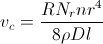
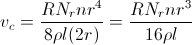
This equation can be further reduced. Diameter is twice the radius, so D = 2r.
Viscosity (h) is common to both equations, so to find a relationship between resistance and critical velocity, we can use the resistance equation and solve for viscosity.
Rearranging the equation for resistance allows us to substitute for h in the critical velocity equation.
This equation can be further reduced. Diameter is twice the radius, so D = 2r.
← Didn't Know|Knew It →
Diffusion can be defined as the net transfer of molecules down a gradient of differing concentrations. This is a passive and spontaneous process and relies on the random movement of molecules and Brownian motion. Diffusion is an important biological process, especially in the respiratory system where oxygen diffuses from alveoli, the basic unit of lung mechanics, to red blood cells in the capillaries.
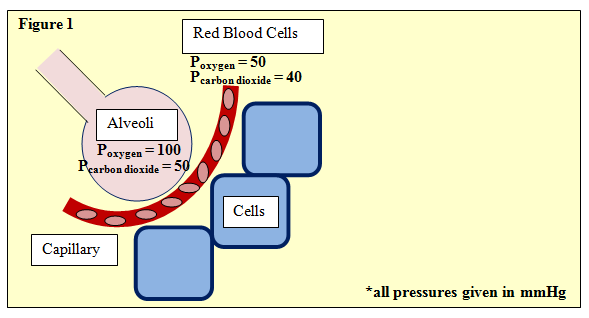
Figure 1 depicts this process, showing an alveoli separated from neighboring cells by a capillary with red blood cells. The partial pressures of oxygen and carbon dioxide are given. One such equation used in determining gas exchange is Fick's law, given by:
ΔV = (Area/Thickness) · Dgas · (P1 – P2)
Where ΔV is flow rate and area and thickness refer to the permeable membrane through which the gas passes, in this case, the wall of the avlveoli. P1 and P2 refer to the partial pressures upstream and downstream, respectively. Further, Dgas, the diffusion constant of the gas, is defined as:
Dgas = Solubility / (Molecular Weight)^(1/2)
Under certain conditions, alveoli enlarge or constrict. How would either change affect ΔV?
Diffusion can be defined as the net transfer of molecules down a gradient of differing concentrations. This is a passive and spontaneous process and relies on the random movement of molecules and Brownian motion. Diffusion is an important biological process, especially in the respiratory system where oxygen diffuses from alveoli, the basic unit of lung mechanics, to red blood cells in the capillaries.
Figure 1 depicts this process, showing an alveoli separated from neighboring cells by a capillary with red blood cells. The partial pressures of oxygen and carbon dioxide are given. One such equation used in determining gas exchange is Fick's law, given by:
ΔV = (Area/Thickness) · Dgas · (P1 – P2)
Where ΔV is flow rate and area and thickness refer to the permeable membrane through which the gas passes, in this case, the wall of the avlveoli. P1 and P2 refer to the partial pressures upstream and downstream, respectively. Further, Dgas, the diffusion constant of the gas, is defined as:
Dgas = Solubility / (Molecular Weight)^(1/2)
Under certain conditions, alveoli enlarge or constrict. How would either change affect ΔV?
Tap to reveal answer
By Fick's law, we see that ΔV, or flow rate, is directly proportional to surface area. Thus, if alveoli enlarge, so will surface area, and therefore flow rate will also increase. Similarly, if alveoli constrict, so does the total surface area, and thus flow rate will also decrease.
This problem mainly tests to see if the test-taker can quickly see the relationship between ΔV and surface area. Also, intuitively, one might guess that the larger the surface area, the more easily and the more areas gas can diffuse.
By Fick's law, we see that ΔV, or flow rate, is directly proportional to surface area. Thus, if alveoli enlarge, so will surface area, and therefore flow rate will also increase. Similarly, if alveoli constrict, so does the total surface area, and thus flow rate will also decrease.
This problem mainly tests to see if the test-taker can quickly see the relationship between ΔV and surface area. Also, intuitively, one might guess that the larger the surface area, the more easily and the more areas gas can diffuse.
← Didn't Know|Knew It →
Diffusion can be defined as the net transfer of molecules down a gradient created by differing concentrations of the molecule in different locations. This is a passive, spontaneous process and relies on the random movement of molecules and Brownian motion. Diffusion is an important biological process, especially in the respiratory system where oxygen diffuses from alveoli, the basic units of lung mechanics, to red blood cells in the capillaries.
Figure 1 depicts this process, showing an alveolus separated from neighboring cells by a capillary with red blood cells. The partial pressures of oxygen and carbon dioxide are given. One equation used in determining gas exchange is Fick's law, given by:

In this equation,  is the flow rate. Area and thickness refer to the permeable membrane through which the gas passes_—_in this case, the wall of the alveolus.
  and
and  refer to the partial pressures upstream and downstream, respectively.
  , the diffusion constant of the gas, is defined as:
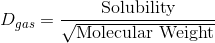
Using the values from Figure 1, what is the flow rate of oxygen in terms of the flow rate of carbon dioxide, given that oxygen and carbon dioxide have equal permeability?
Diffusion can be defined as the net transfer of molecules down a gradient created by differing concentrations of the molecule in different locations. This is a passive, spontaneous process and relies on the random movement of molecules and Brownian motion. Diffusion is an important biological process, especially in the respiratory system where oxygen diffuses from alveoli, the basic units of lung mechanics, to red blood cells in the capillaries.
Figure 1 depicts this process, showing an alveolus separated from neighboring cells by a capillary with red blood cells. The partial pressures of oxygen and carbon dioxide are given. One equation used in determining gas exchange is Fick's law, given by:
In this equation,
Using the values from Figure 1, what is the flow rate of oxygen in terms of the flow rate of carbon dioxide, given that oxygen and carbon dioxide have equal permeability?
Tap to reveal answer
This question is tricky because it asks you oxygen's flow rate in terms of that of carbon dioxide's; however, this problem can also be quickly solved by calculating each flow rate separately. It is important to note that since we have been told that they have equal permeability, the only values they will differ by are their partial pressure differences and molecular weights. The partial pressure difference for oxygen is 100 – 50, or 50 mmHg, and that of carbon dioxide is 50 – 40, or 10 mmHg.
From here, we see that in terms of partial pressure, the flow rate of oxygen will be 5 times greater (50/10 = 5) than carbon dioxide; however, we still must account for molecular weights, which is on the bottom of the equation. The molecular weight for oxygen is 32, and 44 for carbon dioxide; therefore, we can set our equation up to find some factor, X, that when multiplied by Pcarbon dioxide, will give us Poxygen
Poxygen = (Area/Thickness) · solubility/321/2 · 50 = (X) Pcarbon dioxide = (Area/Thickness) · solubility/441/2 · 10
Crossing out what is equal on both sides, we are left with:
50/321/2 = (X) · 10**/**441/2
and, X = 5 · 441/2/321/2
This question is tricky because it asks you oxygen's flow rate in terms of that of carbon dioxide's; however, this problem can also be quickly solved by calculating each flow rate separately. It is important to note that since we have been told that they have equal permeability, the only values they will differ by are their partial pressure differences and molecular weights. The partial pressure difference for oxygen is 100 – 50, or 50 mmHg, and that of carbon dioxide is 50 – 40, or 10 mmHg.
From here, we see that in terms of partial pressure, the flow rate of oxygen will be 5 times greater (50/10 = 5) than carbon dioxide; however, we still must account for molecular weights, which is on the bottom of the equation. The molecular weight for oxygen is 32, and 44 for carbon dioxide; therefore, we can set our equation up to find some factor, X, that when multiplied by Pcarbon dioxide, will give us Poxygen
Poxygen = (Area/Thickness) · solubility/321/2 · 50 = (X) Pcarbon dioxide = (Area/Thickness) · solubility/441/2 · 10
Crossing out what is equal on both sides, we are left with:
50/321/2 = (X) · 10**/**441/2
and, X = 5 · 441/2/321/2
← Didn't Know|Knew It →
Diffusion can be defined as the net transfer of molecules down a gradient created by differing concentrations of the molecule in different locations. This is a passive, spontaneous process and relies on the random movement of molecules and Brownian motion. Diffusion is an important biological process, especially in the respiratory system where oxygen diffuses from alveoli, the basic units of lung mechanics, to red blood cells in the capillaries.
Figure 1 depicts this process, showing an alveolus separated from neighboring cells by a capillary with red blood cells. The partial pressures of oxygen and carbon dioxide are given. One equation used in determining gas exchange is Fick's law, given by:

In this equation,  is the flow rate. Area and thickness refer to the permeable membrane through which the gas passes_—_in this case, the wall of the alveolus.
  and
and  refer to the partial pressures upstream and downstream, respectively.
  , the diffusion constant of the gas, is defined as:

During inspiration, the diaphragm contracts and allows oxygen to rush into the lungs. How would a change in average airway diameter affect the speed at which oxygen moves?
Diffusion can be defined as the net transfer of molecules down a gradient created by differing concentrations of the molecule in different locations. This is a passive, spontaneous process and relies on the random movement of molecules and Brownian motion. Diffusion is an important biological process, especially in the respiratory system where oxygen diffuses from alveoli, the basic units of lung mechanics, to red blood cells in the capillaries.
Figure 1 depicts this process, showing an alveolus separated from neighboring cells by a capillary with red blood cells. The partial pressures of oxygen and carbon dioxide are given. One equation used in determining gas exchange is Fick's law, given by:
In this equation,
During inspiration, the diaphragm contracts and allows oxygen to rush into the lungs. How would a change in average airway diameter affect the speed at which oxygen moves?
Tap to reveal answer
Note, two of the choices say essentially say the same relationship. Therefore, one can immediately infer that they are wrong. The question is based off of knowledge of fluid dynamics. Typically, a decrease in airway diameter will provide more resistance and thus lower the speed at which a fluid (or gas) will move. Think about blowing air through a series of straws of narrowing diameter; the narrower the straw, the harder it is to blow air; therefore, a decrease in airway diameter would cause an decrease in oxygen speed.
Note, two of the choices say essentially say the same relationship. Therefore, one can immediately infer that they are wrong. The question is based off of knowledge of fluid dynamics. Typically, a decrease in airway diameter will provide more resistance and thus lower the speed at which a fluid (or gas) will move. Think about blowing air through a series of straws of narrowing diameter; the narrower the straw, the harder it is to blow air; therefore, a decrease in airway diameter would cause an decrease in oxygen speed.
← Didn't Know|Knew It →
Diffusion can be defined as the net transfer of molecules down a gradient of differing concentrations. This is a passive and spontaneous process and relies on the random movement of molecules and Brownian motion. Diffusion is an important biological process, especially in the respiratory system where oxygen diffuses from alveoli, the basic unit of lung mechanics, to red blood cells in the capillaries.
Figure 1 depicts this process, showing an alveoli separated from neighboring cells by a capillary with red blood cells. The partial pressures of oxygen and carbon dioxide are given. One such equation used in determining gas exchange is Fick's law, given by:
ΔV = (Area/Thickness) · Dgas · (P1 – P2)
Where ΔV is flow rate and area and thickness refer to the permeable membrane through which the gas passes, in this case, the wall of the avlveoli. P1 and P2 refer to the partial pressures upstream and downstream, respectively. Further, Dgas, the diffusion constant of the gas, is defined as:
Dgas = Solubility / (Molecular Weight)^(1/2)
During strenuous exercise, blood flow greatly increases. Compared to red blood cells traveling along the sides of the capillary, how will oxygen diffusion be affected for those red blood cells traveling towards the center of the capillary?
Diffusion can be defined as the net transfer of molecules down a gradient of differing concentrations. This is a passive and spontaneous process and relies on the random movement of molecules and Brownian motion. Diffusion is an important biological process, especially in the respiratory system where oxygen diffuses from alveoli, the basic unit of lung mechanics, to red blood cells in the capillaries.
Figure 1 depicts this process, showing an alveoli separated from neighboring cells by a capillary with red blood cells. The partial pressures of oxygen and carbon dioxide are given. One such equation used in determining gas exchange is Fick's law, given by:
ΔV = (Area/Thickness) · Dgas · (P1 – P2)
Where ΔV is flow rate and area and thickness refer to the permeable membrane through which the gas passes, in this case, the wall of the avlveoli. P1 and P2 refer to the partial pressures upstream and downstream, respectively. Further, Dgas, the diffusion constant of the gas, is defined as:
Dgas = Solubility / (Molecular Weight)^(1/2)
During strenuous exercise, blood flow greatly increases. Compared to red blood cells traveling along the sides of the capillary, how will oxygen diffusion be affected for those red blood cells traveling towards the center of the capillary?
Tap to reveal answer
This is another question testing fluid dynamics. In any fluid, less resistance will be encountered towards the center of the vessel; therefore, red blood cells travelling in the center of the capillary will be travelling faster and have less time to "catch" oxygen as it diffuses towards the blood stream. Interestingly, this same feature also helps to explain why damaged or cut vessels clot so quickly—clotting factors, such as platelets, towards the periphery move more slowly, thus bunching up near the wound site.
This is another question testing fluid dynamics. In any fluid, less resistance will be encountered towards the center of the vessel; therefore, red blood cells travelling in the center of the capillary will be travelling faster and have less time to "catch" oxygen as it diffuses towards the blood stream. Interestingly, this same feature also helps to explain why damaged or cut vessels clot so quickly—clotting factors, such as platelets, towards the periphery move more slowly, thus bunching up near the wound site.
← Didn't Know|Knew It →
Use the following information to answer questions 1-6:
The circulatory system of humans is a closed system consisting of a pump that moves blood throughout the body through arteries, capillaries, and veins. The capillaries are small and thin, allowing blood to easily perfuse the organ systems. Being a closed system, we can model the human circulatory system like an electrical circuit, making modifications for the use of a fluid rather than electrons. The heart acts as the primary force for movement of the fluid, the fluid moves through arteries and veins, and resistance to blood flow occurs depending on perfusion rates.
To model the behavior of fluids in the circulatory system, we can modify Ohm’s law of V = IR to ∆P = FR where ∆P is the change in pressure (mmHg), F is the rate of flow (ml/min), and R is resistance to flow (mm Hg/ml/min). Resistance to fluid flow in a tube is described by Poiseuille’s law: R = 8hl/πr4 where l is the length of the tube, h is the viscosity of the fluid, and r is the radius of the tube. Viscosity of blood is higher than water due to the presence of blood cells such as erythrocytes, leukocytes, and thrombocytes.
The above equations hold true for smooth, laminar flow. Deviations occur, however, when turbulent flow is present. Turbulent flow can be described as nonlinear or tumultuous, with whirling, glugging or otherwise unpredictable flow rates. Turbulence can occur when the anatomy of the tube deviates, for example during sharp bends or compressions. We can also get turbulent flow when the velocity exceeds critical velocity vc, defined below.
vc = NRh/ρD
NR is Reynold’s constant, h is the viscosity of the fluid, ρ is the density of the fluid, and D is the diameter of the tube. The density of blood is measured to be 1060 kg/m3.
Another key feature of the circulatory system is that it is set up such that the organ systems act in parallel rather than in series. This allows the body to modify how much blood is flowing to each organ system, which would not be possible under a serial construction. This setup is represented in Figure 1.
One of the effects of norepinephrine is vasoconstriction of peripheral blood vessels. If the medication reduces the diameter of a peripheral vessel in the hands by ½, what effect does this have on the flow of blood to hands?
Use the following information to answer questions 1-6:
The circulatory system of humans is a closed system consisting of a pump that moves blood throughout the body through arteries, capillaries, and veins. The capillaries are small and thin, allowing blood to easily perfuse the organ systems. Being a closed system, we can model the human circulatory system like an electrical circuit, making modifications for the use of a fluid rather than electrons. The heart acts as the primary force for movement of the fluid, the fluid moves through arteries and veins, and resistance to blood flow occurs depending on perfusion rates.
To model the behavior of fluids in the circulatory system, we can modify Ohm’s law of V = IR to ∆P = FR where ∆P is the change in pressure (mmHg), F is the rate of flow (ml/min), and R is resistance to flow (mm Hg/ml/min). Resistance to fluid flow in a tube is described by Poiseuille’s law: R = 8hl/πr4 where l is the length of the tube, h is the viscosity of the fluid, and r is the radius of the tube. Viscosity of blood is higher than water due to the presence of blood cells such as erythrocytes, leukocytes, and thrombocytes.
The above equations hold true for smooth, laminar flow. Deviations occur, however, when turbulent flow is present. Turbulent flow can be described as nonlinear or tumultuous, with whirling, glugging or otherwise unpredictable flow rates. Turbulence can occur when the anatomy of the tube deviates, for example during sharp bends or compressions. We can also get turbulent flow when the velocity exceeds critical velocity vc, defined below.
vc = NRh/ρD
NR is Reynold’s constant, h is the viscosity of the fluid, ρ is the density of the fluid, and D is the diameter of the tube. The density of blood is measured to be 1060 kg/m3.
Another key feature of the circulatory system is that it is set up such that the organ systems act in parallel rather than in series. This allows the body to modify how much blood is flowing to each organ system, which would not be possible under a serial construction. This setup is represented in Figure 1.
One of the effects of norepinephrine is vasoconstriction of peripheral blood vessels. If the medication reduces the diameter of a peripheral vessel in the hands by ½, what effect does this have on the flow of blood to hands?
Tap to reveal answer
Resistance is measured by the equation  .
.
If the diameter is reduced by half, the radius is reduced by half. This will increase resistance by a factor of 24, or 16. We know that the circulatory system is set up as a parallel system so the pressure in any branch must be constant, allowing only flow to change. Using the equation ∆P = FR, if resistance increases by a factor of 16 and the flow stays the same, then flow decreases by a factor of 16 since pressure is constant.
∆P = F2R2 – F1R1 = 0
16R1 = R2
F2R2 = F1R1
F216R1 = F1R1
F2= (1/16)F1
Resistance is measured by the equation
If the diameter is reduced by half, the radius is reduced by half. This will increase resistance by a factor of 24, or 16. We know that the circulatory system is set up as a parallel system so the pressure in any branch must be constant, allowing only flow to change. Using the equation ∆P = FR, if resistance increases by a factor of 16 and the flow stays the same, then flow decreases by a factor of 16 since pressure is constant.
∆P = F2R2 – F1R1 = 0
16R1 = R2
F2R2 = F1R1
F216R1 = F1R1
F2= (1/16)F1
← Didn't Know|Knew It →
A variation of Poiseuille's law, a relationship that helps explain fluid resistance in a pipe, is given by:

In the formula,  is viscosity,
  is the length of the pipe, and
  is the diameter of the pipe.
Which one of the following effects would decreaseresistance?
A variation of Poiseuille's law, a relationship that helps explain fluid resistance in a pipe, is given by:
In the formula,
Which one of the following effects would decreaseresistance?
Tap to reveal answer
This question can be answered quickly from logic, with little math involved. Temperature itself is not a direct variable in the given equation; however, it does relate to viscosity, . The warmer a fluid is, the lower the viscosity will become, and a fluid that is less viscous will flow more easily, creating less resistance.
The other answer choices either give changes that are unrelated to flow resistance, or increase flow resistance. Narrowing the pipe and increasing the length would increase resistance, according to the given equation. Flow and pressure can be affected by resistance, but cannot change the given resistance in a system.
This question can be answered quickly from logic, with little math involved. Temperature itself is not a direct variable in the given equation; however, it does relate to viscosity,
The other answer choices either give changes that are unrelated to flow resistance, or increase flow resistance. Narrowing the pipe and increasing the length would increase resistance, according to the given equation. Flow and pressure can be affected by resistance, but cannot change the given resistance in a system.
← Didn't Know|Knew It →
Which change will produce the greatest increase to flow rate through a tube?
Which change will produce the greatest increase to flow rate through a tube?
Tap to reveal answer
The equation for flow rate through a section of tube is given by Poiseulle's law. Though you will not need to memorize this equation, you must be familiar with the relationships it describes on a conceptual basis.

In this equation,  is the radius,
  is the change in pressure,
  is the liquid viscosity, and
  is the length of the tube.
Of the given answer option, doubling the radius would multiply the flow rate by  , resulting in the greatest increase.
The equation for flow rate through a section of tube is given by Poiseulle's law. Though you will not need to memorize this equation, you must be familiar with the relationships it describes on a conceptual basis.
In this equation,
Of the given answer option, doubling the radius would multiply the flow rate by
← Didn't Know|Knew It →
Diffusion can be defined as the net transfer of molecules down a gradient of differing concentrations. This is a passive and spontaneous process and relies on the random movement of molecules and Brownian motion. Diffusion is an important biological process, especially in the respiratory system where oxygen diffuses from alveoli, the basic unit of lung mechanics, to red blood cells in the capillaries.
Figure 1 depicts this process, showing an alveoli separated from neighboring cells by a capillary with red blood cells. The partial pressures of oxygen and carbon dioxide are given. One such equation used in determining gas exchange is Fick's law, given by:
ΔV = (Area/Thickness) · Dgas · (P1 – P2)
Where ΔV is flow rate and area and thickness refer to the permeable membrane through which the gas passes, in this case, the wall of the avlveoli. P1 and P2 refer to the partial pressures upstream and downstream, respectively. Further, Dgas, the diffusion constant of the gas, is defined as:
Dgas = Solubility / (Molecular Weight)^(1/2)
In higher altitudes, a decrease in which factors of Fick's law can change in order to achieve the same flow rate at lower altitudes.
Diffusion can be defined as the net transfer of molecules down a gradient of differing concentrations. This is a passive and spontaneous process and relies on the random movement of molecules and Brownian motion. Diffusion is an important biological process, especially in the respiratory system where oxygen diffuses from alveoli, the basic unit of lung mechanics, to red blood cells in the capillaries.
Figure 1 depicts this process, showing an alveoli separated from neighboring cells by a capillary with red blood cells. The partial pressures of oxygen and carbon dioxide are given. One such equation used in determining gas exchange is Fick's law, given by:
ΔV = (Area/Thickness) · Dgas · (P1 – P2)
Where ΔV is flow rate and area and thickness refer to the permeable membrane through which the gas passes, in this case, the wall of the avlveoli. P1 and P2 refer to the partial pressures upstream and downstream, respectively. Further, Dgas, the diffusion constant of the gas, is defined as:
Dgas = Solubility / (Molecular Weight)^(1/2)
In higher altitudes, a decrease in which factors of Fick's law can change in order to achieve the same flow rate at lower altitudes.
Tap to reveal answer
It should be known that in higher altitudes, the partial pressure of oxygen falls. That is, the partial pressure in the alveoli will fall. Thus, flow rate will decrease, and we will need changes to increase flow rate.
By looking at Fick's equation, we can see that a decrease in thickness can help restore flow rate. Biologically speaking, this is less likely to happen, and more correctly, hemoglobin concentration and binding affinity to oxygen increases; however, this is extraneous information not needed for the MCAT.
It should be known that in higher altitudes, the partial pressure of oxygen falls. That is, the partial pressure in the alveoli will fall. Thus, flow rate will decrease, and we will need changes to increase flow rate.
By looking at Fick's equation, we can see that a decrease in thickness can help restore flow rate. Biologically speaking, this is less likely to happen, and more correctly, hemoglobin concentration and binding affinity to oxygen increases; however, this is extraneous information not needed for the MCAT.
← Didn't Know|Knew It →
Diffusion can be defined as the net transfer of molecules down a gradient of differing concentrations. This is a passive and spontaneous process and relies on the random movement of molecules and Brownian motion. Diffusion is an important biological process, especially in the respiratory system where oxygen diffuses from alveoli, the basic unit of lung mechanics, to red blood cells in the capillaries.
Figure 1 depicts this process, showing an alveoli separated from neighboring cells by a capillary with red blood cells. The partial pressures of oxygen and carbon dioxide are given. One such equation used in determining gas exchange is Fick's law, given by:
ΔV = (Area/Thickness) · Dgas · (P1 – P2)
Where ΔV is flow rate and area and thickness refer to the permeable membrane through which the gas passes, in this case, the wall of the avlveoli. P1 and P2 refer to the partial pressures upstream and downstream, respectively. Further, Dgas, the diffusion constant of the gas, is defined as:
Dgas = Solubility / (Molecular Weight)^(1/2)
Conceptually, if alveoli are considered to be perfectly spherical and assuming that its entire surface exchanges gas, which new relationship, introducing the variable, r, the radius of an alveoli, correctly describes Fick's Equation, assuming partial pressures remain constant?
Diffusion can be defined as the net transfer of molecules down a gradient of differing concentrations. This is a passive and spontaneous process and relies on the random movement of molecules and Brownian motion. Diffusion is an important biological process, especially in the respiratory system where oxygen diffuses from alveoli, the basic unit of lung mechanics, to red blood cells in the capillaries.
Figure 1 depicts this process, showing an alveoli separated from neighboring cells by a capillary with red blood cells. The partial pressures of oxygen and carbon dioxide are given. One such equation used in determining gas exchange is Fick's law, given by:
ΔV = (Area/Thickness) · Dgas · (P1 – P2)
Where ΔV is flow rate and area and thickness refer to the permeable membrane through which the gas passes, in this case, the wall of the avlveoli. P1 and P2 refer to the partial pressures upstream and downstream, respectively. Further, Dgas, the diffusion constant of the gas, is defined as:
Dgas = Solubility / (Molecular Weight)^(1/2)
Conceptually, if alveoli are considered to be perfectly spherical and assuming that its entire surface exchanges gas, which new relationship, introducing the variable, r, the radius of an alveoli, correctly describes Fick's Equation, assuming partial pressures remain constant?
Tap to reveal answer
The quickest approach to this equation is to see what variable in Fick's law might be affected by a change in the radius of an alveoli. Pressure is constant and can be ruled out. The diffusion constant would not be effected by radius (hence it being a constant).
The question stem mentions nothing about a change in thickness, therefore, we are left with area.
The surface area of a sphere is measured by 4πr2 and can be substituted. If you had difficulty remembering how to measure surface area, remember that the area of a circle is πr2 andlogically it follows that the surface area of an entire sphere must be greater due to it being three dimensional.
The quickest approach to this equation is to see what variable in Fick's law might be affected by a change in the radius of an alveoli. Pressure is constant and can be ruled out. The diffusion constant would not be effected by radius (hence it being a constant).
The question stem mentions nothing about a change in thickness, therefore, we are left with area.
The surface area of a sphere is measured by 4πr2 and can be substituted. If you had difficulty remembering how to measure surface area, remember that the area of a circle is πr2 andlogically it follows that the surface area of an entire sphere must be greater due to it being three dimensional.
← Didn't Know|Knew It →
Diffusion can be defined as the net transfer of molecules down a gradient created by differing concentrations of the molecule in different locations. This is a passive, spontaneous process and relies on the random movement of molecules and Brownian motion. Diffusion is an important biological process, especially in the respiratory system where oxygen diffuses from alveoli, the basic units of lung mechanics, to red blood cells in the capillaries.
Figure 1 depicts this process, showing an alveolus separated from neighboring cells by a capillary with red blood cells. The partial pressures of oxygen and carbon dioxide are given. One equation used in determining gas exchange is Fick's law, given by:

In this equation,  is the flow rate. Area and thickness refer to the permeable membrane through which the gas passes_—_in this case, the wall of the alveolus.
  and
and  refer to the partial pressures upstream and downstream, respectively.
  , the diffusion constant of the gas, is defined as:
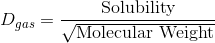
At high altitudes, the partial pressure of oxygen quickly drops while that of carbon dioxide decreases by much less. Given the following table, at what elevation is the pressure gradient of oxygen equal to half that of carbon dioxide, assuming constant capillary partial pressures of oxygen and carbon dioxide of 50mmHg and 40mmHg, respectively?
Elevation (m) PO2 (mmHg) PCO2 (mmHg) 0 100 50 1000 80 40 2000 60 30 3000 40 20 4000 20 10 5000 10 0
Diffusion can be defined as the net transfer of molecules down a gradient created by differing concentrations of the molecule in different locations. This is a passive, spontaneous process and relies on the random movement of molecules and Brownian motion. Diffusion is an important biological process, especially in the respiratory system where oxygen diffuses from alveoli, the basic units of lung mechanics, to red blood cells in the capillaries.
Figure 1 depicts this process, showing an alveolus separated from neighboring cells by a capillary with red blood cells. The partial pressures of oxygen and carbon dioxide are given. One equation used in determining gas exchange is Fick's law, given by:
In this equation,
At high altitudes, the partial pressure of oxygen quickly drops while that of carbon dioxide decreases by much less. Given the following table, at what elevation is the pressure gradient of oxygen equal to half that of carbon dioxide, assuming constant capillary partial pressures of oxygen and carbon dioxide of 50mmHg and 40mmHg, respectively?
| Elevation (m) | PO2 (mmHg) | PCO2 (mmHg) |
|---|---|---|
| 0 | 100 | 50 |
| 1000 | 80 | 40 |
| 2000 | 60 | 30 |
| 3000 | 40 | 20 |
| 4000 | 20 | 10 |
| 5000 | 10 | 0 |
Tap to reveal answer
This problem at first may seem straightforward, until you realize that the gradient (or difference in partial pressures of Fick's law) actually changes.
In normal circumstances, capillary pressure would be subtracted from arterial pressure; however, the body operates at a physiologic equilibrium, which essentially has a constant production of CO2 and demand for O2. At a certain point the capillary pressure will be greater than the arterial, and hence the gradient switches to Pcapillary – Parterial from the original Parterial – Pcapillary.
Simple arithmetic done alongside the table margins can quickly arrive to the correct answer. At an elevation of 3000 m, the gradients of oxygen (50 – 40 = 10 mmHg) and carbon dioxide (40 – 20 = 20 mmHg) differ by twofold. It is easy to be confused over a seemingly complicated table, when in reality, this question only asks for basic arithmetic.
This problem at first may seem straightforward, until you realize that the gradient (or difference in partial pressures of Fick's law) actually changes.
In normal circumstances, capillary pressure would be subtracted from arterial pressure; however, the body operates at a physiologic equilibrium, which essentially has a constant production of CO2 and demand for O2. At a certain point the capillary pressure will be greater than the arterial, and hence the gradient switches to Pcapillary – Parterial from the original Parterial – Pcapillary.
Simple arithmetic done alongside the table margins can quickly arrive to the correct answer. At an elevation of 3000 m, the gradients of oxygen (50 – 40 = 10 mmHg) and carbon dioxide (40 – 20 = 20 mmHg) differ by twofold. It is easy to be confused over a seemingly complicated table, when in reality, this question only asks for basic arithmetic.
← Didn't Know|Knew It →
A barrel of height 10m is filled with water to a height of 5m. If a hole is punctured 2m above the bottom of the barrel, what is the velocity of the water leaving the barrel?
A barrel of height 10m is filled with water to a height of 5m. If a hole is punctured 2m above the bottom of the barrel, what is the velocity of the water leaving the barrel?
Tap to reveal answer
To answer this question, we can use Toricelli’s law.

In this case, h is the height of water above the hole. Since the barrel is filled to a height of 5m, and the hole is punctured 2m from the bottom of the barrel, the height of water is 3m.

To answer this question, we can use Toricelli’s law.
In this case, h is the height of water above the hole. Since the barrel is filled to a height of 5m, and the hole is punctured 2m from the bottom of the barrel, the height of water is 3m.
← Didn't Know|Knew It →
What causes the lift experienced by the wing of an airplane in level flight?
What causes the lift experienced by the wing of an airplane in level flight?
Tap to reveal answer
Air density is considered to be uniform in Bernoulli's equation, which defines the air pressure on the upper and lower surfaces of an aircraft wing. Likewise, air humidity at any one place in the atmosphere is uniform over the space occupied by the wing. Central to the idea of producing lift is the ability of the wing to avoid turbulence, one reason for de-icing wings before winter takeoffs.
Air is considered to move in bulk during flight. This means that a volume of air that has to travel a longer distance than its twin volume (because the airplane wing split them apart) must speed up to arrive at the same place (the trailing edge of the wing) at the same time as its twin. Velocity is squared in Bernoulli's equation, meaning that small differences in flow velocity between the upper and lower wing surfaces translate to large pressure differences.
Attack angle is an important lift factor, but not in level flight.
Air density is considered to be uniform in Bernoulli's equation, which defines the air pressure on the upper and lower surfaces of an aircraft wing. Likewise, air humidity at any one place in the atmosphere is uniform over the space occupied by the wing. Central to the idea of producing lift is the ability of the wing to avoid turbulence, one reason for de-icing wings before winter takeoffs.
Air is considered to move in bulk during flight. This means that a volume of air that has to travel a longer distance than its twin volume (because the airplane wing split them apart) must speed up to arrive at the same place (the trailing edge of the wing) at the same time as its twin. Velocity is squared in Bernoulli's equation, meaning that small differences in flow velocity between the upper and lower wing surfaces translate to large pressure differences.
Attack angle is an important lift factor, but not in level flight.
← Didn't Know|Knew It →
Which of the following is/are assumptions of the Bernoulli equation?
I. The fluid is flowing turbulently
II. The volume of the fluid changes when pressure is applied
III. The fluid is frictionless
Which of the following is/are assumptions of the Bernoulli equation?
I. The fluid is flowing turbulently
II. The volume of the fluid changes when pressure is applied
III. The fluid is frictionless
Tap to reveal answer
Bernoulli’s principle is an equation that states the relationship between the pressure and velocity of a fluid flowing through a pipe.

It operates on three main assumptions. First, the fluid has to have laminar flow. There are two types of flow: laminar and turbulent. Laminar flow is characterized by uniform and ordered flow, whereas turbulent flow is characterized by haphazard and irregular flow. For the Bernoulli equation, the fluid must flow uniformly (laminar). Second, the fluid must be incompressible. This means that the fluid must not change volume (should not be compressed) when an outside pressure is applied. Third, the fluid must experience no friction during flow. Recall that during fluid flow friction usually occurs between layers of fluid because the molecules from each layer interact with each other; however, for the Bernoulli equation to be valid this friction between layers of fluid must be negligible (must be frictionless).
Bernoulli’s principle is an equation that states the relationship between the pressure and velocity of a fluid flowing through a pipe.
It operates on three main assumptions. First, the fluid has to have laminar flow. There are two types of flow: laminar and turbulent. Laminar flow is characterized by uniform and ordered flow, whereas turbulent flow is characterized by haphazard and irregular flow. For the Bernoulli equation, the fluid must flow uniformly (laminar). Second, the fluid must be incompressible. This means that the fluid must not change volume (should not be compressed) when an outside pressure is applied. Third, the fluid must experience no friction during flow. Recall that during fluid flow friction usually occurs between layers of fluid because the molecules from each layer interact with each other; however, for the Bernoulli equation to be valid this friction between layers of fluid must be negligible (must be frictionless).
← Didn't Know|Knew It →
A liquid of density  enters a pipe at velocity
  and with pressure
  . The liquid then exits the pipe a height h above the starting point, at velocity
  . What is the pressure,
  , at this exit point, in terms of
  ,
,  ,
,  , and h?
A liquid of density
Tap to reveal answer
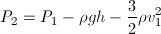
Use Bernoulli's equation: 
Plug in our given values: 
Rearrange to isolate  :
: 
Use Bernoulli's equation:
Plug in our given values:
Rearrange to isolate
← Didn't Know|Knew It →
Which of the following is the gravitational equivalent in mechanical energy to Bernoulli's equation for fluid mechanics?

Which of the following is the gravitational equivalent in mechanical energy to Bernoulli's equation for fluid mechanics?
Tap to reveal answer
Bernoulli's equation states that:

Essentially, this equation notes that pressure, velocity, and height of a fluid during flow can be related by a constant term. Very similarly, kinetic energy and potential energy sum to a constant mechanical energy for static compounds.

Neglecting the term for pressure in Bernoulli's equation, there are direct correlations between kinematic and gravitational terms. Each term has an equivalent in both equations.
Kinematic terms: 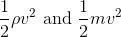
Gravitational terms: 
In Bernoulli's equation, kinetic energy is the kinematic equivalent and potential energy is the gravitational equivalent.
Bernoulli's equation states that:
Essentially, this equation notes that pressure, velocity, and height of a fluid during flow can be related by a constant term. Very similarly, kinetic energy and potential energy sum to a constant mechanical energy for static compounds.
Neglecting the term for pressure in Bernoulli's equation, there are direct correlations between kinematic and gravitational terms. Each term has an equivalent in both equations.
Kinematic terms:
Gravitational terms:
In Bernoulli's equation, kinetic energy is the kinematic equivalent and potential energy is the gravitational equivalent.
← Didn't Know|Knew It →
A researcher is observing a fluid flowing in a pipe. He measures the velocity of the flow at both ends of the pipe and wants to know the relative pressures each end. Which of the following equations will be most useful to him?
A researcher is observing a fluid flowing in a pipe. He measures the velocity of the flow at both ends of the pipe and wants to know the relative pressures each end. Which of the following equations will be most useful to him?
Tap to reveal answer
The question states that the researcher wants to know the relationship between velocity and pressure. Recall that the Bernoulli equation states this relationship for a fluid flowing through a pipe; therefore, the most appropriate principle for the researcher would be Bernoulli’s equation.
Poiseuille’s law and the continuity equation are both fluid mechanics principles, but neither of them state a relationship between velocity and pressure. Poiseuille’s law states the relationship between flow resistance and flow rate for a fluid flowing through a pipe, whereas the continuity equation states the relationship between velocity of the fluid and the area of the pipe. The Doppler effect is irrelevant to this question because it relates changes in frequency of a wave relative to the observer and the wave source; it is not a fluid mechanics principle.
Bernoulli equation: 
Poiseulle's law: 
Continuity equation: 
Doppler effect: 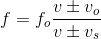
The question states that the researcher wants to know the relationship between velocity and pressure. Recall that the Bernoulli equation states this relationship for a fluid flowing through a pipe; therefore, the most appropriate principle for the researcher would be Bernoulli’s equation.
Poiseuille’s law and the continuity equation are both fluid mechanics principles, but neither of them state a relationship between velocity and pressure. Poiseuille’s law states the relationship between flow resistance and flow rate for a fluid flowing through a pipe, whereas the continuity equation states the relationship between velocity of the fluid and the area of the pipe. The Doppler effect is irrelevant to this question because it relates changes in frequency of a wave relative to the observer and the wave source; it is not a fluid mechanics principle.
Bernoulli equation:
Poiseulle's law:
Continuity equation:
Doppler effect:
← Didn't Know|Knew It →
A fluid is flowing through a pipe from left to right. If you increase the vertical height of the left end, what will happen to the pressure and velocity of the fluid at the left end?
Bernoulli’s equation:

A fluid is flowing through a pipe from left to right. If you increase the vertical height of the left end, what will happen to the pressure and velocity of the fluid at the left end?
Bernoulli’s equation:
Tap to reveal answer
To answer this question you need to know the Bernoulli equation:

In the equation,  is pressure,
  is density,
  is velocity,
  is acceleration due to gravity, and
  is vertical height. Let’s assume that the left side of this equation is for the left end of the pipe and right side is for the right end of the pipe.
The question states that the vertical height,  , is increased at the left end; therefore, the potential energy term on the left hand side of Bernoulli’s equation is increased (
 ). Since the potential energy at the left end increased, the other term(s) on the left hand side of the equation must decrease so that the left hand side equals the right hand side.
This means that the sum of pressure and velocity must decrease; however, we do not have enough information to determine the kinds of changes that will occur in each individual term. It is possible that only one term decreases, while the other term stays constant, or it is possible that both terms decrease; therefore, without more information, we cannot determine the relative changes to pressure and velocity.
To answer this question you need to know the Bernoulli equation:
In the equation,
The question states that the vertical height,
This means that the sum of pressure and velocity must decrease; however, we do not have enough information to determine the kinds of changes that will occur in each individual term. It is possible that only one term decreases, while the other term stays constant, or it is possible that both terms decrease; therefore, without more information, we cannot determine the relative changes to pressure and velocity.
← Didn't Know|Knew It →
Due to plaque buildup, a small part of a patient’s aorta has a smaller radius than a regular, healthy aorta. Which of the following is true regarding the unhealthy and healthy aorta?
Bernoulli's equation:

Continuity equation:

Due to plaque buildup, a small part of a patient’s aorta has a smaller radius than a regular, healthy aorta. Which of the following is true regarding the unhealthy and healthy aorta?
Bernoulli's equation:
Continuity equation:
Tap to reveal answer
The question states that a part of the unhealthy aorta has a smaller radius. This means that this portion of the aorta will have a smaller cross-sectional area. To solve this question we need to use both the continuity equation and the Bernoulli equation. The continuity equation is as follows:

 and
and  are area and velocity of fluid flow, respectively. This equation states that the product of area and velocity of fluid flow on one side of a pipe must equal the product of area and velocity of the fluid flow on the other side of the pipe. Since part of the unhealthy aorta has a smaller radius, it will have a smaller area. According to the continuity equation, the velocity of fluid flowing through the smaller part of the aorta will increase to compensate for the decrease in area; therefore, the velocity of the fluid flow will increase in the clogged region of the aorta.
The second equation we need to use is the Bernoulli equation:

Here,  is pressure,
  is density,
  is velocity,
  is acceleration due to gravity, and
  is vertical height. Bernoulli’s equation states that an increase in velocity of fluid flow will decrease the pressure. This occurs because the pressure will decrease to compensate for the increase in velocity (to ensure that the left hand side of the equation equals the right hand side); therefore, the clogged region of the aorta will have a higher velocity and lower pressure.
The question states that a part of the unhealthy aorta has a smaller radius. This means that this portion of the aorta will have a smaller cross-sectional area. To solve this question we need to use both the continuity equation and the Bernoulli equation. The continuity equation is as follows:
The second equation we need to use is the Bernoulli equation:
Here,
← Didn't Know|Knew It →