Endothermic and Exothermic Reactions - MCAT Chemical and Physical Foundations of Biological Systems
Card 1 of 91
A scientist prepares an experiment to demonstrate the second law of thermodynamics for a chemistry class. In order to conduct the experiment, the scientist brings the class outside in January and gathers a cup of water and a portable stove.
The temperature outside is –10 degrees Celsius. The scientist asks the students to consider the following when answering his questions:
Gibbs Free Energy Formula:
ΔG = ΔH – TΔS
Liquid-Solid Water Phase Change Reaction:
H2O(l) ⇌ H2O(s) + X
The scientist prepares two scenarios.
Scenario 1:
The scientist buries the cup of water outside in the snow, returns to the classroom with his class for one hour, and the class then checks on the cup. They find that the water has frozen in the cup.
Scenario 2:
The scientist then places the frozen cup of water on the stove and starts the gas. The class finds that the water melts quickly.
After the water melts, the scientist asks the students to consider two hypothetical scenarios as a thought experiment.
Scenario 3:
Once the liquid water at the end of scenario 2 melts completely, the scientist turns off the gas and monitors what happens to the water. Despite being in the cold air, the water never freezes.
Scenario 4:
The scientist takes the frozen water from the end of scenario 1, puts it on the active stove, and the water remains frozen.
In scenario 2, the reaction that water undergoes would best be characterized as .
A scientist prepares an experiment to demonstrate the second law of thermodynamics for a chemistry class. In order to conduct the experiment, the scientist brings the class outside in January and gathers a cup of water and a portable stove.
The temperature outside is –10 degrees Celsius. The scientist asks the students to consider the following when answering his questions:
Gibbs Free Energy Formula:
ΔG = ΔH – TΔS
Liquid-Solid Water Phase Change Reaction:
H2O(l) ⇌ H2O(s) + X
The scientist prepares two scenarios.
Scenario 1:
The scientist buries the cup of water outside in the snow, returns to the classroom with his class for one hour, and the class then checks on the cup. They find that the water has frozen in the cup.
Scenario 2:
The scientist then places the frozen cup of water on the stove and starts the gas. The class finds that the water melts quickly.
After the water melts, the scientist asks the students to consider two hypothetical scenarios as a thought experiment.
Scenario 3:
Once the liquid water at the end of scenario 2 melts completely, the scientist turns off the gas and monitors what happens to the water. Despite being in the cold air, the water never freezes.
Scenario 4:
The scientist takes the frozen water from the end of scenario 1, puts it on the active stove, and the water remains frozen.
In scenario 2, the reaction that water undergoes would best be characterized as .
Tap to reveal answer
The "reaction that water undergoes" is melting. Melting is endothermic, as the reaction written in the pre-question passage illustrates. Standard conditions are defined as 0C and 1 atm of pressure. Water freezes at 0C, and thus the melting reaction is nonspontaneous at these conditions.
The "reaction that water undergoes" is melting. Melting is endothermic, as the reaction written in the pre-question passage illustrates. Standard conditions are defined as 0C and 1 atm of pressure. Water freezes at 0C, and thus the melting reaction is nonspontaneous at these conditions.
← Didn't Know|Knew It →
Electronegativity is an important concept in physical chemistry, and often used to help quantify the dipole moment of polar compounds. Polar compounds are different from those compounds that are purely nonpolar or purely ionic. An example can be seen by contrasting sodium chloride, NaCl, with an organic molecule, R-C-OH. The former is purely ionic, and the latter is polar covalent.
When comparing more than one polar covalent molecule, we use the dipole moment value to help us determine relative strength of polarity. Dipole moment, however, is dependent on the electronegativity of the atoms making up the bond. Electronegativity is a property inherent to the atom in question, whereas dipole moment is a property of the bond between them.
For example, oxygen has an electronegativity of 3.44, and hydrogen of 2.20. In other words, oxygen more strongly attracts electrons when in a bond with hydrogen. This leads to the O-H bond having a dipole moment.
When all the dipole moments of polar bonds in a molecule are summed, the molecular dipole moment results, as per the following equation.
Dipole moment = charge * separation distance
A scientist decides that the polar nature of water means that it will be useful to help him investigate the solution chemistry of a salt. He dissolves the salt in water, and is surprised to find that the beaker becomes very hot to the touch. Which of the following is likely true of this reaction?
Assume the system is defined as the beaker with the solute and solvent.
Electronegativity is an important concept in physical chemistry, and often used to help quantify the dipole moment of polar compounds. Polar compounds are different from those compounds that are purely nonpolar or purely ionic. An example can be seen by contrasting sodium chloride, NaCl, with an organic molecule, R-C-OH. The former is purely ionic, and the latter is polar covalent.
When comparing more than one polar covalent molecule, we use the dipole moment value to help us determine relative strength of polarity. Dipole moment, however, is dependent on the electronegativity of the atoms making up the bond. Electronegativity is a property inherent to the atom in question, whereas dipole moment is a property of the bond between them.
For example, oxygen has an electronegativity of 3.44, and hydrogen of 2.20. In other words, oxygen more strongly attracts electrons when in a bond with hydrogen. This leads to the O-H bond having a dipole moment.
When all the dipole moments of polar bonds in a molecule are summed, the molecular dipole moment results, as per the following equation.
Dipole moment = charge * separation distance
A scientist decides that the polar nature of water means that it will be useful to help him investigate the solution chemistry of a salt. He dissolves the salt in water, and is surprised to find that the beaker becomes very hot to the touch. Which of the following is likely true of this reaction?
Assume the system is defined as the beaker with the solute and solvent.
Tap to reveal answer
Energy is always released when bonds form, and always absorbed when bonds break. In the situation described in the question, heat is released when the salt dissolves because energy is released when the water forms dipole-based bonds with the newly dissolved ions. This energy is larger in magnitude than the energy that is absorbed to break the ionic bonds in the salt, thus, there is a net flow of heat out of the system.
The entropy of the system must not necessarily increase in this case, because the entropy of the universe is increasing owing to the release of heat. This could be enough to offset a local decrease in entropy in the system.
Energy is always released when bonds form, and always absorbed when bonds break. In the situation described in the question, heat is released when the salt dissolves because energy is released when the water forms dipole-based bonds with the newly dissolved ions. This energy is larger in magnitude than the energy that is absorbed to break the ionic bonds in the salt, thus, there is a net flow of heat out of the system.
The entropy of the system must not necessarily increase in this case, because the entropy of the universe is increasing owing to the release of heat. This could be enough to offset a local decrease in entropy in the system.
← Didn't Know|Knew It →

5.6g of manganese reacts with 650mL of 6.0M hydrochloric acid to form manganese (V) chloride and hydrogen gas. Along with the products, a large amount of heat is evolved.
This reaction is classified as .
5.6g of manganese reacts with 650mL of 6.0M hydrochloric acid to form manganese (V) chloride and hydrogen gas. Along with the products, a large amount of heat is evolved.
This reaction is classified as .
Tap to reveal answer
Any reaction in which heat is evolved (released) is classified as exothermic. The change in heat content ( ) is negative for this type of reaction.
Any reaction in which heat is evolved (released) is classified as exothermic. The change in heat content (
← Didn't Know|Knew It →

Is the reaction above endothermic or exothermic?
Is the reaction above endothermic or exothermic?
Tap to reveal answer
The reaction is an exothermic reaction, since the heat is added on the products side. An endothermic reaction would have the heat on the reactants side. An increase in heat in this reaction would cause the Keq to decrease, and there will be a shift to the left of the reaction (toward the reactants).
Remember that Keq is dependent on temperature, and can be affected by changes in heat. Keep in mind, also, that the reverse reaction that occurs during the leftward shift will be endothermic, using the additional heat as a reactant rather than a product.
The reaction is an exothermic reaction, since the heat is added on the products side. An endothermic reaction would have the heat on the reactants side. An increase in heat in this reaction would cause the Keq to decrease, and there will be a shift to the left of the reaction (toward the reactants).
Remember that Keq is dependent on temperature, and can be affected by changes in heat. Keep in mind, also, that the reverse reaction that occurs during the leftward shift will be endothermic, using the additional heat as a reactant rather than a product.
← Didn't Know|Knew It →
For any given chemical reaction, one can draw an energy diagram. Energy diagrams depict the energy levels of the different steps in a reaction, while also indicating the net change in energy and giving clues to relative reaction rate.
Below, a reaction diagram is shown for a reaction that a scientist is studying in a lab. A student began the reaction the evening before, but the scientist is unsure as to the type of the reaction. He cannot find the student’s notes, except for the reaction diagram below.
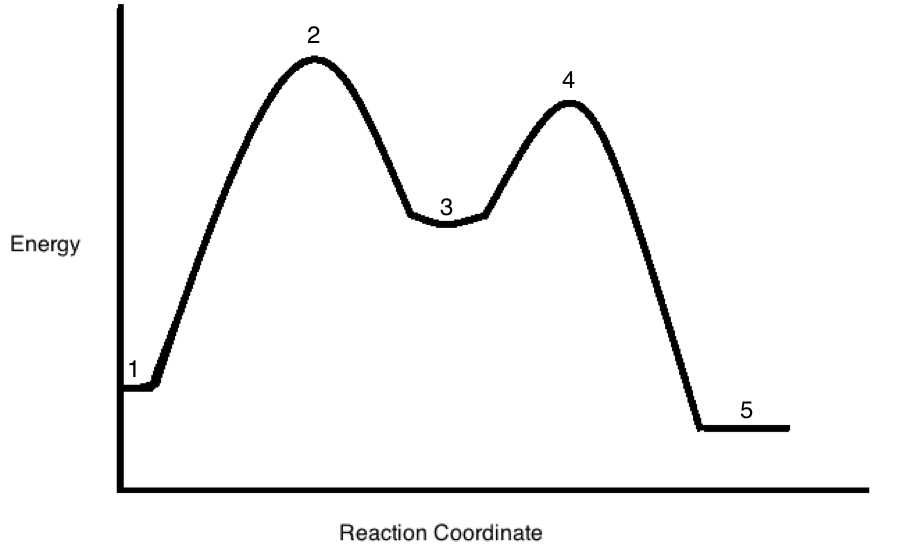
Growing frustrated by his inability to decipher what chemical reaction the student had started, the scientist decides to measure the reaction vessel's temperature. Based only on the above reaction diagram, what is he most likely to find if the reaction is ongoing?
(Assume that the reaction vessel is defined as the system, and that the entropy of the system decreases)
For any given chemical reaction, one can draw an energy diagram. Energy diagrams depict the energy levels of the different steps in a reaction, while also indicating the net change in energy and giving clues to relative reaction rate.
Below, a reaction diagram is shown for a reaction that a scientist is studying in a lab. A student began the reaction the evening before, but the scientist is unsure as to the type of the reaction. He cannot find the student’s notes, except for the reaction diagram below.
Growing frustrated by his inability to decipher what chemical reaction the student had started, the scientist decides to measure the reaction vessel's temperature. Based only on the above reaction diagram, what is he most likely to find if the reaction is ongoing?
(Assume that the reaction vessel is defined as the system, and that the entropy of the system decreases)
Tap to reveal answer
Point 5 is the energy level of the products of the reaction, while point 1 is the energy level of the reactants. Point 5 is lower than is point 1, indicating that the products of this reaction contain lower overall energy than do the reactants. This energy must be released in some form, likely as heat, characteristic of an exothermic reaction.
The question further specifies that there is a local decrease in entropy of the system, thus, the only way that entropy of the universe can increase is to release heat and increase the entropy of the surroundings.
Point 5 is the energy level of the products of the reaction, while point 1 is the energy level of the reactants. Point 5 is lower than is point 1, indicating that the products of this reaction contain lower overall energy than do the reactants. This energy must be released in some form, likely as heat, characteristic of an exothermic reaction.
The question further specifies that there is a local decrease in entropy of the system, thus, the only way that entropy of the universe can increase is to release heat and increase the entropy of the surroundings.
← Didn't Know|Knew It →
The formation of nitrous oxide is a 2-step process.



The overall enthalpy of the reaction is +68kJ.
Given the above information, which of the following statements must be true?
The formation of nitrous oxide is a 2-step process.
The overall enthalpy of the reaction is +68kJ.
Given the above information, which of the following statements must be true?
Tap to reveal answer
When a reaction has a positive enthalpy change, it is said to be endothermic. This means that it requires an addition of heat into the system. Because the forward reaction requires more energy than the reverse reaction in order to take place, we see that the activation energy of the endothermic reaction is greater than the activation energy of the reverse reaction.
Essentially, the forward reaction requires a net input of energy, while the reverse reaction results in a net release of energy.
When a reaction has a positive enthalpy change, it is said to be endothermic. This means that it requires an addition of heat into the system. Because the forward reaction requires more energy than the reverse reaction in order to take place, we see that the activation energy of the endothermic reaction is greater than the activation energy of the reverse reaction.
Essentially, the forward reaction requires a net input of energy, while the reverse reaction results in a net release of energy.
← Didn't Know|Knew It →
When a solution is formed, which of the following is true?
When a solution is formed, which of the following is true?
Tap to reveal answer
When dealing with the enthalpy of a solution, there are three specific steps, each having their own enthalpy.
-
The breaking of solute-solute
-
The breaking of solvent-solvent bonds
-
The formation of solute-solvent bonds
Remember that breaking bonds always requires an input of energy, and is thus considered endothermic. The formation of new bonds is an exothermic process. When an overall solution is exothermic, it means that the new intermolecular bonds are more stable. A system with less energy is considered more stable.
When dealing with the enthalpy of a solution, there are three specific steps, each having their own enthalpy.
-
The breaking of solute-solute
-
The breaking of solvent-solvent bonds
-
The formation of solute-solvent bonds
Remember that breaking bonds always requires an input of energy, and is thus considered endothermic. The formation of new bonds is an exothermic process. When an overall solution is exothermic, it means that the new intermolecular bonds are more stable. A system with less energy is considered more stable.
← Didn't Know|Knew It →

Which of the following is true in the reaction above?
Which of the following is true in the reaction above?
Tap to reveal answer
The process of bond formation in chemistry is exothermic. By definition, exothermic reactions have a negative enthalpy change; therefore  must be less than zero in this bond-forming reaction.
Reducing moles of gas will decrease entropy, meaning that  . If both entropy and enthalpy are negative, as in this reaction, we cannot determine the value of Gibbs free energy without knowing the temperature.

The process of bond formation in chemistry is exothermic. By definition, exothermic reactions have a negative enthalpy change; therefore
Reducing moles of gas will decrease entropy, meaning that
← Didn't Know|Knew It →
A student is performing a reaction with unknown compounds in his chemistry lab. The only information the student knows about the reaction is that it is endothermic and reversible. Using this knowledge alone, how can the student increase the yield of his product?
A student is performing a reaction with unknown compounds in his chemistry lab. The only information the student knows about the reaction is that it is endothermic and reversible. Using this knowledge alone, how can the student increase the yield of his product?
Tap to reveal answer
To answer this question, we need to have a solid understanding of Le Chatelier's principle.
In an endothermic reaction, heat is needed to facilitate the reaction. To increase the products, we want to shift the reaction to the right.

We should already know that adding product or removing reactant shifts the equilibrium to the left, and yields more starting material rather than product. In an endothermic reaction, we can consider heat as a reactant; thus, adding heat (increasing temperature) would allow us to shift the reaction to the right.
Decreasing the temperature, removing reactant, or adding product would all increase the yield of the starting materials.
To answer this question, we need to have a solid understanding of Le Chatelier's principle.
In an endothermic reaction, heat is needed to facilitate the reaction. To increase the products, we want to shift the reaction to the right.
We should already know that adding product or removing reactant shifts the equilibrium to the left, and yields more starting material rather than product. In an endothermic reaction, we can consider heat as a reactant; thus, adding heat (increasing temperature) would allow us to shift the reaction to the right.
Decreasing the temperature, removing reactant, or adding product would all increase the yield of the starting materials.
← Didn't Know|Knew It →
Boiling point is the temperature a liquid needs to achieve in order to begin its transformation into a gaseous state. Campers and hikers who prepare food during their trips have to account for differences in atmospheric pressure as they ascend in elevation. During the ascent, the decrease in atmospheric pressure changes the temperature at which water boils.
Further complicating the matter is the observation that addition of a solute to a pure liquid also changes the boiling point. Raoult’s Law can be used to understand the changes in boiling point if a non-volatile solute is present, as expressed here.

In this law,  is the mole fraction of the solvent,
  is the vapor pressure of the pure solvent, and
  is the vapor pressure of the solution. When this vapor pressure is equal to the local atmospheric pressure, the solution boils.
A scientist is creating a solution to study vapor pressure. When she adds the solute, intermolecular bonds in the solute break to allow the solution to form. The formation of the solution is exothermic. Which of the following is true?
Boiling point is the temperature a liquid needs to achieve in order to begin its transformation into a gaseous state. Campers and hikers who prepare food during their trips have to account for differences in atmospheric pressure as they ascend in elevation. During the ascent, the decrease in atmospheric pressure changes the temperature at which water boils.
Further complicating the matter is the observation that addition of a solute to a pure liquid also changes the boiling point. Raoult’s Law can be used to understand the changes in boiling point if a non-volatile solute is present, as expressed here.
In this law,
A scientist is creating a solution to study vapor pressure. When she adds the solute, intermolecular bonds in the solute break to allow the solution to form. The formation of the solution is exothermic. Which of the following is true?
Tap to reveal answer
Even though the dissolution process is exothermic, breaking bonds ALWAYS requires energy input. In the case of an exothermic dissolution, more energy is released when solute-solvent bonds are formed, than was absorbed when solute-solute bonds were broken. The initial step requires an input of activation energy, but the final product allows for a net energy release.
Even though the dissolution process is exothermic, breaking bonds ALWAYS requires energy input. In the case of an exothermic dissolution, more energy is released when solute-solvent bonds are formed, than was absorbed when solute-solute bonds were broken. The initial step requires an input of activation energy, but the final product allows for a net energy release.
← Didn't Know|Knew It →
Based on the energy diagram, which chemical processes are exothermic?
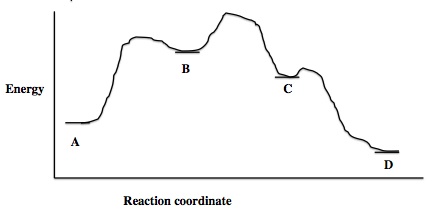
Based on the energy diagram, which chemical processes are exothermic?
Tap to reveal answer
An exothermic process, by definition, involves a reaction in which the products are lower in energy than the reactants. The reduction in chemical energy results in a release of heat from the reaction.
In the diagram, the path between points is irrelevant. We are simply looking for any instances in which the product point is below the reactant point. Point C has less energy than point B, and point D has less energy than A, B, or C. Transitions from B to C, C to D, or A to D will all result in a reduction of chemical energy, and a release of heat.
An exothermic process, by definition, involves a reaction in which the products are lower in energy than the reactants. The reduction in chemical energy results in a release of heat from the reaction.
In the diagram, the path between points is irrelevant. We are simply looking for any instances in which the product point is below the reactant point. Point C has less energy than point B, and point D has less energy than A, B, or C. Transitions from B to C, C to D, or A to D will all result in a reduction of chemical energy, and a release of heat.
← Didn't Know|Knew It →
A system experiences the following energetic changes:



Which of the following is true?
A system experiences the following energetic changes:
Which of the following is true?
Tap to reveal answer
Remember that a negative sign denotes an exothermic process (heat is released into the surroundings), while a positive energy change denotes an endothermic process (heat is absorbed).
Using the given values we can calculate the total energy change of the system:

Since the overall energy change is positive,  of energy is input into the system rather than lost to the surroundings.
Remember that a negative sign denotes an exothermic process (heat is released into the surroundings), while a positive energy change denotes an endothermic process (heat is absorbed).
Using the given values we can calculate the total energy change of the system:
Since the overall energy change is positive,
← Didn't Know|Knew It →
Why does a chemical ice pack feel cold?
Why does a chemical ice pack feel cold?
Tap to reveal answer
Endothermic reactions by definition, require heat as a reactant. By drawing in heat from the surrounding, the surrounding will have a lower temperature compared to air temperature, which is why the ice pack feels cold. If it were an exothermic reaction, the pack would release heat, making the pack feel warm.
Endothermic reactions by definition, require heat as a reactant. By drawing in heat from the surrounding, the surrounding will have a lower temperature compared to air temperature, which is why the ice pack feels cold. If it were an exothermic reaction, the pack would release heat, making the pack feel warm.
← Didn't Know|Knew It →
A scientist prepares an experiment to demonstrate the second law of thermodynamics for a chemistry class. In order to conduct the experiment, the scientist brings the class outside in January and gathers a cup of water and a portable stove.
The temperature outside is –10 degrees Celsius. The scientist asks the students to consider the following when answering his questions:
Gibbs Free Energy Formula:
ΔG = ΔH – TΔS
Liquid-Solid Water Phase Change Reaction:
H2O(l) ⇌ H2O(s) + X
The scientist prepares two scenarios.
Scenario 1:
The scientist buries the cup of water outside in the snow, returns to the classroom with his class for one hour, and the class then checks on the cup. They find that the water has frozen in the cup.
Scenario 2:
The scientist then places the frozen cup of water on the stove and starts the gas. The class finds that the water melts quickly.
After the water melts, the scientist asks the students to consider two hypothetical scenarios as a thought experiment.
Scenario 3:
Once the liquid water at the end of scenario 2 melts completely, the scientist turns off the gas and monitors what happens to the water. Despite being in the cold air, the water never freezes.
Scenario 4:
The scientist takes the frozen water from the end of scenario 1, puts it on the active stove, and the water remains frozen.
In scenario 2, the reaction that water undergoes would best be characterized as .
A scientist prepares an experiment to demonstrate the second law of thermodynamics for a chemistry class. In order to conduct the experiment, the scientist brings the class outside in January and gathers a cup of water and a portable stove.
The temperature outside is –10 degrees Celsius. The scientist asks the students to consider the following when answering his questions:
Gibbs Free Energy Formula:
ΔG = ΔH – TΔS
Liquid-Solid Water Phase Change Reaction:
H2O(l) ⇌ H2O(s) + X
The scientist prepares two scenarios.
Scenario 1:
The scientist buries the cup of water outside in the snow, returns to the classroom with his class for one hour, and the class then checks on the cup. They find that the water has frozen in the cup.
Scenario 2:
The scientist then places the frozen cup of water on the stove and starts the gas. The class finds that the water melts quickly.
After the water melts, the scientist asks the students to consider two hypothetical scenarios as a thought experiment.
Scenario 3:
Once the liquid water at the end of scenario 2 melts completely, the scientist turns off the gas and monitors what happens to the water. Despite being in the cold air, the water never freezes.
Scenario 4:
The scientist takes the frozen water from the end of scenario 1, puts it on the active stove, and the water remains frozen.
In scenario 2, the reaction that water undergoes would best be characterized as .
Tap to reveal answer
The "reaction that water undergoes" is melting. Melting is endothermic, as the reaction written in the pre-question passage illustrates. Standard conditions are defined as 0C and 1 atm of pressure. Water freezes at 0C, and thus the melting reaction is nonspontaneous at these conditions.
The "reaction that water undergoes" is melting. Melting is endothermic, as the reaction written in the pre-question passage illustrates. Standard conditions are defined as 0C and 1 atm of pressure. Water freezes at 0C, and thus the melting reaction is nonspontaneous at these conditions.
← Didn't Know|Knew It →
Electronegativity is an important concept in physical chemistry, and often used to help quantify the dipole moment of polar compounds. Polar compounds are different from those compounds that are purely nonpolar or purely ionic. An example can be seen by contrasting sodium chloride, NaCl, with an organic molecule, R-C-OH. The former is purely ionic, and the latter is polar covalent.
When comparing more than one polar covalent molecule, we use the dipole moment value to help us determine relative strength of polarity. Dipole moment, however, is dependent on the electronegativity of the atoms making up the bond. Electronegativity is a property inherent to the atom in question, whereas dipole moment is a property of the bond between them.
For example, oxygen has an electronegativity of 3.44, and hydrogen of 2.20. In other words, oxygen more strongly attracts electrons when in a bond with hydrogen. This leads to the O-H bond having a dipole moment.
When all the dipole moments of polar bonds in a molecule are summed, the molecular dipole moment results, as per the following equation.
Dipole moment = charge * separation distance
A scientist decides that the polar nature of water means that it will be useful to help him investigate the solution chemistry of a salt. He dissolves the salt in water, and is surprised to find that the beaker becomes very hot to the touch. Which of the following is likely true of this reaction?
Assume the system is defined as the beaker with the solute and solvent.
Electronegativity is an important concept in physical chemistry, and often used to help quantify the dipole moment of polar compounds. Polar compounds are different from those compounds that are purely nonpolar or purely ionic. An example can be seen by contrasting sodium chloride, NaCl, with an organic molecule, R-C-OH. The former is purely ionic, and the latter is polar covalent.
When comparing more than one polar covalent molecule, we use the dipole moment value to help us determine relative strength of polarity. Dipole moment, however, is dependent on the electronegativity of the atoms making up the bond. Electronegativity is a property inherent to the atom in question, whereas dipole moment is a property of the bond between them.
For example, oxygen has an electronegativity of 3.44, and hydrogen of 2.20. In other words, oxygen more strongly attracts electrons when in a bond with hydrogen. This leads to the O-H bond having a dipole moment.
When all the dipole moments of polar bonds in a molecule are summed, the molecular dipole moment results, as per the following equation.
Dipole moment = charge * separation distance
A scientist decides that the polar nature of water means that it will be useful to help him investigate the solution chemistry of a salt. He dissolves the salt in water, and is surprised to find that the beaker becomes very hot to the touch. Which of the following is likely true of this reaction?
Assume the system is defined as the beaker with the solute and solvent.
Tap to reveal answer
Energy is always released when bonds form, and always absorbed when bonds break. In the situation described in the question, heat is released when the salt dissolves because energy is released when the water forms dipole-based bonds with the newly dissolved ions. This energy is larger in magnitude than the energy that is absorbed to break the ionic bonds in the salt, thus, there is a net flow of heat out of the system.
The entropy of the system must not necessarily increase in this case, because the entropy of the universe is increasing owing to the release of heat. This could be enough to offset a local decrease in entropy in the system.
Energy is always released when bonds form, and always absorbed when bonds break. In the situation described in the question, heat is released when the salt dissolves because energy is released when the water forms dipole-based bonds with the newly dissolved ions. This energy is larger in magnitude than the energy that is absorbed to break the ionic bonds in the salt, thus, there is a net flow of heat out of the system.
The entropy of the system must not necessarily increase in this case, because the entropy of the universe is increasing owing to the release of heat. This could be enough to offset a local decrease in entropy in the system.
← Didn't Know|Knew It →
5.6g of manganese reacts with 650mL of 6.0M hydrochloric acid to form manganese (V) chloride and hydrogen gas. Along with the products, a large amount of heat is evolved.
This reaction is classified as .
5.6g of manganese reacts with 650mL of 6.0M hydrochloric acid to form manganese (V) chloride and hydrogen gas. Along with the products, a large amount of heat is evolved.
This reaction is classified as .
Tap to reveal answer
Any reaction in which heat is evolved (released) is classified as exothermic. The change in heat content () is negative for this type of reaction.
Any reaction in which heat is evolved (released) is classified as exothermic. The change in heat content (
← Didn't Know|Knew It →
Is the reaction above endothermic or exothermic?
Is the reaction above endothermic or exothermic?
Tap to reveal answer
The reaction is an exothermic reaction, since the heat is added on the products side. An endothermic reaction would have the heat on the reactants side. An increase in heat in this reaction would cause the Keq to decrease, and there will be a shift to the left of the reaction (toward the reactants).
Remember that Keq is dependent on temperature, and can be affected by changes in heat. Keep in mind, also, that the reverse reaction that occurs during the leftward shift will be endothermic, using the additional heat as a reactant rather than a product.
The reaction is an exothermic reaction, since the heat is added on the products side. An endothermic reaction would have the heat on the reactants side. An increase in heat in this reaction would cause the Keq to decrease, and there will be a shift to the left of the reaction (toward the reactants).
Remember that Keq is dependent on temperature, and can be affected by changes in heat. Keep in mind, also, that the reverse reaction that occurs during the leftward shift will be endothermic, using the additional heat as a reactant rather than a product.
← Didn't Know|Knew It →
For any given chemical reaction, one can draw an energy diagram. Energy diagrams depict the energy levels of the different steps in a reaction, while also indicating the net change in energy and giving clues to relative reaction rate.
Below, a reaction diagram is shown for a reaction that a scientist is studying in a lab. A student began the reaction the evening before, but the scientist is unsure as to the type of the reaction. He cannot find the student’s notes, except for the reaction diagram below.
Growing frustrated by his inability to decipher what chemical reaction the student had started, the scientist decides to measure the reaction vessel's temperature. Based only on the above reaction diagram, what is he most likely to find if the reaction is ongoing?
(Assume that the reaction vessel is defined as the system, and that the entropy of the system decreases)
For any given chemical reaction, one can draw an energy diagram. Energy diagrams depict the energy levels of the different steps in a reaction, while also indicating the net change in energy and giving clues to relative reaction rate.
Below, a reaction diagram is shown for a reaction that a scientist is studying in a lab. A student began the reaction the evening before, but the scientist is unsure as to the type of the reaction. He cannot find the student’s notes, except for the reaction diagram below.
Growing frustrated by his inability to decipher what chemical reaction the student had started, the scientist decides to measure the reaction vessel's temperature. Based only on the above reaction diagram, what is he most likely to find if the reaction is ongoing?
(Assume that the reaction vessel is defined as the system, and that the entropy of the system decreases)
Tap to reveal answer
Point 5 is the energy level of the products of the reaction, while point 1 is the energy level of the reactants. Point 5 is lower than is point 1, indicating that the products of this reaction contain lower overall energy than do the reactants. This energy must be released in some form, likely as heat, characteristic of an exothermic reaction.
The question further specifies that there is a local decrease in entropy of the system, thus, the only way that entropy of the universe can increase is to release heat and increase the entropy of the surroundings.
Point 5 is the energy level of the products of the reaction, while point 1 is the energy level of the reactants. Point 5 is lower than is point 1, indicating that the products of this reaction contain lower overall energy than do the reactants. This energy must be released in some form, likely as heat, characteristic of an exothermic reaction.
The question further specifies that there is a local decrease in entropy of the system, thus, the only way that entropy of the universe can increase is to release heat and increase the entropy of the surroundings.
← Didn't Know|Knew It →
The formation of nitrous oxide is a 2-step process.
The overall enthalpy of the reaction is +68kJ.
Given the above information, which of the following statements must be true?
The formation of nitrous oxide is a 2-step process.
The overall enthalpy of the reaction is +68kJ.
Given the above information, which of the following statements must be true?
Tap to reveal answer
When a reaction has a positive enthalpy change, it is said to be endothermic. This means that it requires an addition of heat into the system. Because the forward reaction requires more energy than the reverse reaction in order to take place, we see that the activation energy of the endothermic reaction is greater than the activation energy of the reverse reaction.
Essentially, the forward reaction requires a net input of energy, while the reverse reaction results in a net release of energy.
When a reaction has a positive enthalpy change, it is said to be endothermic. This means that it requires an addition of heat into the system. Because the forward reaction requires more energy than the reverse reaction in order to take place, we see that the activation energy of the endothermic reaction is greater than the activation energy of the reverse reaction.
Essentially, the forward reaction requires a net input of energy, while the reverse reaction results in a net release of energy.
← Didn't Know|Knew It →
When a solution is formed, which of the following is true?
When a solution is formed, which of the following is true?
Tap to reveal answer
When dealing with the enthalpy of a solution, there are three specific steps, each having their own enthalpy.
-
The breaking of solute-solute
-
The breaking of solvent-solvent bonds
-
The formation of solute-solvent bonds
Remember that breaking bonds always requires an input of energy, and is thus considered endothermic. The formation of new bonds is an exothermic process. When an overall solution is exothermic, it means that the new intermolecular bonds are more stable. A system with less energy is considered more stable.
When dealing with the enthalpy of a solution, there are three specific steps, each having their own enthalpy.
-
The breaking of solute-solute
-
The breaking of solvent-solvent bonds
-
The formation of solute-solvent bonds
Remember that breaking bonds always requires an input of energy, and is thus considered endothermic. The formation of new bonds is an exothermic process. When an overall solution is exothermic, it means that the new intermolecular bonds are more stable. A system with less energy is considered more stable.
← Didn't Know|Knew It →