Covalent Bonds - MCAT Chemical and Physical Foundations of Biological Systems
Card 1 of 70
Diffusion can be defined as the net transfer of molecules down a gradient of differing concentrations. This is a passive and spontaneous process and relies on the random movement of molecules and Brownian motion. Diffusion is an important biological process, especially in the respiratory system where oxygen diffuses from alveoli, the basic unit of lung mechanics, to red blood cells in the capillaries.
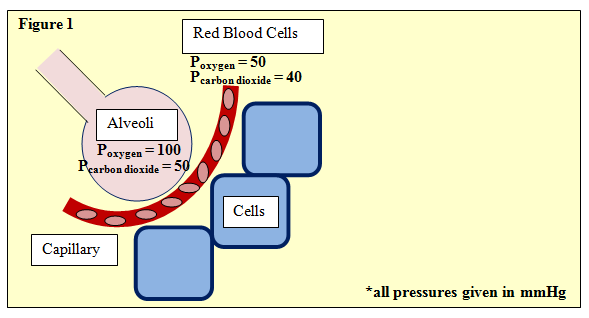
Figure 1 depicts this process, showing an alveoli separated from neighboring cells by a capillary with red blood cells. The partial pressures of oxygen and carbon dioxide are given. One such equation used in determining gas exchange is Fick's law, given by:
ΔV = (Area/Thickness) · Dgas · (P1 – P2)
Where ΔV is flow rate and area and thickness refer to the permeable membrane through which the gas passes, in this case, the wall of the avlveoli. P1 and P2 refer to the partial pressures upstream and downstream, respectively. Further, Dgas, the diffusion constant of the gas, is defined as:
Dgas = Solubility / (Molecular Weight)^(1/2)
Carbon dioxide and oxygen have which type of intra-molecular bonds?
Diffusion can be defined as the net transfer of molecules down a gradient of differing concentrations. This is a passive and spontaneous process and relies on the random movement of molecules and Brownian motion. Diffusion is an important biological process, especially in the respiratory system where oxygen diffuses from alveoli, the basic unit of lung mechanics, to red blood cells in the capillaries.
Figure 1 depicts this process, showing an alveoli separated from neighboring cells by a capillary with red blood cells. The partial pressures of oxygen and carbon dioxide are given. One such equation used in determining gas exchange is Fick's law, given by:
ΔV = (Area/Thickness) · Dgas · (P1 – P2)
Where ΔV is flow rate and area and thickness refer to the permeable membrane through which the gas passes, in this case, the wall of the avlveoli. P1 and P2 refer to the partial pressures upstream and downstream, respectively. Further, Dgas, the diffusion constant of the gas, is defined as:
Dgas = Solubility / (Molecular Weight)^(1/2)
Carbon dioxide and oxygen have which type of intra-molecular bonds?
Tap to reveal answer
Note how this question has little to do with the passage. Often you will see questions like this on the MCAT. This is a simple, straightforward vocabulary question. The bonds between each compound are covalent. One might get confused and misunderstand the question to read inter-molecular bonds—those between different molecules—as opposed to the bonds within a molecule.
Note how this question has little to do with the passage. Often you will see questions like this on the MCAT. This is a simple, straightforward vocabulary question. The bonds between each compound are covalent. One might get confused and misunderstand the question to read inter-molecular bonds—those between different molecules—as opposed to the bonds within a molecule.
← Didn't Know|Knew It →
Electronegativity is an important concept in physical chemistry, and often used to help quantify the dipole moment of polar compounds. Polar compounds are different from those compounds that are purely nonpolar or purely ionic. An example can be seen by contrasting sodium chloride, NaCl, with an organic molecule, R-C-OH. The former is purely ionic, and the latter is polar covalent.
When comparing more than one polar covalent molecule, we use the dipole moment value to help us determine relative strength of polarity. Dipole moment, however, is dependent on the electronegativity of the atoms making up the bond. Electronegativity is a property inherent to the atom in question, whereas dipole moment is a property of the bond between them.
For example, oxygen has an electronegativity of 3.44, and hydrogen of 2.20. In other words, oxygen more strongly attracts electrons when in a bond with hydrogen. This leads to the O-H bond having a dipole moment.
When all the dipole moments of polar bonds in a molecule are summed, the molecular dipole moment results, as per the following equation.
Dipole moment = charge * separation distance
Water is commonly called the universal solvent, in part due to its relatively strong molecular dipole moment. What is true of the oxygen atom in water's O-H bonds?
Electronegativity is an important concept in physical chemistry, and often used to help quantify the dipole moment of polar compounds. Polar compounds are different from those compounds that are purely nonpolar or purely ionic. An example can be seen by contrasting sodium chloride, NaCl, with an organic molecule, R-C-OH. The former is purely ionic, and the latter is polar covalent.
When comparing more than one polar covalent molecule, we use the dipole moment value to help us determine relative strength of polarity. Dipole moment, however, is dependent on the electronegativity of the atoms making up the bond. Electronegativity is a property inherent to the atom in question, whereas dipole moment is a property of the bond between them.
For example, oxygen has an electronegativity of 3.44, and hydrogen of 2.20. In other words, oxygen more strongly attracts electrons when in a bond with hydrogen. This leads to the O-H bond having a dipole moment.
When all the dipole moments of polar bonds in a molecule are summed, the molecular dipole moment results, as per the following equation.
Dipole moment = charge * separation distance
Water is commonly called the universal solvent, in part due to its relatively strong molecular dipole moment. What is true of the oxygen atom in water's O-H bonds?
Tap to reveal answer
The oxygen atom in water has two lone pairs, though they are not as often drawn into depictions of the molecule as they are in nitgrogenous molecules, such as ammonia. They, along with the two bonds formed with hydrogen in stable water, make up the satisfied octet of oxygen.
The oxygen atom in water has two lone pairs, though they are not as often drawn into depictions of the molecule as they are in nitgrogenous molecules, such as ammonia. They, along with the two bonds formed with hydrogen in stable water, make up the satisfied octet of oxygen.
← Didn't Know|Knew It →
Which is not a property of covalent compounds?
Which is not a property of covalent compounds?
Tap to reveal answer
The incorrect statement is a property of ionic compounds rather than covalent. Recall that electronegativity is a measure of the ability of an atom to draw electrons to itself. Ionic compounds are formed by elements with very different electronegativities, since elements with different electronegativities will tend to form positive and negative ions (that is, they give away or gain electrons easily). In contrast, covalent bonds are formed by elements which are close in electronegativity and could exist as stable free molecules. All other statements are true of covalent compounds.
The incorrect statement is a property of ionic compounds rather than covalent. Recall that electronegativity is a measure of the ability of an atom to draw electrons to itself. Ionic compounds are formed by elements with very different electronegativities, since elements with different electronegativities will tend to form positive and negative ions (that is, they give away or gain electrons easily). In contrast, covalent bonds are formed by elements which are close in electronegativity and could exist as stable free molecules. All other statements are true of covalent compounds.
← Didn't Know|Knew It →
Which of the folling carbon-carbon bonds exhibits the stongest bond?
Which of the folling carbon-carbon bonds exhibits the stongest bond?
Tap to reveal answer
The suffix -yne tells us that this is an aklyne and contains a carbon-carbon triple bond. Ethyne has the stongest carbon-carbon bond because it has the shortest bond length. It is important to remember that as the bond length gets shorter, the bond strength increases, and vice versa.
The suffix -yne tells us that this is an aklyne and contains a carbon-carbon triple bond. Ethyne has the stongest carbon-carbon bond because it has the shortest bond length. It is important to remember that as the bond length gets shorter, the bond strength increases, and vice versa.
← Didn't Know|Knew It →
What type of bond does O2 have?
What type of bond does O2 have?
Tap to reveal answer
O2 has a nonpolar covalent bond. Nonpolar covalent bonds are bonds formed between atoms that have the same (or nearly the same) electronegativity. Since both oxygen atoms have the same electronegativity, they will have a nonpolar covalent bond between them.
O2 has a nonpolar covalent bond. Nonpolar covalent bonds are bonds formed between atoms that have the same (or nearly the same) electronegativity. Since both oxygen atoms have the same electronegativity, they will have a nonpolar covalent bond between them.
← Didn't Know|Knew It →
What type of bonds form between the two hydrogen atoms and one oxygen atom within a single water molucule?
What type of bonds form between the two hydrogen atoms and one oxygen atom within a single water molucule?
Tap to reveal answer
The intramolecular bonds within a water molecule are polar covalent bonds. O-H bonds are polar covalent since there is more electron density around the oxygen atom than there is around the hydrogen atom, making the oxygen atom slightly negative and the hydrogen atom slighty positive. This polarity allows for intermolecular hydrogen bonding; water does not exhibit intramolecular hydrogen bonding.
This bond is not ionic since the oxygen does not completly steal the electron away from the hydrogen (the electronegativity difference between the two atoms is between 0.4 and 1.7 on the Pauling scale).
The intramolecular bonds within a water molecule are polar covalent bonds. O-H bonds are polar covalent since there is more electron density around the oxygen atom than there is around the hydrogen atom, making the oxygen atom slightly negative and the hydrogen atom slighty positive. This polarity allows for intermolecular hydrogen bonding; water does not exhibit intramolecular hydrogen bonding.
This bond is not ionic since the oxygen does not completly steal the electron away from the hydrogen (the electronegativity difference between the two atoms is between 0.4 and 1.7 on the Pauling scale).
← Didn't Know|Knew It →
Which of the following molecules contains polar, covalent bonds?
I. 
II. 
III. 
IV. 
V. 
Which of the following molecules contains polar, covalent bonds?
I.
II.
III.
IV.
V.
Tap to reveal answer
 is an ionic compound, while
  is a nonpolar covalent compound. Remember that polarity results from a difference in the electronegativities of the atoms involved in the bond. Too great of a difference will result in an ionic bond; two of the same atoms will have zero difference, resulting in a nonpolar bond.
 ,
,  , and
, and  contain polar covalent bonds. In the first two, oxygen will carry a slight negative charge, leaving sulfate and phosphorus with slight positive charges. In
  , chlorine will carry a slight negative charge, leaving the carbon slightly positive. In
  and
and  , symmetry helps to balance the polar bonds, resulting in an overall nonpolar molecule, even though the individual bonds are nonpolar.
← Didn't Know|Knew It →
Which of the following molecules contains the shortest bond between nitrogen and oxygen?
Which of the following molecules contains the shortest bond between nitrogen and oxygen?
Tap to reveal answer
This question is testing your ability to draw Lewis dot structures and your knowledge of how resonance effects bond length. The N-O bond with the greatest pi-bond character will be the shortest; thus, we are looking for a double- or triple-bond between nitrogen and oxygen.
Hydroxylamine ( ) only contains single bonds, which have the least pi-bond character.
The nitrite and nitrate ions both have a double bond between the nitrogen and oxygen, but also one or more single bonds between these elements. This means that, because of resonance, the N-O bonds in these molecules will be averaged and our average bond order will be somewhere between single and double. Nitrate will have one double bond and two single bonds, for an average bond order of 1.33. Nitrite has one single bond and one double bond, for a bond order of 1.5.
The nitrosyl ion, however, will contain a triple bonds between the nitrogen and oxygen atoms, giving it the greatest pi-bond character. This bond will contain more energy and be shorter than the bonds in the other answer options.
This question is testing your ability to draw Lewis dot structures and your knowledge of how resonance effects bond length. The N-O bond with the greatest pi-bond character will be the shortest; thus, we are looking for a double- or triple-bond between nitrogen and oxygen.
Hydroxylamine (
The nitrite and nitrate ions both have a double bond between the nitrogen and oxygen, but also one or more single bonds between these elements. This means that, because of resonance, the N-O bonds in these molecules will be averaged and our average bond order will be somewhere between single and double. Nitrate will have one double bond and two single bonds, for an average bond order of 1.33. Nitrite has one single bond and one double bond, for a bond order of 1.5.
The nitrosyl ion, however, will contain a triple bonds between the nitrogen and oxygen atoms, giving it the greatest pi-bond character. This bond will contain more energy and be shorter than the bonds in the other answer options.
← Didn't Know|Knew It →
When covalent bonds are formed .
When covalent bonds are formed .
Tap to reveal answer
Covalency is a form of electron sharing that lets an atom fulfill the octet rule. The sharing may be unequal, in which case the more electronegative species more strongly attracts the electrons than the weaker, less electronegative species, creating a polar covalent bond. In the Lewis dot model, however, we draw the electrons in freeze-frame, equally distributed between the various atoms.
Covalency is a form of electron sharing that lets an atom fulfill the octet rule. The sharing may be unequal, in which case the more electronegative species more strongly attracts the electrons than the weaker, less electronegative species, creating a polar covalent bond. In the Lewis dot model, however, we draw the electrons in freeze-frame, equally distributed between the various atoms.
← Didn't Know|Knew It →
Which of the following represents a triple bond?
Which of the following represents a triple bond?
Tap to reveal answer
A sigma bond is a single covalent bond, involving an electron pair located between the two bonding atoms. A pi bond occurs when the p orbitals above and below the bonding atoms overlap, or when the p orbitals to the left and right overlap. In any covalent bond, the first bond formed is a sigma bond and any additional bonds must be pi bonds. Initial orbital overlap always comes from the sigma, or s, subshell; subsequent overlap comes from the pi, or p, subshells.
A sigma bond is a single covalent bond, involving an electron pair located between the two bonding atoms. A pi bond occurs when the p orbitals above and below the bonding atoms overlap, or when the p orbitals to the left and right overlap. In any covalent bond, the first bond formed is a sigma bond and any additional bonds must be pi bonds. Initial orbital overlap always comes from the sigma, or s, subshell; subsequent overlap comes from the pi, or p, subshells.
← Didn't Know|Knew It →
Diffusion can be defined as the net transfer of molecules down a gradient of differing concentrations. This is a passive and spontaneous process and relies on the random movement of molecules and Brownian motion. Diffusion is an important biological process, especially in the respiratory system where oxygen diffuses from alveoli, the basic unit of lung mechanics, to red blood cells in the capillaries.
Figure 1 depicts this process, showing an alveoli separated from neighboring cells by a capillary with red blood cells. The partial pressures of oxygen and carbon dioxide are given. One such equation used in determining gas exchange is Fick's law, given by:
ΔV = (Area/Thickness) · Dgas · (P1 – P2)
Where ΔV is flow rate and area and thickness refer to the permeable membrane through which the gas passes, in this case, the wall of the avlveoli. P1 and P2 refer to the partial pressures upstream and downstream, respectively. Further, Dgas, the diffusion constant of the gas, is defined as:
Dgas = Solubility / (Molecular Weight)^(1/2)
Carbon dioxide and oxygen have which type of intra-molecular bonds?
Diffusion can be defined as the net transfer of molecules down a gradient of differing concentrations. This is a passive and spontaneous process and relies on the random movement of molecules and Brownian motion. Diffusion is an important biological process, especially in the respiratory system where oxygen diffuses from alveoli, the basic unit of lung mechanics, to red blood cells in the capillaries.
Figure 1 depicts this process, showing an alveoli separated from neighboring cells by a capillary with red blood cells. The partial pressures of oxygen and carbon dioxide are given. One such equation used in determining gas exchange is Fick's law, given by:
ΔV = (Area/Thickness) · Dgas · (P1 – P2)
Where ΔV is flow rate and area and thickness refer to the permeable membrane through which the gas passes, in this case, the wall of the avlveoli. P1 and P2 refer to the partial pressures upstream and downstream, respectively. Further, Dgas, the diffusion constant of the gas, is defined as:
Dgas = Solubility / (Molecular Weight)^(1/2)
Carbon dioxide and oxygen have which type of intra-molecular bonds?
Tap to reveal answer
Note how this question has little to do with the passage. Often you will see questions like this on the MCAT. This is a simple, straightforward vocabulary question. The bonds between each compound are covalent. One might get confused and misunderstand the question to read inter-molecular bonds—those between different molecules—as opposed to the bonds within a molecule.
Note how this question has little to do with the passage. Often you will see questions like this on the MCAT. This is a simple, straightforward vocabulary question. The bonds between each compound are covalent. One might get confused and misunderstand the question to read inter-molecular bonds—those between different molecules—as opposed to the bonds within a molecule.
← Didn't Know|Knew It →
Electronegativity is an important concept in physical chemistry, and often used to help quantify the dipole moment of polar compounds. Polar compounds are different from those compounds that are purely nonpolar or purely ionic. An example can be seen by contrasting sodium chloride, NaCl, with an organic molecule, R-C-OH. The former is purely ionic, and the latter is polar covalent.
When comparing more than one polar covalent molecule, we use the dipole moment value to help us determine relative strength of polarity. Dipole moment, however, is dependent on the electronegativity of the atoms making up the bond. Electronegativity is a property inherent to the atom in question, whereas dipole moment is a property of the bond between them.
For example, oxygen has an electronegativity of 3.44, and hydrogen of 2.20. In other words, oxygen more strongly attracts electrons when in a bond with hydrogen. This leads to the O-H bond having a dipole moment.
When all the dipole moments of polar bonds in a molecule are summed, the molecular dipole moment results, as per the following equation.
Dipole moment = charge * separation distance
Water is commonly called the universal solvent, in part due to its relatively strong molecular dipole moment. What is true of the oxygen atom in water's O-H bonds?
Electronegativity is an important concept in physical chemistry, and often used to help quantify the dipole moment of polar compounds. Polar compounds are different from those compounds that are purely nonpolar or purely ionic. An example can be seen by contrasting sodium chloride, NaCl, with an organic molecule, R-C-OH. The former is purely ionic, and the latter is polar covalent.
When comparing more than one polar covalent molecule, we use the dipole moment value to help us determine relative strength of polarity. Dipole moment, however, is dependent on the electronegativity of the atoms making up the bond. Electronegativity is a property inherent to the atom in question, whereas dipole moment is a property of the bond between them.
For example, oxygen has an electronegativity of 3.44, and hydrogen of 2.20. In other words, oxygen more strongly attracts electrons when in a bond with hydrogen. This leads to the O-H bond having a dipole moment.
When all the dipole moments of polar bonds in a molecule are summed, the molecular dipole moment results, as per the following equation.
Dipole moment = charge * separation distance
Water is commonly called the universal solvent, in part due to its relatively strong molecular dipole moment. What is true of the oxygen atom in water's O-H bonds?
Tap to reveal answer
The oxygen atom in water has two lone pairs, though they are not as often drawn into depictions of the molecule as they are in nitgrogenous molecules, such as ammonia. They, along with the two bonds formed with hydrogen in stable water, make up the satisfied octet of oxygen.
The oxygen atom in water has two lone pairs, though they are not as often drawn into depictions of the molecule as they are in nitgrogenous molecules, such as ammonia. They, along with the two bonds formed with hydrogen in stable water, make up the satisfied octet of oxygen.
← Didn't Know|Knew It →
Which is not a property of covalent compounds?
Which is not a property of covalent compounds?
Tap to reveal answer
The incorrect statement is a property of ionic compounds rather than covalent. Recall that electronegativity is a measure of the ability of an atom to draw electrons to itself. Ionic compounds are formed by elements with very different electronegativities, since elements with different electronegativities will tend to form positive and negative ions (that is, they give away or gain electrons easily). In contrast, covalent bonds are formed by elements which are close in electronegativity and could exist as stable free molecules. All other statements are true of covalent compounds.
The incorrect statement is a property of ionic compounds rather than covalent. Recall that electronegativity is a measure of the ability of an atom to draw electrons to itself. Ionic compounds are formed by elements with very different electronegativities, since elements with different electronegativities will tend to form positive and negative ions (that is, they give away or gain electrons easily). In contrast, covalent bonds are formed by elements which are close in electronegativity and could exist as stable free molecules. All other statements are true of covalent compounds.
← Didn't Know|Knew It →
Which of the folling carbon-carbon bonds exhibits the stongest bond?
Which of the folling carbon-carbon bonds exhibits the stongest bond?
Tap to reveal answer
The suffix -yne tells us that this is an aklyne and contains a carbon-carbon triple bond. Ethyne has the stongest carbon-carbon bond because it has the shortest bond length. It is important to remember that as the bond length gets shorter, the bond strength increases, and vice versa.
The suffix -yne tells us that this is an aklyne and contains a carbon-carbon triple bond. Ethyne has the stongest carbon-carbon bond because it has the shortest bond length. It is important to remember that as the bond length gets shorter, the bond strength increases, and vice versa.
← Didn't Know|Knew It →
What type of bond does O2 have?
What type of bond does O2 have?
Tap to reveal answer
O2 has a nonpolar covalent bond. Nonpolar covalent bonds are bonds formed between atoms that have the same (or nearly the same) electronegativity. Since both oxygen atoms have the same electronegativity, they will have a nonpolar covalent bond between them.
O2 has a nonpolar covalent bond. Nonpolar covalent bonds are bonds formed between atoms that have the same (or nearly the same) electronegativity. Since both oxygen atoms have the same electronegativity, they will have a nonpolar covalent bond between them.
← Didn't Know|Knew It →
What type of bonds form between the two hydrogen atoms and one oxygen atom within a single water molucule?
What type of bonds form between the two hydrogen atoms and one oxygen atom within a single water molucule?
Tap to reveal answer
The intramolecular bonds within a water molecule are polar covalent bonds. O-H bonds are polar covalent since there is more electron density around the oxygen atom than there is around the hydrogen atom, making the oxygen atom slightly negative and the hydrogen atom slighty positive. This polarity allows for intermolecular hydrogen bonding; water does not exhibit intramolecular hydrogen bonding.
This bond is not ionic since the oxygen does not completly steal the electron away from the hydrogen (the electronegativity difference between the two atoms is between 0.4 and 1.7 on the Pauling scale).
The intramolecular bonds within a water molecule are polar covalent bonds. O-H bonds are polar covalent since there is more electron density around the oxygen atom than there is around the hydrogen atom, making the oxygen atom slightly negative and the hydrogen atom slighty positive. This polarity allows for intermolecular hydrogen bonding; water does not exhibit intramolecular hydrogen bonding.
This bond is not ionic since the oxygen does not completly steal the electron away from the hydrogen (the electronegativity difference between the two atoms is between 0.4 and 1.7 on the Pauling scale).
← Didn't Know|Knew It →
Which of the following molecules contains polar, covalent bonds?
I.
II.
III.
IV.
V.
Which of the following molecules contains polar, covalent bonds?
I.
II.
III.
IV.
V.
Tap to reveal answer
is an ionic compound, while is a nonpolar covalent compound. Remember that polarity results from a difference in the electronegativities of the atoms involved in the bond. Too great of a difference will result in an ionic bond; two of the same atoms will have zero difference, resulting in a nonpolar bond.
, , and contain polar covalent bonds. In the first two, oxygen will carry a slight negative charge, leaving sulfate and phosphorus with slight positive charges. In , chlorine will carry a slight negative charge, leaving the carbon slightly positive. In and , symmetry helps to balance the polar bonds, resulting in an overall nonpolar molecule, even though the individual bonds are nonpolar.
← Didn't Know|Knew It →
Which of the following molecules contains the shortest bond between nitrogen and oxygen?
Which of the following molecules contains the shortest bond between nitrogen and oxygen?
Tap to reveal answer
This question is testing your ability to draw Lewis dot structures and your knowledge of how resonance effects bond length. The N-O bond with the greatest pi-bond character will be the shortest; thus, we are looking for a double- or triple-bond between nitrogen and oxygen.
Hydroxylamine () only contains single bonds, which have the least pi-bond character.
The nitrite and nitrate ions both have a double bond between the nitrogen and oxygen, but also one or more single bonds between these elements. This means that, because of resonance, the N-O bonds in these molecules will be averaged and our average bond order will be somewhere between single and double. Nitrate will have one double bond and two single bonds, for an average bond order of 1.33. Nitrite has one single bond and one double bond, for a bond order of 1.5.
The nitrosyl ion, however, will contain a triple bonds between the nitrogen and oxygen atoms, giving it the greatest pi-bond character. This bond will contain more energy and be shorter than the bonds in the other answer options.
This question is testing your ability to draw Lewis dot structures and your knowledge of how resonance effects bond length. The N-O bond with the greatest pi-bond character will be the shortest; thus, we are looking for a double- or triple-bond between nitrogen and oxygen.
Hydroxylamine (
The nitrite and nitrate ions both have a double bond between the nitrogen and oxygen, but also one or more single bonds between these elements. This means that, because of resonance, the N-O bonds in these molecules will be averaged and our average bond order will be somewhere between single and double. Nitrate will have one double bond and two single bonds, for an average bond order of 1.33. Nitrite has one single bond and one double bond, for a bond order of 1.5.
The nitrosyl ion, however, will contain a triple bonds between the nitrogen and oxygen atoms, giving it the greatest pi-bond character. This bond will contain more energy and be shorter than the bonds in the other answer options.
← Didn't Know|Knew It →
When covalent bonds are formed .
When covalent bonds are formed .
Tap to reveal answer
Covalency is a form of electron sharing that lets an atom fulfill the octet rule. The sharing may be unequal, in which case the more electronegative species more strongly attracts the electrons than the weaker, less electronegative species, creating a polar covalent bond. In the Lewis dot model, however, we draw the electrons in freeze-frame, equally distributed between the various atoms.
Covalency is a form of electron sharing that lets an atom fulfill the octet rule. The sharing may be unequal, in which case the more electronegative species more strongly attracts the electrons than the weaker, less electronegative species, creating a polar covalent bond. In the Lewis dot model, however, we draw the electrons in freeze-frame, equally distributed between the various atoms.
← Didn't Know|Knew It →
Which of the following represents a triple bond?
Which of the following represents a triple bond?
Tap to reveal answer
A sigma bond is a single covalent bond, involving an electron pair located between the two bonding atoms. A pi bond occurs when the p orbitals above and below the bonding atoms overlap, or when the p orbitals to the left and right overlap. In any covalent bond, the first bond formed is a sigma bond and any additional bonds must be pi bonds. Initial orbital overlap always comes from the sigma, or s, subshell; subsequent overlap comes from the pi, or p, subshells.
A sigma bond is a single covalent bond, involving an electron pair located between the two bonding atoms. A pi bond occurs when the p orbitals above and below the bonding atoms overlap, or when the p orbitals to the left and right overlap. In any covalent bond, the first bond formed is a sigma bond and any additional bonds must be pi bonds. Initial orbital overlap always comes from the sigma, or s, subshell; subsequent overlap comes from the pi, or p, subshells.
← Didn't Know|Knew It →