Trigonometry
Help Questions
Math › Trigonometry
In the figure below, 


Which of the following is a true statement?
The area of quadrilateral 

The area of quadrilateral 

The perimeter of quadrilateral 

The perimeter of quadrilateral 

Explanation
Since 


Therefore, 


Suppose the distance from a student's eyes to the floor is 4 feet. He stares up at the top of a tree that is 20 feet away, creating a 30 degree angle of elevation. How tall is the tree?


Explanation
The height of the tree requires using trigonometry to solve. The distance of the student to the tree 

The tangent operation will be best used for this scenario, since we have the known distance of the student to the tree, and the partial height of the tree.
Set up an equation to solve for the partial height of the tree.


Multiply by 20 on both sides.

We will need to add this with the height of the student's eyes to the ground to get the height of the tree.

The answer is:

What angle is complementary to 


Explanation
Two complementary angles add up to 
Therefore, 


How many radians are in 


Explanation
The conversion for radians is 

Cross multiply:

Isolate 


If Angle 


Explanation
To convert between radians and degrees, it is important to remember that:

With this relationship in mind, we can convert from degrees to radians with the following formula:

Simplify


Explanation
The first step to simplifying is to remember an important trig identity.

If we rewrite it to look like the denominator, it is.

Now we can substitute this in the denominator.

Now write each term separately.

Remember the following identities.

Now simplify, and combine each term.

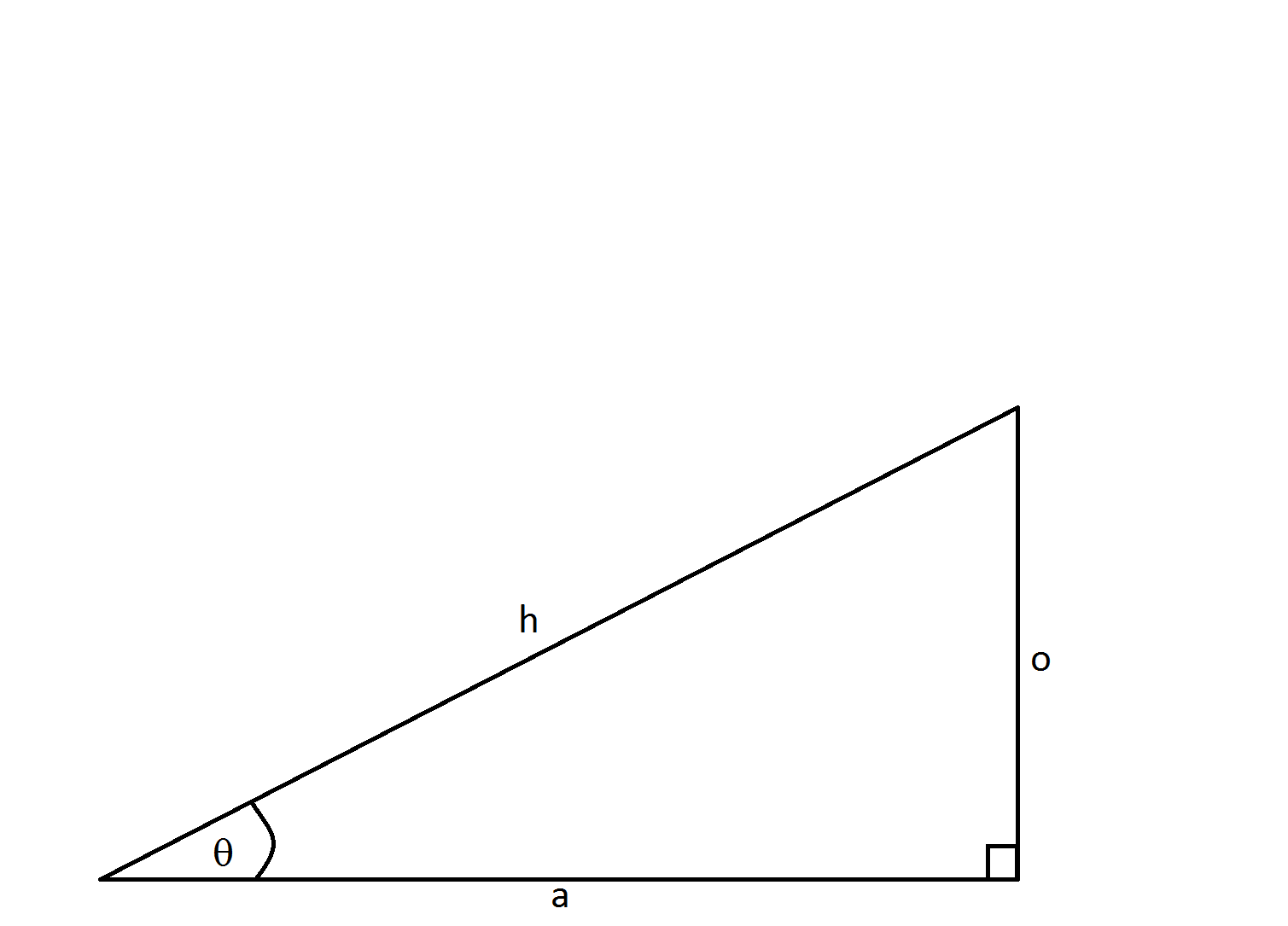
What is 


Explanation
In order to find 


Now to find the measure of the angle using the 


If you calculated the angle's measure to be 
Using trigonometric identities prove whether the following is valid:

True
False
Uncertain
Only in the range of:

Only in the range of:

Explanation
We can work with either side of the equation as we choose. We work with the right hand side of the equation since there is an obvious double angle here. We can factor the numerator to receive the following:

Next we note the power reducing formula for sine so we can extract the necessary components as follows:

The power reducing formula must be inverted giving:

Now we can distribute and reduce:

Finally recalling the basic identity for the cotangent:

This proves the equivalence.
Which of the following is the correct definition of a phase shift?
A measure of the length of a function between vertical asymptotes
The distance a function is shifted diagonally from the general position
The distance a function is shifted horizontally from the general position
The distance a function is shifted vertically from the general position
Explanation
Take the function 

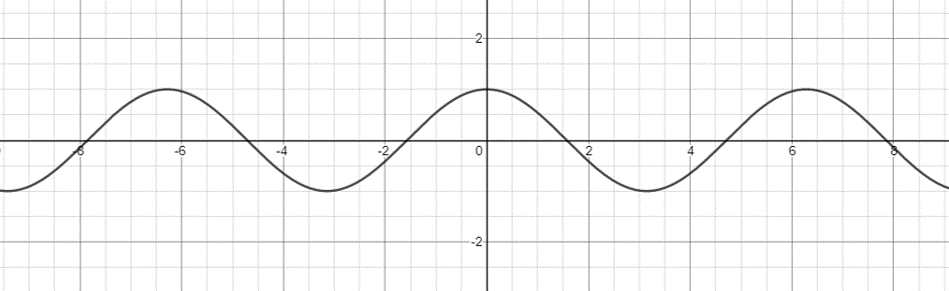
If we were to change the function to 


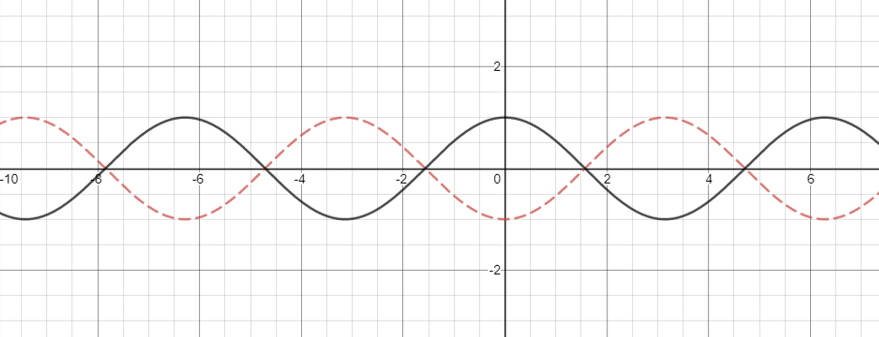
Our new graph 
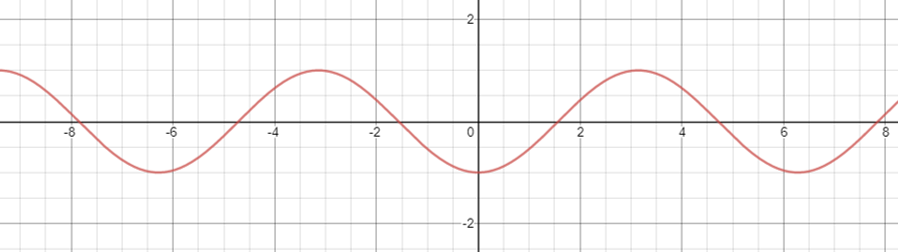
Which of the following describes a triangle with sides one kilometer, 100 meters, and 100 meters?
The triangle cannot exist.
The triangle is acute and equilateral.
The triangle is obtuse and isosceles, but not equilateral.
The triangle is acute and isosceles, but not equilateral.
The triangle is obtuse and scalene.
Explanation
One kilometer is equal to 1,000 meters, so the triangle has sides of length 100, 100, and 1,000. However,

That is, the sum of the least two sidelengths is not greater than the third. This violates the Triangle Inequality, and this triangle cannot exist.