Trapezoids
Help Questions
Math › Trapezoids
Which of the following shapes is a trapezoid?


Explanation
A trapezoid is a four-sided shape with straight sides that has a pair of opposite parallel sides. The other sides may or may not be parallel. A square and a rectangle are both considered trapezoids.
In the trapezoid below, find the degree measure of 


Explanation
In a trapezoid, the angles on the same leg (called adjacent angles) are supplementary, meaning they add up to 


Given Trapezoid 


True, false, or undetermined: Trapezoid 

False
True
Undetermined
Explanation
The fact that the trapezoid is isosceles is actually irrelevant. Since 


and

It follows that

However, the bases of each trapezoid are noncongruent, by definition, so, in particular,

Assume that 


Since the bases are of unequal length, 


Since 

and

This disproves similarity, since one condition is that corresponding sides must be in proportion.
Find the area of the figure.


Explanation

From the figure, you should notice that it is made up of a right triangle and a trapezoid. The lower base of the trapezoid is also the hypotenuse of the right triangle.
First, find the length of the hypotenuse of the right triangle using the Pythagorean Theorem.


Next, use this value to find the area of the trapezoid.

Plug in the given and found values to find the area.

Next, find the area of the triangle.


To find the area of the figure, add the two areas together.


Make sure to round to 
An isosceles trapezoid has base measurements of 


Explanation
To solve this problem, first note that an isosceles trapezoid has two parallel bases that are nonequivalent in length. Additionally, an isosceles trapezoid must have two nonparallel sides that have equivalent lengths. Since this problem provides the length for both of the bases as well as the total perimeter, the missing sides can be found using the following formula: Perimeter= Base one 


Thus, the solution is:


Check the solution by plugging in the answer:


Which of the following shapes is a trapezoid?
Explanation
A trapezoid is a four-sided shape with straight sides that has a pair of opposite parallel sides. The other sides may or may not be parallel. A square and a rectangle are both considered trapezoids.
An isosceles trapezoid has two bases that are parallel to each other. The larger base is 


What is the perimeter of the trapezoid?


Explanation
To find the perimeter of this trapezoid, first find the length of the larger base. Then, find the sum of all of the sides. It's important to note that since this is an isosceles trapezoid, both of the non-parallel sides will have the same length.
The solution is:
The smaller base is equal to 






In the above figure, 


33 to 19
10 to 3
13 to 6
20 to 13
Explanation
Midsegment 


The area of a trapezoid is one half multiplied by its height multiplied by the sum of the lengths of its bases. Therefore, the area of Trapezoid 

The area of Trapezoid 

The ratio of the areas is

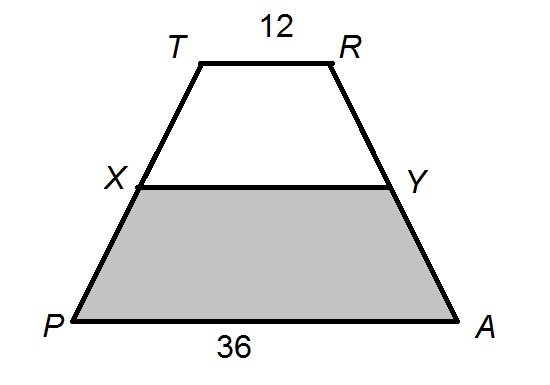
In the above figure, 

Which is the greater quantity?
(a) Three times the area of Trapezoid

(b) Twice the area of Trapezoid

(b) is the greater quantity
(a) is the greater quantity
(a) and (b) are equal
It is impossible to determine which is greater from the information given
Explanation
Midsegment 


The area of a trapezoid is one half multiplied by its height multiplied by the sum of the lengths of its bases. Therefore, the area of Trapezoid 

Three times this is

The area of Trapezoid 

Twice this is

That makes (b) the greater quantity.
Find the area of the figure.
Explanation
From the figure, you should notice that it is made up of a right triangle and a trapezoid. The lower base of the trapezoid is also the hypotenuse of the right triangle.
First, find the length of the hypotenuse of the right triangle using the Pythagorean Theorem.
Next, use this value to find the area of the trapezoid.
Plug in the given and found values to find the area.
Next, find the area of the triangle.
To find the area of the figure, add the two areas together.
Make sure to round to