Cones
Help Questions
Math › Cones
The slant height of a cone is 


Explanation
The formula for the surface area of a cone with base of radius 


The diameter of the base is 

Substitute in the surface area formula:


The slant height of a cone is
Explanation
The formula for the surface area of a cone with base of radius
The diameter of the base is
Substitute in the surface area formula:
What is the surface area of the following cone?


Explanation
The formula for the surface area of a cone is:


where 

Plugging in our values, we get:


What is the surface area of the following cone?
Explanation
The formula for the surface area of a cone is:
where
Plugging in our values, we get:
The surface area of cone 


Explanation
To figure out 


This equation can be reduced to:


For a normal right angle cone, 


so

Our 

The height of cone 

The surface area of cone
Explanation
To figure out
This equation can be reduced to:
For a normal right angle cone,
so
Our
The height of cone
The lateral area is twice as big as the base area of a cone. If the height of the cone is 9, what is the entire surface area (base area plus lateral area)?
27π
54π
81π
9π
90π
Explanation
Lateral Area = LA = π(r)(l) where r = radius of the base and l = slant height
LA = 2B
π(r)(l) = 2π(r2)
rl = 2r2
l = 2r
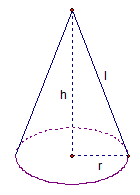
From the diagram, we can see that r2 + h2 = l2. Since h = 9 and l = 2r, some substitution yields
r2 + 92 = (2r)2
r2 + 81 = 4r2
81 = 3r2
27 = r2
B = π(r2) = 27π
LA = 2B = 2(27π) = 54π
SA = B + LA = 81π
The lateral area is twice as big as the base area of a cone. If the height of the cone is 9, what is the entire surface area (base area plus lateral area)?
27π
54π
81π
9π
90π
Explanation
Lateral Area = LA = π(r)(l) where r = radius of the base and l = slant height
LA = 2B
π(r)(l) = 2π(r2)
rl = 2r2
l = 2r
From the diagram, we can see that r2 + h2 = l2. Since h = 9 and l = 2r, some substitution yields
r2 + 92 = (2r)2
r2 + 81 = 4r2
81 = 3r2
27 = r2
B = π(r2) = 27π
LA = 2B = 2(27π) = 54π
SA = B + LA = 81π
Find the surface area of the following cone.
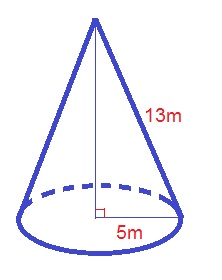


Explanation
The formula for the surface area of a cone is:


where 

Plugging in our values, we get:


Find the surface area of the following half cone.
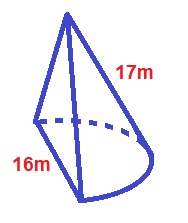





Explanation
The formula for the surface area of the half cone is:


Where 


Use the Pythagorean Theorem to find the height of the cone:



Plugging in our values, we get:


