Parallelograms
Help Questions
Math › Parallelograms
Find the area of the parallelogram.


Explanation

Recall how to find the area of a parallelogram:

From the given parallelogram, we will need to use the Pythagorean Theorem to find the length of the height of the parallelogram.


Plug in the given values to find the length of the height.

Now, use the height to find the area of the parallelogram.

Remember to round to 
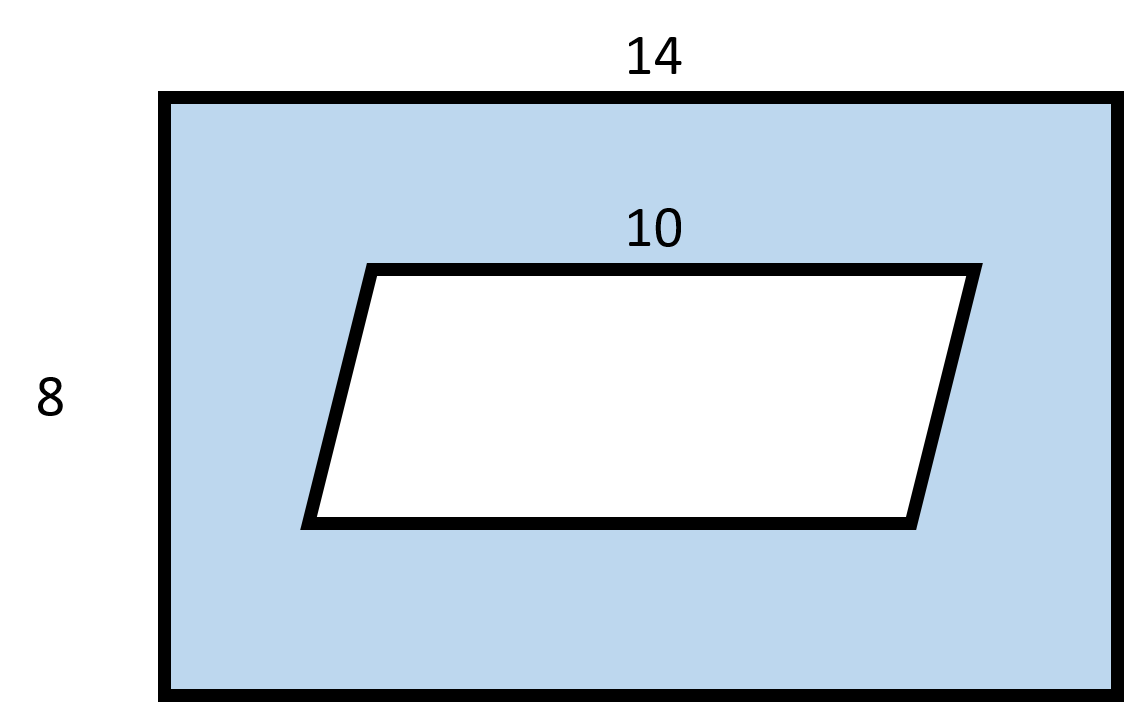
If the height of the parallelogram is half of the length of the rectangle, then find the area of the shaded region in the figure.


Explanation
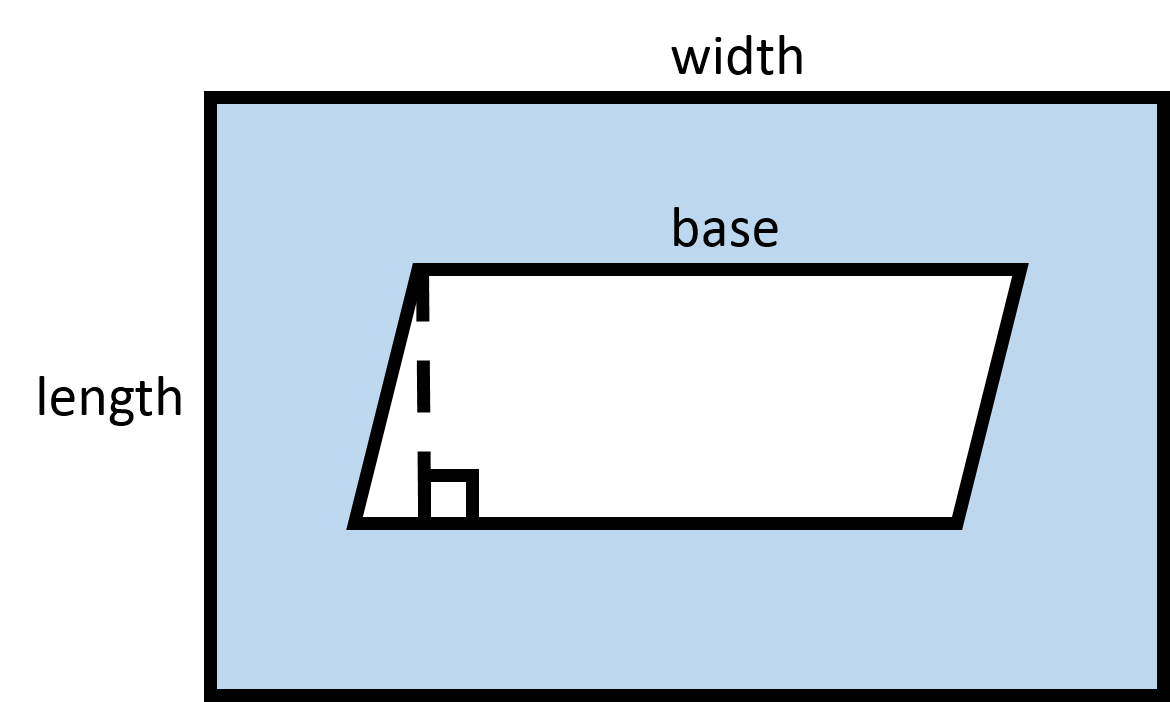
In order to find the area of the shaded region, we must first find the areas of the rectangle and parallelogram.
Recall how to find the area of a rectangle:

Substitute in the given length and height to find the area of the rectangle.


Next, find the area of the parallelogram.
Recall how to find the area of a parallelogram:

We need to find the height of the parallelogram. From the question, we know the following relationship:
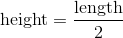
Substitute in the length of the rectangle to find the height of the parallelogram.


Now, substitute in the height and the given length of the base to find the area of the parallelogram.


Now, we are ready to find the area of the shaded region by subtracting the area of the parallelogram from the area of the rectangle.



In the figure, the area of the parallelogram is 


Cannot be determined
Explanation

Recall how to find the area of a parallelogram:

Now, substitute in the area, base, and height values that are given by the question.

Expand this equation.


Now factor this equation.

Solve for 

Since the values of lengths of shapes can only be positive, we know that the base of the parallelogram must be 
In Parallelogram 


(A)

(B)

It cannot be determined which of (a) and (b) is greater
(b) is the greater quantity
(a) is the greater quantity
(a) and (b) are equal
Explanation
In Parallelogram 


Find the area of the parallelogram.


Explanation
Recall how to find the area of a parallelogram:

From the given parallelogram, we will need to use the Pythagorean Theorem to find the length of the height of the parallelogram.


Plug in the given values to find the length of the height.

Now, use the height to find the area of the parallelogram.

Remember to round to 
In the figure, the height of the parallelogram is half the height of the equilateral triangle. Find the area of the shaded region.


Explanation
First, we will need to find the height of the equilateral triangle.

Recall that the height of an equilateral triangle will cut the equilateral triangle into two congruent 

Use the given side length of the equilateral triangle in order to find the length of the height.


Now, find the area of the equilateral triangle.


Now, use the height of the equilateral triangle to find the height of the parallelogram.


Next, find the area of the parallelogram.


Now, from the figure, we can see that we will need to subtract the area of the parallelogram from the area of the triangle in order to find the area of the shaded region.


Solve and round to two decimal places.

If the height of the parallelogram is half of the length of the rectangle, then find the area of the shaded region in the figure.


Explanation
In order to find the area of the shaded region, we must first find the areas of the rectangle and parallelogram.
Recall how to find the area of a rectangle:

Substitute in the given length and height to find the area of the rectangle.


Next, find the area of the parallelogram.
Recall how to find the area of a parallelogram:

We need to find the height of the parallelogram. From the question, we know the following relationship:

Substitute in the length of the rectangle to find the height of the parallelogram.


Now, substitute in the height and the given length of the base to find the area of the parallelogram.


Now, we are ready to find the area of the shaded region by subtracting the area of the parallelogram from the area of the rectangle.


Solve.

In the figure, the area of the parallelogram is 


Explanation
Recall how to find the area of a parallelogram:

Now, substitute in the area, base, and height values that are given by the question.

Expand this equation.


Now factor this equation.

Solve for 

Since the values of lengths of shapes can only be positive, we know that the base of the parallelogram must be 
Find the area of the parallelogram.



Explanation
Recall how to find the area of a parallelogram:

From the given parallelogram, we will need to use the Pythagorean Theorem to find the length of the height of the parallelogram.



Plug in the given values to find the length of the height.

Now, use the height to find the area of the parallelogram.

Remember to round to 
In the figure, the area of the parallelogram is 


Explanation
Recall how to find the area of a parallelogram:

Now, substitute in the area, base, and height values that are given by the question.

Expand this equation.


Now factor this equation.

Solve for 

Since the values of lengths of shapes can only be positive, we know that the base of the parallelogram must be 