Triangles
Help Questions
Math › Triangles
A triangle is placed in a parallelogram so they share a base.

If the height of the triangle is half that of the parallelogram, find the area of the shaded region.


Explanation

In order to find the area of the shaded region, we will need to find the areas of the triangle and of the parallelogram.
First, recall how to find the area of a parallelogram.


Next, recall how to find the area of a triangle.

Now, find the height of the triangle.


Plug this value in to find the area of the triangle.

Subtract the two areas to find the area of the shaded region.


In the figure, a triangle that shares its base with the width of the rectangle has a height that is half the length of the rectangle. Find the area of the shaded region.


Explanation

In order to find the area of the shaded region, we must first find the areas of the triangle and the rectangle.
Recall how to find the area of a rectangle:

Substitute in the given length and width to find the area.


Next, recall how to find the area of a triangle:

From the question, we know that the height of the triangle is half the length of the rectangle. Use the length of the rectangle to find the height of the triangle:


Since the base of the triangle and the width of the rectangle are the same, we can find the area of the triangle:


To find the area of the shaded region, subtract the area of the triangle from the area of the rectangle.


Solve.

An isosceles triangle is placed in a circle as shown by the figure below.

If diameter of the circle is 


Explanation

From the given image, you should notice that the base of the triangle is also the diameter of the circle. In addition, the height of the triangle is also the radius of the circle.
Thus, we can find the area of the triangle.


Next, recall how to find the area of a circle.


To find the area of the shaded region, subtract the two areas.


Make sure to round to 
An isosceles triangle has a perimeter of 


The height of the triangle cannot be determined with the given information.
Explanation
First, find the lengths of the triangle.
Let 

Use the information given about the perimeter to solve for 


Plug this value in to find the length of the base.

Now, recall that the height of an isosceles triangle can split the entire triangle into two congruent right triangle as shown by the figure below.

Thus, we can use the Pythagorean Theorem to find the length of the height.

Plug in the given values to find the height of the triangle.

Make sure to round to 
A circle is placed in an equilateral triangle as shown by the figure.

If the radius of the circle is 


Explanation

In order to find the area of the shaded region, you must first find the areas of the triangle and circle.
First, recall how to find the area of an equilateral triangle:

Substitute in the value of the side to find the area of the triangle.


Next, recall how to find the area of a circle.

Substitue in the value of the radius to find the area of the circle.


Finally, find the area of the shaded region.


Solve and round to two decimal places.

An equilateral triangle is placed on top of a square as shown by the figure below.

Find the perimeter of the shape.


Explanation
Recall that the perimeter is the sum of all the exterior sides of a shape. The sides that add up to the perimeter are highlighted in red.

Since the equilateral triangle shares a side with the square, each of the five sides that are outlined have the same length.
Recall that the height of an equilateral triangle splits the triangle into 

We can then use the height to find the length of the side of the triangle.
Recall that a 

Thus, we can use the ratio and the length of the height to set up the following equation:


Plug in the given height to find the length of the side.

Now, since the perimeter of the shape consists of 


Find the perimeter.


Explanation
How do you find the perimeter of a right triangle?
There are three primary methods used to find the perimeter of a right triangle.
- When side lengths are given, add them together.
- Solve for a missing side using the Pythagorean theorem.
- If we know side-angle-side information, solve for the missing side using the Law of Cosines.
Method 1:
This method will show you how to calculate the perimeter of a triangle when all sides lengths are known. Consider the following figure:

If we know the lengths of sides 


Method 2:
In right triangles, we can calculate the perimeter of a triangle when we are provided only two sides. We can do this by using the Pythagorean theorem. Let's first discuss right triangles in a general sense. A right triangle is a triangle that has one 


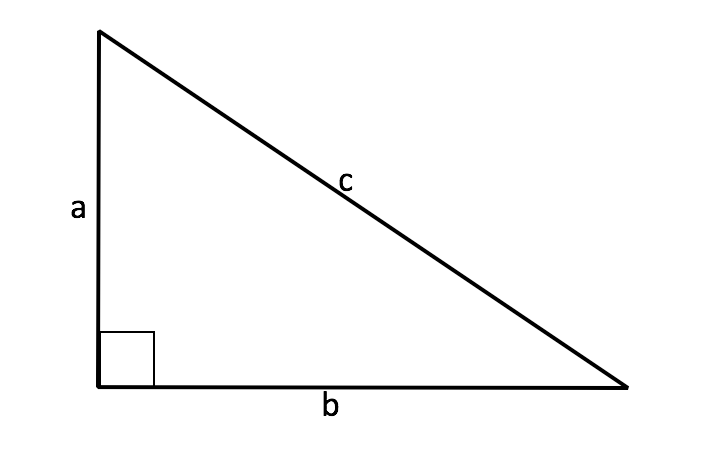
If a triangle appears in this format, then we can use the Pythagorean theorem to solve for any missing side. This formula is written in the following manner:

We can rearrange it in a number of ways to solve for each of the sides of the triangle. Let's rearrange it to solve for the hypotenuse, 

Rearrange and take the square root of both sides.

Simplify.

Now, let's use the Pythagorean theorem to solve for one of the legs, 

Subtract 


Take the square root of both sides.

Simplify.

Last, let's use the Pythagorean theorem to solve for the adjacent leg, 

Subtract 


Take the square root of both sides.

Simplify.

It is important to note that we can only use the following formulas to solve for the missing side of a right triangle when two other sides are known:


After we find the missing side, we can use the perimeter formula to calculate the triangle's perimeter.
Method 3:
This method is the most complicated method and can only be used when we know two side lengths of a triangle as well as the measure of the angle that is between them. When we know side-angle-side (SAS) information, we can use the Law of Cosines to find the missing side. In order for this formula to accurately calculate the missing side we need to label the triangle in the following manner:

When the triangle is labeled in this way each side directly corresponds to the angle directly opposite of it. If we label our triangle carefully, then we can use the following formulas to find missing sides in any triangle given SAS information:


After, we calculate the right side of the equation, we need to take the square root of both sides in order to obtain the final side length of the missing side. Last, we need to use the perimeter formula to obtain the distance of the side lengths of the polygon.
Solution:
Now, that we have discussed the three methods used to calculate the perimeter of a triangle, we can use this information to solve the problem.

In order to find the perimeter, we must first find the length of the hypotenuse of the right triangle.
Use Pythagorean's theorem to find the length of the hypotenuse:


Plug in the values of the lengths of the legs of the given triangle.

Now, recall how to find the perimeter of a triangle:

Plug in all the values of the sides of the triangle to find the perimeter.

Make sure to round to 
Find the perimeter.


Explanation
How do you find the perimeter of a right triangle?
There are three primary methods used to find the perimeter of a right triangle.
- When side lengths are given, add them together.
- Solve for a missing side using the Pythagorean theorem.
- If we know side-angle-side information, solve for the missing side using the Law of Cosines.
Method 1:
This method will show you how to calculate the perimeter of a triangle when all sides lengths are known. Consider the following figure:
If we know the lengths of sides
Method 2:
In right triangles, we can calculate the perimeter of a triangle when we are provided only two sides. We can do this by using the Pythagorean theorem. Let's first discuss right triangles in a general sense. A right triangle is a triangle that has one
If a triangle appears in this format, then we can use the Pythagorean theorem to solve for any missing side. This formula is written in the following manner:
We can rearrange it in a number of ways to solve for each of the sides of the triangle. Let's rearrange it to solve for the hypotenuse,
Rearrange and take the square root of both sides.
Simplify.
Now, let's use the Pythagorean theorem to solve for one of the legs,
Subtract
Take the square root of both sides.
Simplify.
Last, let's use the Pythagorean theorem to solve for the adjacent leg,
Subtract
Take the square root of both sides.
Simplify.
It is important to note that we can only use the following formulas to solve for the missing side of a right triangle when two other sides are known:
After we find the missing side, we can use the perimeter formula to calculate the triangle's perimeter.
Method 3:
This method is the most complicated method and can only be used when we know two side lengths of a triangle as well as the measure of the angle that is between them. When we know side-angle-side (SAS) information, we can use the Law of Cosines to find the missing side. In order for this formula to accurately calculate the missing side we need to label the triangle in the following manner:
When the triangle is labeled in this way each side directly corresponds to the angle directly opposite of it. If we label our triangle carefully, then we can use the following formulas to find missing sides in any triangle given SAS information:
After, we calculate the right side of the equation, we need to take the square root of both sides in order to obtain the final side length of the missing side. Last, we need to use the perimeter formula to obtain the distance of the side lengths of the polygon.
Solution:
Now, that we have discussed the three methods used to calculate the perimeter of a triangle, we can use this information to solve the problem.
In order to find the perimeter, we must first find the length of the hypotenuse of the right triangle.
Use Pythagorean's theorem to find the length of the hypotenuse:


Plug in the values of the lengths of the legs of the given triangle.

Now, recall how to find the perimeter of a triangle:

Plug in all the values of the sides of the triangle to find the perimeter.

Make sure to round to 
Which of the following could NOT be the perimeter of a right triangle with sides of length 


None of these work
All of these work
Explanation
How do you find the perimeter of a right triangle?
There are three primary methods used to find the perimeter of a right triangle.
- When side lengths are given, add them together.
- Solve for a missing side using the Pythagorean theorem.
- If we know side-angle-side information, solve for the missing side using the Law of Cosines.
Method 1:
This method will show you how to calculate the perimeter of a triangle when all sides lengths are known. Consider the following figure:
If we know the lengths of sides
Method 2:
In right triangles, we can calculate the perimeter of a triangle when we are provided only two sides. We can do this by using the Pythagorean theorem. Let's first discuss right triangles in a general sense. A right triangle is a triangle that has one
If a triangle appears in this format, then we can use the Pythagorean theorem to solve for any missing side. This formula is written in the following manner:
We can rearrange it in a number of ways to solve for each of the sides of the triangle. Let's rearrange it to solve for the hypotenuse,
Rearrange and take the square root of both sides.
Simplify.
Now, let's use the Pythagorean theorem to solve for one of the legs,
Subtract
Take the square root of both sides.
Simplify.
Last, let's use the Pythagorean theorem to solve for the adjacent leg,
Subtract
Take the square root of both sides.
Simplify.
It is important to note that we can only use the following formulas to solve for the missing side of a right triangle when two other sides are known:
After we find the missing side, we can use the perimeter formula to calculate the triangle's perimeter.
Method 3:
This method is the most complicated method and can only be used when we know two side lengths of a triangle as well as the measure of the angle that is between them. When we know side-angle-side (SAS) information, we can use the Law of Cosines to find the missing side. In order for this formula to accurately calculate the missing side we need to label the triangle in the following manner:
When the triangle is labeled in this way each side directly corresponds to the angle directly opposite of it. If we label our triangle carefully, then we can use the following formulas to find missing sides in any triangle given SAS information:
After, we calculate the right side of the equation, we need to take the square root of both sides in order to obtain the final side length of the missing side. Last, we need to use the perimeter formula to obtain the distance of the side lengths of the polygon.
Solution:
Now, that we have discussed the three methods used to calculate the perimeter of a triangle, we can use this information to solve the problem.
Since it wasn't specified if the two lengths given were the legs, or a leg and the hypotenuse, there are 2 options for the third side length.
Option 1:


To find the perimeter, add the following:

Option 2:


To find the perimeter, add the following:

The only option listed that isn't either of those is 
A circle with a radius of 


Find the area of the shaded region.


Explanation
In order to find the area of the shaded region, we must first find the area of the circle and the area of the equilateral triangle.
Recall how to find the area of a circle:

Plug in the given radius to find the area of the circle.

Next, recall how to find the area of an equilateral triangle:

Plug in the length of the side of the triangle to find the area.

In order to find the area of the shaded region, we will need to subtract the area of the circle from the area of the triangle.


Make sure to round to 