Mathematical Relationships and Basic Graphs
Help Questions
Math › Mathematical Relationships and Basic Graphs
Solve the absolute value equation:


Explanation
Recall that the absolute value sign will convert any value to a positive sign. There will be no occurrences of 
There are no solutions for this equation.
The answer is:

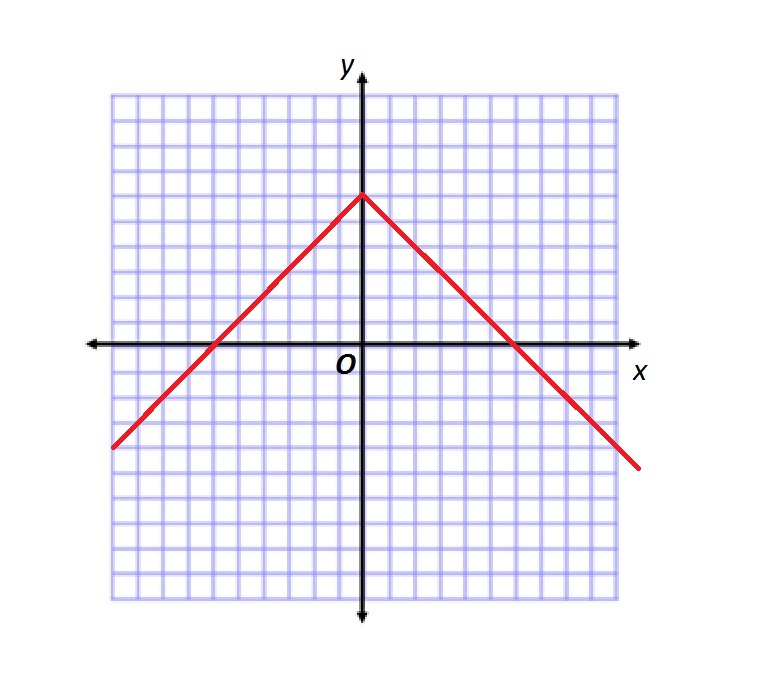
Refer to the above figure.
Which of the following functions is graphed?


Explanation
Below is the graph of 
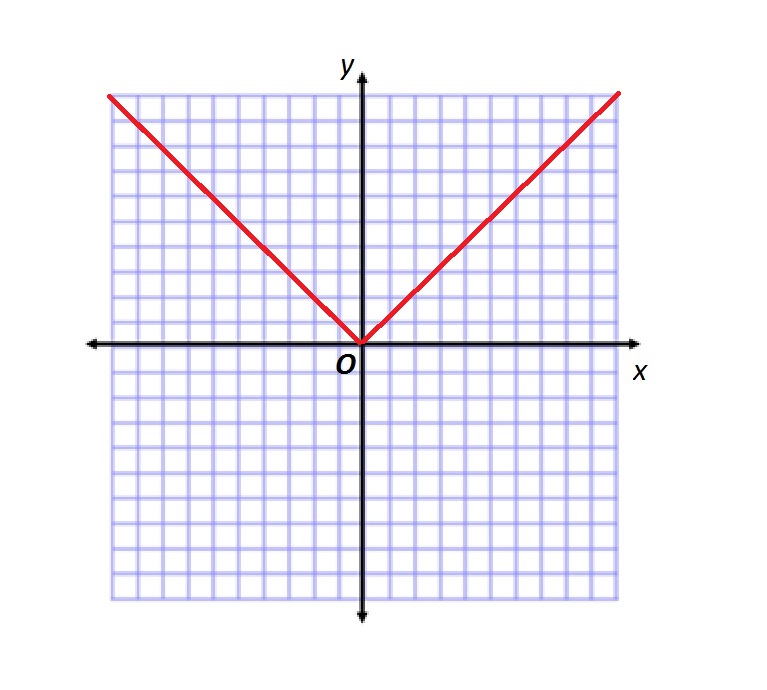
The given graph is the graph of 


The function graphed is therefore


Give the vertex of the graph of the function 


None of the other choices gives the correct response.
Explanation
Let

The graph of this basic absolute value function is a "V"-shaped graph with a vertex at the origin, or the point with coordinates 


or, alternatively written,

The graph of 


Add the following numbers:


Explanation
Write an expression to set up the problem.

Add the ones digits.

The carryover is tens place, which is two.
Add the tens digits.

The carryover is three.
Add the hundreds places with the carryover. The two digit numbers will have zero as the hundreds places.

Combine the ones digits from each calculation.
The answer is:

Evaluate:


Explanation
In order to subtract these two numbers, we will first need to take out a common factor of negative one.

We can then subtract the terms.
Borrow a one from the tens digit to subtract the ones digits. The tens digit of 981 becomes a 7.

Borrow a one from the hundreds place to subtract the tens digits. The hundreds place of 981 becomes an eight.
Subtract the tens digits.

Subtract the hundreds digits.

The expression becomes:

The answer is:

What is 


Explanation
Remember PEMDAS, the acronym that stands for Parentheses, Exponents, Multiplication, Division, Addition, and Subtraction. This is the order of operations we need to adhere to when doing any arithmetic.
The parentheses go first so do what's inside the parentheses.
The sum of 


Then we multiply that with 

Solve for 



Explanation
Raise both sides of the equation to the inverse power of 


Subtract 


Evaluate


Explanation
When dealing with fractional exponents, remember this form:


Evaluate:


Explanation
When dealing with negative exponents, we convert to fractions as such: 


Simplify:


Explanation
Recall that when an exponent is raised to another exponent, you will need to multiply the two exponents together.
Start by simplifying the numerator:

Now, place this on top of the denominator and simplify. Recall that when you divide exponents that have the same base, you will subtract the exponent in the denominator from the exponent in the numerator.
