45/45/90 Right Isosceles Triangles
Help Questions
Math › 45/45/90 Right Isosceles Triangles
If the width of the rectangle is half the length of the hypotenuse of the triangle, then what is the area of the shaded region?


Explanation

In order to find the area of the shaded region, we will need to first find the areas of the rectangle and of the triangle.
First, let's recall how to find the area of a rectangle.

Now, the question tells us the following relationship between the width of the rectangle and the hypotenuse of the triangle:

Now, let's use the Pythagorean theorem to find the length of the hypotenuse.


Substitute in the values of the base and of the height to find the hypotenuse.


Now, substitute this value in to find the width of the rectangle.

Now, find the area of the rectangle.


Next, recall how to find the area of a triangle:

Substitute in the given base and height to find the area.


Finally, we are ready to find the area of the shaded region.


Solve.

If the width of the rectangle is half the hypotenuse of the triangle, then what is the area of the shaded region?


Explanation
In order to find the area of the shaded region, we will need to first find the areas of the rectangle and of the triangle.
First, let's recall how to find the area of a rectangle.

Now, the question tells us the following relationship between the width of the rectangle and the hypotenuse of the triangle:

Now, let's use the Pythagorean theorem to find the length of the hypotenuse.


Substitute in the values of the base and of the height to find the hypotenuse.


Now, substitute this value in to find the width of the rectangle.

Now, find the area of the rectangle.


Next, recall how to find the area of a triangle:

Substitute in the given base and height to find the area.


Finally, we are ready to find the area of the shaded region.


Solve.

What is the area of a square that has a diagonal whose endpoints in the coordinate plane are located at (-8, 6) and (2, -4)?
100
100√2
50√2
50
200√2
Explanation
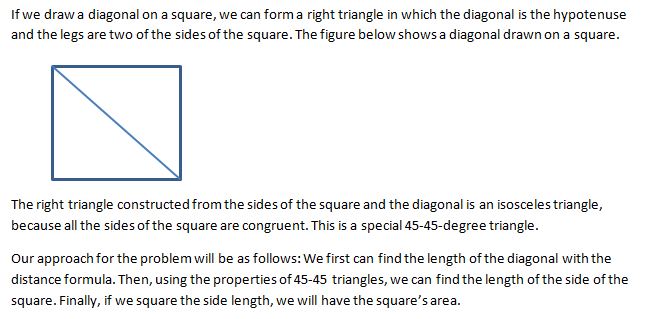
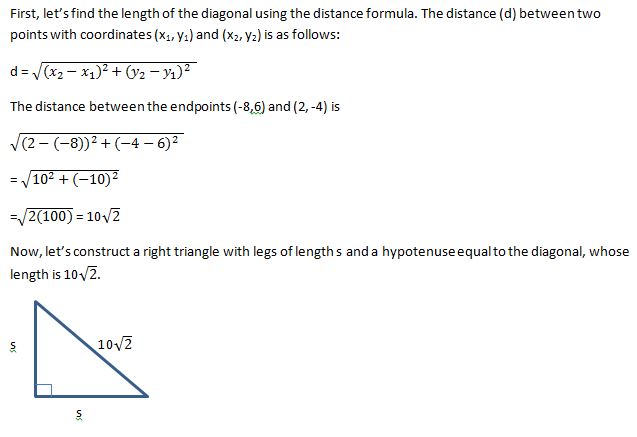
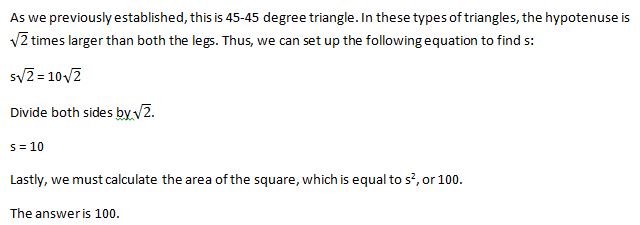
A right isosceles triangle has leg lengths of 


Explanation

Recall the Pythagorean Theorem:

Since we know that this is an isosceles right triangle, we know the following:

The Pythagorean Theorem can then be simplifed to the following equation:

Now, solve for 


Now, plug in the given value for 

What is the area of a square that has a diagonal whose endpoints in the coordinate plane are located at (-8, 6) and (2, -4)?
100
100√2
50√2
50
200√2
Explanation
Find the length of the hypotenuse.


Explanation
To find the hypotenuse of a triangle, you can use the Pythagorean Theorem. For any right triangle with leg lengths of 


Now, plug in the values of 


Solve.

Simplify.

Find the length of the hypotenuse.


Explanation
To find the hypotenuse of a triangle, you can use the Pythagorean Theorem. For any right triangle with leg lengths of 


Now, plug in the values of 


Solve.

Simplify.

An isosceles triangle has a base of 6 and a height of 4. What is the perimeter of the triangle?


None of these
Explanation
An isosceles triangle is basically two right triangles stuck together. The isosceles triangle has a base of 6, which means that from the midpoint of the base to one of the angles, the length is 3. Now, you have a right triangle with a base of 3 and a height of 4. The hypotenuse of this right triangle, which is one of the two congruent sides of the isosceles triangle, is 5 units long (according to the Pythagorean Theorem).
The total perimeter will be the length of the base (6) plus the length of the hypotenuse of each right triangle (5).
5 + 5 + 6 = 16
If the hypotenuse of a right isosceles triangle is 


Explanation
An isosceles right triangle is another way of saying that the triangle is a 

Now, recall the Pythagorean Theorem:

Because we are working with a 


Now, plug in the value of the hypotenuse to find the height for the given triangle.

Now, recall how to find the area of a triangle:

Since the base and the height are the same length, we can then find the area of the given triangle.

Find the area of the triangle if the radius of the circle is 


Explanation
The two tick marks on the image indicate that those sides are congruent; therefore, this is an isosceles right triangle.
Notice that the hypotenuse of the triangle is also the diameter of the circle. Recall the relationship between the diameter of a circle and its radius:

Substitute in the value of the radius to find the length of the diameter.

Simplify.

Now, use the Pythagorean theorem to find the lengths of the missing sides of the triangle.


Now, recall how to find the area of a triangle:

In this case, because we have an isosceles right triangle,


Take the equation derived from the Pythagorean theorem and plug it in to the equation above.

Simplify.

Now, substitute in the value of the hypotenuse to find the area of the triangle.

Solve.
