Rectangles
Help Questions
Math › Rectangles
A rectangle has an area of 


Explanation
For a rectangle, area is 


Let 

The area equation to solve becomes 

To factor, find two numbers the sum to -4 and multiply to -96. -12 and 8 will work:
x2 + 8x - 12x - 96 = 0
x(x + 8) - 12(x + 8) = 0
(x - 12)(x + 8) = 0
Set each factor equal to zero and solve:


Therefore the length is 


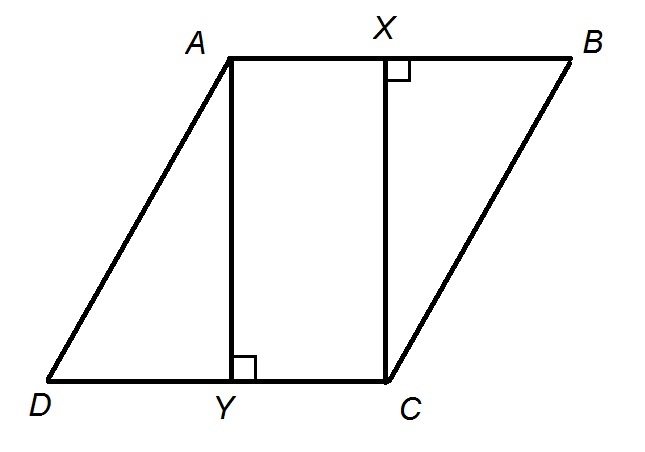
Note: Figure NOT drawn to scale
The above figure shows Rhombus 
Which is the greater quantity?
(a)

(b)

(a) and (b) are equal
It is impossible to determine which is greater from the information given
(b) is the greater quantity
(a) is the greater quantity
Explanation
The opposite sides of a parallelogram - a rhombus included - are congruent, so

Also, Quadrilateral 




Find the area of a rectangle with a length of 16cm and a width that is a quarter of the length.


Explanation
To find the area of a rectangle, we will use the following formula:

where l is the length and w is the width of the rectangle.
Now, we know the length of the rectangle is 16cm. We also know the width of the rectangle is a quarter of the length. To find the width, we will divide 16 by 4. Therefore, the width the 4cm.
Knowing this, we will substitute into the formula. We get


Find the area of a rectangle with a length of 12cm and a width that is a quarter of the length.


Explanation
To find the area of a rectangle, we will use the following formula:

where l is the length and w is the width of the rectangle.
Now, we know the length of the rectangle is 12cm. We also know the width of the rectangle is a quarter of the length. To find the width, we will divide 12 by 4. Therefore, the width the 3cm.
Knowing this, we will substitute into the formula. We get


Find the area of a rectangle with a length of 14in and a width that is half the length.


Explanation
To find the area of a rectangle, we will use the following formula:

where l is the length and w is the width of the rectangle.
Now, we know the length of the rectangle is 14in. We also know the width of the rectangle is half the length. Therefore, the width is 7in.
Knowing this, we will substitute into the formula. We get


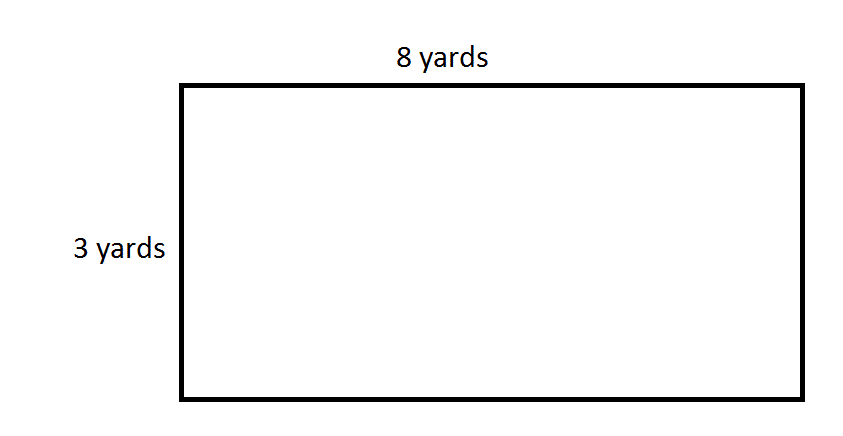
Give the area of the above rectangle in square feet.


Explanation
Since 1 yard = 3 feet, multiply each dimension by 3 to convert from yards to feet:


Use the area formula, substituting 


The sum of the lengths of three sides of a rectangle is 572 inches; the width of the rectangle is 60% of its length. Give its area in square inches.
It is impossible to determine the area from the given information.


Explanation
Since the width of the rectangle is 60% of its length, we can write 
However, it is not clear from the problem which three sides - two lengths and a width or two widths and a length - we are choosing to have sum 572 inches. Depending on the three sides chosen, we can either set up


or


Since the length cannot be determined with certainty, neither can the width, and, subsequently, neither can the area.
A rectangular postage stamp has a width of 3 cm and a height of 12 cm. Find the area of the stamp.


Explanation
A rectangular postage stamp has a width of 3 cm and a height of 12 cm. Find the area of the stamp.
To find the area of a rectangle, we must perform the following:

Where l and w are our length and width.
This means we need to multiply the given measurements. Be sure to use the right units!

And we have our answer. It must be centimeters squared, because we are dealing with area.
A rectangle is two feet shorter than twice its width; its perimeter is six yards. Give its area in square inches.


Explanation
The length of the rectangle is two feet, or 24 inches, shorter than twice the width, so, if 

Six yards, the perimeter of the rectangle, is equal to 


The length and width are 64 inches and 44 inches; the area is their product, which is

The ratio of the perimeter of one square to that of another square is 


Explanation
For the sake of simplicity, we will assume that the second square has sidelength 1; Then its perimeter is 

The perimeter of the first square is 


The ratio of the areas is therefore 