Plane Geometry
Help Questions
Math › Plane Geometry
A kite has an area of 


Explanation
Let 

Recall how to find the area of a kite:

Plug in the given area and solve for 


Since we are dealing with geometric shapes, the answer must be a positive value. Thus, 
The length of the shorter diagonal is 
Find the area of the rhombus.


Explanation
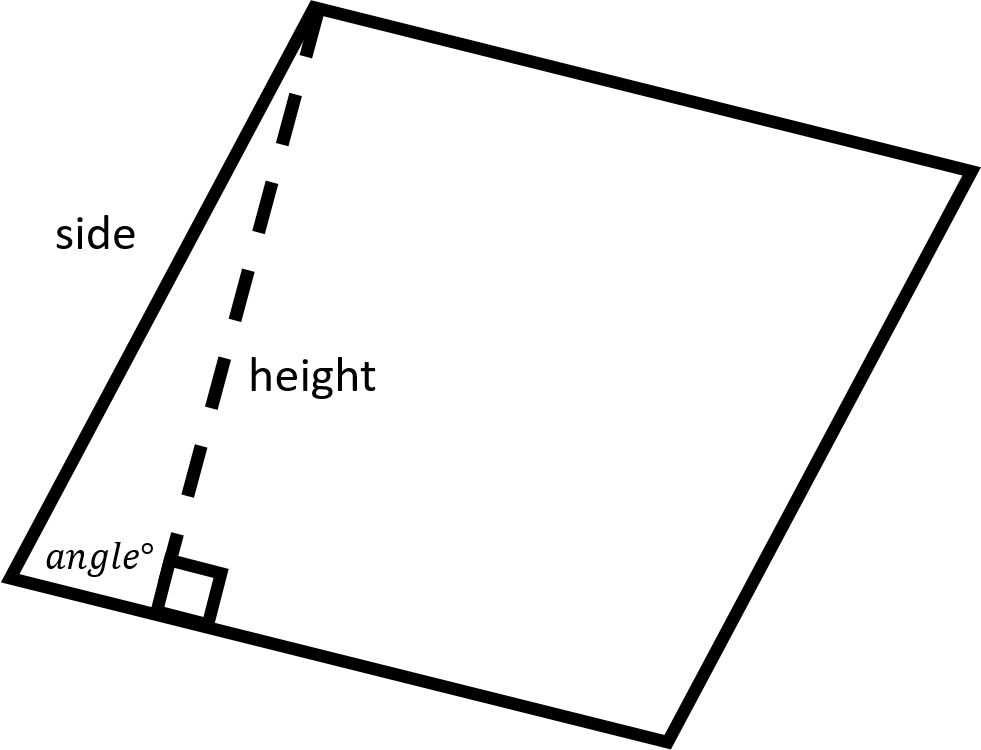
Recall that one of the ways to find the area of a rhombus is with the following formula:

Now, since all four sides in the rhombus are the same, we know from the given side value what the length of the base will be. In order to find the length of the height, we will need to use sine.


Now, plug this into the equation for the area to get the following equation:

Plug in the given side length and angle values to find the area.

Make sure to round to 


True or false: From the given information, it follows that 
True
False
Explanation
As we are establishing whether or not 


A triangle is equilateral (having three sides of the same length) if and only if it is also equiangular (having three angles of the same measure, each of which is 

Specifically, 


An isosceles trapezoid has base measurements of 


Explanation
To solve this problem, first note that an isosceles trapezoid has two parallel bases that are nonequivalent in length. Additionally, an isosceles trapezoid must have two nonparallel sides that have equivalent lengths. Since this problem provides the length for both of the bases as well as the total perimeter, the missing sides can be found using the following formula: Perimeter= Base one 


Thus, the solution is:


Check the solution by plugging in the answer:


Find the length of a side of a rhombus that has diagonal lengths of 


Explanation

Recall that in a rhombus, the diagonals are not only perpendicular to each other, but also bisect one another.
Thus, we can find the lengths of half of each diagonal and use that in the Pythagorean Theorem to find the length of the side of the rhombus.
First, find the lengths of half of each diagonal.


Now, use these half diagonals as the legs of a right triangle that has the side of the rhombus as its hypotenuse.

Plug in the lengths of the half diagonals to find the length of the rhombus.

Make sure to round to 
Find the length of the hypotenuse.


Explanation
Recall how to find the length of the hypotenuse, 

Substitute in the given values.

Simplify.

Solve.

Now, because we want to solve for just 

What is the hypotenuse of a right triangle with side lengths 


Explanation
The Pythagorean Theorem states that 


Take 


Now we can start solving for 


The length of the hypotenuse is 

Using the kite shown above, find the length of side


Explanation
A kite is a geometric shape that has two sets of equivalent adjacent sides.
Thus, the length of side 
Since, 


Find the value of 


Explanation
The formula to find the area of a trapezoid is

Substitute in the values for the area, a base, and the height. Then solve for 


Given Trapezoid 


True, false, or undetermined: Trapezoid 

False
True
Undetermined
Explanation
The fact that the trapezoid is isosceles is actually irrelevant. Since 


and

It follows that

However, the bases of each trapezoid are noncongruent, by definition, so, in particular,

Assume that 


Since the bases are of unequal length, 


Since 

and

This disproves similarity, since one condition is that corresponding sides must be in proportion.