Functions and Graphs
Help Questions
Math › Functions and Graphs
Determine whether each function represents exponential decay or growth.


a) decay
b) growth
a) growth
b) growth
a) decay
b) decay
a) growth
b) decay
Explanation
a)
This is exponential decay since the base, 


b)
This is exponential growth since the base, 

Find the equation of the line passing through the points 


Explanation
To calculate a line passing through two points, we first need to calculate the slope, 

Now that we have the slope, we can plug it into our equation for a line in slope intercept form.

To solve for 


Now that we have solved for b, we can plug that into our slope intercept form and produce and the answer

Find the y-intercept of the following line.


Explanation
To find the y-intercept of any line, we must get the equation into the form

where m is the slope and b is the y-intercept.
To manipulate our equation into this form, we must solve for y. First, we must move the x term to the right side of our equation by subtracting it from both sides.


To isolate y, we now must divide each side by 3.


Now that our equation is in the desired form, our y-intercept is simply

What are the coordinates of the center of a circle with the equation 


Explanation
The equation of a circle is 
What is the domain and range of the following graph?

Domain: All real numbers
Range:

Domain:

Range: All real numbers
Domain: All real numbers
Range:

Domain:

Range: All real numbers
Domain: All real numbers
Range: All real numbers
Explanation
Domain looks at x-values and range looks at y-values.
The x-values appear to continue to go on forever, which suggests the answer:
"all real numbers"
The y-values are all number that are equal to nine or less which is

So you answer is:
Domain: All real numbers
Range:


Explanation
All inputs are valid. There is nothing you can put in for x that won't work.
Based on the figure below, which line depicts a quadratic function?

Red line
Blue line
Green line
Purple line
None of them
Explanation
A parabola is one example of a quadratic function, regardless of whether it points upwards or downwards.
The red line represents a quadratic function and will have a formula similar to 
The blue line represents a linear function and will have a formula similar to 
The green line represents an exponential function and will have a formula similar to 
The purple line represents an absolute value function and will have a formula similar to 
Consider the equation:

The vertex of this parabolic function would be located at:


Explanation
For any parabola, the general equation is


For the given problem, the x-coordinate is
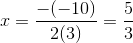
To find the y-coordinate, plug 

Therefore the vertex is at 
What are the 


There are no 
Explanation
To find the x-intercepts of the equation, we set the numerator equal to zero.


Consider the following two functions:


How is the function 


Explanation
The 

