Applications of Derivatives
Help Questions
Math › Applications of Derivatives
For which of the following functions can the Maclaurin series representation be expressed in four or fewer non-zero terms?



Explanation
Recall the Maclaurin series formula:
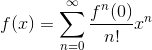

Despite being a 5th degree polynomial recall that the Maclaurin series for any polynomial is just the polynomial itself, so this function's Taylor series is identical to itself with two non-zero terms.
The only function that has four or fewer terms is 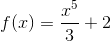

For which of the following functions can the Maclaurin series representation be expressed in four or fewer non-zero terms?
Explanation
Recall the Maclaurin series formula:
Despite being a 5th degree polynomial recall that the Maclaurin series for any polynomial is just the polynomial itself, so this function's Taylor series is identical to itself with two non-zero terms.
The only function that has four or fewer terms is
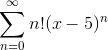
Find the interval of convergence for 


Explanation
Using the root test

and

herefore, the series only converges when it is equal to zero.
This occurs when x=5.
Find the interval of convergence for
Explanation
Using the root test
and
herefore, the series only converges when it is equal to zero.
This occurs when x=5.
Write out the first four terms of the Taylor series about 




Explanation
The Taylor series about x=a of any function is given by the following:
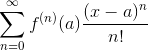
So, we must find the zeroth, first, second, and third derivatives of the function (for n=0, 1, 2, and 3 which makes the first four terms):
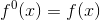



The derivatives were found using the following rule:
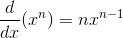
Now, evaluated at x=a=1, and plugging in the correct n where appropriate, we get the following:

which when simplified is equal to

Write out the first four terms of the Taylor series about
Explanation
The Taylor series about x=a of any function is given by the following:
So, we must find the zeroth, first, second, and third derivatives of the function (for n=0, 1, 2, and 3 which makes the first four terms):
The derivatives were found using the following rule:
Now, evaluated at x=a=1, and plugging in the correct n where appropriate, we get the following:
which when simplified is equal to
Find the minimum of the function:



Explanation

To find minimum take the derivative of the function and set it equal to zero.
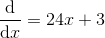

Solve for x.


Plugging x back in the equation will allow us to find the y value that results in the minimum.

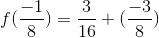
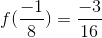
The graph has a minimum at y=-3/16
Find the minimum of the function:
Explanation
To find minimum take the derivative of the function and set it equal to zero.
Solve for x.
Plugging x back in the equation will allow us to find the y value that results in the minimum.
The graph has a minimum at y=-3/16
Write out the first three terms of the Taylor series for the following function about 




Explanation
The general formula for the Taylor series of a given function about x=a is
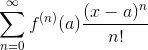
We were asked to find the first three terms, which correspond to n=0, 1, and 2. So first, we need to find the zeroth, first, and second derivative of the given function. The zeroth derivative is just the function itself.


The derivatives were found using the following rules:
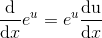
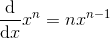
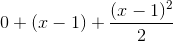
Now use the above formula to write out the first three terms:

Simplified, this becomes

Write out the first three terms of the Taylor series for the following function about
Explanation
The general formula for the Taylor series of a given function about x=a is
We were asked to find the first three terms, which correspond to n=0, 1, and 2. So first, we need to find the zeroth, first, and second derivative of the given function. The zeroth derivative is just the function itself.
The derivatives were found using the following rules:
Now use the above formula to write out the first three terms:
Simplified, this becomes