Understanding Sine, Cosine, and Tangent - Math
Card 1 of 20
What is the  ?
?
What is the
Tap to reveal answer


← Didn't Know|Knew It →
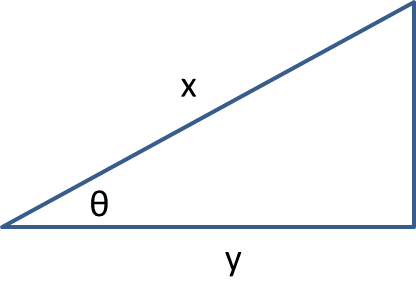
In the right triangle above, which of the following expressions gives the length of y?
In the right triangle above, which of the following expressions gives the length of y?
Tap to reveal answer
 is defined as the ratio of the adjacent side to the hypotenuse, or in this case
  . Solving for y gives the correct expression.
← Didn't Know|Knew It →
If the polar coordinates of a point are  , then what are its rectangular coordinates?
If the polar coordinates of a point are
Tap to reveal answer
The polar coordinates of a point are given as  , where r represents the distance from the point to the origin, and
  represents the angle of rotation. (A negative angle of rotation denotes a clockwise rotation, while a positive angle denotes a counterclockwise rotation.)
The following formulas are used for conversion from polar coordinates to rectangular (x, y) coordinates.


In this problem, the polar coordinates of the point are  , which means that
  and
and  . We can apply the conversion formulas to find the values of x and y.


The rectangular coordinates are  .
.
The answer is  .
.
The polar coordinates of a point are given as
The following formulas are used for conversion from polar coordinates to rectangular (x, y) coordinates.
In this problem, the polar coordinates of the point are
The rectangular coordinates are
The answer is
← Didn't Know|Knew It →
What is the cosine of  ?
?
What is the cosine of
Tap to reveal answer
The pattern for the side of a  triangle is
  .
.
Since 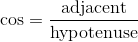 , we can plug in our given values.
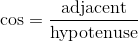

Notice that the  's cancel out.

The pattern for the side of a
Since
Notice that the
← Didn't Know|Knew It →
If  , what is
  if
if  is between
  and
and  ?
?
If
Tap to reveal answer
Recall that 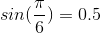 .
.
Therefore, we are looking for  or
or  .
.
Now, this has a reference angle of  , but it is in the third quadrant. This means that the value will be negative. The value of
  is
is  . However, given the quadrant of our angle, it will be
  .
.
Recall that
Therefore, we are looking for
Now, this has a reference angle of
← Didn't Know|Knew It →
What is the ?
What is the
Tap to reveal answer
← Didn't Know|Knew It →
In the right triangle above, which of the following expressions gives the length of y?
In the right triangle above, which of the following expressions gives the length of y?
Tap to reveal answer
is defined as the ratio of the adjacent side to the hypotenuse, or in this case . Solving for y gives the correct expression.
← Didn't Know|Knew It →
If the polar coordinates of a point are , then what are its rectangular coordinates?
If the polar coordinates of a point are
Tap to reveal answer
The polar coordinates of a point are given as , where r represents the distance from the point to the origin, and represents the angle of rotation. (A negative angle of rotation denotes a clockwise rotation, while a positive angle denotes a counterclockwise rotation.)
The following formulas are used for conversion from polar coordinates to rectangular (x, y) coordinates.
In this problem, the polar coordinates of the point are , which means that and . We can apply the conversion formulas to find the values of x and y.
The rectangular coordinates are .
The answer is .
The polar coordinates of a point are given as
The following formulas are used for conversion from polar coordinates to rectangular (x, y) coordinates.
In this problem, the polar coordinates of the point are
The rectangular coordinates are
The answer is
← Didn't Know|Knew It →
What is the cosine of ?
What is the cosine of
Tap to reveal answer
The pattern for the side of a triangle is .
Since , we can plug in our given values.
Notice that the 's cancel out.
The pattern for the side of a
Since
Notice that the
← Didn't Know|Knew It →
If , what is if is between and ?
If
Tap to reveal answer
Recall that .
Therefore, we are looking for or .
Now, this has a reference angle of , but it is in the third quadrant. This means that the value will be negative. The value of is . However, given the quadrant of our angle, it will be .
Recall that
Therefore, we are looking for
Now, this has a reference angle of
← Didn't Know|Knew It →
What is the ?
What is the
Tap to reveal answer
← Didn't Know|Knew It →
In the right triangle above, which of the following expressions gives the length of y?
In the right triangle above, which of the following expressions gives the length of y?
Tap to reveal answer
is defined as the ratio of the adjacent side to the hypotenuse, or in this case . Solving for y gives the correct expression.
← Didn't Know|Knew It →
If the polar coordinates of a point are , then what are its rectangular coordinates?
If the polar coordinates of a point are
Tap to reveal answer
The polar coordinates of a point are given as , where r represents the distance from the point to the origin, and represents the angle of rotation. (A negative angle of rotation denotes a clockwise rotation, while a positive angle denotes a counterclockwise rotation.)
The following formulas are used for conversion from polar coordinates to rectangular (x, y) coordinates.
In this problem, the polar coordinates of the point are , which means that and . We can apply the conversion formulas to find the values of x and y.
The rectangular coordinates are .
The answer is .
The polar coordinates of a point are given as
The following formulas are used for conversion from polar coordinates to rectangular (x, y) coordinates.
In this problem, the polar coordinates of the point are
The rectangular coordinates are
The answer is
← Didn't Know|Knew It →
What is the cosine of ?
What is the cosine of
Tap to reveal answer
The pattern for the side of a triangle is .
Since , we can plug in our given values.
Notice that the 's cancel out.
The pattern for the side of a
Since
Notice that the
← Didn't Know|Knew It →
If , what is if is between and ?
If
Tap to reveal answer
Recall that .
Therefore, we are looking for or .
Now, this has a reference angle of , but it is in the third quadrant. This means that the value will be negative. The value of is . However, given the quadrant of our angle, it will be .
Recall that
Therefore, we are looking for
Now, this has a reference angle of
← Didn't Know|Knew It →
What is the ?
What is the
Tap to reveal answer
← Didn't Know|Knew It →
In the right triangle above, which of the following expressions gives the length of y?
In the right triangle above, which of the following expressions gives the length of y?
Tap to reveal answer
is defined as the ratio of the adjacent side to the hypotenuse, or in this case . Solving for y gives the correct expression.
← Didn't Know|Knew It →
If the polar coordinates of a point are , then what are its rectangular coordinates?
If the polar coordinates of a point are
Tap to reveal answer
The polar coordinates of a point are given as , where r represents the distance from the point to the origin, and represents the angle of rotation. (A negative angle of rotation denotes a clockwise rotation, while a positive angle denotes a counterclockwise rotation.)
The following formulas are used for conversion from polar coordinates to rectangular (x, y) coordinates.
In this problem, the polar coordinates of the point are , which means that and . We can apply the conversion formulas to find the values of x and y.
The rectangular coordinates are .
The answer is .
The polar coordinates of a point are given as
The following formulas are used for conversion from polar coordinates to rectangular (x, y) coordinates.
In this problem, the polar coordinates of the point are
The rectangular coordinates are
The answer is
← Didn't Know|Knew It →
What is the cosine of ?
What is the cosine of
Tap to reveal answer
The pattern for the side of a triangle is .
Since , we can plug in our given values.
Notice that the 's cancel out.
The pattern for the side of a
Since
Notice that the
← Didn't Know|Knew It →
If , what is if is between and ?
If
Tap to reveal answer
Recall that .
Therefore, we are looking for or .
Now, this has a reference angle of , but it is in the third quadrant. This means that the value will be negative. The value of is . However, given the quadrant of our angle, it will be .
Recall that
Therefore, we are looking for
Now, this has a reference angle of
← Didn't Know|Knew It →