Understanding Rational Expressions - Math
Card 1 of 8
Solve:
If  varies directly as
  , and
, and  when
when  , find
  when
when  .
.
Solve:
If
Tap to reveal answer
The formula for a direct variation is:

Plugging in our values, we get:


The formula for a direct variation is:
Plugging in our values, we get:
← Didn't Know|Knew It →
If two boxes have the same depth and capacity, the length is inversely proportional to the width. One box is  long and
  wide. A second box (same depth and capacity) is
  long. How wide is it?
If two boxes have the same depth and capacity, the length is inversely proportional to the width. One box is
Tap to reveal answer
The formula for an indirect variation is:

Plugging in our values, we get:
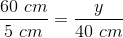


The formula for an indirect variation is:
Plugging in our values, we get:
← Didn't Know|Knew It →
Solve:
If varies directly as , and when , find when .
Solve:
If
Tap to reveal answer
The formula for a direct variation is:
Plugging in our values, we get:
The formula for a direct variation is:
Plugging in our values, we get:
← Didn't Know|Knew It →
If two boxes have the same depth and capacity, the length is inversely proportional to the width. One box is long and wide. A second box (same depth and capacity) is long. How wide is it?
If two boxes have the same depth and capacity, the length is inversely proportional to the width. One box is
Tap to reveal answer
The formula for an indirect variation is:
Plugging in our values, we get:
The formula for an indirect variation is:
Plugging in our values, we get:
← Didn't Know|Knew It →
Solve:
If varies directly as , and when , find when .
Solve:
If
Tap to reveal answer
The formula for a direct variation is:
Plugging in our values, we get:
The formula for a direct variation is:
Plugging in our values, we get:
← Didn't Know|Knew It →
If two boxes have the same depth and capacity, the length is inversely proportional to the width. One box is long and wide. A second box (same depth and capacity) is long. How wide is it?
If two boxes have the same depth and capacity, the length is inversely proportional to the width. One box is
Tap to reveal answer
The formula for an indirect variation is:
Plugging in our values, we get:
The formula for an indirect variation is:
Plugging in our values, we get:
← Didn't Know|Knew It →
Solve:
If varies directly as , and when , find when .
Solve:
If
Tap to reveal answer
The formula for a direct variation is:
Plugging in our values, we get:
The formula for a direct variation is:
Plugging in our values, we get:
← Didn't Know|Knew It →
If two boxes have the same depth and capacity, the length is inversely proportional to the width. One box is long and wide. A second box (same depth and capacity) is long. How wide is it?
If two boxes have the same depth and capacity, the length is inversely proportional to the width. One box is
Tap to reveal answer
The formula for an indirect variation is:
Plugging in our values, we get:
The formula for an indirect variation is:
Plugging in our values, we get:
← Didn't Know|Knew It →