Understanding Asymptotes - Math
Card 1 of 60

What is the horizontal asymptote of this equation?
What is the horizontal asymptote of this equation?
Tap to reveal answer
Look at the exponents of the variables. Both our numerator and denominator are  . Therefore the horizontal asymptote is calculated by dividing the coefficient of the numerator by the coefficient of the denomenator.

Look at the exponents of the variables. Both our numerator and denominator are
← Didn't Know|Knew It →
Find the vertical asymptote of the equation.

Find the vertical asymptote of the equation.
Tap to reveal answer
To find the vertical asymptotes, we set the denominator of the function equal to zero and solve.


To find the vertical asymptotes, we set the denominator of the function equal to zero and solve.
← Didn't Know|Knew It →
What are the  -intercepts of the equation?

What are the
Tap to reveal answer
To find the x-intercepts of the equation, we set the numerator equal to zero.


To find the x-intercepts of the equation, we set the numerator equal to zero.
← Didn't Know|Knew It →

What are the y-intercepts of this equation?
What are the y-intercepts of this equation?
Tap to reveal answer
To find the y-intercepts, set the  value equal to
  and solve.


To find the y-intercepts, set the
← Didn't Know|Knew It →

What are the horizontal asymptotes of this equation?
What are the horizontal asymptotes of this equation?
Tap to reveal answer
Since the exponents of the variables in both the numerator and denominator are equal, the horizontal asymptote will be the coefficient of the numerator's variable divided by the coefficient of the denominator's variable.
For this problem, since we have  , our asymptote will be
  .
.
Since the exponents of the variables in both the numerator and denominator are equal, the horizontal asymptote will be the coefficient of the numerator's variable divided by the coefficient of the denominator's variable.
For this problem, since we have
← Didn't Know|Knew It →

What are the vertical asymptotes of the equation?
What are the vertical asymptotes of the equation?
Tap to reveal answer
To find the vertical asymptotes, we set the denominator equal to zero and solve.


Since we'd be trying to find a negative number, we have no real solution. Therefore, there are no real vertical asymptotes.
To find the vertical asymptotes, we set the denominator equal to zero and solve.
Since we'd be trying to find a negative number, we have no real solution. Therefore, there are no real vertical asymptotes.
← Didn't Know|Knew It →

What are the horizontal asymptotes of this equation?
What are the horizontal asymptotes of this equation?
Tap to reveal answer
When looking for the horizontal asymptotes, examine the exponents of the variables. Because the variable in the denominator has a higher exponent than the variable in the numerator, the horizontal asymptote will be at  .
.
When looking for the horizontal asymptotes, examine the exponents of the variables. Because the variable in the denominator has a higher exponent than the variable in the numerator, the horizontal asymptote will be at
← Didn't Know|Knew It →

What are the vertical asymptotes of the equation?
What are the vertical asymptotes of the equation?
Tap to reveal answer
To find the vertical asymptotes, set the denominator equal to zero and solve.


However, we need to rationalize from here. We need to get rid of the cubed root in the denominator.
 .
.
Therefore:


Bring the exponent from the numerator under the radical:

Simplify:

To find the vertical asymptotes, set the denominator equal to zero and solve.
However, we need to rationalize from here. We need to get rid of the cubed root in the denominator.
Therefore:
Bring the exponent from the numerator under the radical:
Simplify:
← Didn't Know|Knew It →

What is the horizontal asymptote of this equation?
What is the horizontal asymptote of this equation?
Tap to reveal answer
To find the horizontal asymptotes, we compare the exponents of  in our fraction. Because the denominator variable's exponent is greater than the numerator variable's exponent, our horizontal asymptote is at
  .
.
To find the horizontal asymptotes, we compare the exponents of
← Didn't Know|Knew It →

What are the vertical asymptotes of the equation?
What are the vertical asymptotes of the equation?
Tap to reveal answer
To find the vertical asymptotes, we set the denominator equal to zero.


Because the square root only gives us the absolute value, our answer will be:

To find the vertical asymptotes, we set the denominator equal to zero.
Because the square root only gives us the absolute value, our answer will be:
← Didn't Know|Knew It →

What is the horizontal asymptote of this equation?
What is the horizontal asymptote of this equation?
Tap to reveal answer
Since the exponent of the leading term in the numerator is greater than the exponent of the leading term in the denominator, there is no horizontal asymptote.
Since the exponent of the leading term in the numerator is greater than the exponent of the leading term in the denominator, there is no horizontal asymptote.
← Didn't Know|Knew It →

What are the vertical asymptotes of this equation?
What are the vertical asymptotes of this equation?
Tap to reveal answer
To find the vertical asymptotes, we set the denominator equal to zero.


To find the vertical asymptotes, we set the denominator equal to zero.
← Didn't Know|Knew It →
Find the vertical asymptote(s) of 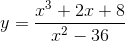 .
.
Find the vertical asymptote(s) of
Tap to reveal answer
To find the vertical asymptotes, we set the denominator of the fraction equal to zero, as dividing anything by zero is "undefined." Since it's undefined, there's no way for us to graph that point!
Take our given equation, 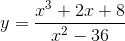 , and now set the denominator equal to zero:
 .
.


Don't forget, the root of a positive number can be both positive or negative ( as does
  ), so our answer will be
  .
.
Therefore the vertical asymptotes are at  and
and  .
.
To find the vertical asymptotes, we set the denominator of the fraction equal to zero, as dividing anything by zero is "undefined." Since it's undefined, there's no way for us to graph that point!
Take our given equation,
Don't forget, the root of a positive number can be both positive or negative (
Therefore the vertical asymptotes are at
← Didn't Know|Knew It →
Find the horizontal asymptote(s) of 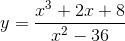 .
.
Find the horizontal asymptote(s) of
Tap to reveal answer
To find the horizontal asymptote of the function, look at the variable with the highest exponent. In the case of our equation, 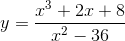 , the highest exponent is
  in the numerator.
When the variable with the highest exponent is in the numberator, there are NO horizontal asymptotes. Horizontal asymptotes only appear when the greatest exponent is in the denominator OR when the exponents have same power in both the denominator and numerator.
To find the horizontal asymptote of the function, look at the variable with the highest exponent. In the case of our equation,
When the variable with the highest exponent is in the numberator, there are NO horizontal asymptotes. Horizontal asymptotes only appear when the greatest exponent is in the denominator OR when the exponents have same power in both the denominator and numerator.
← Didn't Know|Knew It →
Find the vertical asymptote(s) of  .
.
Find the vertical asymptote(s) of
Tap to reveal answer
To find the vertical asymptotes, we set the denominator of the fraction equal to zero, as dividing anything by zero is undefined.
Take our given equation,  , and now set the denominator equal to zero:


 is not a perfect square, but let's see if we can pull anything out.


Don't forget that there is a negative result as well:
 .
.
To find the vertical asymptotes, we set the denominator of the fraction equal to zero, as dividing anything by zero is undefined.
Take our given equation,
Don't forget that there is a negative result as well:
← Didn't Know|Knew It →
What is the horizontal asymptote of this equation?
What is the horizontal asymptote of this equation?
Tap to reveal answer
Look at the exponents of the variables. Both our numerator and denominator are . Therefore the horizontal asymptote is calculated by dividing the coefficient of the numerator by the coefficient of the denomenator.
Look at the exponents of the variables. Both our numerator and denominator are
← Didn't Know|Knew It →
Find the vertical asymptote of the equation.
Find the vertical asymptote of the equation.
Tap to reveal answer
To find the vertical asymptotes, we set the denominator of the function equal to zero and solve.
To find the vertical asymptotes, we set the denominator of the function equal to zero and solve.
← Didn't Know|Knew It →
What are the -intercepts of the equation?
What are the
Tap to reveal answer
To find the x-intercepts of the equation, we set the numerator equal to zero.
To find the x-intercepts of the equation, we set the numerator equal to zero.
← Didn't Know|Knew It →
What are the y-intercepts of this equation?
What are the y-intercepts of this equation?
Tap to reveal answer
To find the y-intercepts, set the value equal to and solve.
To find the y-intercepts, set the
← Didn't Know|Knew It →
What are the horizontal asymptotes of this equation?
What are the horizontal asymptotes of this equation?
Tap to reveal answer
Since the exponents of the variables in both the numerator and denominator are equal, the horizontal asymptote will be the coefficient of the numerator's variable divided by the coefficient of the denominator's variable.
For this problem, since we have , our asymptote will be .
Since the exponents of the variables in both the numerator and denominator are equal, the horizontal asymptote will be the coefficient of the numerator's variable divided by the coefficient of the denominator's variable.
For this problem, since we have
← Didn't Know|Knew It →