Rhombuses - Math
Card 1 of 360
Given: Rhombuses  and
and  .
.
 and
and 
True, false, or undetermined: Rhombus  Rhombus
  .
.
Given: Rhombuses
True, false, or undetermined: Rhombus
Tap to reveal answer
Two figures are similar by definition if all of their corresponding sides are proportional and all of their corresponding angles are congruent.
By definition, a rhombus has four sides that are congruent. If we let  be the common sidelength of Rhombus
  and
and  be the common sidelength of Rhombus
  , it can easily be seen that the ratio of the length of each side of the former to that of the latter is the same ratio, namely,
  .
.
Also, a rhombus being a parallelogram, its opposite angles are congruent, and its consecutive angles are supplementary. Therefore, since  , it follows that
  , and
, and  . By a similar argument,
  and
and  . Therefore,


Since all corresponding sides are proportional and all corresponding angles are congruent, it holds that Rhombus  Rhombus
  .
.
Two figures are similar by definition if all of their corresponding sides are proportional and all of their corresponding angles are congruent.
By definition, a rhombus has four sides that are congruent. If we let
Also, a rhombus being a parallelogram, its opposite angles are congruent, and its consecutive angles are supplementary. Therefore, since
Since all corresponding sides are proportional and all corresponding angles are congruent, it holds that Rhombus
← Didn't Know|Knew It →
Given: Rhombuses  and
and  .
.

True, false, or undetermined: Rhombus  Rhombus
  .
.
Given: Rhombuses
True, false, or undetermined: Rhombus
Tap to reveal answer
Two figures are congruent by definition if all of their corresponding sides are congruent and all of their corresponding angles are congruent.
By definition, a rhombus has four sides of equal length. If we let  be the common sidelength of Rhombus
  and
and  be the common sidelength of Rhombus
  , then, since
  , it follows that
  , so corresponding sides are congruent. However, no information is given about their angle measures. Therefore, it cannot be determined whether or not the two rhombuses are congruent.
Two figures are congruent by definition if all of their corresponding sides are congruent and all of their corresponding angles are congruent.
By definition, a rhombus has four sides of equal length. If we let
← Didn't Know|Knew It →
A quadrilateral ABCD has diagonals that are perpendicular bisectors of one another. Which of the following classifications must apply to quadrilateral ABCD?
I. parallelogram
II. rhombus
III. square
A quadrilateral ABCD has diagonals that are perpendicular bisectors of one another. Which of the following classifications must apply to quadrilateral ABCD?
I. parallelogram
II. rhombus
III. square
Tap to reveal answer
If the diagonals of a quadrilateral are perpendicular bisectors of one another, then the quadrilateral must be a rhombus, but not necessarily a square. Since all rhombi are also parallelograms, quadrilateral ABCD must be both a rhombus and parallelogram.
If the diagonals of a quadrilateral are perpendicular bisectors of one another, then the quadrilateral must be a rhombus, but not necessarily a square. Since all rhombi are also parallelograms, quadrilateral ABCD must be both a rhombus and parallelogram.
← Didn't Know|Knew It →
Given a rhombus with diagonal lengths of 12cm and 16cm, find the perimeter.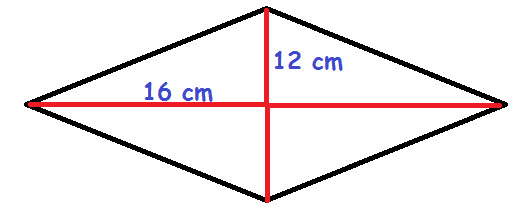
Given a rhombus with diagonal lengths of 12cm and 16cm, find the perimeter.
Tap to reveal answer

A rhombus is a parallelogram with all of its sides being equal. A square is a rhombus with all of the angles being equal as well as all of the sides. Both squares and rhombuses have perpendicular diagonal bisectors that split each diagonal into 2 equal pieces, and also splitting the quadrilateral into 4 equal right triangles.
With this being said, we know the Pythagorean Theorem would work great in this situation, using half of each diagonal as the two legs of the right triangle.
 where
where  is the hypotenuse.

 -->
--> 
We find the hypotenuse to be 10cm. Since the hypotenuse of each triangle is a side of the rhombus, we have found what we need to find the perimeter.
Each side is the same, so we add all 4 sides to find the perimeter.

A rhombus is a parallelogram with all of its sides being equal. A square is a rhombus with all of the angles being equal as well as all of the sides. Both squares and rhombuses have perpendicular diagonal bisectors that split each diagonal into 2 equal pieces, and also splitting the quadrilateral into 4 equal right triangles.
With this being said, we know the Pythagorean Theorem would work great in this situation, using half of each diagonal as the two legs of the right triangle.
We find the hypotenuse to be 10cm. Since the hypotenuse of each triangle is a side of the rhombus, we have found what we need to find the perimeter.
Each side is the same, so we add all 4 sides to find the perimeter.
← Didn't Know|Knew It →
The diagonals of a rhombus have lengths  and
and  units. What is its perimeter?
The diagonals of a rhombus have lengths
Tap to reveal answer
We should begin with a picture.
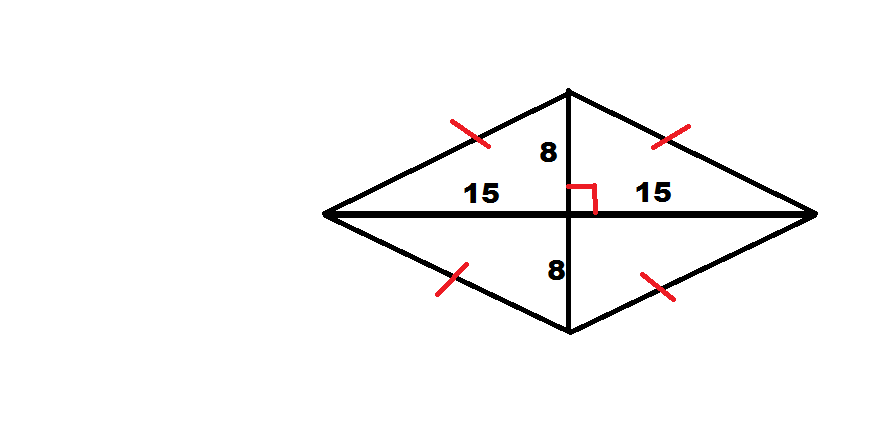
We should recall several things. First, all four sides of a rhombus are congruent, meaning that if we find one side, we can simply multiply by four to find the perimeter. Second, the diagonals of a rhombus are perpendicular bisectors of each other, thus giving us four right triangles and splitting each diagonal in half. We therefore have four congruent right triangles. Using Pythagorean Theorem on any one of them will give us the length of our sides.
With a side length of 17, our perimeter is easy to obtain.

Our perimeter is 68 units.
We should begin with a picture.
We should recall several things. First, all four sides of a rhombus are congruent, meaning that if we find one side, we can simply multiply by four to find the perimeter. Second, the diagonals of a rhombus are perpendicular bisectors of each other, thus giving us four right triangles and splitting each diagonal in half. We therefore have four congruent right triangles. Using Pythagorean Theorem on any one of them will give us the length of our sides.
With a side length of 17, our perimeter is easy to obtain.
Our perimeter is 68 units.
← Didn't Know|Knew It →
A rhombus has a side length of  foot, what is the length of the perimeter (in inches).
A rhombus has a side length of
Tap to reveal answer
To find the perimeter, first convert  foot into the equivalent amount of inches. Since,
  and
and  ,
,  is equal to
  inches.
Then apply the formula  , where
  is equal to the length of one side of the rhombus.
Since, 
The solution is:

To find the perimeter, first convert
Then apply the formula
Since,
The solution is:
← Didn't Know|Knew It →
Find the perimeter of a rhombus that has a side length of  .
.
Find the perimeter of a rhombus that has a side length of
Tap to reveal answer
In order to find the perimeter of this rhombus, first convert  from a mixed number to an improper fraction:

Then apply the formula:  , where
  is equal to one side of the rhombus.
Since,  the solution is:

In order to find the perimeter of this rhombus, first convert
Then apply the formula:
Since,
← Didn't Know|Knew It →
A rhombus has an area of  square units and an altitude of
  . Find the perimeter of the rhombus.
A rhombus has an area of
Tap to reveal answer
In order to solve this problem, use the given information to work backwards to find a side length of the rhombus:


Then apply the perimeter formula:
 , where
  a side of the rhombus.

In order to solve this problem, use the given information to work backwards to find a side length of the rhombus:
Then apply the perimeter formula:
← Didn't Know|Knew It →
A rhombus has an area of  square units, an altitude of
  . Find the perimeter of the rhombus.
A rhombus has an area of
Tap to reveal answer
In order to solve this problem, use the given information to work backwards to find a side length of the rhombus:


Then apply the perimeter formula:
 , where
  is equal to the length of one side of the rhombus.
The solution is:

In order to solve this problem, use the given information to work backwards to find a side length of the rhombus:
Then apply the perimeter formula:
The solution is:
← Didn't Know|Knew It →
A rhombus has an area of  square units and an altitude of
  . Find the perimeter of the rhombus.
A rhombus has an area of
Tap to reveal answer
In order to solve this problem, use the given information to work backwards to find a side length of the rhombus:


Then apply the perimeter formula:
 , where
  the length of one side of the rhombus.

In order to solve this problem, use the given information to work backwards to find a side length of the rhombus:
Then apply the perimeter formula:
← Didn't Know|Knew It →
Given that a rhombus has an area of  square units and an altitude of
  , find the perimeter of the rhombus.
Given that a rhombus has an area of
Tap to reveal answer
In order to solve this problem, use the given information to work backwards to find a side length of the rhombus:


Then apply the formula:  , where

In order to solve this problem, use the given information to work backwards to find a side length of the rhombus:
Then apply the formula:
← Didn't Know|Knew It →
A rhombus has an area of  square units and an altitude of
  , find the perimeter of the rhombus.
A rhombus has an area of
Tap to reveal answer
In order to solve this problem, use the given information to work backwards to find a side length of the rhombus:


Then apply the formula:  , where

In order to solve this problem, use the given information to work backwards to find a side length of the rhombus:
Then apply the formula:
← Didn't Know|Knew It →
A rhombus has an area of  square units, and an altitude of
  . Find the perimeter of the rhombus.
A rhombus has an area of
Tap to reveal answer
In order to solve this problem, use the given information to work backwards to find a side length of the rhombus:


Since, perimeter 
 , where
  is equal to
Perimeter=
In order to solve this problem, use the given information to work backwards to find a side length of the rhombus:
Since, perimeter
Perimeter=
← Didn't Know|Knew It →
A rhombus has a side length of  . Find the perimeter of the rhombus.
A rhombus has a side length of
Tap to reveal answer
To find the perimeter, apply the formula:  , where

To find the perimeter, apply the formula:
← Didn't Know|Knew It →
A rhombus has an area of  square units, and an altitude of
  . Find the perimeter of the rhombus.
A rhombus has an area of
Tap to reveal answer
In order to solve this problem, use the given information to work backwards to find a side length of the rhombus:


 , where

In order to solve this problem, use the given information to work backwards to find a side length of the rhombus:
← Didn't Know|Knew It →
A rhombus has an area of  square units, and an altitude of
  . Find the perimeter of the rhombus.
A rhombus has an area of
Tap to reveal answer
In order to solve this problem, use the given information to work backwards to find a side length of the rhombus:


 , where

In order to solve this problem, use the given information to work backwards to find a side length of the rhombus:
← Didn't Know|Knew It →
Given that a rhombus has a side length of  , find the perimeter of the rhombus.
Given that a rhombus has a side length of
Tap to reveal answer
To find the perimeter of this rhombus, apply the formula:  , where

To find the perimeter of this rhombus, apply the formula:
← Didn't Know|Knew It →
Find the perimeter of a rhombus if it has diagonals of the following lengths:  and
and  .
.
Find the perimeter of a rhombus if it has diagonals of the following lengths:
Tap to reveal answer
Recall that the diagonals of a rhombus bisect each other and are perpendicular to one another.

In order to find the length of the side, we can use Pythagorean's theorem. The lengths of half of the diagonals are the legs, and the length of the side of the rhombus is the hypotenuse.
First, find the lengths of half of the diagonals.


Next, substitute these half diagonals as the legs in a right triangle using the Pythagorean theorem.


Since the sides of a rhombus all have the same length, multiply the side length by  in order to find the perimeter.


Solve and round to two decimal places.

Recall that the diagonals of a rhombus bisect each other and are perpendicular to one another.
In order to find the length of the side, we can use Pythagorean's theorem. The lengths of half of the diagonals are the legs, and the length of the side of the rhombus is the hypotenuse.
First, find the lengths of half of the diagonals.
Next, substitute these half diagonals as the legs in a right triangle using the Pythagorean theorem.
Since the sides of a rhombus all have the same length, multiply the side length by
Solve and round to two decimal places.
← Didn't Know|Knew It →
Find the perimeter of a rhombus if it has diagonals of the following lengths:  and
and 
Find the perimeter of a rhombus if it has diagonals of the following lengths:
Tap to reveal answer
Recall that the diagonals of a rhombus bisect each other and are perpendicular to one another.
In order to find the length of the side, we can use Pythagorean's theorem. The lengths of half of the diagonals are the legs, and the length of the side of the rhombus is the hypotenuse.
First, find the lengths of half of the diagonals.


Next, substitute these half diagonals as the legs in a right triangle using the Pythagorean theorem.


Since the sides of a rhombus all have the same length, multiply the side length by in order to find the perimeter.


Solve and round to two decimal places.

Recall that the diagonals of a rhombus bisect each other and are perpendicular to one another.
In order to find the length of the side, we can use Pythagorean's theorem. The lengths of half of the diagonals are the legs, and the length of the side of the rhombus is the hypotenuse.
First, find the lengths of half of the diagonals.
Next, substitute these half diagonals as the legs in a right triangle using the Pythagorean theorem.
Since the sides of a rhombus all have the same length, multiply the side length by
Solve and round to two decimal places.
← Didn't Know|Knew It →
Find the perimeter of a rhombus if it has diagonals of the following lengths:  and
and  .
.
Find the perimeter of a rhombus if it has diagonals of the following lengths:
Tap to reveal answer
Recall that the diagonals of a rhombus bisect each other and are perpendicular to one another.
In order to find the length of the side, we can use Pythagorean's theorem. The lengths of half of the diagonals are the legs, and the length of the side of the rhombus is the hypotenuse.
First, find the lengths of half of the diagonals.


Next, substitute these half diagonals as the legs in a right triangle using the Pythagorean theorem.


Since the sides of a rhombus all have the same length, multiply the side length by in order to find the perimeter.


Solve and round to two decimal places.

Recall that the diagonals of a rhombus bisect each other and are perpendicular to one another.
In order to find the length of the side, we can use Pythagorean's theorem. The lengths of half of the diagonals are the legs, and the length of the side of the rhombus is the hypotenuse.
First, find the lengths of half of the diagonals.
Next, substitute these half diagonals as the legs in a right triangle using the Pythagorean theorem.
Since the sides of a rhombus all have the same length, multiply the side length by
Solve and round to two decimal places.
← Didn't Know|Knew It →